


惯性聚合 高效追踪和阅读你感兴趣的博客、新闻、科技资讯
阅读原文 在惯性聚合中打开

推荐订阅源

Cyberwarzone
Cyberwarzone
Vercel News
Vercel News
freeCodeCamp Programming Tutorials: Python, JavaScript, Git & More
奇客Solidot–传递最新科技情报
奇客Solidot–传递最新科技情报
aimingoo的专栏
aimingoo的专栏
B
Blog RSS Feed
A
About on SuperTechFans
T
The Blog of Author Tim Ferriss
爱范儿
爱范儿
腾讯CDC
S
SegmentFault 最新的问题
Exploit-DB.com RSS Feed
The Hacker News
The Hacker News
J
Java Code Geeks
大猫的无限游戏
大猫的无限游戏
B
Blog
IT之家
IT之家
Spread Privacy
Spread Privacy
K
KPMG report finds enterprise disconnect between AI and its ROI | CIO
C
Cisco Blogs
Recent Announcements
H
Hacker News: Front Page
AI
AI
I
InfoQ
H
Heimdal Security Blog
T
Threatpost
Cisco Talos Blog
Cisco Talos Blog
Threat Intelligence Blog | Flashpoint
I
Intezer
W
WeLiveSecurity
SecWiki News
SecWiki News
MongoDB | Blog
MongoDB | Blog
宝玉的分享
宝玉的分享
博客园 - 【当耐特】
云风的 BLOG
云风的 BLOG
T
Threat Research - Cisco Blogs
V2EX - 技术
V2EX - 技术
N
News and Events Feed by Topic
cs.CV updates on arXiv.org
O
OpenAI News
阮一峰的网络日志
阮一峰的网络日志
T
Troy Hunt's Blog
www.infosecurity-magazine.com
博客园 - 司徒正美
Apple Machine Learning Research
雷峰网
雷峰网
T
Tor Project blog
有赞技术团队
有赞技术团队
Schneier on Security
Last Week in AI
Last Week in AI

VMware Blogs

Diagnostics for VMware Cloud Foundation (VCF) 9.1 with Old Versions of VCF Components Mastering Infrastructure Policies in VMware Cloud Foundation Automation 9.1 Modernizing the Private Cloud: Why VCF 9.1 Lifecycle Management is a Game Changer Announcing the VMware Cloud Foundation 9.1 Upgrade Planning Tool VCF Breakroom Chats Episode 86 – Containers Made Easy: The New “Container-as-a-Service” in VCF 9.1 Securing Your VCF 9.1 Infrastructure with the Symantec Identity Security Platform Virtually Speaking: The AI Reality Check with Dave Linthicum Zero Touch Provisioning: Activating Edge Sites with VMware Cloud Foundation Edge 9.1 VCF Breakroom Chats Episode 85 – Cloning Success at Scale: Inside VCF 9.1’s App Stack Formation VMware Cloud on AWS の使用状況を確認できる API Unlocking the Full Potential of Programmable Infrastructure with VMware Cloud Foundation 9.1 – New Features and Capabilities Smarter Patching at Scale: Vulnerability Assessment and Remediation with VMware Tanzu Platform Encrypted vMotion Offload to Intel QAT in VMware Cloud Foundation 9.1 Deepen Your Expertise: Four Key Benefits of Attending Increase Deployment Flexibility with VCF Edge Automation 1.0.3 Avi Advantage: Automating Certificate Management of VCF Workloads More Memory, Less Effort: Configuring Memory Tiering in VCF 9.1 VCF 9.1 Licensing: Programmatic, Centralized, and Built to Scale Why APJ Networking Professionals Need Private Cloud Expertise VCF 9.1 Networking: Simpler VPC Connectivity Control VCF 9.1 Networking: Exploring Network Services for Virtual Private Clouds VCF Networking 9.1: Seamless DDI Integration with Infoblox The Open Source Advantage: Building from Source for Ultimate Security Expand Shared VMDKs with Clustered Applications in VMware vSAN for VCF 9.1 Monetizing Zero-Trust Security with VCF 9.1 and VMware vDefend VMware vSAN Protection and Recovery Enhancements for VCF 9.1 Deliver Production SQL Server DBaaS with VMware Data Services Manager 9.1 Maximizing Profitability: VCF 9.1 Cost-Focused Approach for VMware Cloud Service Providers Modernizing Your Infrastructure: Introducing VMware Cloud Foundation 9.1 to VCSPs VCF 9.1 is Available: Explore the New Features in Hands-on Labs What’s New with vSphere in VMware Cloud Foundation 9.1? Resizing VMware vCenter in VMware Cloud Foundation 9 Non-Disruptive VMware vCenter Patching in VMware Cloud Foundation 9.1 VMware vCenter Virtual Hardware Gets an Upgrade in vSphere with VCF 9.1 AI Has Changed the Threat Landscape. Is Your Infrastructure Ready? Simplifying Storage with the New Effective Capacity View in VMware vSAN for VCF 9.1 Auto-RAID in VMware vSAN for VCF 9.1 – Comprehensive System-Managed Data Resilience Introducing VMmark 4.1: Enhanced Power Efficiency Benchmarking for Private Cloud Infrastructure VCF 9.1 Is Here. See It in Action. 博通發布 VMware Cloud Foundation 9.1 How Broadcom Is Helping Enterprises Win the AI Security Sprint How to Prepare for the World of AI Driven Exploits Avi Innovations for VCF 9.1: Powering Kubernetes, Agentic AI and VPC Workloads VCF 9.1: The Secure, Cost-Effective Private Cloud Platform for Production AI Announcing VCF 9.1: Modern Private Cloud Built for Efficiency and Resilience Announcing VMware Cloud Foundation Edge 9.1: A Scalable, Autonomous Edge Platform Accelerate, Streamline, and Control Your Self-Service Private Cloud with VMware Cloud Foundation 9.1 Deploy Modern Apps Faster, Scale Smarter, and Lower Your TCO with VMware vSphere Kubernetes Service in VCF 9.1 Scale Smarter, Save More: Redefining Infrastructure Economics with VMware vSphere in VCF 9.1 AI with VCF 9.1 on AMD GPUs: Build with open frameworks and simplify management, at a lower TCO Streamline, Simplify and Protect all your AI workloads with VCF 9.1 Simplify Workload Connectivity and Enhance Network Scale and Performance with VCF 9.1 VMware and CrowdStrike Deliver New Integration for Cyber Recovery Workflows How Many Users Can Your LLM Server Really Handle? From Infrastructure to Agents: A Hands-On Guide to Secure Private AI with Broadcom – Part 2 The New Frontier: Leading the Cloud-Native Evolution Replicating VMware vSphere Configuration Profile Desired State Webinar Recap: Design and Architecture Considerations for VMware vSphere Kubernetes Service on VMware Cloud Foundation Kubernetes 1.36: What Actually Changed for Enterprise Platforms Enhance Lateral Security and Ingress Load Balancing for Kubernetes Workloads Avi Load Balancer Analytics: Root Cause Application Performance Issues in Minutes Analyst Insight Series #3: Policy-Driven Governance and Multi-Tenant Control Post-Quantum Readiness on VMware Cloud Foundation Registration Is Live for Las Vegas | $ave with Early-Bird May 21, 2026: What’s New in VMware Tanzu Data Intelligence 10.4 From Infrastructure to Agents: A Hands-On Guide to Secure Private AI with Broadcom – Part 1 Stop Guessing: Advanced Monitoring and Troubleshooting for Data Services CPU, Disk, Network, and Memory Workload Profiles for DVD Store Database Testing How VMware Salt Automates Compliance Across Private Cloud Analyst Insight Series #2: Operational Scalability and Lifecycle Management MCP vs. APIs: Why You Need Both for AI Applications The Real Constraint on Enterprise AI isn’t GPUs; It’s Power Deploying Harbor Service in Air-Gapped VMware Cloud Foundation 9.0 Why Enhanced DirectPath Wins for High-Performance Apps Bridging the (.Local) Gap: A Split-Domain Design for VMware Cloud Foundation Deployment Observability on VMware vSphere Kubernetes Service VMware Cloud on AWS: Introducing the Usage Report APIs Converging VMware vSphere to VMware Cloud Foundation 9.0: The Top 10 Questions Answered May 6, 2026: What’s New in Tanzu Platform 10.4: Powering Agentic Apps at Scale VMware Tanzu RabbitMQ Powers the Modern Data Lakehouse with New Spark Integration and Enterprise Tooling Tanzu Data Intelligence 10.4 Delivers AI-Driven Analytics, Unified Real-Time Operations, and Sovereign Resilience Enterprise-Ready Agents Made Simple & Safe with VMware Tanzu Platform Agent Foundations Introducing Tanzu Platform 10.4: Extending Platform as a Service to Agentic Applications How AI-Assisted Analytics in Tanzu Data Intelligence Can Help Remove the SQL Bottleneck From Prototype to Production: Securing Database MCP at Enterprise Scale The Compelling Case for a Private Cloud Data Intelligence Platform The Unification Dividend: Consolidating Database Operations on VMware Cloud Foundation The Modern Spring Workflow Is Enterprise-Ready and AI-Boosted [TAM Blog] セキュアブート証明書の有効期限切れに関する注意点と対応について Accelerate Lateral Security and Ingress Load Balancing for Kubernetes Workloads From Platform to Data: Building a Cloud-Native Developer Experience On-Prem with VMware Cloud Foundation How VMware Cloud Foundation (VCF) Training Helps Keep Top Tech Talent in APJ Build Your Case for Attending VMware Explore 2026 Spring 開発元が提供する商用サポート「VMware Tanzu® Spring Essentials」とは VMware Cloud on AWS より i7i.metal-24xl インスタンスの提供開始 VMware Advanced Memory Tiering Tips for Success VMware Cloud Foundation Edge 9.0: Two-Host Edge Site Deployment with Brownfield Import Your Database Is About to Become an AI Tool. Is It Ready? Applying GitOps Principles to Maintain Desired State Configuration using VMware vSphere Configuration Profile – Part 3 Webinar Recap: Converging VMware vSphere to VMware Cloud Foundation 9.0
Advanced Memory Tiering Enhancements in VMware Cloud Foundation 9.1
dave morera · 2026-05-07 · via VMware Blogs

If you’ve been anywhere near a server procurement conversation lately, you already know the punchline: memory prices have gone through the roof. Since 2023, enterprise DDR5 RDIMM costs have surged through the roof, driven largely by manufacturers shifting production capacity toward High Bandwidth Memory for AI GPUs. A high-density virtualization node has more than doubled in price and memory alone accounts for over 95% of the Bill of Materials. I’ve started calling it the “RAMpocalypse,” and it’s real.

This is exactly why Memory Tiering matters, and why the improvements we’re shipping in VCF 9.1 are such a big deal. Let me walk you through what’s new.

What Is Memory Tiering?

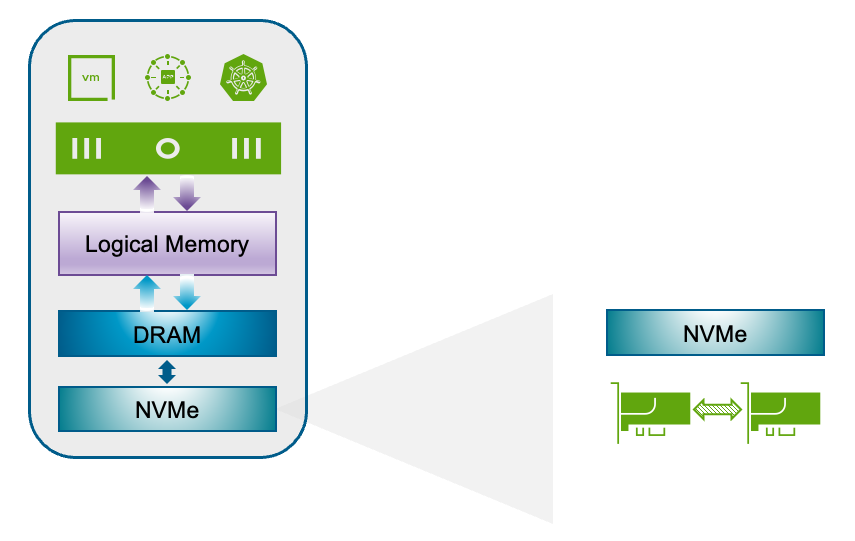
For those of you who haven’t explored this yet, Memory Tiering allows ESX hosts to use NVMe devices as a secondary memory tier alongside traditional DRAM. VMs consume what we call “logical memory”, which is the unified pool that spans both tiers (DRAM and NVMe); and the hypervisor intelligently classifies memory pages as hot, or cold. Hot pages stay in fast DRAM; cold pages migrate to NVMe. The whole process is transparent to your applications.

The result? Up to 4x more available memory per host, 2x better VM consolidation, 20–30% improved CPU efficiency (because your processors are no longer starved for memory), and up to 40% lower TCO. That’s not marketing fluff — those are the numbers customers are seeing in production.
What’s New in VCF 9.1

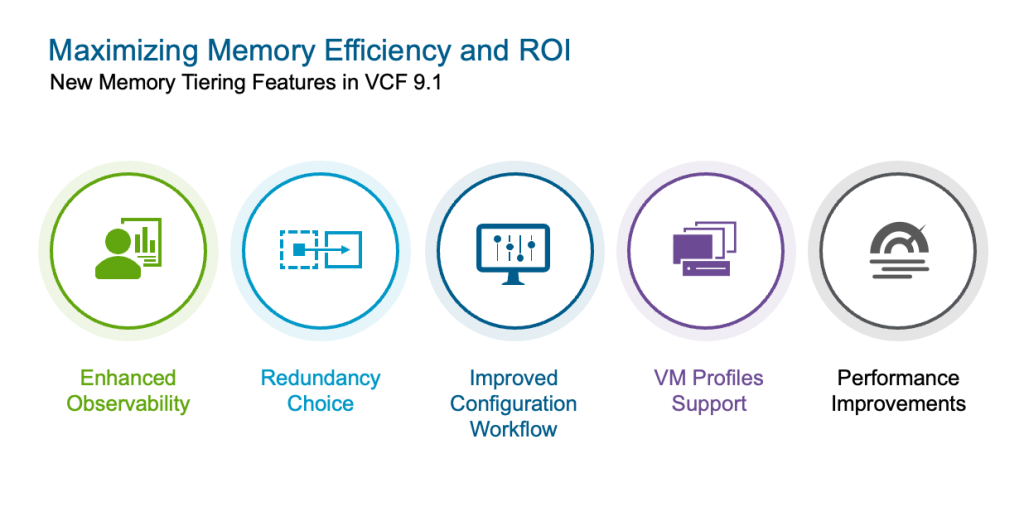
VCF 9.1 brings five major improvements to Memory Tiering, and each one addresses real-world feedback we’ve been hearing since the 9.0 release.
Performance Improvements

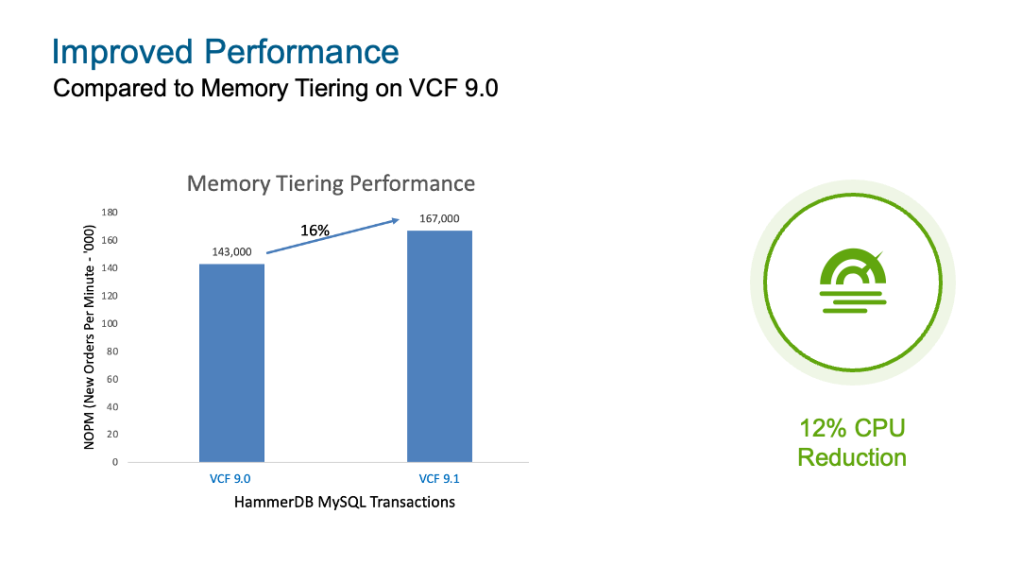
Let’s start with the one everyone wants to know about. Compared to Memory Tiering on VCF 9.0, we’re seeing up to 16% performance gains in database workloads measured with HammerDB, along with a 12% CPU reduction in VMmark benchmarks. These aren’t theoretical, they come from optimizations in how the hypervisor manages page classification and tier movement. If you were on the fence about enabling Memory Tiering because of performance concerns, this is your sign to take another look.
Software NVMe Mirroring

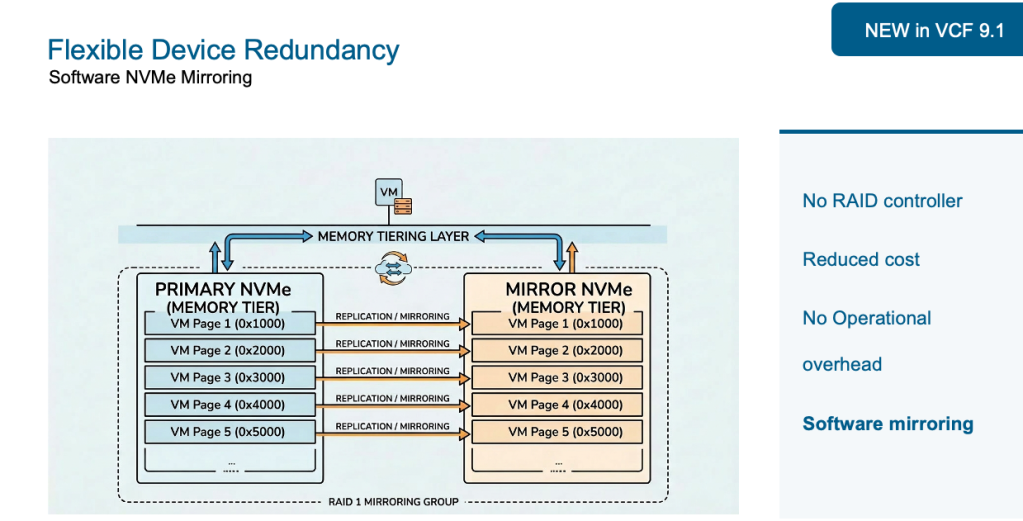
This one is a game changer. In VCF 9.0, the only way to get redundancy for your NVMe tier was through hardware-based RAID. Your options were either a Tri-Mode controller, or Intel VROC. That meant additional cost for controllers, operational overhead for firmware and driver management, and potential compatibility headaches with vSAN if you were sharing controllers.

VCF 9.1 introduces software-based NVMe mirroring built directly into vSphere. No RAID controller required. No extra procurement, which means lower cost. No operational overhead required for configuration, installation, FW/drivers, etc. The hypervisor handles mirroring natively, giving it full control over memory page distribution across devices. This is the kind of simplicity customers have been asking for, and it’s here.
Simplified Configuration

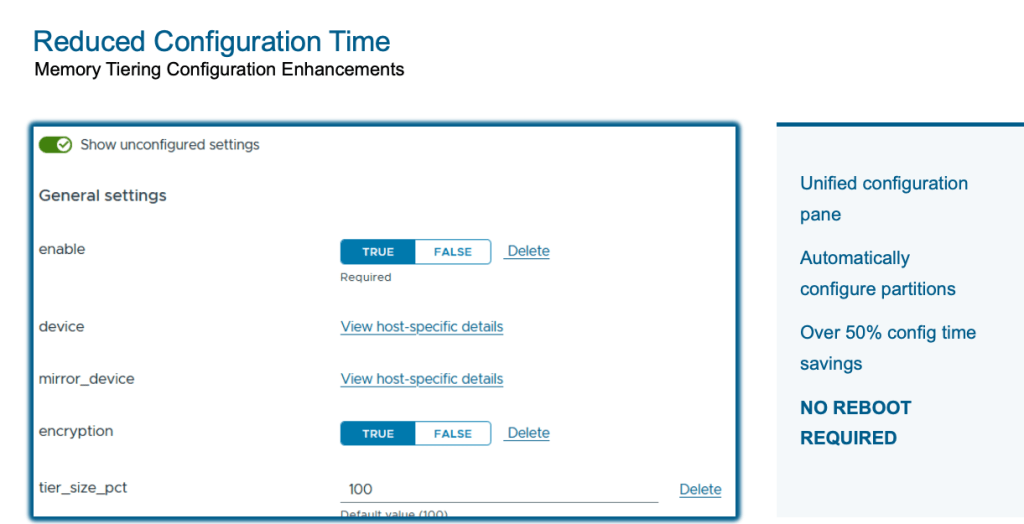
Configuring Memory Tiering in 9.0 involved separate steps for NVMe partition creation and feature enablement. That changes in 9.1. We’ve collapsed the entire workflow into a single unified configuration pane using vSphere Configuration Profiles. NVMe disk partitions are now created automatically (no more manual ESXCLI commands or PowerShell scripts, though you still can if that’s your thing). And here’s the best part: the configuration no longer requires a host reboot. Just maintenance mode. The net result is over 50% reduction in configuration time. Easy enough, right?
Enhanced Observability

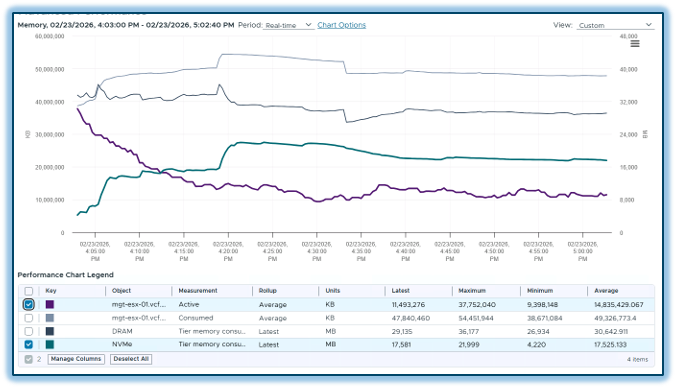
You can’t optimize what you can’t see, and VCF 9.1 delivers significantly better visibility into your Memory Tiering environment. In vCenter, new summary cards at both the host and cluster level show configuration state, tier breakdowns, consumed memory per tier, and consumed versus active comparisons. You also get a full tiering device list with health status details.

Post-deployment, you can monitor bandwidth and latencies for both memory tiers, and even drill down to see tier bandwidth utilization at an individual VM level. This gives you the performance visibility you need to validate that Memory Tiering is working as expected for your specific workloads.

On the VCF Operations side, there is a dedicated Memory Tiering dashboard, and perhaps my favorite addition, a “What-If” analysis tool. This lets you model what would happen if you turned Memory Tiering on based on your environment, and what your cost savings would look like. It’s a fantastic way to build the business case before you even flip the switch.
VM Profile Support

In VCF 9.0, certain VM profiles couldn’t power on when Memory Tiering was enabled on a host. That restriction is completely gone in 9.1. Security VMs, low-latency VMs, fault-tolerant VMs, among others  can all power on now. While some of these profiles still won’t participate in tiering directly, you no longer need to maintain separate hosts just to accommodate these type of VMs.

And one more thing, nested virtualization is now fully supported with Memory Tiering. If you’re running nested VMs in your lab environment, they’ll participate in tiering just like any other workload.

The Bottom Line

Let’s bring this home with the business case. Memory Tiering in VCF 9.1 delivers up to 40% lower TCO through better VM consolidation ratios and increased resource consumption. Those underutilized CPUs you’ve been paying for? You can finally put them to work.

Don’t worry if you’re not sure where to start, the new What-If analysis in VCF Operations makes it straightforward to assess your environment and quantify the savings before committing. Memory Tiering is production-ready, it’s shipping now, and it fundamentally changes the economics of memory in virtualized environments.

For more details, visit brcm.tech/vcf-memory-tiering


Discover more from VMware Cloud Foundation (VCF) Blog

Subscribe to get the latest posts sent to your email.