


惯性聚合 高效追踪和阅读你感兴趣的博客、新闻、科技资讯
阅读原文 在惯性聚合中打开

推荐订阅源

博客园 - 三生石上(FineUI控件)
Hugging Face - Blog
Hugging Face - Blog
M
MIT News - Artificial intelligence
T
Tailwind CSS Blog
Webroot Blog
Webroot Blog
S
Secure Thoughts
N
News and Events Feed by Topic
月光博客
月光博客
TaoSecurity Blog
TaoSecurity Blog
Microsoft Azure Blog
B
Blog RSS Feed
N
News | PayPal Newsroom
Exploit-DB.com RSS Feed
小众软件
小众软件
Recent Commits to openclaw:main
P
Privacy & Cybersecurity Law Blog
GbyAI
GbyAI
K
Kaspersky official blog
WordPress大学
WordPress大学
P
Proofpoint News Feed
cs.CV updates on arXiv.org
博客园 - 叶小钗
W
WeLiveSecurity
Jina AI
Jina AI
The Cloudflare Blog
Project Zero
Project Zero
Simon Willison's Weblog
V
Vulnerabilities – Threatpost
L
LangChain Blog
Forbes - Security
Forbes - Security
PCI Perspectives
PCI Perspectives
Engineering at Meta
Engineering at Meta
Google DeepMind News
Recorded Future
Recorded Future
博客园 - 【当耐特】
H
Heimdal Security Blog
A
About on SuperTechFans
Cisco Talos Blog
Cisco Talos Blog
T
Threat Research - Cisco Blogs
云风的 BLOG
云风的 BLOG
Spread Privacy
Spread Privacy
L
LINUX DO - 最新话题
L
Lohrmann on Cybersecurity
Last Week in AI
Last Week in AI
Google DeepMind News
CTFtime.org: upcoming CTF events
I
Intezer
Martin Fowler
Martin Fowler
S
Securelist
Threat Intelligence Blog | Flashpoint

VMware Blogs

Diagnostics for VMware Cloud Foundation (VCF) 9.1 with Old Versions of VCF Components Mastering Infrastructure Policies in VMware Cloud Foundation Automation 9.1 Modernizing the Private Cloud: Why VCF 9.1 Lifecycle Management is a Game Changer Announcing the VMware Cloud Foundation 9.1 Upgrade Planning Tool VCF Breakroom Chats Episode 86 – Containers Made Easy: The New “Container-as-a-Service” in VCF 9.1 Securing Your VCF 9.1 Infrastructure with the Symantec Identity Security Platform Virtually Speaking: The AI Reality Check with Dave Linthicum Zero Touch Provisioning: Activating Edge Sites with VMware Cloud Foundation Edge 9.1 VCF Breakroom Chats Episode 85 – Cloning Success at Scale: Inside VCF 9.1’s App Stack Formation VMware Cloud on AWS の使用状況を確認できる API Unlocking the Full Potential of Programmable Infrastructure with VMware Cloud Foundation 9.1 – New Features and Capabilities Smarter Patching at Scale: Vulnerability Assessment and Remediation with VMware Tanzu Platform Encrypted vMotion Offload to Intel QAT in VMware Cloud Foundation 9.1 Deepen Your Expertise: Four Key Benefits of Attending Increase Deployment Flexibility with VCF Edge Automation 1.0.3 Avi Advantage: Automating Certificate Management of VCF Workloads More Memory, Less Effort: Configuring Memory Tiering in VCF 9.1 VCF 9.1 Licensing: Programmatic, Centralized, and Built to Scale Why APJ Networking Professionals Need Private Cloud Expertise VCF 9.1 Networking: Simpler VPC Connectivity Control VCF 9.1 Networking: Exploring Network Services for Virtual Private Clouds VCF Networking 9.1: Seamless DDI Integration with Infoblox The Open Source Advantage: Building from Source for Ultimate Security Expand Shared VMDKs with Clustered Applications in VMware vSAN for VCF 9.1 Monetizing Zero-Trust Security with VCF 9.1 and VMware vDefend VMware vSAN Protection and Recovery Enhancements for VCF 9.1 Deliver Production SQL Server DBaaS with VMware Data Services Manager 9.1 Maximizing Profitability: VCF 9.1 Cost-Focused Approach for VMware Cloud Service Providers Modernizing Your Infrastructure: Introducing VMware Cloud Foundation 9.1 to VCSPs VCF 9.1 is Available: Explore the New Features in Hands-on Labs What’s New with vSphere in VMware Cloud Foundation 9.1? Resizing VMware vCenter in VMware Cloud Foundation 9 Non-Disruptive VMware vCenter Patching in VMware Cloud Foundation 9.1 VMware vCenter Virtual Hardware Gets an Upgrade in vSphere with VCF 9.1 AI Has Changed the Threat Landscape. Is Your Infrastructure Ready? Simplifying Storage with the New Effective Capacity View in VMware vSAN for VCF 9.1 Auto-RAID in VMware vSAN for VCF 9.1 – Comprehensive System-Managed Data Resilience Introducing VMmark 4.1: Enhanced Power Efficiency Benchmarking for Private Cloud Infrastructure Advanced Memory Tiering Enhancements in VMware Cloud Foundation 9.1 VCF 9.1 Is Here. See It in Action. 博通發布 VMware Cloud Foundation 9.1 How Broadcom Is Helping Enterprises Win the AI Security Sprint How to Prepare for the World of AI Driven Exploits Avi Innovations for VCF 9.1: Powering Kubernetes, Agentic AI and VPC Workloads VCF 9.1: The Secure, Cost-Effective Private Cloud Platform for Production AI Announcing VCF 9.1: Modern Private Cloud Built for Efficiency and Resilience Announcing VMware Cloud Foundation Edge 9.1: A Scalable, Autonomous Edge Platform Accelerate, Streamline, and Control Your Self-Service Private Cloud with VMware Cloud Foundation 9.1 Deploy Modern Apps Faster, Scale Smarter, and Lower Your TCO with VMware vSphere Kubernetes Service in VCF 9.1 Scale Smarter, Save More: Redefining Infrastructure Economics with VMware vSphere in VCF 9.1 AI with VCF 9.1 on AMD GPUs: Build with open frameworks and simplify management, at a lower TCO Streamline, Simplify and Protect all your AI workloads with VCF 9.1 VMware and CrowdStrike Deliver New Integration for Cyber Recovery Workflows How Many Users Can Your LLM Server Really Handle? From Infrastructure to Agents: A Hands-On Guide to Secure Private AI with Broadcom – Part 2 The New Frontier: Leading the Cloud-Native Evolution Replicating VMware vSphere Configuration Profile Desired State Webinar Recap: Design and Architecture Considerations for VMware vSphere Kubernetes Service on VMware Cloud Foundation Kubernetes 1.36: What Actually Changed for Enterprise Platforms Enhance Lateral Security and Ingress Load Balancing for Kubernetes Workloads Avi Load Balancer Analytics: Root Cause Application Performance Issues in Minutes Analyst Insight Series #3: Policy-Driven Governance and Multi-Tenant Control Post-Quantum Readiness on VMware Cloud Foundation Registration Is Live for Las Vegas | $ave with Early-Bird May 21, 2026: What’s New in VMware Tanzu Data Intelligence 10.4 From Infrastructure to Agents: A Hands-On Guide to Secure Private AI with Broadcom – Part 1 Stop Guessing: Advanced Monitoring and Troubleshooting for Data Services CPU, Disk, Network, and Memory Workload Profiles for DVD Store Database Testing How VMware Salt Automates Compliance Across Private Cloud Analyst Insight Series #2: Operational Scalability and Lifecycle Management MCP vs. APIs: Why You Need Both for AI Applications The Real Constraint on Enterprise AI isn’t GPUs; It’s Power Deploying Harbor Service in Air-Gapped VMware Cloud Foundation 9.0 Why Enhanced DirectPath Wins for High-Performance Apps Bridging the (.Local) Gap: A Split-Domain Design for VMware Cloud Foundation Deployment Observability on VMware vSphere Kubernetes Service VMware Cloud on AWS: Introducing the Usage Report APIs Converging VMware vSphere to VMware Cloud Foundation 9.0: The Top 10 Questions Answered May 6, 2026: What’s New in Tanzu Platform 10.4: Powering Agentic Apps at Scale VMware Tanzu RabbitMQ Powers the Modern Data Lakehouse with New Spark Integration and Enterprise Tooling Tanzu Data Intelligence 10.4 Delivers AI-Driven Analytics, Unified Real-Time Operations, and Sovereign Resilience Enterprise-Ready Agents Made Simple & Safe with VMware Tanzu Platform Agent Foundations Introducing Tanzu Platform 10.4: Extending Platform as a Service to Agentic Applications How AI-Assisted Analytics in Tanzu Data Intelligence Can Help Remove the SQL Bottleneck From Prototype to Production: Securing Database MCP at Enterprise Scale The Compelling Case for a Private Cloud Data Intelligence Platform The Unification Dividend: Consolidating Database Operations on VMware Cloud Foundation The Modern Spring Workflow Is Enterprise-Ready and AI-Boosted [TAM Blog] セキュアブート証明書の有効期限切れに関する注意点と対応について Accelerate Lateral Security and Ingress Load Balancing for Kubernetes Workloads From Platform to Data: Building a Cloud-Native Developer Experience On-Prem with VMware Cloud Foundation How VMware Cloud Foundation (VCF) Training Helps Keep Top Tech Talent in APJ Build Your Case for Attending VMware Explore 2026 Spring 開発元が提供する商用サポート「VMware Tanzu® Spring Essentials」とは VMware Cloud on AWS より i7i.metal-24xl インスタンスの提供開始 VMware Advanced Memory Tiering Tips for Success VMware Cloud Foundation Edge 9.0: Two-Host Edge Site Deployment with Brownfield Import Your Database Is About to Become an AI Tool. Is It Ready? Applying GitOps Principles to Maintain Desired State Configuration using VMware vSphere Configuration Profile – Part 3 Webinar Recap: Converging VMware vSphere to VMware Cloud Foundation 9.0
Simplify Workload Connectivity and Enhance Network Scale and Performance with VCF 9.1
Varun Santos · 2026-05-05 · via VMware Blogs

In today’s fast-paced digital landscape, IT organizations are caught between two worlds: rapidly adopting and scaling modern infrastructure while maintaining visibility, security and control.

VMware Cloud Foundation (VCF) Networking evolved significantly in VCF 9.0 with a simpler network deployment model with VPCs, self-service access to network services, and strong integration across the VCF stack. VCF 9.1 will build on these capabilities, delivering enhanced interoperability with the underlying physical fabric, flexible connectivity options, enhanced network services, greater support for VMware vSphere Kubernetes Service (VKS), and deeper flow analytics, VPC planning, and network diagnostics.

A Unified Network Fabric for the Private Cloud

EVPN-VXLAN interoperability with the network fabric

Traditional networking often involves deploying bespoke connectivity and network protocols to support VMs, containers, and physical workloads. This creates inconsistent policies and deployment models, indeterministic network performance, and a lack of end-to-end visibility and troubleshooting across these environments.

With VCF 9.1, we’ll introduce EVPN-VXLAN based interoperability with the network fabric which will further simplify how VPCs and VCF workloads connect to the physical infrastructure.
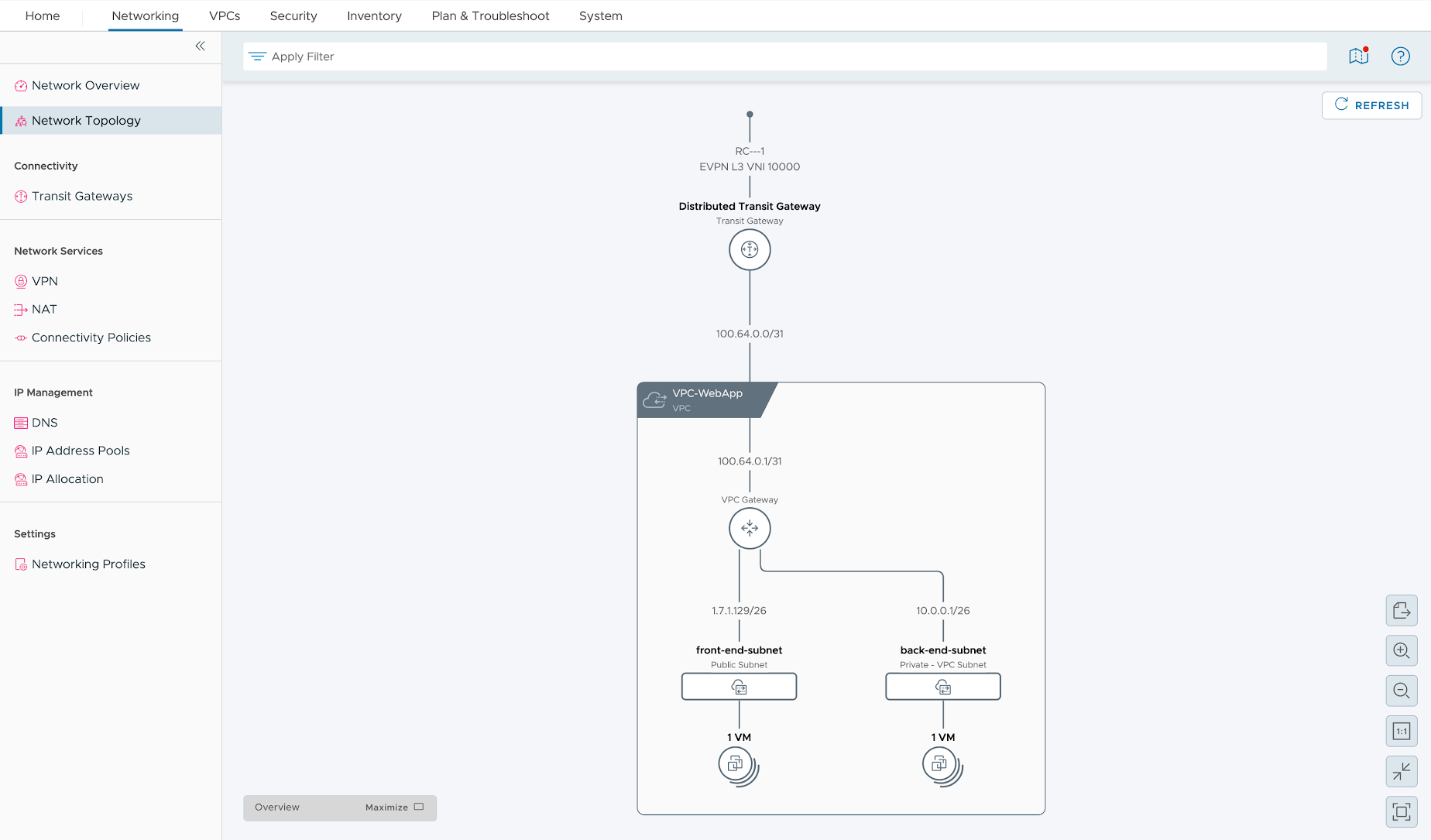
Figure 1. EVPN-VXLAN based connectivity in VMware Cloud Foundation

This standards-based interoperability between VCF and leading physical switch fabrics including Arista UCN, Cisco Nexus ONE, and SONiC, will allow networking teams to use consistent network connectivity and protocols across the entire network fabric (and down to the ESX host) and provide VCF admins a pre-configured external connection to connect their VPCs and workloads.

  • For networking teams, this means achieving consistent topology and configuration across the entire private cloud network which also simplifies monitoring and troubleshooting.
  • For VCF admins and virtualization teams, this means being able to deploy and connect their workloads and VPCs without needing deep expertise in networking or managing virtual appliances.

Furthermore, distributed connectivity from ESX hosts directly to the physical fabric will also eliminate the need for dedicated network edge nodes, cut capital costs, and address scaling bottlenecks associated with centralized connectivity.

Read the blog to learn more about the Broadcom-Arista Networks collaboration.

Flexible Connectivity for Complex Routing Topologies

VCF 9.1 will make several enhancements to how VPCs and Transit Gateways are deployed and managed. VCF 9.1 will enable new flexible connectivity options for tenants including multiple external connections, and multiple Transit Gateways with distributed VLAN connections per tenant with isolated VPN, static routes, and custom NAT configurations. This will deliver flexible multi-site routing with precise traffic management without needing external routing equipment. VCF 9.1 will also enable administrators to define the span of VPCs directly from vCenter or NSX. The user can restrict VPCs to specific clusters or configure them to across all vCenters in the networking domain when required.

Enhanced DirectPath I/O and Uniform Passthrough for NVIDIA Accelerated NICs

VCF 9.1 will deliver high throughput, high packet rate, low latency networking by providing virtual machines with direct hardware access to NVIDIA Connect-X and BlueField adapters.

Enhanced DirectPath I/O (EDPIO) for NVIDIA ConnectX-6 DX, Connect-7 or BlueField-3 (NIC mode) is specifically optimized for AI, machine learning, and distributed computing, and will offer support for GPUDirect RDMA to facilitate high-speed, direct communication between GPUs across the network. This will maximize hardware-level performance and offer advanced RDMA capabilities for compute-intensive applications.

Uniform Passthrough (UPT) for NVIDIA ConnectX-7, BlueField-2, and BlueField-3 adapters (NIC mode) is optimized for non-AI high-performance workloads, and will deliver hardware-level acceleration by leveraging VMXNET3 Hardware Emulation. It will provide exceptional speeds and efficiency without requiring customers to manage guest OS drivers.

Crucially, both EDPIO and UPT maintain full compatibility with essential cluster features—including vMotion, High Availability (HA), and Distributed Resource Scheduler (DRS)—ensuring you do not have to compromise between network performance and workload mobility.

VPC services / Enhanced Workload Connectivity and Services

VPC Policy-based Connectivity

Scaling a private cloud shouldn’t mean reconfiguring firewalls every time a new department needs a network. VCF 9.1 will streamline network connectivity and isolation using VPC Policy-based Connectivity. Admins will be able to use different types of Communities to enforce granular VPC isolation and deliver shared services without complex network changes:

  • Regular Communities: VPCs within a Community can communicate; those outside cannot
  • Isolated Communities: Strict “no-communication” zones for VPCs with sensitive workloads
  • Shared Communities: Designed for universal services like DNS that need to be reachable from all VPCs

These capabilities will be available through the VMware Advanced Cyber Compliance add-on. Read the blog for more details.

IP Address Management (IPAM) for Cloud Consumption

VCF 9.1 will include enhanced IPAM allocation, usage and visibility. VCF administrators will be able to consume these capabilities within though their console of choice – VCF Automation, vCenter, and NSX. The VCF 9.1 implementation will allow one IP Block to support up to 10 CIDRs, 10 IP ranges, and to exclude specific Ips, minimizing any disruption to the existing VPC consumers. Refer to the VCF 9.1 release notes for more details.

Furthermore, new integration with Infoblox will provide a “single source of truth” for IPAM and DNS, preventing IP conflicts automatically across your entire environment. This native support for Infoblox IPAM for VPC deployments in VCF 9.1 will allow the user to:

  • Discover Infoblox Network Views, DNS Views and Network Containers
  • Use Infoblox Network Containers to create Subnets and update VM IP/FQDN information
  • Configure the IPAM integration in VCF Automation (IP block definition) or NSX (Infoblox pairing, IP block definition)

Enhanced VPC Network Services

The Distributed Transit Gateway (DTGW) connectivity model for VCF workloads offers simplicity by eliminating the need for NSX edge nodes. However, customers utilizing the DTGW connectivity model were previously limited to basic services such as DHCP and external NAT. VCF 9.1 will make stateful network services available for DTGW deployments through the Virtual Network Appliance (VNA) cluster. In addition to DHCP and external NAT, this cluster will enable stateful services—including various NAT options and load balancing—without complicating the distributed architecture or network configuration.

For customers utilizing the Centralized Transit Gateway design using edge nodes to provide newtork services, VCF 9.1 will provide improvements for network throughput by supporting active-active Tier-0 gateway configuration for up to eight edge nodes. A new VPN service will also be available within the transit gateway to provide secure and flexible connectivity.

Native Networking for VMware vSphere Kubernetes Service (VKS)

High-performance Networking for VKS Clusters

As containerized workloads grow, so does the need for enterprise-grade networking within vSphere Kubernetes Service (VKS). With VCF 9.1, you will be able to deploy Kubernetes clusters in VKS with a secondary network interface. This capability will enable any VKS cluster, as well as pods within, to be deployed with a secondary network interface (vNIC) using the VMware Antrea CNI. Both VKS Cluster nodes and pods’ secondary NICs will then be mapped to VLANs or network subnets in the VCF Virtual Private Cloud (VPC).
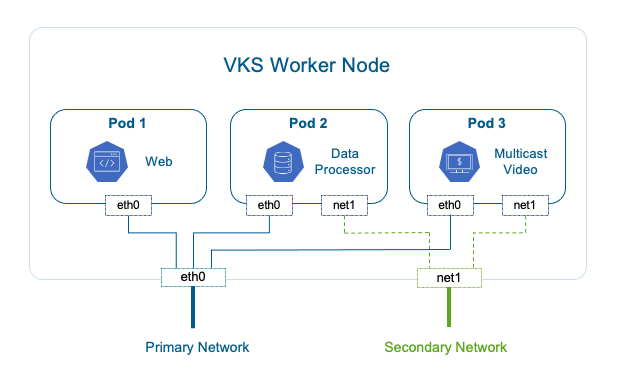
Figure 2. Multi-NIC Connectivity for VKS pods

This is critical for container-based applications that need to separate different types of traffic such as isolating traffic from primary networks, isolating unicast traffic from multicast traffic to/from container workloads, or direct access to physical systems such as high-performance NFS storage.

Support for Istio Service Mesh

Large-scale environments in banking and other regulated sectors require the security offered by a service mesh. VCF 9.1 will embed lightweight Istio Service Mesh natively, providing mTLS security and traffic management without requiring changes to your application code. Istio Service Mesh will be made available at a per-VKS cluster level for workloads running on vSphere Supervisor. Key functionalities will include:

  • mTLS between containers within a VKS cluster
  • Sidecar and Istio Ambient (Sidecar-less) mode
  • Istio Security and Traffic Management APIs
  • Layer 4 and Layer 7 routing

Enhanced Visibility, Planning, and Diagnostics

Flow Analytics and Path Topology

VCF 9.1 will deliver IPFIX support on vSphere Distributed Switch (VDS) and Antrea CNI, enabling granular flow visibility across VMs and VKS pods.
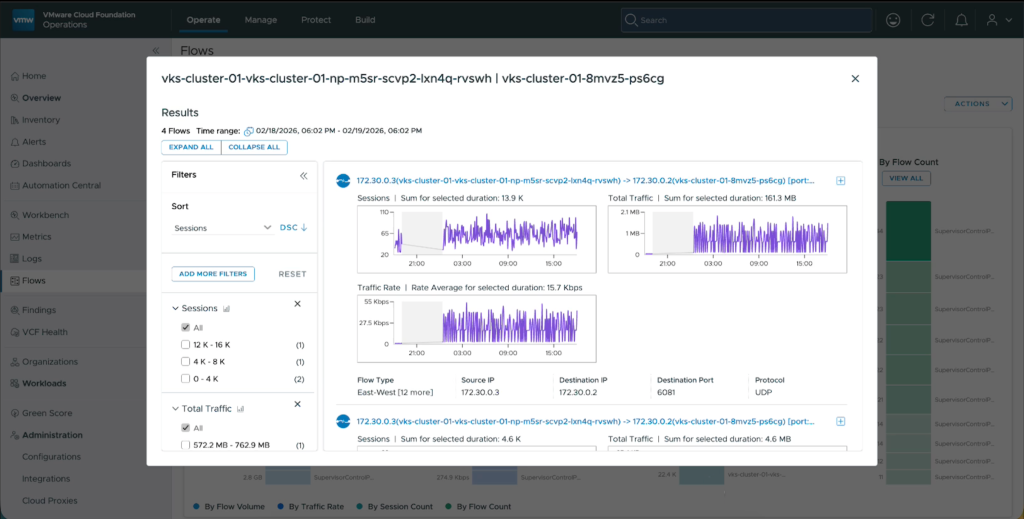
Figure 3. Flow analytics for VKS pods

This will help VCF administrators understand the traffic patterns and top talkers and correlate container traffic with VM traffic directly in the VCF Operations console. It will also provide traffic path visibility for troubleshooting performance issues.

Network Assessment and VPC Planning

Thinking of moving from traditional vSphere networking to VPCs? VCF 9.1 will include a Network Assessment and Value report that evaluates your current traffic and provides a guided transition plan.
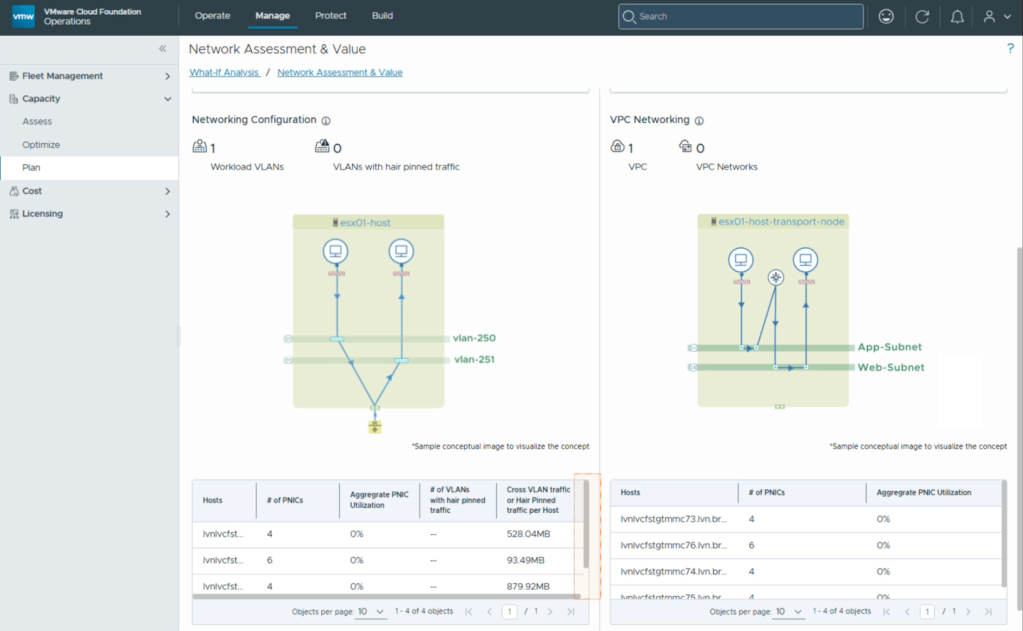
Figure 4. Network Assessment and Value

Key capabilities will include:

  • Assessment and Value: Assess existing network architecture and configuration including vSphere Distributed Switch (VDS) and vSphere clusters to evaluate potential improvements in server consolidation, workload mobility, and traffic hair-pinning through the physical infrastructure. This will allow VCF users to monitor east-west and north-south traffic flows without challenging and time-consuming manual processes and optimize infrastructure costs.
  • VPC Planning and Adoption: Design and plan the transition from vSphere networking (VDS) to VPC based networking. VPC planning in VCF 9.1 will analyze your existing network infrastructure including VLANs, network traffic patterns, and reachability and provides the users relevant networking parameters required to create VPCs. This will help drive server consolidation and workload mobility, logical workload isolation, and self-service for developers.

Network Diagnostics and Findings

VCF 9.1 will introduce an overall health dashboard that provides infrastructure visibility into critical issues impacting virtual network appliances and capabilities. This will include out of the box dashboards for network inventory, capacity monitoring, and detailed metrics for the NSX Edge appliance and ESX host networking. Users will be run integrated ODS runbooks and triage issues quickly. A troubleshooting workbench will provide VCF wide alerting, metrics, and logging mechanism that centralizes networking alerts, metrics and logs.

Conclusion: Efficiency at Scale

VCF 9.1 is more than just a collection of features – it’s a strategic shift toward a self-service, automated private cloud that is deployable at scale. With tighter integration with the physical fabric, flexible connectivity options and network services, native networking support for VKS container workloads, and enhanced planning and diagnostics, organizations can finally bridge the skills gap, lower their TCO, and get applications to market faster than ever before.

Ready to simplify your network? Check out the full VCF 9.1 release notes and other resources linked below to see how these features can transform your private cloud.


Learn More


Discover more from VMware Cloud Foundation (VCF) Blog

Subscribe to get the latest posts sent to your email.