


惯性聚合 高效追踪和阅读你感兴趣的博客、新闻、科技资讯
阅读原文 在惯性聚合中打开

推荐订阅源

C
CERT Recently Published Vulnerability Notes
freeCodeCamp Programming Tutorials: Python, JavaScript, Git & More
WordPress大学
WordPress大学
CTFtime.org: upcoming CTF events
V
Visual Studio Blog
Stack Overflow Blog
Stack Overflow Blog
aimingoo的专栏
aimingoo的专栏
C
Check Point Blog
cs.AI updates on arXiv.org
T
Tor Project blog
P
Proofpoint News Feed
让小产品的独立变现更简单 - ezindie.com
Latest news
Latest news
L
LINUX DO - 热门话题
罗磊的独立博客
T
Tenable Blog
The Hacker News
The Hacker News
美团技术团队
N
Netflix TechBlog - Medium
V
Vulnerabilities – Threatpost
阮一峰的网络日志
阮一峰的网络日志
Last Week in AI
Last Week in AI
博客园 - 司徒正美
Jina AI
Jina AI
Cyberwarzone
Cyberwarzone
云风的 BLOG
云风的 BLOG
S
Secure Thoughts
Cloudbric
Cloudbric
S
Security @ Cisco Blogs
奇客Solidot–传递最新科技情报
奇客Solidot–传递最新科技情报
Microsoft Security Blog
Spread Privacy
Spread Privacy
U
Unit 42
雷峰网
雷峰网
C
CXSECURITY Database RSS Feed - CXSecurity.com
Webroot Blog
Webroot Blog
爱范儿
爱范儿
博客园 - 【当耐特】
Know Your Adversary
Know Your Adversary
P
Privacy International News Feed
P
Palo Alto Networks Blog
Google Online Security Blog
The Last Watchdog
The Last Watchdog
博客园 - 聂微东
Help Net Security
Help Net Security
Hacker News: Ask HN
Hacker News: Ask HN
F
Full Disclosure
cs.CL updates on arXiv.org
S
Security Affairs
Project Zero
Project Zero

VMware Blogs

Diagnostics for VMware Cloud Foundation (VCF) 9.1 with Old Versions of VCF Components Mastering Infrastructure Policies in VMware Cloud Foundation Automation 9.1 Modernizing the Private Cloud: Why VCF 9.1 Lifecycle Management is a Game Changer Announcing the VMware Cloud Foundation 9.1 Upgrade Planning Tool VCF Breakroom Chats Episode 86 – Containers Made Easy: The New “Container-as-a-Service” in VCF 9.1 Securing Your VCF 9.1 Infrastructure with the Symantec Identity Security Platform Virtually Speaking: The AI Reality Check with Dave Linthicum Zero Touch Provisioning: Activating Edge Sites with VMware Cloud Foundation Edge 9.1 VCF Breakroom Chats Episode 85 – Cloning Success at Scale: Inside VCF 9.1’s App Stack Formation VMware Cloud on AWS の使用状況を確認できる API Unlocking the Full Potential of Programmable Infrastructure with VMware Cloud Foundation 9.1 – New Features and Capabilities Smarter Patching at Scale: Vulnerability Assessment and Remediation with VMware Tanzu Platform Encrypted vMotion Offload to Intel QAT in VMware Cloud Foundation 9.1 Deepen Your Expertise: Four Key Benefits of Attending Increase Deployment Flexibility with VCF Edge Automation 1.0.3 Avi Advantage: Automating Certificate Management of VCF Workloads More Memory, Less Effort: Configuring Memory Tiering in VCF 9.1 VCF 9.1 Licensing: Programmatic, Centralized, and Built to Scale Why APJ Networking Professionals Need Private Cloud Expertise VCF 9.1 Networking: Simpler VPC Connectivity Control VCF 9.1 Networking: Exploring Network Services for Virtual Private Clouds VCF Networking 9.1: Seamless DDI Integration with Infoblox The Open Source Advantage: Building from Source for Ultimate Security Expand Shared VMDKs with Clustered Applications in VMware vSAN for VCF 9.1 Monetizing Zero-Trust Security with VCF 9.1 and VMware vDefend VMware vSAN Protection and Recovery Enhancements for VCF 9.1 Deliver Production SQL Server DBaaS with VMware Data Services Manager 9.1 Maximizing Profitability: VCF 9.1 Cost-Focused Approach for VMware Cloud Service Providers Modernizing Your Infrastructure: Introducing VMware Cloud Foundation 9.1 to VCSPs VCF 9.1 is Available: Explore the New Features in Hands-on Labs What’s New with vSphere in VMware Cloud Foundation 9.1? Resizing VMware vCenter in VMware Cloud Foundation 9 Non-Disruptive VMware vCenter Patching in VMware Cloud Foundation 9.1 VMware vCenter Virtual Hardware Gets an Upgrade in vSphere with VCF 9.1 AI Has Changed the Threat Landscape. Is Your Infrastructure Ready? Simplifying Storage with the New Effective Capacity View in VMware vSAN for VCF 9.1 Auto-RAID in VMware vSAN for VCF 9.1 – Comprehensive System-Managed Data Resilience Introducing VMmark 4.1: Enhanced Power Efficiency Benchmarking for Private Cloud Infrastructure Advanced Memory Tiering Enhancements in VMware Cloud Foundation 9.1 VCF 9.1 Is Here. See It in Action. 博通發布 VMware Cloud Foundation 9.1 How Broadcom Is Helping Enterprises Win the AI Security Sprint How to Prepare for the World of AI Driven Exploits Avi Innovations for VCF 9.1: Powering Kubernetes, Agentic AI and VPC Workloads VCF 9.1: The Secure, Cost-Effective Private Cloud Platform for Production AI Announcing VCF 9.1: Modern Private Cloud Built for Efficiency and Resilience Announcing VMware Cloud Foundation Edge 9.1: A Scalable, Autonomous Edge Platform Accelerate, Streamline, and Control Your Self-Service Private Cloud with VMware Cloud Foundation 9.1 Deploy Modern Apps Faster, Scale Smarter, and Lower Your TCO with VMware vSphere Kubernetes Service in VCF 9.1 Scale Smarter, Save More: Redefining Infrastructure Economics with VMware vSphere in VCF 9.1 AI with VCF 9.1 on AMD GPUs: Build with open frameworks and simplify management, at a lower TCO Streamline, Simplify and Protect all your AI workloads with VCF 9.1 Simplify Workload Connectivity and Enhance Network Scale and Performance with VCF 9.1 VMware and CrowdStrike Deliver New Integration for Cyber Recovery Workflows How Many Users Can Your LLM Server Really Handle? From Infrastructure to Agents: A Hands-On Guide to Secure Private AI with Broadcom – Part 2 The New Frontier: Leading the Cloud-Native Evolution Replicating VMware vSphere Configuration Profile Desired State Webinar Recap: Design and Architecture Considerations for VMware vSphere Kubernetes Service on VMware Cloud Foundation Kubernetes 1.36: What Actually Changed for Enterprise Platforms Enhance Lateral Security and Ingress Load Balancing for Kubernetes Workloads Avi Load Balancer Analytics: Root Cause Application Performance Issues in Minutes Analyst Insight Series #3: Policy-Driven Governance and Multi-Tenant Control Post-Quantum Readiness on VMware Cloud Foundation Registration Is Live for Las Vegas | $ave with Early-Bird May 21, 2026: What’s New in VMware Tanzu Data Intelligence 10.4 From Infrastructure to Agents: A Hands-On Guide to Secure Private AI with Broadcom – Part 1 Stop Guessing: Advanced Monitoring and Troubleshooting for Data Services CPU, Disk, Network, and Memory Workload Profiles for DVD Store Database Testing How VMware Salt Automates Compliance Across Private Cloud Analyst Insight Series #2: Operational Scalability and Lifecycle Management MCP vs. APIs: Why You Need Both for AI Applications The Real Constraint on Enterprise AI isn’t GPUs; It’s Power Deploying Harbor Service in Air-Gapped VMware Cloud Foundation 9.0 Why Enhanced DirectPath Wins for High-Performance Apps Bridging the (.Local) Gap: A Split-Domain Design for VMware Cloud Foundation Deployment Observability on VMware vSphere Kubernetes Service Converging VMware vSphere to VMware Cloud Foundation 9.0: The Top 10 Questions Answered May 6, 2026: What’s New in Tanzu Platform 10.4: Powering Agentic Apps at Scale VMware Tanzu RabbitMQ Powers the Modern Data Lakehouse with New Spark Integration and Enterprise Tooling Tanzu Data Intelligence 10.4 Delivers AI-Driven Analytics, Unified Real-Time Operations, and Sovereign Resilience Enterprise-Ready Agents Made Simple & Safe with VMware Tanzu Platform Agent Foundations Introducing Tanzu Platform 10.4: Extending Platform as a Service to Agentic Applications How AI-Assisted Analytics in Tanzu Data Intelligence Can Help Remove the SQL Bottleneck From Prototype to Production: Securing Database MCP at Enterprise Scale The Compelling Case for a Private Cloud Data Intelligence Platform The Unification Dividend: Consolidating Database Operations on VMware Cloud Foundation The Modern Spring Workflow Is Enterprise-Ready and AI-Boosted [TAM Blog] セキュアブート証明書の有効期限切れに関する注意点と対応について Accelerate Lateral Security and Ingress Load Balancing for Kubernetes Workloads From Platform to Data: Building a Cloud-Native Developer Experience On-Prem with VMware Cloud Foundation How VMware Cloud Foundation (VCF) Training Helps Keep Top Tech Talent in APJ Build Your Case for Attending VMware Explore 2026 Spring 開発元が提供する商用サポート「VMware Tanzu® Spring Essentials」とは VMware Cloud on AWS より i7i.metal-24xl インスタンスの提供開始 VMware Advanced Memory Tiering Tips for Success VMware Cloud Foundation Edge 9.0: Two-Host Edge Site Deployment with Brownfield Import Your Database Is About to Become an AI Tool. Is It Ready? Applying GitOps Principles to Maintain Desired State Configuration using VMware vSphere Configuration Profile – Part 3 Webinar Recap: Converging VMware vSphere to VMware Cloud Foundation 9.0
VMware Cloud on AWS: Introducing the Usage Report APIs
vmwareblogs · 2026-04-17 · via VMware Blogs

Tracking VMware Cloud on AWS consumption across hosts, SPLA, and non-host charges today requires manual data pulls and waiting for invoice every quarter. Customers building FinOps practices and mature cloud financial operations have consistently asked for programmatic access to this data, in a format their existing tools can consume.

Today, we’re delivering on that with three new Usage Report APIs for Host Usage, Microsoft SPLA Usage, and Miscellaneous Usage (non-host charges) covering networking charges like EIP, TGW, data transfer, and Direct Connect.

These Usage Report APIs  provide daily-granularity usage data through clean, filterable endpoints that integrate directly into your existing cost management, BI, and reporting workflows. Whether you’re tracking costs, analyzing consumption patterns, or building custom dashboards, these APIs give you the flexibility to retrieve and organize usage data on your terms.

All three APIs are available now to all VMware Cloud on AWS customers.

What’s Available

1. Host Usage Report API

GET /activityanalytic/{org_id}/hosts/{freq}/usage-report

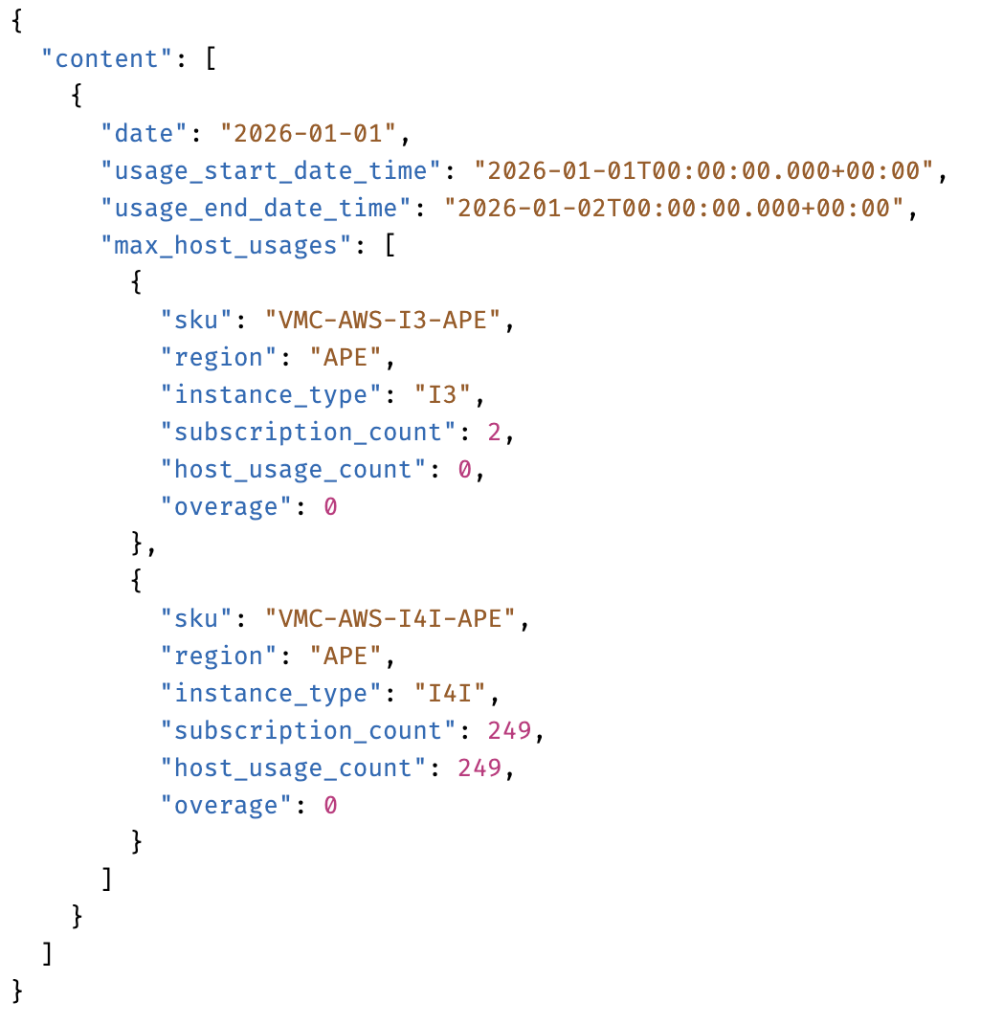
Retrieve daily host consumption data for any date range, broken down by instance type and region group. Each record includes the SKU, region, instance type, subscription count, actual host usage count, and overage. This gives you the data needed for forecasting invoices, understanding usage spikes, financial planning, chargeback, and subscription right-sizing.

The API returns the maximum host usage per day, per instance type, per region group. Values are aggregated across all SDDCs, allowing you to compare actual consumption against subscriptions purchased. Host usage data is available starting from 2025-02-01. 

For more details please review the API details on the developer portal.

Sample API Response:
2. SPLA Usage Report API

GET /activityanalytic/{org_id}/spla/{freq}/usage-report

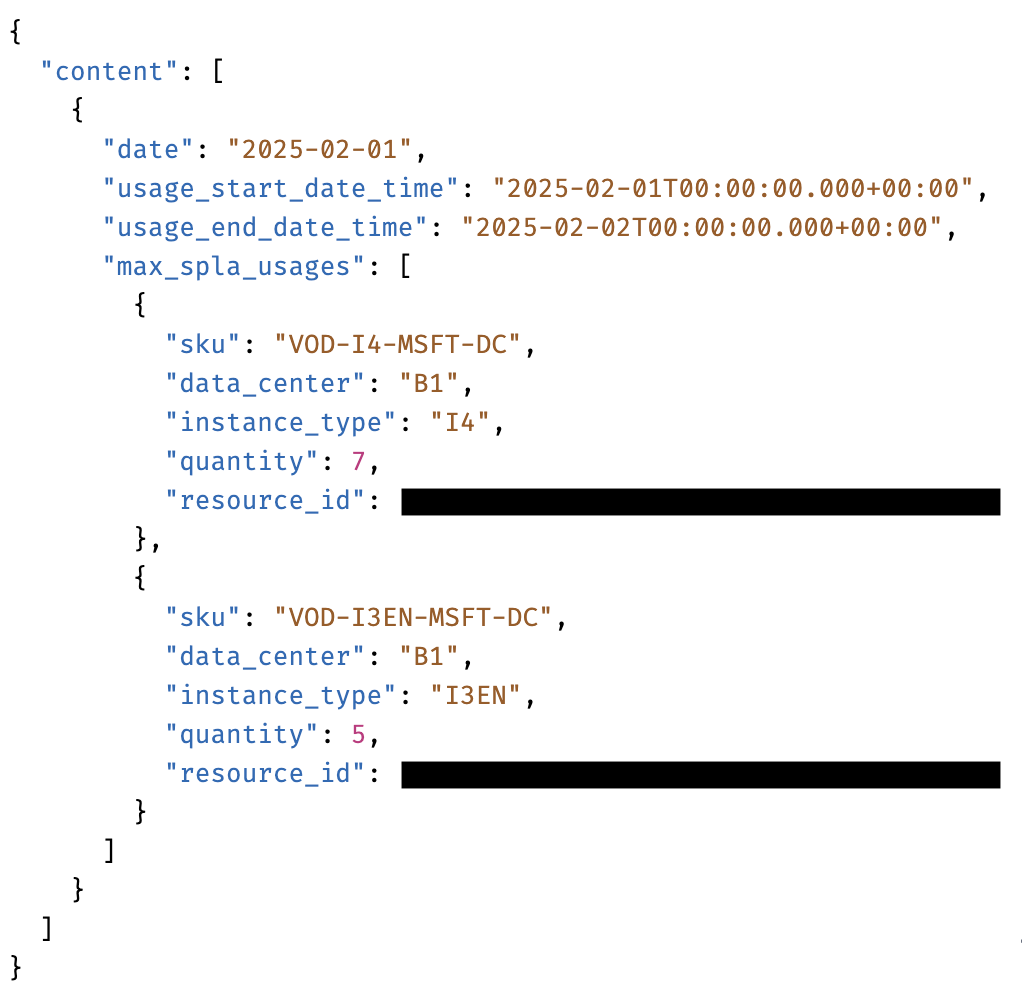
Access your Microsoft SPLA usage data programmatically, broken down by instance type, SKU, quantity, and resource ID (SDDC ID). This API enables you to precisely track license consumption across your SDDCs and validate upcoming SPLA charges. 

The API considers the maximum SPLA usage for the day per instance type, SPLA license type, and SDDC. SPLA usage data is available starting from 2026-01-01.

SKU Format: VOD-<Instance Type>-MSFT-<License Type>

Instance types: I3, I4I, I7I, I3EN

License types:

  • DC : Windows DC Server, Commercial
  • DCA : Windows DC Server, Academic
  • SQL : MSFT Windows SQL Server Enterprise, Commercial
  • SQLA : MSFT Windows SQL Server Enterprise, Academic

We will be adding SKU descriptions in a future update for easier reference.

For more details please review the API details on the developer portal.

Sample API Response:
3. Miscellaneous Usage Report API (Non-Host Networking Charges)

GET /activityanalytic/{org_id}/misc/{freq}/usage-report

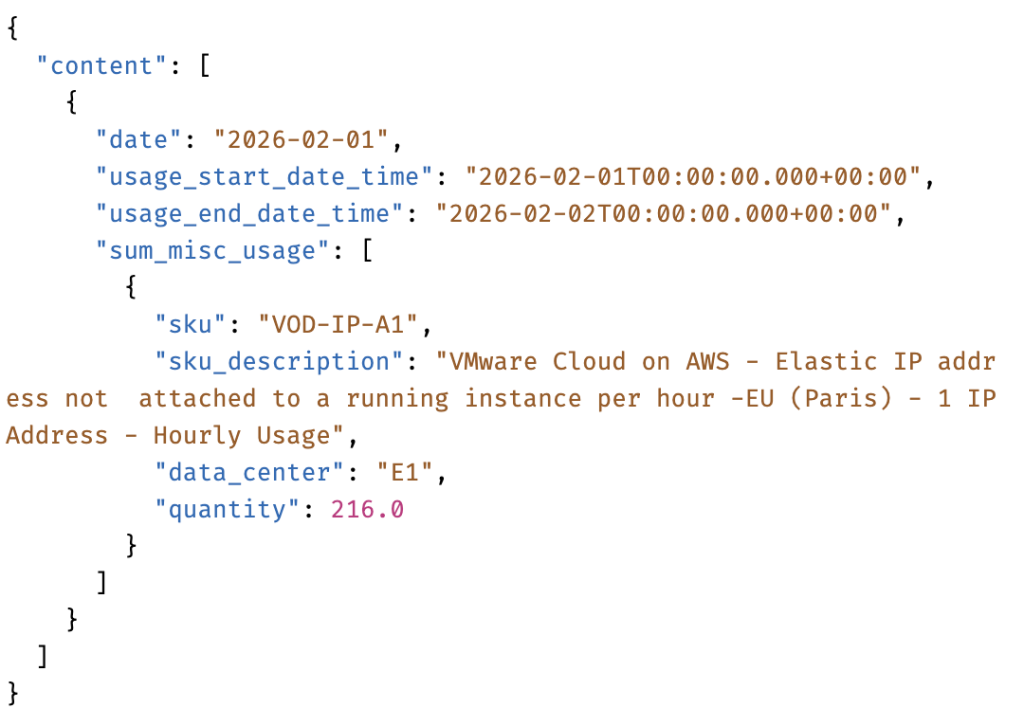
Retrieve daily usage data for supplemental and add-on charges. This gives you full visibility into networking and ancillary costs that contribute to your total cost of ownership.

Charge types covered:

  • Egress Data Transfer (Per GB)
  • Cross Region Data Transfer (Per GB)
  • Direct Connect (Per GB)
  • Elastic IP (Per IP Address, Per Hour)
  • Transit Connect (Per Hour, Per GB, Per Attachment)

Daily quantities are summed across each charge type. Historical data is available from 2026-01-01 onward.

For more details please review the API details on the developer portal.

Sample API Response:
Key Capabilities

All three APIs share a common set of capabilities designed for operational integration.

  • Custom date ranges. Query any start and end date to match your reporting periods, billing cycles, or ad-hoc analysis needs. The maximum range per API call is 31 days, but you can call the API multiple times to retrieve data across longer periods.
  • Granular filtering. Filter results by region, instance type, SKU, and other key attributes to retrieve exactly the data you need.
  • Sort and filter operations. Standard query parameters for organizing and structuring API responses to match your downstream tooling.
  • Daily granularity. Day-level records across all three endpoints, providing the resolution required for trend analysis, anomaly detection, and accurate cost allocation.

Use Cases

  • Invoice forecasting. Track daily consumption against subscription entitlements to identify overage trends early and project upcoming invoice totals across all charge types.
  • Usage dashboards and reporting. Integrate host, SPLA, and miscellaneous usage data into your BI platform or cost management tools for a unified view of VMC spend.
  • Capacity planning. Analyze host usage trends over time to inform subscription renewal decisions and capacity forecasting with actual consumption data.

HTML Usage Report Generator

For teams that need a visual summary without building API integrations, we’re also releasing the HTML Usage Report Generator. This command-line tool produces a Broadcom-branded HTML report combining host, SPLA, and miscellaneous usage data into daily trend charts, Non-Host Charges Usage API Documentationfiltering controls, and detailed data tables.

For setup instructions and usage examples, see the Interactive Usage Report Generator – KB Article.

Getting Started

All three APIs are available now. To start retrieving usage data:

  1. Authenticate using your VMware Cloud on AWS API credentials.
  2. Identify your organization ID from the VMC console.
  3. Choose your endpoint and specify a date range (up to 31 days per call).
  4. Add optional filters for region, instance type, or SKU to narrow results.

For complete API references, authentication details, and additional examples:

What’s Next

We’re continuing to invest in usage visibility with enhanced visualization in the VMC console, additional filtering and aggregation capabilities, and bulk export options for large datasets.

For questions, feedback, or feature requests, reach out to your account team. Your input directly informs our roadmap.


Discover more from VMware Cloud Foundation (VCF) Blog

Subscribe to get the latest posts sent to your email.