












Morning all,
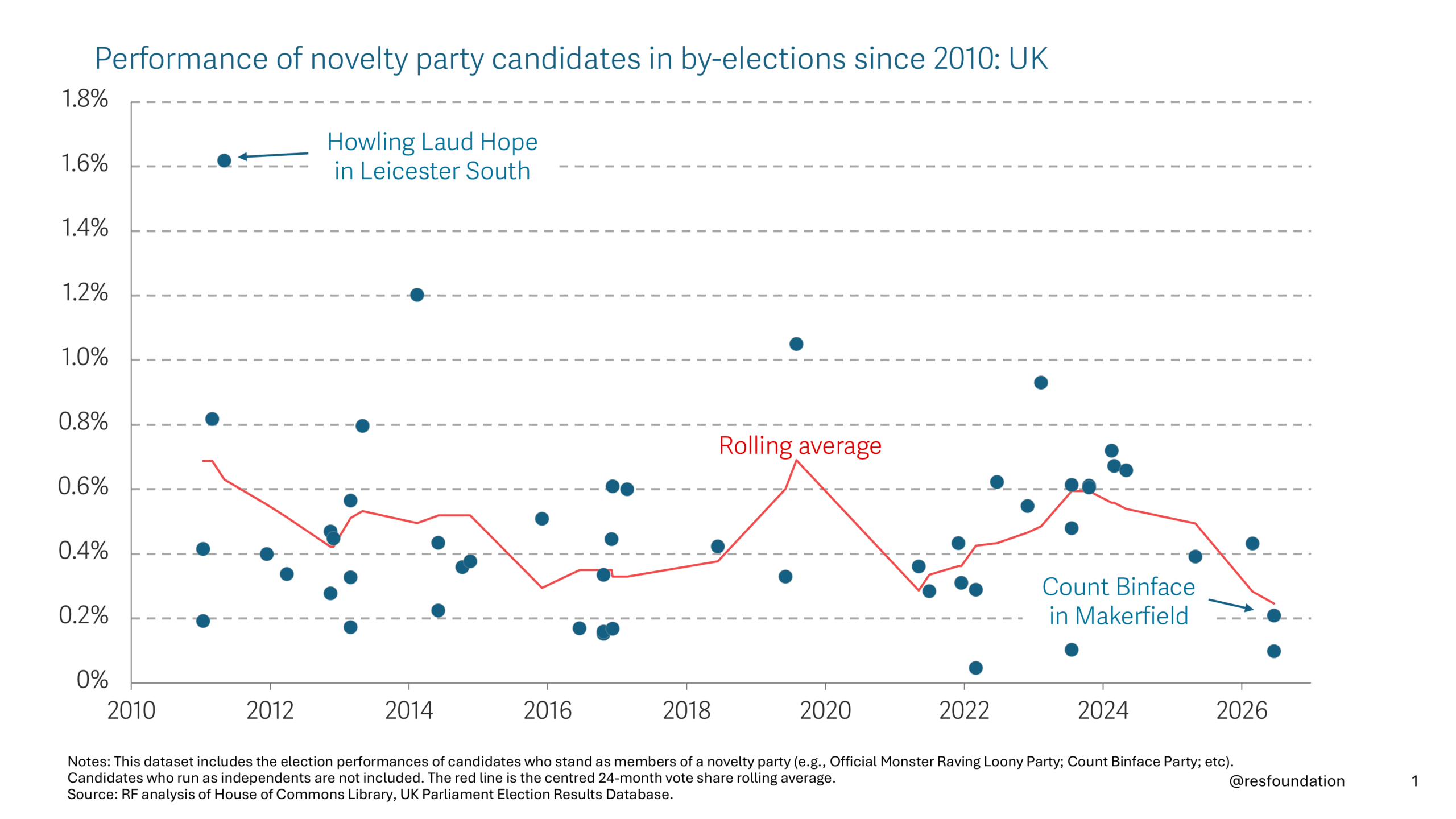
We’re well into silly season, arguably augmented this year by one particularly articulate rubbish receptable. In anticipation of next week’s hotly contested by-election, we’ve rustled up a Chart of the week that considers the performance of both the not-entirely-serious and the downright extra-terrestrial candidates in recent by-elections.
Plus, we’ve got plenty of insights into AI – how it flatters, provokes and (maybe) boosts productivity – and the long (loooong) shadow of inflation.
Next week we’ve got one more brilliant guest editor for you, before we tuck our beach towels under our arms and log off for our late August break, to return to your inbox in September. Whatever this summer brings you – and here’s hoping for some rain – I hope it’s a great one.
Mike
Deputy Chief Executive
Resolution Foundation
The price is right(?) This Substack adds fuel to the debate on why US consumer sentiment is low despite low unemployment, rising real wages and near-record-highs in the stock market. One theory is that the relentless negative news and media is to blame, but the author found media narratives aren’t doing much heavy lifting. Instead, the strongest predictor by far of how chirpy US consumers are feeling is the share of Americans who say higher prices are making their finances worse than a year ago – a variable that beat unemployment, the S&P 500 and even inflation itself. Households don’t care that inflation is slowing down: they’re focused on the fact that milk, rent and filling up their gas tanks still cost a lot more than they remember. Later this autumn, in work supported by the Nuffield Foundation, we’ll take a similar look at how shocks since 2020 have hit living standards and savings in the UK. If anything, we’ve had it worse than the US, with prices up 28 per cent since 2021, and food, energy and rent up by 39, 52 and 33 per cent.
Arse-kissing AI. You may have suspected that AI chatbots are professional yes-men, nodding along while you talk yourself into something daft. A new paper puts this fear to the test, running 1,500 people through 30 decision-making exercises with randomised chatbot access. In fact, the study finds that AI users ended up reaching more accurate conclusions on questions with right answers. The reason seems to be that, although the bots did indeed lay the flattery on thick, they bundled it with useful information and left people better informed. But when a second, extra-sycophantic model was used instead, the effect was weakened and users rated it as less useful, less enjoyable and were less keen to use it again. Everything in moderation, including robo-praise.
Plotlines. Sticking with the subject of AI, here’s an interesting blog written (in a personal capacity) by the Guardian’s “head of editorial innovation”, which offers a cautiously optimistic picture. The author, in partnership with his daughter, used vibe-coding to create a tool that maps the key events of famous novels. Aimed at non-experts, the blog covers the opening prompts, the use of multiple agents to achieve different sub-tasks, and issues Claude flagged that hadn’t occurred to the father-daughter duo. But the author and his daughter learned more than just how to use Claude better: building the tool helped them engage with the novels themselves. As he puts it: “Conversations about LLMs in education…tend to start and end with the idea of cheating or avoiding thinking by shortcutting. I hope this example might underline why there is far more value to discover.” Explore their library of maps for yourself: 43 novels and counting.
Place (t)roubles. Here’s a fun economic history lesson from China. In the 1950s, the ‘Million-Rouble Plants’ programme involved the USSR building 150 state-of-the-art industrial facilities in China. Initially, these had huge benefits: in the short and medium run, GDP per capita ended up roughly 80 per cent higher in those regions than those without the shiny new factories, with industrial employment shares up 22 percentage points. But the gains didn’t last: by the 2010s, the left-behind regions had caught up, and then actually moved ahead, being 20 per cent more productive. What went wrong? Local economies became so specialised around the plants’ supply chains that other companies were weakened, and entrepreneurs took their talents elsewhere. So, for any new Prime Ministers thinking about how to get good growth in every postcode, the takeaway for an enduring place-based industrial strategy is diversity in initial investment within local labour markets.
Byte sized. We’ve got one more AI read for you, this one grappling with its economic impact. The good folk over at the Bank of England have gone looking into UK industry data since ChatGPT was released in 2023 to compare what each sector contributed to output per hour against the previous decade. There appears to be a bit of movement, with ‘Computer programming, consultancy and related activities’ raising its contribution to annual productivity growth from 0.01 to 0.10 percentage points, while ‘Information services’ has gone from dragging growth down to adding 0.06 points. That is exactly the shape of the ICT revolution in the 1970s, where the chip and software makers boomed first and everyone else waited a decade or more for their share. Encouraging if you’re patient, less so if you’re hoping our productivity problem might be solved by before the next set of OBR forecasts…
Next Thursday will see the political event of, um, August 2026, as Nigel Farage contests his recently-held seat in Clacton. He’ll be facing off against Count Binface and 32 other contenders. In fact, the list of runners and riders is so long, it’s been widely reported that the cost of printing the ballot papers is four times the usual amount. But, as well as the record-breaking list of candidates, there’s another way this by-election could make history. As our Chart of the Week shows, what we might call the ‘novelty’ candidates usually don’t get more than about half a percentage point of the vote, despite being a long-held part of British electoral tradition. So, with as many as one-in-five voters in Clacton considering putting a cross in Binface’s box, the Count could end up with a vote share ten-times higher than the norm for candidates of his ilk. The highest vote share of any novelty candidate in at least the last 16 years is an honour currently held by Howling ‘Laud’ Hope (of the Official Monster Raving Loony Party), who persuaded 553 good people of Leicester South (a mightly 1.6 per cent of votes cast) to vote for him. Mr Hope is also running in Clacton next week but, given that he was roundly defeated by Count Binface at the Makerfield by-election, I think we can discount him as an electoral threat… for now.
此内容由惯性聚合(RSS阅读器)自动聚合整理,仅供阅读参考。 原文来自 — 版权归原作者所有。