






Here’s some uncomfortable reading for you. If you grew up in deep poverty and managed to get yourself a university degree – already a long-odds achievement – you will still earn thousands of pounds a year less than your more privileged peers a decade into your career. Even if you studied the same subject, at the same university, got the same grade, and work at the same firm.
That’s the headline finding from The Long Shadow, a new briefing note by Julia Diniz, Richmond Egyei, Anna Stansbury and yours truly at the Resolution Foundation, funded by the Nuffield Foundation. We tracked the educational records and tax returns of over half a million university graduates in England born in the late 1980s, using the Longitudinal Education Outcomes dataset – which links school records, university data, and HMRC tax returns for the entire population.
Let’s start with the raw numbers. Ten years after graduation, graduates who were eligible for Free School Meals at age 16 – a proxy for deep poverty – earn 13 per cent less than those who weren’t. That’s £7,590 a year. It’s larger than the gender pay gap among graduates and many ethnicity pay gaps. And it’s there for men and women, and for White and BAME graduates alike.
This is a group that has already beaten considerable odds by overcoming poverty to get to university. Only 16 per cent of children in deep poverty at 16 go on to graduate, compared to 32 per cent of their more affluent peers. So, we’re looking at people who’ve already cleared a high hurdle only to find they’re still unable to escape the long shadow of where they started.
We can decompose the gap into three pieces.
The first is education. Graduates from disadvantaged backgrounds are less likely to attend selective universities – 15 per cent go to the most competitive institutions, versus 29 per cent of their better-off peers – and less likely to get top marks (36 per cent get a First or 2:1, compared to 44 per cent).
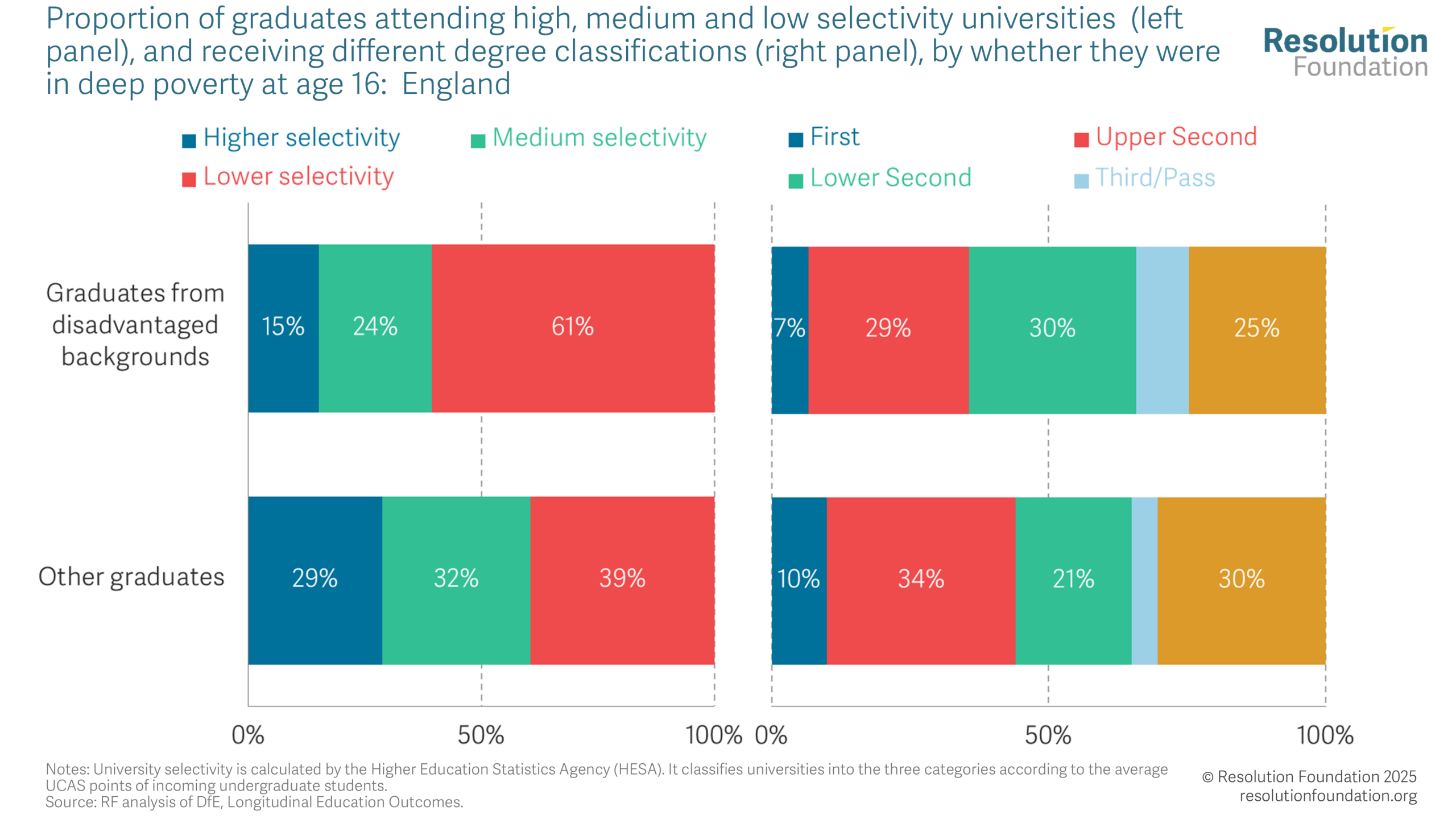
Where you go to university and how you do there matters for earnings. These differences in educational pathways account for about half the earnings gap. But it also means that if access to and performance at university were more equal, the penalty would be substantially smaller.
The second piece is employers. Graduates from poorer backgrounds work at lower-paying firms. This accounts for about 2 percentage points of the gap after 10 years of work.
The third piece is the residual. After accounting for education, region, industry, and even the specific firm someone works at, a gap of 5 per cent – over £2,800 a year – remains. Two colleagues sitting next to each other, with the same degree from the same university, working at the same company, earning different amounts because one of them grew up poor.
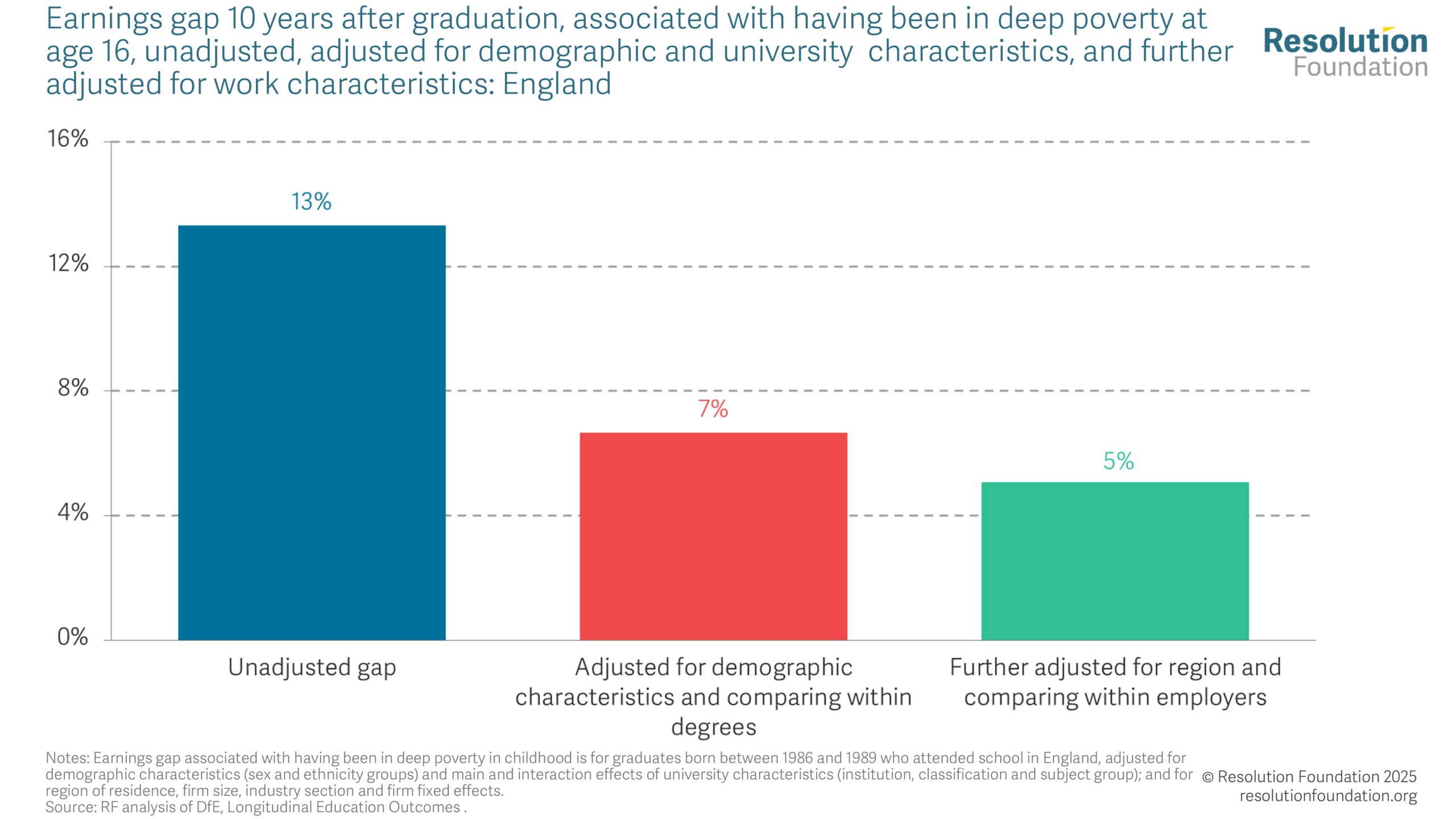
You might hope that as time passes and graduates demonstrate their abilities, the effect of their childhood circumstances would fade. It doesn’t.
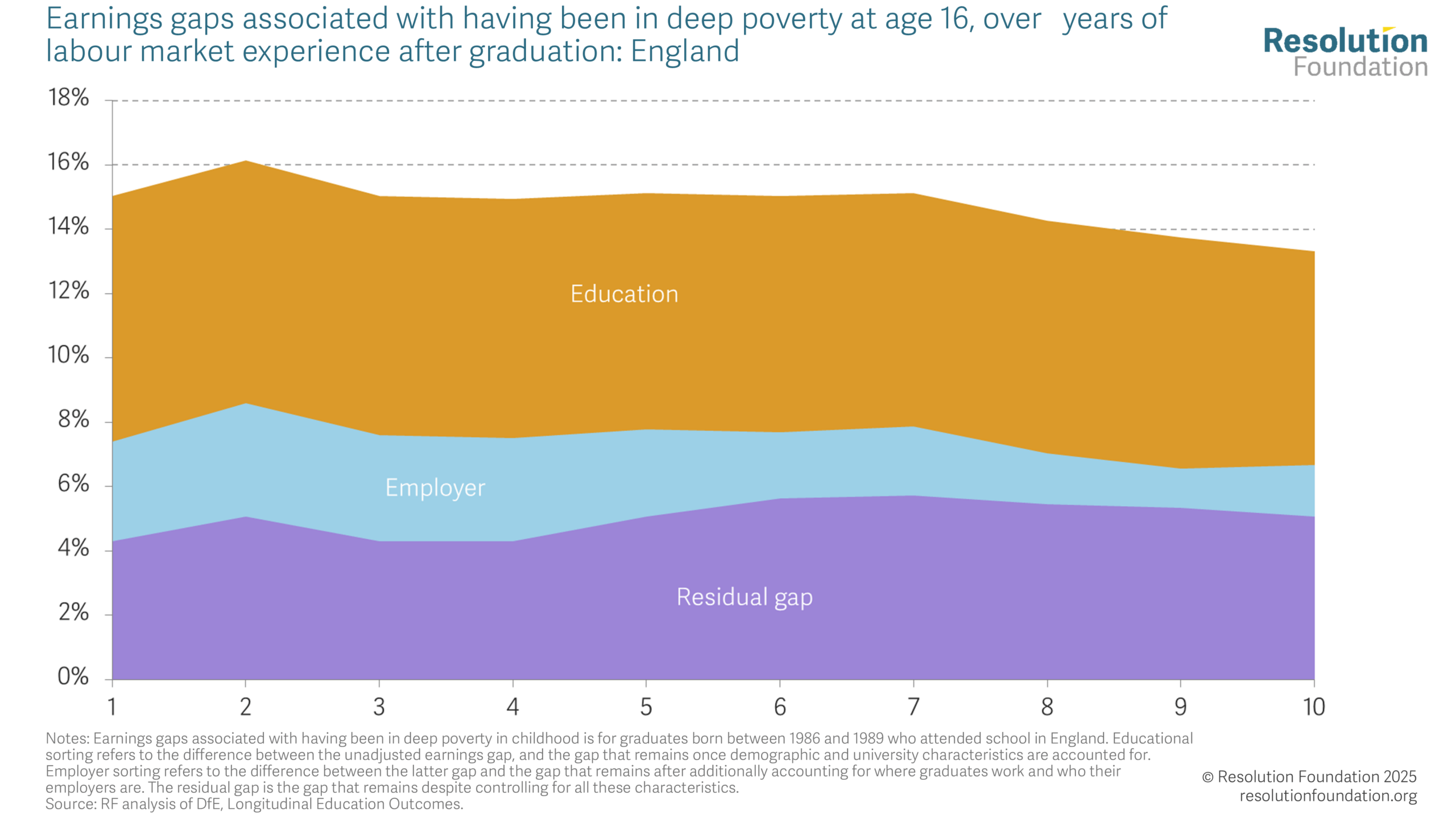
The total gap narrows only slightly, from 15 per cent on entering the labour market to 13 per cent a decade later.
Within that, the bit driven by employer sorting does shrink – disadvantaged graduates move up the job ladder, closing some of the gap with their peers. Over the first decade of work, disadvantaged graduates do actually climb the job ladder faster than their peers, moving to more similarly-paying firms. As a result, t
he employer contribution to the gap roughly halves.
But every silver lining has a cloud. The residual pay gap – the 5 per cent penalty that remains after accounting for everything we can measure – is there from year one and still there at year ten. Experience in the labour market does nothing to offset the pay penalty associated with childhood disadvantage, except insofar as it lets people move to better firms.
The findings point in two directions. First, educational access matters enormously. Half the gap comes from disadvantaged students ending up at less selective universities with lower grades. Interventions that improve school outcomes and university access for poorer children would directly reduce the penalty.
But second, fixing the education pipeline wouldn’t be enough. A large and stubborn gap persists even among graduates with identical credentials at the same employer. That’s a reminder that child poverty leaves marks that run deeper than educational attainment – and another reason to take seriously the long-term costs of growing up poor.
This blog was originally published on the Resolution Foundation’s substack.
此内容由惯性聚合(RSS阅读器)自动聚合整理,仅供阅读参考。 原文来自 — 版权归原作者所有。