







Afternoon all,
As thunder rumbles over Westminster, the battle for ideas over how to govern Britain has begun.
Yuan Yang MP joined us yesterday, with Sir John Curtice and Tom McTague, to discuss a government reset – along with our own report on what it might take to lift living standards. I can safely say our panel was in no danger of being in violent agreement with each other.
Meanwhile, the question hanging over the bond market has been whether a new leader, or a new direction, would mean more borrowing. Yuan suggested it could be easier for left-wing Labour leaders to take fiscally tight decisions – for example on welfare reform – because of the political capital they have within the party. The reality is that with the higher energy costs resulting from the Iran war making the UK government and its citizens poorer there is no loose change for vote winners – whoever is in power.
Have a great weekend,
Ruth
Chief Executive
Resolution Foundation
One-trick pony. Worried about AI stealing all jobs? Just remember you are not a horse. The economist Brian Albrecht takes a sceptical look at the doomsters’ view that AI will do to jobs what tractors did to horses, whose US population peaked at 27 million in 1920 and crashed to 3 million by 1960. So (bear with me) how are people different from horses? Horses only ever had one job, whereas humans are adaptable. For labour demand to truly collapse, every penny saved from paying wages would have to land in a sector that employed zero human labour throughout its entire supply chain. History suggests otherwise: as goods got cheaper across the 20th century, spending migrated to labour-intensive services, which now absorb two-thirds of consumer expenditure. So humans got to spend the savings of automation on each other. Horses weren’t so lucky.
Cut me some slack. The UK’s labour market could be hiding more slack than we previously thought. Since 2008, more workers have been working fewer hours than they’d like. The authors argue that calculating employment rates that account not just for headcount but for hours worked (and wanted) captures complexity that conventional measures miss. Their employment rate is 11 percentage points lower than conventional measures, and the unemployment rate is double – meaning there’s far more spare labour capacity than we thought. But the story of the slack depends on which part of the country you’re looking at. London shifts from below to above the UK average employment rate when switching from the conventional to the new measure, reflecting its concentration of full-time jobs and longer hours. Wales, meanwhile, records the highest youth unemployment rate of any UK region under the new measure (22.4 per cent). The authors suggest their findings underline the importance of thinking beyond ‘any job’ and towards good jobs.
The bots are back in town. Chris Curtis MP has written an article about the role bots may have played in recent shocking headlines about young men. When pollsters run online surveys, they must make the samples representative. Young men are less likely to complete online surveys and are therefore more likely to be invited to participate. This makes them the optimum demographic for fraudsters to model their bots to reap survey rewards. More fake accounts mean more random answers for a group increasingly surveyed on controversial topics. This comes after YouGov had to retract their Quiet Revival report. The poll claimed that church attendance among young people had increased from 4% in 2018 to 16% in 2024 but several respondents were found to be fraudulent. Until quality control is properly incentivised, we ought to second-guess the next survey that finds young men think the earth is flat.
Reinventing the wheel. How long does the world wait for new inventions once they become technically possible? This article has a go at estimating how much earlier each of 190 major inventions could have been built, given a well-equipped era-appropriate workshop. The results are oddly reassuring: 64 per cent of new inventions could have appeared within 50 years of their actual arrival date, and the binding constraint is far more often technological than scientific. Aeroplanes, for example, needed an engine light enough to fly, not new laws of physics. The gaps have narrowed sharply since 1900, suggesting that once a tool is possible to build, we crack on with it quick as. Caveat emptor, this analysis is more speculative history than a hard finding, but a fun romp nonetheless.
Something for the weekend | The only way is up
Next Wednesday we’ll get the inflation rate for April for the first official signs of the impact of the war on the cost of living. We found out this week that US inflation jumped half a percentage point from 3.3 to 3.8 per cent – its highest level in three years.
Early evidence from the UK indicates UK firms are already feeling the heat. According to the Bank of England’s Decision Maker Panel, businesses expect to raise prices and accept thinner margins to absorb the shock. Firms expect their prices to grow by 4.4 per cent over the next year, up from 3.4 per cent in January. More than a third also expect headcount to suffer. The key factor affecting the scale of the upcoming price hike will be the energy shock’s scale and duration.
We may hear more from the Chancellor next week about the planned approach to support with energy bills, ahead of the announcement of the new energy price cap (effective from July). It’s expected to increase by about £200, bringing us roughly back to where we were last April. While that is unwelcome, the impact on households over the summer, when gas use is low, will be small – about £20 extra between July and September. With warning signs flashing in global energy markets however, ministers should be standing by to help families this winter if prices rise further.
Chart of the week
As leadership speculation hots up so does chatter about what the real masters of the universe, the bond markets, make of it all. You’ll have noticed this week that Keir Starmer’s fortunes have gone down and the cost of government borrowing has gone up. So in our chart this week we look at whether there is a longer run relationship between the betting market’s view of the Prime Minister’s future and how much more the UK pays to borrow than Germany. Yes we know…correlation is not causation and this is not a perfect measure of UK-specific risk. The thing is, though, there isn’t even any correlation since January, on average, between daily moves in the two.We tend to agree with others that there is quite a lot else going on besides UK politics. But the best way for politics to cast less of a shadow on the gilt market would be to a have a government united behind a plan to consolidate and the political capital to deliver it – a tall ask for whoever is in charge.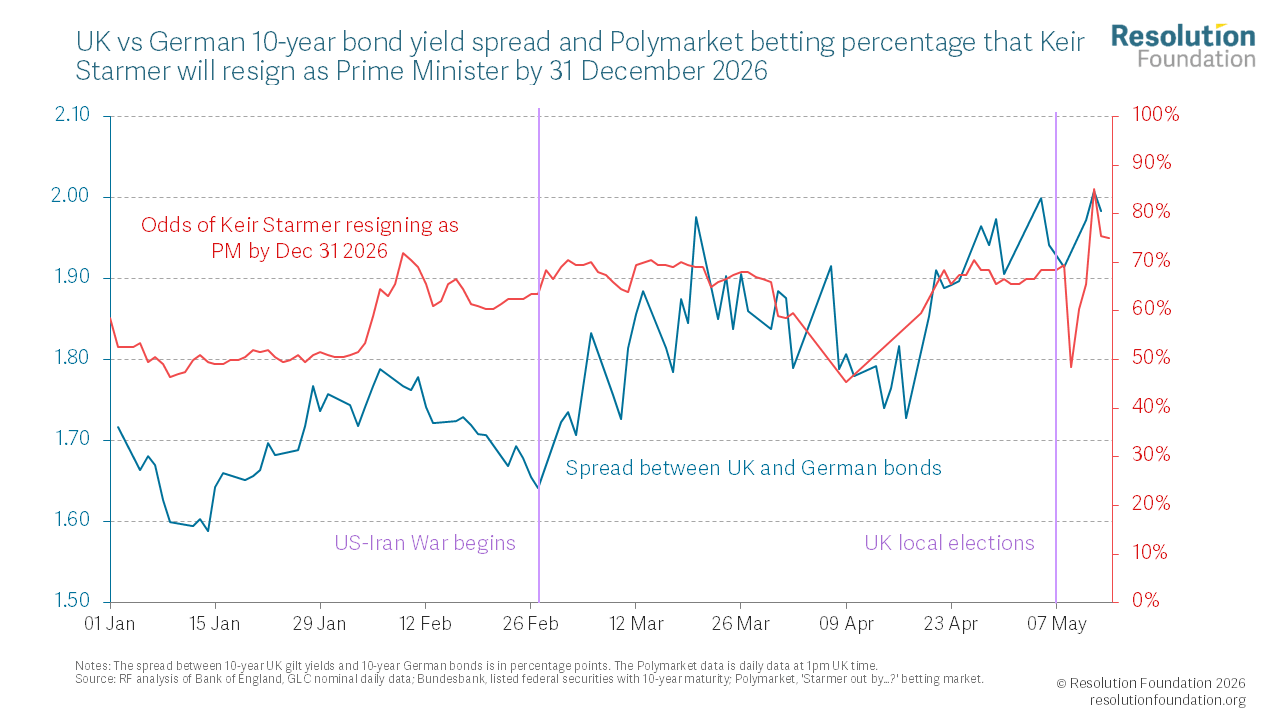
此内容由惯性聚合(RSS阅读器)自动聚合整理,仅供阅读参考。 原文来自 — 版权归原作者所有。