


Afternoon all,
Housing’s been on my mind this week. Private renters face the highest housing costs. For many social housing could offer the best route out, and for others it would be a helping hand onto the property ladder.
Speaking at the Housing Finance Conference in Liverpool, I was struck by the tricky trade-offs between prioritising current residents of social housing and the 1.3 million on the waiting list (e.g. in the approach to rents). It’s clear the burden of refurbishing existing stock is still holding back the sector’s ability to deliver new homes. Just another reason why it’s so important to make a success of the National Housing Bank, launching on Wednesday, as a new route to boost housing supply.
Back at RF towers, we published our own proposals for helping the 1.1 million people or families who would have lower housing costs (and higher living standards) if they got past the hurdle of saving for a deposit to buy their first home. With property tax still a mess, next Wednesday also marks the gloomier milestone of big Council Tax rises. For more on that, the lingering effects of child poverty, and how X shapes political views, keep scrolling.
Have a great weekend,
Ruth
Chief Executive
Resolution Foundation
Star player. The conventional wisdom is that hotshot colleagues make you better. Unfortunately, they might also make you invisible. This clever paper exploits the NBA draft lottery, which quasi-randomly assigns players to teams, to show that rookies placed in stronger rosters play and score less in their debut season and earn around $2.8 million less in their first freely negotiated contract. The mechanism is a “visibility penalty”: when time is scarce and stakes are high, managers turn to experienced hands, leaving novices on the bench. The authors argue this extends beyond basketball – for skill-intensive, team-based industries (academia, tech, finance and law), early exposure, or lack thereof, can shape your career. But given that most jobs aren’t timed to the second and assessed with constant win/fail mechanisms, I’m optimistic that a rising tide can in fact lift all boats – at least when it comes to think tanks.
Crude awakening. The Strait of Hormuz has knocked out more than 20 per cent of global oil supply. So why is crude oil below $100 a barrel (at time of pixel) and not $150-plus? This piece offers a useful primer. Because the short run demand elasticity for oil is low – when petrol jumps in price most people don’t immediately buy an EV – you could reasonably expect a big supply shock to spike prices enormously. Two factors are holding the oil-pocalypse at bay for now: firstly, the infamous TACO equilibrium suggests that Trump will retreat before the domestic fuel prices reach genuinely crisis levels. And secondly, the supply that comes from the Persian Gulf is mostly “heavy oil” destined for Asian refineries rather than the light stuff beloved by Western households. So the greatest damage is being done to the countries least involved.
Closing up shop. What happens when you pull the plug on low-skilled migration? Korea found out during the pandemic, when strict border controls cut its guest worker population by 22 per cent in two years. This paper finds that migrant and native workers weren’t competing for the same jobs but holding up opposite ends of the same production process. Low-wage, low-productivity firms that relied on guest workers were more likely to go bust. Instead of hiring more Korean workers, survivors reshuffled existing staff into lower-paid roles: from supervision into manual labour. Turns out the labour market is more of a house of cards than a game of musical chairs.
X factor. Scroll long enough on X and the feed will, it seems, do the thinking for you. In this study, the authors randomly assigned 5,000 US X users to algorithmic or chronological feeds for seven weeks. The algorithmic feed made users more likely to prioritise conservative policy issues, more sympathetic to Trump’s legal woes, and more pro-Kremlin on Ukraine. The mechanism is also sticky: the algorithm promotes right-wing activist accounts, users follow them, and they keep following them even after the algorithm is switched off. For more on the frightening effects social media is having on our politics, check out Liam Byrne MP’s new book “Why Populists Are Winning and How to Beat Them” – I had a lot of fun chairing a book launch for it this week, including some lively debate with our discussants David Gauke and Gaby Hinsliff.
Something for the weekend | Council of despair
Next week April brings with it welcome falls in energy bills (worth £135 to a typical household)… and a near-universal rise in Council Tax (CT) which averages out at £111 more than last year for Band D homes in England.
The increase will sting most for those who can least afford it. The lowest-income families spend nearly 5 per cent of their income on the unpopular tax – compared to just 1.5 per cent for the richest households. And yet, despite years of steep rises, local authorities are still in financial difficulty. Cuts to central government grants since 2010 mean their spending power remains 8.2 per cent lower in real terms since then, even as pressures from adult social care and SEND have risen.
There is some relief on the horizon, as increased central funding and higher CT push core council funding up by 5.8 per cent this year. It’s sorely needed – local services are a visible test of whether government is working – with just 56 per cent of residents satisfied with how their council runs things.
So, is there a fairer way to fund local government? Options range from replacing CT with a new tax tied to current property values, to raising rates on higher bands, to full proportionality with annual revaluations (that last one is ours).
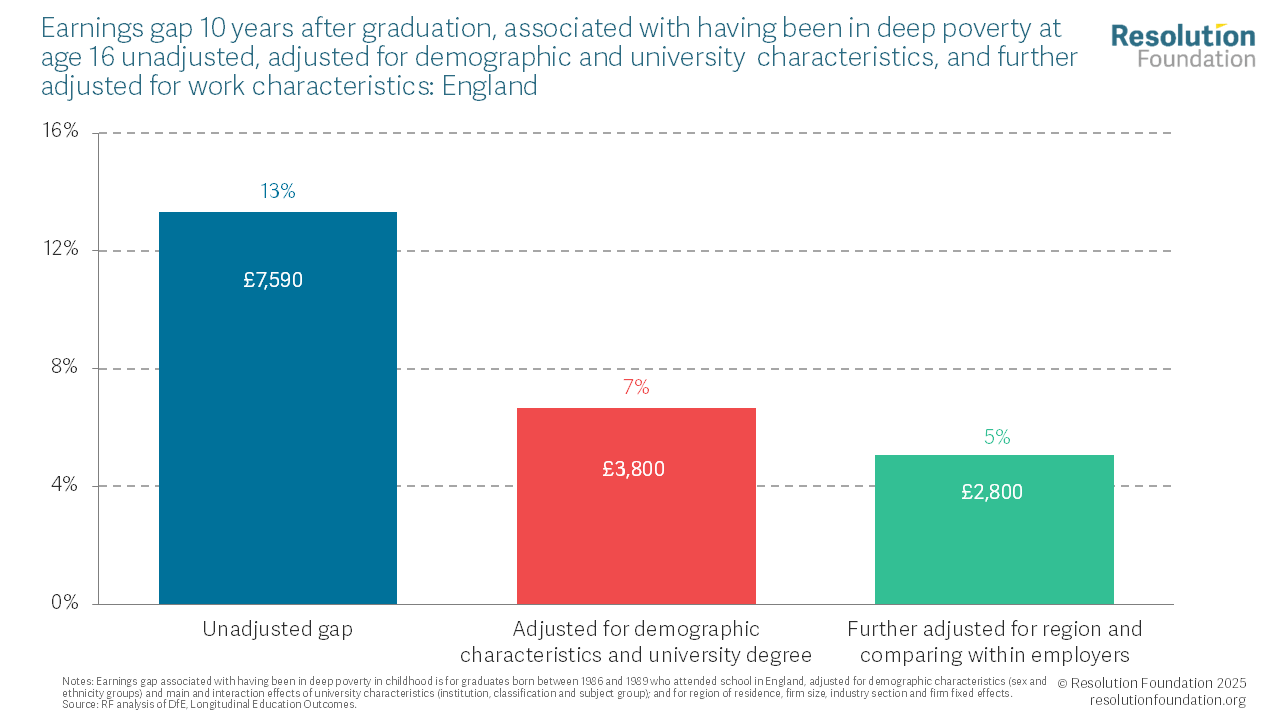
Child poverty is harmful – both in the here and now, and in the long run. New data revisions may have pushed the relative poverty rate for children down – so that half a million fewer children were living in poverty last year than previously thought. But with UK rates still likely to be one of the highest in Europe it shouldn’t stall the Government’s poverty-reducing ambitions. In fact, this week we published research identifying a new dimension of harm from childhood poverty. Using the educational records and tax returns of every university graduate in England born since 1985, we find a 13 per cent gap (worth more than £7,000 a year) between the earnings of graduates who grew up poor and those who did not, 10 years after graduation. That could be down to poorer students attending less prestigious universities or getting lower grades – but even after controlling for those factors, an unexplained gap persists. Even for people who attended the same university, earned the same degree and work for the same firm, the graduate who grew up poor earns 5 per cent less, or £2,800 a year. Even when poorer students follow the ‘right’ path to career success, the labour market still holds them back.
此内容由惯性聚合(RSS阅读器)自动聚合整理,仅供阅读参考。 原文来自 — 版权归原作者所有。