





Afternoon all,
What do Take That, Dua Lipa and Little Mix all have in common? Their fans favour Reform more than other parties (according to fun More in Common polling). I guess in August we will find out whether Farage is back for good or if Binface rule(s) the world.
Alongside rubbish jokes, regional inequality is flavour of the month. This week we published our updated analysis and I enjoyed launching it at Atom bank in Newcastle. We gathered in their HQ, The Pattern Shop, formerly where the patterns were put together for Robert Stephenson’s steam engines. Hard to find a better symbol of the transition from manufacturing to services that has defined the UK economy.
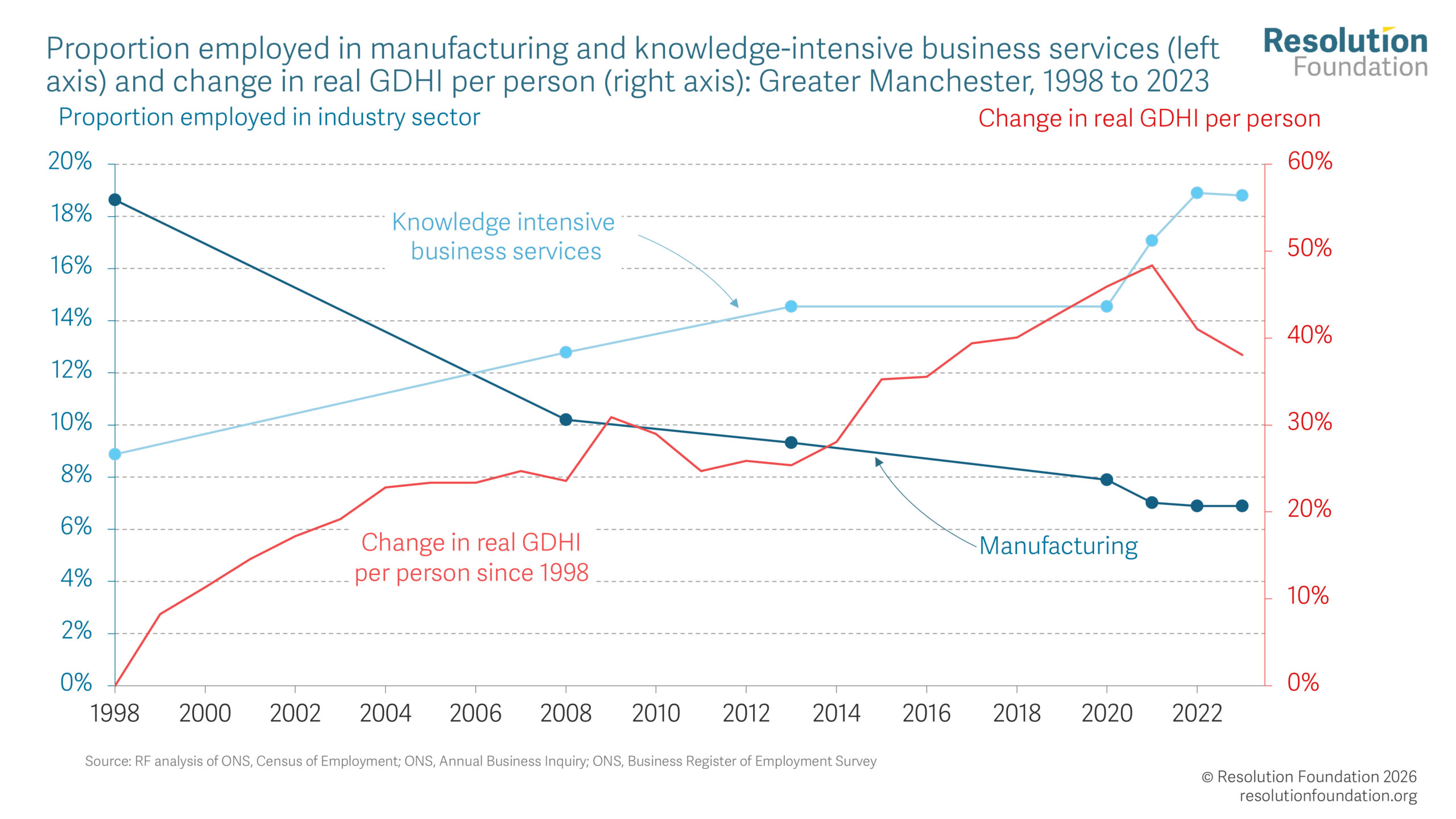
Chart of the week considers this shift and why we need a modern interpretation of ‘reindustrialisation’ for it to be a success. Ed Balls, Anna Stansbury (who still found the time to deliver a v cool masterclass for RF staff), and Dan Turner came to the conclusion in their stocktake that the Starmer government’s efforts to address regional inequality still fell “well short of the scale, balance and ambition required…to reverse long-standing spatial inequalities”. Of course, change may be coming.
Below you’ll find Lily’s triumph over Amelia, the lowdown on Lancashire, and a deep dive on the OBR’s latest forecasts of long-term fiscal risks.
Have a great weekend,
Ruth
Chief Executive
Resolution Foundation
Look north. Continuing our Northern theme, here’s the latest in a Northern Economy Substack series, considering Lancashire. The county ranks in the middle of the Northern productivity leaderboard (but above the UK average) with professional services and education showing promise. Manufacturing also saw a big increase in GVA. Is this Burnham’s case-study for re-industrialisation? His birthplace of Aintree did historically lie in Lancs. Alas, perhaps not. Readers of the wider series may recall how Cumbria’s impressive manufacturing figures were driven by ‘transport equipment’ – aka submarines. Lancashire’s equivalent turned out to be aerospace machinery made in Preston. Unlike Cumbria, this specialist sector offered no real boost for jobs. Indeed, despite decent overall performance serious deprivation remains in Blackpool, Blackburn and Burnley.
Who counts the… counting people. What’s the price of playing politics with the numbers? $20 billion, according to Nick Bloom and colleagues, who’ve put a figure on the fallout from the firing of the US Bureau of Labour Statistics Commissioner last year amid (evidence-free) claims of data manipulation. The authors attribute 9 per cent of the subsequent jump in the Economic Policy Uncertainty Index to the sacking, corresponding to a hiring and investment hit of $20 billion off GDP. There’s been a plethora of political uncertainty on both sides of the pond, but America has forged ahead: its index averaged nearly three times its historical level in 2025, against two-and-a-half times for the UK that year. But that’s cold comfort: as we showed in January, UK policy uncertainty in this Parliament has been higher than in any of the previous seven. We’ve found our own ways to keep businesses guessing.
The name game. The ONS’s annual baby names update this week confirmed Olivia and Muhammad reign supreme. But there’s churn: Lily leapfrogged Amelia into second place for girls, while Leo finally broke the boys’ top three. Meanwhile, pour one out for Jessica and Bodhi which tumbled out of the top 100 altogether, making room for newcomers Eliana, Gracie, Vincent and Carter. While ‘Andy’ has held fairly steady in popularity this century, ‘Keir’ has fallen off a cliff, with only four bouncing baby Keirs born in 2023, and none in 2024. The writing was on the wall.
Home truths. Housing (un)affordability is rising up the policy agenda and new research examines its material consequences. Analysing data from across EU27 countries from 2010 to 2023, the authors find that housing costs just 1 per cent above the EU average sees housing inadequacy rise, with overcrowding rates 2.3 per cent higher and severe housing deprivation 1.4 per cent higher. As a result labour force participation falls 0.55 per cent, poverty rates rise 0.9 per cent and “bad” self-reported health rises 1 per cent. A lack of affordable housing is undoubtedly shaping life experiences for the worse. In the long run, we can’t address this without housebuilding. In the short term, it’s time to make sure support is linked to the actual cost of rents.
Something for the weekend | Risky business
This week saw the publication of the OBR’s regular Fiscal risks and sustainability report, providing the usual terrifying projections for the public finances over the next half-century, but with a glorious number of scenarios and explanations of which assumptions matter.
The OBR has to warn of this debt-pocalypse (public sector net debt at 300 per cent of GDP by 2075) because we’re on track to keep spending more on the health and care of our aging, ailing country, with no plans in train for how to fund it. The baseline scenario projects that health spending will rise from 8 per cent of GDP in 2030-31 to 13 per cent in 2075-76 – over the same period, state pension spending will rise from 5 per cent to 9 per cent.
You can always rely on the OBR for Top of the Charts worthy charts. I particularly enjoyed productivity by “era” (chart 2.7) – even if it shows we’re in the worst era for productivity growth since the 1800s. There’s also an excellent box on how AI might impact tax receipts, where they illustrate that if AI reduces the labour share in the economy it could be huge(ly bad) for government tax revenues – in one scenario they consider, it could lead to a drop in tax receipts worth 4 percentage points of GDP compared with the baseline.
The good news is that sorting out the public finances is simple: fix health and social care spending, rejig the tax system and raise the pension age! Ok, I said it was simple, I didn’t say it was easy. Luckily, we’ll be hosting an event next week about breaking free of fiscal chains…
Chart of the week
As we look for clues on Andy Burnham’s forthcoming policy agenda, the word ‘reindustrialisation’ has caught our eye. He’s hardly the first politician to hark back to a country’s proud manufacturing heritage. But manufacturing jobs have been declining for decades across the western world, and no politician yet has turned back the clock on the automation and globalisation that have driven this fall. Is the Manchester story different? No, as COTW shows. Much like other cities, Manchester has been deindustrialising for decades, and the sector now accounts for fewer than one-in-twelve jobs. Instead, Manchester has reinvented itself as a major services hub. The share of jobs in knowledge intensive business services (scientists, engineers, software developers, etc.) has almost doubled in size since the late 1990s and now provides more than twice as many jobs as manufacturing. And this transition has not come at a cost to living standards. Gross Disposable Household Incomes (GDHI) grew over this period, when Manchester performed better than any other major city since 1997. This ‘reindustrialisation’ feels eerily similar to the economic strategy we called for in our Economy 2030 Inquiry. It looks like a winning strategy…
此内容由惯性聚合(RSS阅读器)自动聚合整理,仅供阅读参考。 原文来自 — 版权归原作者所有。