






Morning all,
Mike here, filling in for Ruth this week.
What a week it’s been – and only four days long! The hottest ever day in May, temperatures rising in the Labour party, and the not-so-cool news that the UK now has over one million
16- 24 years olds not in employment, education or training (NEETs). A disastrous milestone that underpinned the importance of Alan Milburn’s review into the crisis, which published its interim report this week. More on that later.
A popular first-job for young people is in hospitality. But what’s working life like in that sector, as well as other low-paying industries like cleaning and warehousing? New RF research paints a sobering picture of what power imbalances in those jobs can mean for workers’ pay and prospects. Catch-up on Thursday’s thoughtful discussion here.
Ruth will be back next week, and kicking off our mini book festival! Soumaya Keynes and Chad Bown will teach us how to win a trade war on Tuesday, before Sarah O’Connor tells us how to beat the job-stealing robots on Thursday. We’ll then give you the insiders’ guide to money on 16 June.
All the best,
Mike
Britain’s boiling point. 35.1° C felt pretty balmy in Westminster on Tuesday. But this report from the Climate Change Committee finds that by 2050, heatwaves over 40° C could be the new norm in southern England. With air-con not widespread across the UK, 92 per cent of existing homes could overheat. Winters will also be more extreme, with risks like flooding increasingly likely. The Committee says that Government action on adaptation so far clearly isn’t working. Their solutions? There are plenty here to pick from, including protecting the most vulnerable by installing solar panels on care homes and schools to power air-conditioning. But not every adaptation will be affordable, and the Committee calls for a government-led public discussion on expectations, and willingness to pay.
Caring on the edge. For many unpaid carers, the demands of this often non-negotiable duty can become impossible to balance with work. New analysis from Carers UK (which I heard about at their recent annual conference) asks why nearly half of working carers are considering reducing their hours or leaving work. Over one third (35 per cent) said more accessible social care would help keep them in work, and even more (43 per cent) said workplace inflexibility intensified the issue, making an already exhausting juggle untenable. Respondents said that a sympathetic manager can make a real difference, echoing findings from our new work on precarious workers. But good managers alone can’t fix the unpaid care dilemma: supportive workplace policies and reliable social care services are also needed to bring unpaid carers back from the edge.
Northern Powerhouse. With the Makerfield by-election looming, this Substack traces how Manchester became a serious post-industrial growth story. What drove the turnaround was a Big Bang-like collision of political factors. Pragmatic and long-termist local authority leadership worked across parties with devolved powers to welcome developers and foreign capital to unlock Manchester’s economic potential. Metrolink, the Commonwealth Games, and the Abu Dhabi takeover of Manchester City all played their part. The lesson? Combining fiscal devolution, policy continuity, and deliberate planning around productivity, such as linking Manchester Piccadilly and Victoria with a tram. Burnham is getting all the Manchester buzz (see: the Bee Network), but he also inherited a formidable legacy.
Digital handcuffs. When the people who lived through an experiment turn around and recommend it be banned for the next cohort, it’s worth listening to. A new report from the Ada Lovelace Institute convened young Britons aged 14 to 24 – the first true digital natives – and asked them what growing up online has actually been like. The answer, repeatedly: exhausting, harmful, and impossible to opt out of, since schoolwork, job applications, banking and benefits now all run alongside their social ecosystem. Most striking is their verdict: not just age limits, but also safety-by-design standards as a condition of UK market entry, with non-compliant incumbents shown the door. Future kids, they say, should not be allowed to grow up the way they did.
Regimented roles. Adam Smith liked the simplification of tasks as he thought it made it easier to raise productivity (his famous pin factory example). Karl Marx disliked it for making workers more replaceable and lowering wages. A new paper presents a model giving the edge to Marx and in doing so explains some of the more puzzling features of the modern labour market. Enter “commoditisation”: technologies that don’t replace workers but standardise their tasks so that almost anyone can do the job (think call-centre workers with digital scripts). This standardisation means firms can be less picky about who they hire, giving them more power to force wages down. This could explain some of the divergence between productivity and wages in the service sector (not to mention the working conditions). So even where technology does not take your job, it might make you fight harder with your fellow humans to keep it. (And, for more on what commoditisation might make you feel about your job, see Sarah O’Connor’s new book.)
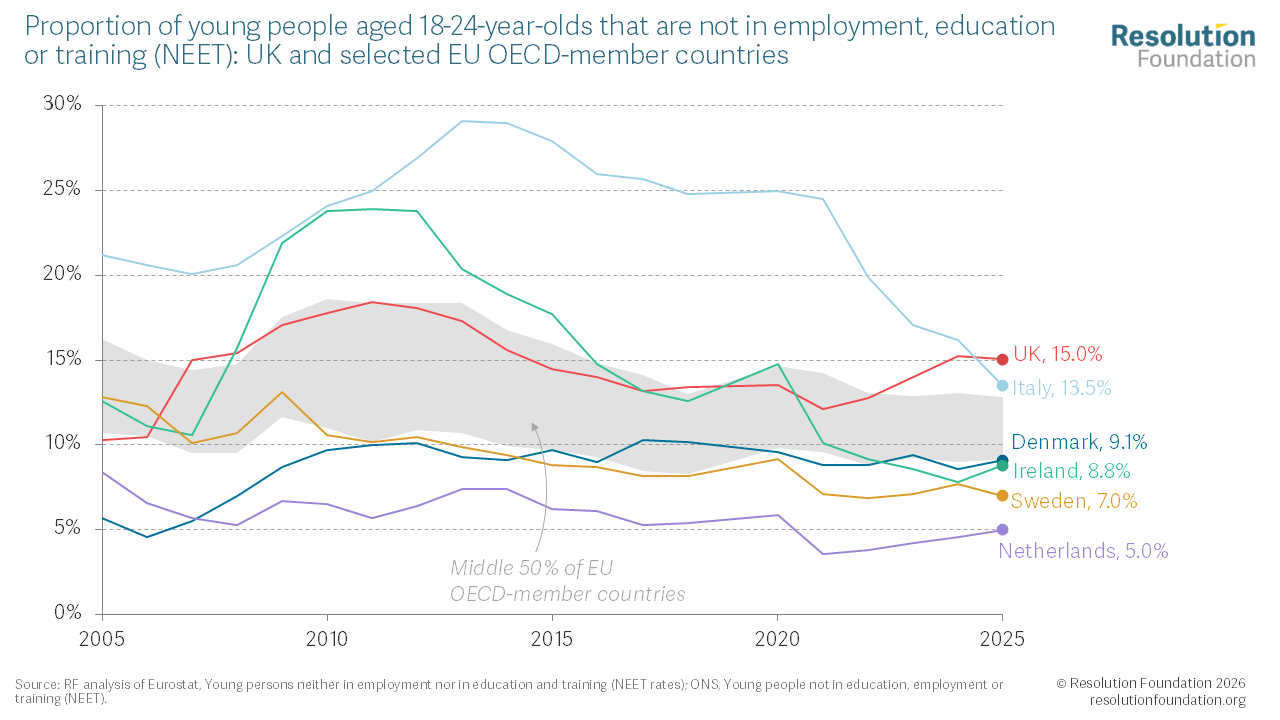
Chart of the week
The UK’s growing NEETs crisis has rightly been the big domestic story of the week. Chart of the Week puts it into a European perspective, and the story is equally depressing. The UK has the highest (18-24 year old) NEET rate compared to the 22 EU economies in the OECD, and the only country in the EU with a higher NEET rate than us is Romania (which is not in the OECD). Some of the drivers of being NEET in the UK are common across many economies, like the rising prevalence of poor mental health. But the Netherlands has a NEET rate that is one-third of the UK’s despite young adults who are (apparently) more depressed, and other countries – notably Italy and Ireland – have made great progress in getting young people back into learning or the labour market. Our recent report delves into why others do better than us; TL:DR, years of scrimping on vocational education and employment support have left too many young Brits on the scrapheap. How to fund that extra investment is far from straightforward, however…
此内容由惯性聚合(RSS阅读器)自动聚合整理,仅供阅读参考。 原文来自 — 版权归原作者所有。