

惯性聚合 高效追踪和阅读你感兴趣的博客、新闻、科技资讯
阅读原文 在惯性聚合中打开

推荐订阅源

T
Threatpost
S
Schneier on Security
P
Palo Alto Networks Blog
www.infosecurity-magazine.com
S
Securelist
T
Threat Research - Cisco Blogs
D
Darknet – Hacking Tools, Hacker News & Cyber Security
Threat Intelligence Blog | Flashpoint
V
Vulnerabilities – Threatpost
AI
AI
C
CERT Recently Published Vulnerability Notes
C
Cyber Attacks, Cyber Crime and Cyber Security
Recent Commits to openclaw:main
Know Your Adversary
Know Your Adversary
AWS News Blog
AWS News Blog
TaoSecurity Blog
TaoSecurity Blog
O
OpenAI News
Cyberwarzone
Cyberwarzone
G
GRAHAM CLULEY
SecWiki News
SecWiki News
cs.AI updates on arXiv.org
Simon Willison's Weblog
I
Intezer
C
CXSECURITY Database RSS Feed - CXSecurity.com
C
Cisco Blogs
K
Kaspersky official blog
Spread Privacy
Spread Privacy
S
Security @ Cisco Blogs
Hacker News - Newest:
Hacker News - Newest: "LLM"
IT之家
IT之家
有赞技术团队
有赞技术团队
B
Blog
T
Tailwind CSS Blog
PCI Perspectives
PCI Perspectives
P
Privacy & Cybersecurity Law Blog
Last Week in AI
Last Week in AI
freeCodeCamp Programming Tutorials: Python, JavaScript, Git & More
Webroot Blog
Webroot Blog
博客园 - 叶小钗
Cisco Talos Blog
Cisco Talos Blog
cs.CL updates on arXiv.org
奇客Solidot–传递最新科技情报
奇客Solidot–传递最新科技情报
H
Hacker News: Front Page
The Cloudflare Blog
C
Cybersecurity and Infrastructure Security Agency CISA
美团技术团队
V
V2EX
腾讯CDC
S
SegmentFault 最新的问题
Security Archives - TechRepublic

Pinecone

Pinecone Assistant: A Managed Knowledge Layer for Production AI Applications Multi-domain RAG in n8n: why one knowledge base is not enough Allspice Transforms the Culinary Experience with Semantic Search Powered by Pinecone | Pinecone Building RAG workflows in n8n: choosing the right Pinecone node Knowledge needs a meta-knowledge layer Garbage Day: How Pinecone Safely Deletes Billions of Objects at Scale When "Performance" Means Two Different Things Pinecone BYOC: Pinecone in your AWS, GCP, or Azure account, no vendor access True, Relevant, and Wrong: The Applicability Problem in RAG Use the Pinecone Plugin for Claude Code to develop AI Applications Faster Millions at Stake: How Melange's High-Recall Retrieval Prevents Litigation Collapse Powering High-stakes Patent Search at Scale: How Melange Built a Reliable AI System on Pinecone | Pinecone Pinecone Assistant Node in n8n: Turn Any Data Source Into Knowledge RAG with Access Control Pinecone Dedicated Read Nodes are now in Public Preview Inside Pinecone: Slab Architecture New Bulk Data Operations: Update, Delete, and Fetch by Metadata The Hidden Cost of Building: Lessons from Aquant Simplifying Vector Embeddings with Pinecone Integrated Inference Capabilities Pinecone joins Microsoft Marketplace as a Launch Partner GTM Engineering: Clay + Pinecone for AI-powered Sales Outbound Build an AI knowledge assistant with Google Docs and Pinecone Moving Pinecone forward with Ash Ashutosh as CEO and Edo spearheading our growing AI ambitions as Chief Scientist Pinecone Founder Edo Liberty to Spearhead Pinecone’s Growing AI Ambitions; Appoints Ash Ashutosh as CEO to Expand Vector Database Market Leadership Fast, Accurate Retrieval for Creators at Scale: Delphi’s Path Toward a Million Conversational Agents with Pinecone | Pinecone Announcing Pinecone Pioneers: A Program for Builders, Organizers, and Community Leaders What is Context Engineering? Chunking Strategies for LLM Applications Beyond the hype: Why RAG remains essential for modern AI Build more knowledgeable AI applications with new LLMs and greater control in Pinecone Assistant #NYTECHWEEK 2025 Retrieval-Augmented Generation (RAG) Accurate and Efficient Metadata Filtering in Pinecone’s Serverless Vector Database | Pinecone Terminal X AI Agents, Powered by Pinecone, Turn Complex Financial Data Into Production-grade Insights at Scale | Pinecone Aquant Delivers Scalable, Expert-level Service Intelligence with Pinecone | Pinecone Cascading retrieval with multi-vector representations: balancing efficiency and effectiveness Vector databases aren't just for large-scale enterprise AI Unveiling DIME: Reproducibility, Scalability, and Formal Analysis of Dimension Importance Estimation for Dense Retrieval | Pinecone Fast and Effective Early Termination for Simple Ranking Functions | Pinecone Domain-specific AI Agents at Scale: CustomGPT.ai Serves 10,000+ Customers with Pinecone | Pinecone Using Pinecone asynchronously with FastAPI A Flexible Resource for Top-Weighted Comparisons Between Sets and Rankings | Pinecone Build secure, scalable agentic AI workflows with Rubrik Annapurna and Pinecone Tool up: Pinecone’s first MCP servers are here Add context to your agent with Pinecone Assistant MCP remote server E2Rank: Efficient and Effective Layer-wise Reranking | Pinecone ColBERT-serve: Efficient Multi-Stage Memory-Mapped Scoring | Pinecone Efficient Constant-Space Multi-Vector Retrieval | Pinecone How Vanguard Worked with Pinecone to Boost Customer Support with Faster Calls and 12% More Accurate Responses | Pinecone Pinecone Named to Fast Company's Annual List of the World's Most Innovative Companies of 2025 Launch Week: Pinecone for agents, search, recommendations, and more Optimizing Pinecone for agents (and more) Retrieval Inference for scale and performance How 1up Turns Sales Reps Into Product Experts with Pinecone | Pinecone Don’t be dense: Launching sparse indexes in Pinecone Unlock High-Precision Keyword Search with pinecone-sparse-english-v0 Evolving Pinecone's architecture to meet the demands of Knowledgeable AI Pinpoint references faster with citation highlights in Pinecone Assistant Bringing the leading vector database to your cloud Getting started with llama-text-embed-v2 Natural Language Counterfactual Explanations for Graphs Using Large Language Models | Pinecone Easily build knowledgeable chat and agent-based applications in minutes with Pinecone Assistant, now generally available How to build an agentic, chat or RAG knowledge system using Pinecone Assistant Real-time RAG with Pinecone and Estuary Flow BigQuery to Pinecone in Real-Time with Estuary Flow Stravito Turns Market and Consumer Data Into Actionable Insights with Pinecone Inference | Pinecone Accelerate prototyping and development with Pinecone Local First-of-its-kind Pinecone Knowledge Platform to Power Best-in-class Retrieval for Customers Introducing integrated inference: Embed, rerank, and retrieve your data with a single API Strengthening security and increasing control with CMEK and API key roles Introducing Pinecone Rerank V0 Introducing cascading retrieval: Unifying dense and sparse with reranking From Idea to Action: How Pinecone Assistant Meaningfully Accelerates AI Business Building AI apps on Azure with Pinecone just got a lot easier Building a reliable, curated, and accurate RAG system with Cleanlab and Pinecone Four features of the Assistant API you aren't using - but should Deploying Pinecone with Infrastructure as Code (IaC) Streamlining CI/CD with Pinecone Local September 2024 Product Update Results of the Big ANN: NeurIPS'23 competition | Pinecone Introducing import from object storage for more efficient data transfer to Pinecone serverless Simplify, enhance, and evaluate RAG development with Pinecone Assistant, now in public preview Vectors and Graphs: Better Together August 2024 Product Update Pinecone Helps Deep Talk Deliver World-Class AI Assistants with Lower Engineering Overhead | Pinecone Assembled Delivers Better, Faster AI- Driven Support with Pinecone | Pinecone Llama 3.1 Agent using LangGraph and Ollama Build knowledgeable AI with Pinecone serverless, now generally available on Microsoft Azure Pinecone serverless is now generally available on Google Cloud, adding knowledge to AI assistants and other applications Accelerating Legal Discovery and Analysis with Pinecone and Voyage AI Bridging Dense and Sparse Maximum Inner Product Search | Pinecone Refine Retrieval Quality with Pinecone Rerank Introducing reranking to Pinecone Inference to simplify building accurate AI July 2024 Product Update Connect to Pinecone within your platform to enable a seamless AI development experience Introducing Pinecone API Versioning RAG Brag with Inkeep Co-Founder Nick Gomez LangGraph and Research Agents Introducing Pinecone Inference to streamline your AI workflow Build Privacy-aware AI software using Pinecone
Obviant Makes 30% More Accurate Defense Acquisition Recommendations Combining Sparse and Dense Retrieval with Pinecone | Pinecone
2025-06-24 · via Pinecone

The defense sector is known for its complexity and opacity. For both government agencies shaping requirements and private companies seeking to contribute solutions, understanding how to engage—who to collaborate with, what capabilities are needed, and where opportunities exist—makes navigating this landscape a monumental task. Government data is often siloed, inconsistently formatted, and buried across a multitude of sources, making it difficult to identify the relationships and insights that truly matter.

Obviant was built to solve this problem. As a unified defense market intelligence platform, Obviant aggregates and synthesizes structured and unstructured data, from budget lines and contract awards to organizational charts and program histories, into intuitive dashboards with actionable insights. But delivering that knowledge at speed and scale required a retrieval engine capable of understanding more than just keywords. It needed to understand meaning, nuance, and connection.

Challenge

Meeting complex demands with advanced retrieval

From the beginning, Obviant's core mission was to close the gap between information and action. To do that, the team needed to surface highly relevant content and recommendations from vast datasets that included PDFs, webpages, presentations, government reports, and more. Traditional keyword-based search powered by document stores simply wasn’t enough.

These systems could match terms, but they couldn’t understand context. Important insights, such as the relationship between two government programs or the relevance of a past contract to a new funding line, were often buried too deep to retrieve without significant manual effort.

Obviant’s team began exploring semantic search and retrieval-augmented generation (RAG) approaches. But early experiments with other vector databases exposed additional challenges including:

  • Scalability issues: Many struggled with efficient scaling to tens of millions of vectors, leading to latency spikes and bottlenecks as data or query loads increased.
  • Indexing and query performance: Rigid or inefficient indexing strategies resulted in degraded search performance and high operational costs at scale.
  • Infrastructure reliability: Weak fault tolerance and limited high-availability features made some solutions unsuitable for production environments.
  • Database consistency: Inconsistent data updates and weak concurrency guarantees often led to stale or unreliable results, especially under hybrid workloads.
  • Documentation and support: Incomplete or outdated documentation and slow support responses hindered deployment and troubleshooting.

To meet the expectations of users operating in mission-critical environments, Obviant needed a retrieval solution that could combine the precision of sparse retrieval with the semantic understanding of dense embeddings. It also had to be performant at scale, flexible, and reliable enough to sit at the heart of a product serving defense decision-makers every day.

Solution
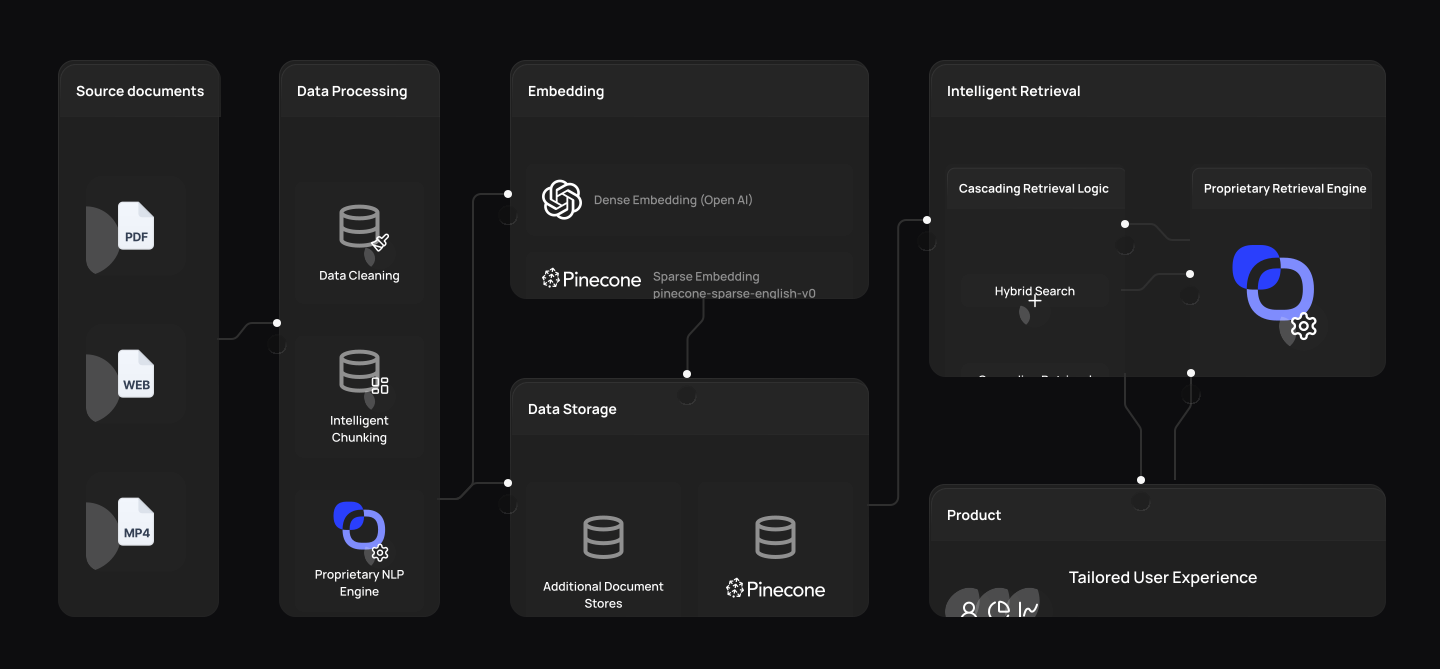
Hybrid retrieval built for production at scale

Obviant turned to Pinecone after a thorough prototyping effort that evaluated scalability, developer experience, and performance under real-world load. What began as an exploration into dense vector search quickly evolved into a full-scale implementation of Pinecone’s hybrid retrieval architecture, combining sparse and dense indexes to deliver a deeper level of relevance and insight.

Obviant’s success with Pinecone was grounded in specific product requirements that other vector solutions failed to meet. Their criteria included:

  • Ability to easily scale to hundreds of millions of vectors or more
  • Hybrid search support (dense + sparse)
  • Flexibility with vector lengths, types, and retrieval algorithms
  • Metadata filtering
  • TypeScript SDK support
  • Competitive cost at scale

The first integration point came in Obviant’s data pipeline. The team built a wrapper around Pinecone’s TypeScript SDK to streamline ingestion and updates, allowing them to efficiently process and store vast quantities of vectorized content. Today, that system supports over 120 million vectors distributed across dozens of namespaces, each tuned to different aspects of the defense acquisition landscape.

As the team dug deeper into Pinecone’s capabilities, they began layering on more advanced retrieval techniques. Cascading retrieval pipelines were introduced, starting with the use of the pinecone-sparse-english-v0 sparse embedding model for converting text to sparse vectors for hybrid semantic/keyword search through Pinecone Inference. Hybrid search results then served as a filter for downstream reranking models. This sophisticated retrieval method of dense and sparse vectors became the default for recommendations, allowing the system to precisely understand not only what users were asking but what they were really trying to find.

Pinecone’s reliability, flexibility, and support for both high-performance read and write operations made it easy for every engineer at Obviant to interact with the system. By abstracting their interaction with Pinecone behind an internal client, they ensured consistency across their entire application stack.

Pinecone gave us the flexibility and performance we needed to move from basic search to something much more knowledgeable—retrieval that understands context, adapts to our data, and scales with our growth. — Max Tano and Harrison Linowes, Founding Engineers at Obviant

result

Reliable infrastructure, superior relevance

Pinecone gave Obviant the infrastructure to scale retrieval without friction. What previously required significant manual intervention, such as surfacing related government programs or connecting adjacent contract opportunities, could now be done automatically, in real time. With hybrid sparse-dense retrieval and a cascading architecture in place, Obviant saw a 30% increase in the relevance of recommended content, making it easier for users to find what they needed faster and with greater confidence.

The improvements were also felt internally. Developers gained a consistent interface to work with Pinecone through a custom SDK wrapper, streamlining updates and ingestion pipelines. Operational headaches around indexing, latency, and scaling effectively disappeared. Pinecone easily worked, even under production pressure.

Our goal has always been to get decision-makers closer to the signal. Pinecone enables that by helping us cut through the noise, fast. — Dylan Taylor, Co-Founder at Obviant

What improved under the hood:

  • More than 120 million sparse and dense vectors indexed across dozens of namespaces
  • <50ms P50 latency with 40 QPS in production
  • High availability and fault tolerance across large-scale ingestion and retrieval workloads
  • Streamlined developer operations through an internal Pinecone SDK integration

By powering an experience that provides deep knowledge and delivering consistent performance at scale, Pinecone has become an essential part of Obviant’s infrastructure and product strategy.

What's next

Building on the success of hybrid sparse-dense retrieval, Obviant is now focused on expanding its capabilities to deliver even richer, more actionable insights to defense decision-makers. Upcoming initiatives include integrating real-time feedback loops to continuously refine recommendation accuracy, incorporating additional data sources to broaden market coverage, and exploring deeper AI-driven analytics powered by Pinecone’s evolving infrastructure.

As Obviant’s platform scales to handle increasingly complex datasets and higher query volumes, Pinecone’s robust performance and scalability will remain central to supporting rapid innovation and mission-critical reliability. Together, they aim to push the boundaries of what unified defense intelligence platforms can deliver—making critical insights faster, more knowledgeable, and more accessible to users navigating one of the world’s most challenging information landscapes.