









Evolving an API is a complex process with implications for both our team and users. At Pinecone, we view an API as a contract between our services and our users. This contract must balance the need for us to innovate while maintaining stability for existing integrations. API versioning allows us to manage this balance by providing a way to introduce changes while preserving compatibility.
API versioning is necessary for several reasons. First, it ensures stability and predictability. By maintaining multiple versions of an API, we can introduce new features and improvements without disrupting existing integrations. This approach allows developers to continue using a stable and predictable environment, reducing the risk of breaking changes that could adversely affect their applications.
Second, versioning offers the flexibility to innovate. It enables us to make necessary changes and enhancements to our API, knowing that existing users will not be forced to adapt immediately. While versioning gives us the flexibility to evolve our API, we take extreme care to minimize changes that could impact current users. Outgoing changes are funneled through a review process, where they’re are designed, documented, and reviewed by a broader audience within the company. This visibility helps catch errors and inconsistencies early, ensuring a cleaner and more robust API.
In developing our approach to API versioning, we looked to industry best practices of leading developer products like Stripe and Google Cloud. The most common approach is entity versioning via the URL path, such as using v1 and v2 to denote different versions of the API. This method clearly distinguishes between major versions, allowing developers to opt into new versions when they are ready.
However, while this approach is effective, it has its limitations. It can sometimes be challenging to communicate the incremental nature of changes within a major version and to manage the lifecycle of multiple versions simultaneously. As a result, we explored alternative approaches that could offer more nuanced control and communication.
After careful consideration, we opted for a date-based API versioning schema managed via a custom header. This method offers several advantages. By using dates to denote versions, we can clearly communicate the age and stage of each API iteration. This transparency helps developers understand the context of each version and make informed decisions about upgrading.
Additionally, date-based versioning simplifies the upgrade process. Developers can plan and manage updates more effectively, knowing that each version represents a specific snapshot in time with incremental changes. This approach also allows us to introduce improvements more frequently, as we are not constrained by the need to bundle changes into larger, less frequent major releases.
Each version of our API is additive and typically contains a small set of incremental changes to ensure a smooth transition for developers. While we strive to minimize disruptions, there may be intentional breaking changes when deprecating features. This approach allows us to introduce improvements and changes without breaking previously released stable versions.
By adopting a date-based API versioning schema, we aim to provide a clear, predictable, and manageable API lifecycle for our users. This strategy enables developers to leverage our platform’s capabilities without unexpected disruptions, ensuring a seamless and productive experience.
Pinecone will release a new stable and a release candidate of the API on a quarterly basis, starting in July.
Below is an example of Pinecone’s version support schedule:
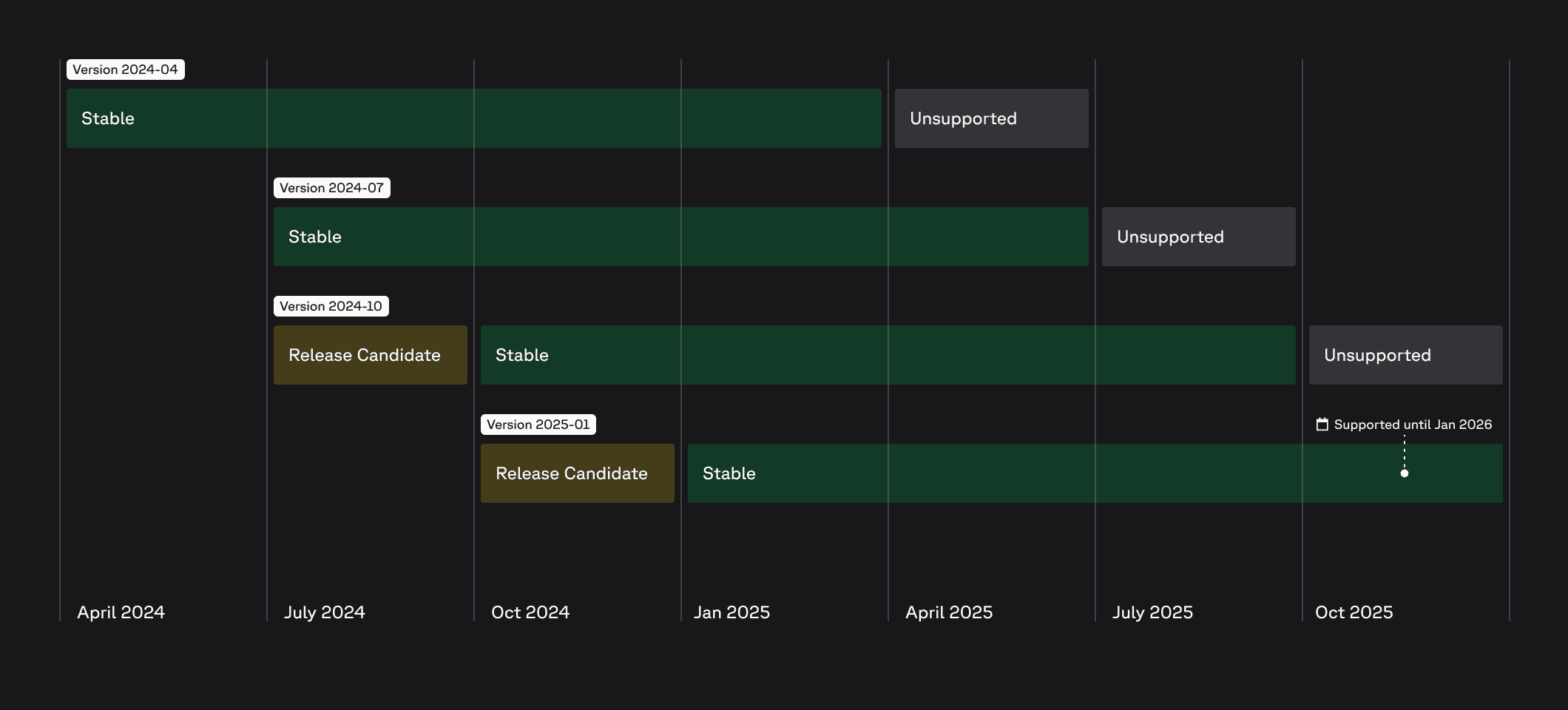
Release Schedule Example
Official Pinecone clients provide convenient access to Pinecone APIs. Client versions are pinned to specific API versions. When a new API version is released, a new version of the client library is also released.
The mappings between API versions and client library versions are as follows:
| 2024-04 | 2024-07 | |
|---|---|---|
| Python client | 4.x | 5.x |
| Node.js client | 2.x | 3.x |
| Java client | 1.x | 2.x |
| Go client | 0.x | 1.x |
View our docs to learn more about our API versioning and start building with Pinecone today.
此内容由惯性聚合(RSS阅读器)自动聚合整理,仅供阅读参考。 原文来自 — 版权归原作者所有。