


惯性聚合 高效追踪和阅读你感兴趣的博客、新闻、科技资讯
阅读原文 在惯性聚合中打开

推荐订阅源

Cyberwarzone
Cyberwarzone
V
Vulnerabilities – Threatpost
T
Tenable Blog
Forbes - Security
Forbes - Security
Simon Willison's Weblog
AWS News Blog
AWS News Blog
G
GRAHAM CLULEY
Know Your Adversary
Know Your Adversary
S
Securelist
C
Cybersecurity and Infrastructure Security Agency CISA
Project Zero
Project Zero
C
CXSECURITY Database RSS Feed - CXSecurity.com
V
Visual Studio Blog
WordPress大学
WordPress大学
Latest news
Latest news
K
Kaspersky official blog
T
Tailwind CSS Blog
T
Threat Research - Cisco Blogs
B
Blog RSS Feed
C
Cisco Blogs
博客园 - 聂微东
Martin Fowler
Martin Fowler
T
The Blog of Author Tim Ferriss
小众软件
小众软件
L
LangChain Blog
阮一峰的网络日志
阮一峰的网络日志
L
LINUX DO - 热门话题
Stack Overflow Blog
Stack Overflow Blog
罗磊的独立博客
P
Proofpoint News Feed
CTFtime.org: upcoming CTF events
P
Privacy International News Feed
Cyber Security Advisories - MS-ISAC
C
CERT Recently Published Vulnerability Notes
Cisco Talos Blog
Cisco Talos Blog
S
SegmentFault 最新的问题
Security Latest
Security Latest
Y
Y Combinator Blog
爱范儿
爱范儿
aimingoo的专栏
aimingoo的专栏
P
Privacy & Cybersecurity Law Blog
L
LINUX DO - 最新话题
月光博客
月光博客
The GitHub Blog
The GitHub Blog
博客园 - 三生石上(FineUI控件)
S
Security Affairs
P
Proofpoint News Feed
D
DataBreaches.Net
有赞技术团队
有赞技术团队
云风的 BLOG
云风的 BLOG

Pinecone

Pinecone Assistant: A Managed Knowledge Layer for Production AI Applications Multi-domain RAG in n8n: why one knowledge base is not enough Allspice Transforms the Culinary Experience with Semantic Search Powered by Pinecone | Pinecone Building RAG workflows in n8n: choosing the right Pinecone node Knowledge needs a meta-knowledge layer Garbage Day: How Pinecone Safely Deletes Billions of Objects at Scale When "Performance" Means Two Different Things Pinecone BYOC: Pinecone in your AWS, GCP, or Azure account, no vendor access True, Relevant, and Wrong: The Applicability Problem in RAG Use the Pinecone Plugin for Claude Code to develop AI Applications Faster Millions at Stake: How Melange's High-Recall Retrieval Prevents Litigation Collapse Powering High-stakes Patent Search at Scale: How Melange Built a Reliable AI System on Pinecone | Pinecone Pinecone Assistant Node in n8n: Turn Any Data Source Into Knowledge RAG with Access Control Pinecone Dedicated Read Nodes are now in Public Preview Inside Pinecone: Slab Architecture New Bulk Data Operations: Update, Delete, and Fetch by Metadata The Hidden Cost of Building: Lessons from Aquant Simplifying Vector Embeddings with Pinecone Integrated Inference Capabilities Pinecone joins Microsoft Marketplace as a Launch Partner GTM Engineering: Clay + Pinecone for AI-powered Sales Outbound Build an AI knowledge assistant with Google Docs and Pinecone Moving Pinecone forward with Ash Ashutosh as CEO and Edo spearheading our growing AI ambitions as Chief Scientist Pinecone Founder Edo Liberty to Spearhead Pinecone’s Growing AI Ambitions; Appoints Ash Ashutosh as CEO to Expand Vector Database Market Leadership Fast, Accurate Retrieval for Creators at Scale: Delphi’s Path Toward a Million Conversational Agents with Pinecone | Pinecone Announcing Pinecone Pioneers: A Program for Builders, Organizers, and Community Leaders What is Context Engineering? Chunking Strategies for LLM Applications Beyond the hype: Why RAG remains essential for modern AI Obviant Makes 30% More Accurate Defense Acquisition Recommendations Combining Sparse and Dense Retrieval with Pinecone | Pinecone Build more knowledgeable AI applications with new LLMs and greater control in Pinecone Assistant #NYTECHWEEK 2025 Retrieval-Augmented Generation (RAG) Accurate and Efficient Metadata Filtering in Pinecone’s Serverless Vector Database | Pinecone Terminal X AI Agents, Powered by Pinecone, Turn Complex Financial Data Into Production-grade Insights at Scale | Pinecone Aquant Delivers Scalable, Expert-level Service Intelligence with Pinecone | Pinecone Cascading retrieval with multi-vector representations: balancing efficiency and effectiveness Vector databases aren't just for large-scale enterprise AI Unveiling DIME: Reproducibility, Scalability, and Formal Analysis of Dimension Importance Estimation for Dense Retrieval | Pinecone Fast and Effective Early Termination for Simple Ranking Functions | Pinecone Domain-specific AI Agents at Scale: CustomGPT.ai Serves 10,000+ Customers with Pinecone | Pinecone Using Pinecone asynchronously with FastAPI A Flexible Resource for Top-Weighted Comparisons Between Sets and Rankings | Pinecone Build secure, scalable agentic AI workflows with Rubrik Annapurna and Pinecone Tool up: Pinecone’s first MCP servers are here Add context to your agent with Pinecone Assistant MCP remote server E2Rank: Efficient and Effective Layer-wise Reranking | Pinecone ColBERT-serve: Efficient Multi-Stage Memory-Mapped Scoring | Pinecone Efficient Constant-Space Multi-Vector Retrieval | Pinecone How Vanguard Worked with Pinecone to Boost Customer Support with Faster Calls and 12% More Accurate Responses | Pinecone Pinecone Named to Fast Company's Annual List of the World's Most Innovative Companies of 2025 Launch Week: Pinecone for agents, search, recommendations, and more Optimizing Pinecone for agents (and more) Retrieval Inference for scale and performance How 1up Turns Sales Reps Into Product Experts with Pinecone | Pinecone Don’t be dense: Launching sparse indexes in Pinecone Unlock High-Precision Keyword Search with pinecone-sparse-english-v0 Evolving Pinecone's architecture to meet the demands of Knowledgeable AI Pinpoint references faster with citation highlights in Pinecone Assistant Bringing the leading vector database to your cloud Getting started with llama-text-embed-v2 Natural Language Counterfactual Explanations for Graphs Using Large Language Models | Pinecone Easily build knowledgeable chat and agent-based applications in minutes with Pinecone Assistant, now generally available How to build an agentic, chat or RAG knowledge system using Pinecone Assistant Real-time RAG with Pinecone and Estuary Flow BigQuery to Pinecone in Real-Time with Estuary Flow Stravito Turns Market and Consumer Data Into Actionable Insights with Pinecone Inference | Pinecone Accelerate prototyping and development with Pinecone Local First-of-its-kind Pinecone Knowledge Platform to Power Best-in-class Retrieval for Customers Introducing integrated inference: Embed, rerank, and retrieve your data with a single API Strengthening security and increasing control with CMEK and API key roles Introducing Pinecone Rerank V0 Introducing cascading retrieval: Unifying dense and sparse with reranking From Idea to Action: How Pinecone Assistant Meaningfully Accelerates AI Business Building AI apps on Azure with Pinecone just got a lot easier Building a reliable, curated, and accurate RAG system with Cleanlab and Pinecone Four features of the Assistant API you aren't using - but should Deploying Pinecone with Infrastructure as Code (IaC) Streamlining CI/CD with Pinecone Local September 2024 Product Update Results of the Big ANN: NeurIPS'23 competition | Pinecone Introducing import from object storage for more efficient data transfer to Pinecone serverless Simplify, enhance, and evaluate RAG development with Pinecone Assistant, now in public preview Vectors and Graphs: Better Together August 2024 Product Update Pinecone Helps Deep Talk Deliver World-Class AI Assistants with Lower Engineering Overhead | Pinecone Assembled Delivers Better, Faster AI- Driven Support with Pinecone | Pinecone Llama 3.1 Agent using LangGraph and Ollama Build knowledgeable AI with Pinecone serverless, now generally available on Microsoft Azure Pinecone serverless is now generally available on Google Cloud, adding knowledge to AI assistants and other applications Accelerating Legal Discovery and Analysis with Pinecone and Voyage AI Bridging Dense and Sparse Maximum Inner Product Search | Pinecone Refine Retrieval Quality with Pinecone Rerank Introducing reranking to Pinecone Inference to simplify building accurate AI July 2024 Product Update Connect to Pinecone within your platform to enable a seamless AI development experience Introducing Pinecone API Versioning RAG Brag with Inkeep Co-Founder Nick Gomez LangGraph and Research Agents Introducing Pinecone Inference to streamline your AI workflow
Full Observability for Pinecone: Introducing an Open-Source Monitoring Stack for SaaS and BYOC
Allan Schiebold · 2026-06-09 · via Pinecone

After working with enough production deployments, a pattern becomes clear: a stale, undersized, or under-resourced index doesn't go down. It returns the wrong results. The problem is that without continuous visibility into index health — record counts, upsert rates, storage utilization, latency trends — there's no signal that anything is wrong until the AI application has already been serving degraded results.

This post introduces pinecone-field/pinecone-monitoring: an open-source stack with pre-built Grafana dashboards, Prometheus metric collection, and support for both Pinecone SaaS (Serverless) and Bring Your Own Cloud (BYOC) deployments.

What's in the Stack

The monitoring solution is built on two industry-standard open-source tools:

Prometheus handles metric collection and time-series storage. It scrapes the Pinecone Metrics API at regular intervals, capturing operational data across all your indexes. For BYOC deployments, it also collects Kubernetes infrastructure metrics via Node Exporter.

Grafana provides the visualization layer — pre-configured dashboards that surface the right data, with built-in alerting capabilities so your team can respond to signals before they become incidents.

The repo supports three deployment configurations:

  • SaaS Only: Docker Compose-based setup for teams using Pinecone Serverless. Operational in minutes.
  • BYOC Only: Kubernetes-native deployment using Helm charts, with pod-level and node-level infrastructure visibility.
  • BYOC + SaaS: A unified monitoring instance that covers both index types simultaneously, ideal for teams running mixed environments.

Why Monitoring a Vector Database Is Different

Monitoring a vector database isn't the same as monitoring a relational database or a REST API. Availability and latency are table stakes; what matters here is the health of high-dimensional index structures, the performance of approximate nearest-neighbor operations, and in BYOC deployments, the Kubernetes layer underneath.

Record counts, upsert rates, and storage utilization tell a different story than uptime alone. A gradual p99 increase over several days might indicate an index approaching a resource ceiling, a shift in query patterns, or a regression from a recent deploy. That signal doesn't exist without time-series data. And unlike databases where a DBA team controls load, Pinecone workloads are shaped by application code, users, and ML pipelines — which makes unexpected changes in operation rates often the first sign something has gone wrong.

What it enables

Proactive operations. Continuous metric collection with Grafana alerting lets teams set thresholds on latency baselines, pod CPU and memory utilization, operation rate deviations, and index storage growth. Issues caught at the signal stage get resolved in minutes; issues caught after users notice get resolved in hours, if not longer.

Root cause analysis. When incidents happen, the dashboards provide a complete operational timeline across every Pinecone operation type — queries, upserts, fetches, updates, deletes — with latency at p50 and p99. BYOC deployments add per-pod CPU, memory, and storage alongside Kubernetes node health. Post-incident reviews have data; recurring issues get traced rather than treated.
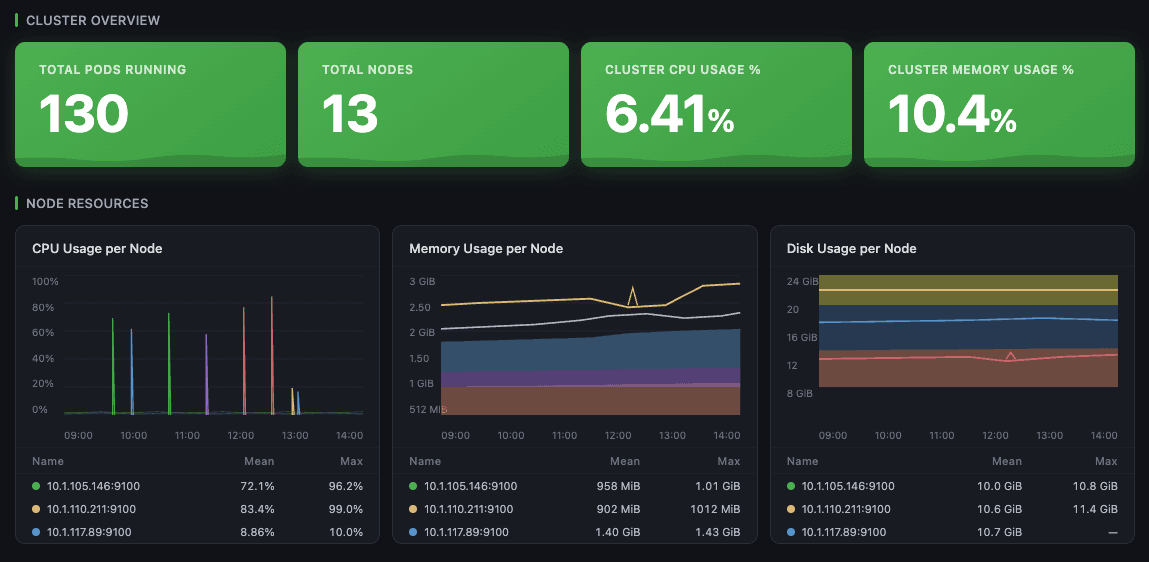
Workload change detection. AI applications change fast. New model versions, feature launches, and pipeline modifications all shift how Pinecone gets used — sometimes intentionally, sometimes not. A 5x query spike after a feature launch is expected but worth confirming. A background process looping through redundant upserts is invisible without operation rate tracking. A drop in query traffic signaling a broken integration gets caught before users do.

Cost visibility. Pinecone costs are tied to usage. Without visibility into operation rates and storage growth, cost surprises are common. With it, teams can correlate application behavior with usage spikes, identify inefficient patterns, validate that optimizations are actually reducing load, and set alerts before usage hits unexpected thresholds.

Capacity planning. The stack supports infrastructure decisions grounded in trend data rather than incident response. Months of index growth, query volume, and utilization history make it possible to project when a BYOC cluster needs additional nodes, how latency has responded to index growth, and what headroom looks like across pod memory.

Multi-project visibility. The stack supports multiple Pinecone projects in a single deployment. For platform teams managing staging, production, and customer-specific environments, unified visibility makes it straightforward to validate that a deployment change didn't introduce a regression, or that a new environment is performing consistently with an established one.

BYOC infrastructure health. For organizations running BYOC for data residency, compliance, or performance reasons, the stack brings Kubernetes-level observability to Pinecone infrastructure that previously required custom solutions. Pod CPU and memory, node health, filesystem utilization, and storage metrics are all captured and visualized — consistent with the tooling, alerting, and runbooks applied to the rest of the Kubernetes estate.
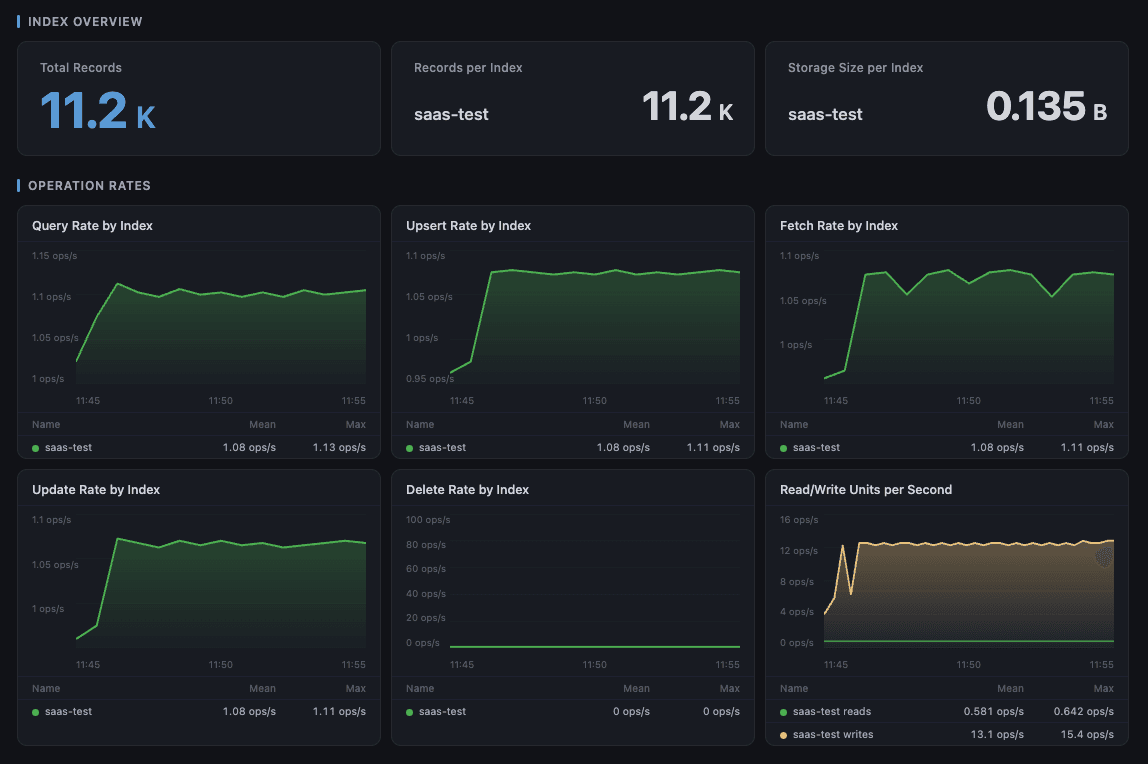
SLA documentation. Uptime and latency data matter beyond operations. Ninety days of Grafana data supports reliability conversations with business stakeholders, informs SLA commitments, and provides documentation for compliance or audit purposes.

Getting started

For SaaS monitoring, Docker Compose brings up Prometheus and Grafana with pre-configured dashboards in a few minutes. The only prerequisites are a Pinecone API key and project details.

For BYOC, Helm charts deploy the stack into the cluster. Node Exporter is included for infrastructure-level metrics, with deploy and uninstall scripts for lifecycle management.

All dashboards are pre-built and provisioned automatically.

View the repository on GitHub