







Introduction to Real-Time Retrieval-Augmented Generation (RAG)
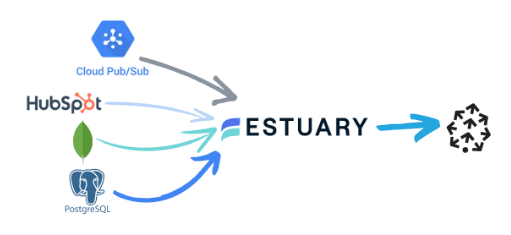
The emergence of Retrieval-Augmented Generation (RAG) has transformed the way AI applications interact with vast datasets. By combining the generative power of LLMs with retrieval systems, RAG enables real-time, context-aware responses for various use cases, from customer support to advanced analytics. While many RAG implementations rely on custom-built infrastructure, you can leverage existing data warehouses to simplify the process and speed up implementation.
This guide will walk you through how to build a real-time RAG system using tools like Estuary Flow, and Pinecone. Together, these components allow you to:
- Extract and transform data from your source in real time.
- Enrich and store processed data as high-dimensional vector embeddings.
- Serve the enriched data to AI models for immediate, relevant retrievals.
We’ll begin by exploring how to set up a robust pipeline that integrates these tools, transforming your data warehouse into the backbone of your RAG system. This process involves setting up Estuary Flow for real-time data streaming and transformation and Pinecone for efficient vector storage and retrieval.
By the end of this chapter, you'll have a clear understanding of how combining Estuary Flow and Pinecone enables real-time RAG systems and why this is important for AI applications.
In the following chapters, we’ll explore integrating other real-time data sources into Pinecone, such as BigQuery, PostgreSQL, MongoDB, and HubSpot.
Let’s start building!
What is Estuary Flow?
Estuary Flow is a unified, batch, and real-time data integration platform that facilitates high-throughput data processing and integration. It addresses the growing need for immediate data availability in modern applications, particularly AI-powered ones.
Key features of Estuary Flow:
- No-code interface: Simplifies pipeline setup and management, reducing the barrier to entry for real-time data processing.
- Change Data Capture (CDC): Enables real-time tracking and propagation of data changes from source systems.
- Enterprise-ready: Estuary Flow can be deployed in any networking environment for maximum data protection without compromising performance.
- Native Pinecone support: Offers seamless integration with Pinecone vector database for AI applications.
The Pinecone Materialization Connector
The Pinecone Materialization Connector is a specialized Estuary Flow materialization connector designed to efficiently vectorize collections and load data into a Pinecone vector database in real time.
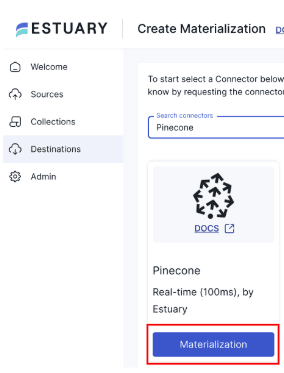
Features
- Real-time data ingestion: Continuously streams data into Pinecone as it's captured from source systems.
- Automatic vectorization: Converts incoming data into vector representations suitable for Pinecone storage.
- Incremental updates: Efficiently manages partial updates to existing vectors in Pinecone through upserts.
- Schema inference and mapping: Automatically maps source data fields to Pinecone index structures.
Configuration
The Pinecone Materialization Connector is configured through Estuary Flow's interface or API. Key configuration parameters include:
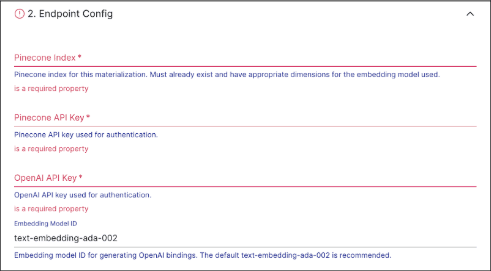
- Pinecone API Key
- These values will be used to authenticate to Pinecone.
- OpenAI API Key
- This API key is required so the connector can vectorize collections using OpenAI’s API.
- Embedding Model
- If you’d like to use a different model from OpenAI’s text-embedding-ada-002, in this field you can do so by specifying the full name of it.
The vectorized records in Pinecone follow best practices regarding metadata support.
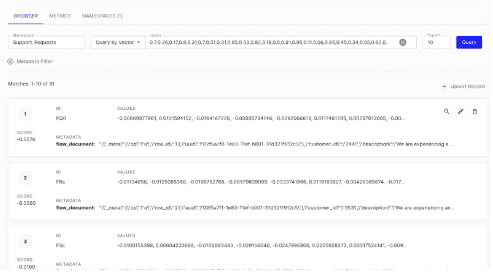
The Pinecone materialization connector generates a vector embedding for each document in the source connector's collection, along with some additional metadata.
The structure of the embeddings is simple. Estuary Flow packages the whole document under the flow_document key, including the metadata fields it produces while capturing changes from the source which include a uuid value, the original id and the operation type that triggered the change event.
Because Pinecone supports upserts, you can always use only the latest version for every record – this is critical to avoid stale data.
Benefits of Real-Time Data Integration in AI-powered Applications
Real-time data integration is transforming AI-powered applications, offering significant advantages in accuracy, relevance, and responsiveness. Real-time data integration can help to reduce hallucinations too, because data is being continuously generated and updated, by not ingesting the changes as soon as possible, you risk compiling outdated information into your prompts.
Let's explore how this integration can enhance your AI systems:
Enhanced Accuracy and Relevance
- Sub-100ms latency ensures AI models operate on the most current data
- Reduced data staleness minimizes the gap between data creation and AI processing
Exactly-once Delivery Guarantees
- Prevents duplicate or missing data, crucial for maintaining accurate AI model inputs
- Ensures consistent state in systems like Pinecone indexes
Key Use Cases
- Real-time recommendation systems
- Fraud detection
- Dynamic pricing
- Content moderation
By implementing real-time data integration, AI applications can achieve new levels of performance and accuracy. This combination allows for more intelligent, responsive, and adaptive systems that can better meet the demands of today's fast-paced digital landscape.
Was this article helpful?