


惯性聚合 高效追踪和阅读你感兴趣的博客、新闻、科技资讯
阅读原文 在惯性聚合中打开

推荐订阅源

Google DeepMind News
V
Visual Studio Blog
博客园 - Franky
N
Netflix TechBlog - Medium
WordPress大学
WordPress大学
小众软件
小众软件
Jina AI
Jina AI
L
Lohrmann on Cybersecurity
罗磊的独立博客
I
Intezer
W
WeLiveSecurity
T
Tenable Blog
Cyberwarzone
Cyberwarzone
P
Privacy & Cybersecurity Law Blog
D
Darknet – Hacking Tools, Hacker News & Cyber Security
S
Securelist
Recent Announcements
cs.CV updates on arXiv.org
Engineering at Meta
Engineering at Meta
Hacker News: Ask HN
Hacker News: Ask HN
F
Full Disclosure
S
SegmentFault 最新的问题
S
Security Affairs
L
LINUX DO - 热门话题
C
CERT Recently Published Vulnerability Notes
博客园 - 叶小钗
Stack Overflow Blog
Stack Overflow Blog
OSCHINA 社区最新新闻
OSCHINA 社区最新新闻
S
Secure Thoughts
C
CXSECURITY Database RSS Feed - CXSecurity.com
The Register - Security
月光博客
月光博客
Microsoft Azure Blog
Last Week in AI
Last Week in AI
PCI Perspectives
PCI Perspectives
N
News | PayPal Newsroom
Schneier on Security
T
Threat Research - Cisco Blogs
B
Blog RSS Feed
L
LINUX DO - 最新话题
F
Fortinet All Blogs
雷峰网
雷峰网
Security Latest
Security Latest
大猫的无限游戏
大猫的无限游戏
P
Palo Alto Networks Blog
C
Cyber Attacks, Cyber Crime and Cyber Security
V
V2EX
人人都是产品经理
人人都是产品经理
酷 壳 – CoolShell
酷 壳 – CoolShell
博客园 - 【当耐特】

Pinecone

Pinecone Assistant: A Managed Knowledge Layer for Production AI Applications Multi-domain RAG in n8n: why one knowledge base is not enough Allspice Transforms the Culinary Experience with Semantic Search Powered by Pinecone | Pinecone Building RAG workflows in n8n: choosing the right Pinecone node Knowledge needs a meta-knowledge layer Garbage Day: How Pinecone Safely Deletes Billions of Objects at Scale When "Performance" Means Two Different Things Pinecone BYOC: Pinecone in your AWS, GCP, or Azure account, no vendor access True, Relevant, and Wrong: The Applicability Problem in RAG Use the Pinecone Plugin for Claude Code to develop AI Applications Faster Millions at Stake: How Melange's High-Recall Retrieval Prevents Litigation Collapse Powering High-stakes Patent Search at Scale: How Melange Built a Reliable AI System on Pinecone | Pinecone Pinecone Assistant Node in n8n: Turn Any Data Source Into Knowledge RAG with Access Control Pinecone Dedicated Read Nodes are now in Public Preview Inside Pinecone: Slab Architecture New Bulk Data Operations: Update, Delete, and Fetch by Metadata The Hidden Cost of Building: Lessons from Aquant Simplifying Vector Embeddings with Pinecone Integrated Inference Capabilities Pinecone joins Microsoft Marketplace as a Launch Partner GTM Engineering: Clay + Pinecone for AI-powered Sales Outbound Build an AI knowledge assistant with Google Docs and Pinecone Moving Pinecone forward with Ash Ashutosh as CEO and Edo spearheading our growing AI ambitions as Chief Scientist Pinecone Founder Edo Liberty to Spearhead Pinecone’s Growing AI Ambitions; Appoints Ash Ashutosh as CEO to Expand Vector Database Market Leadership Fast, Accurate Retrieval for Creators at Scale: Delphi’s Path Toward a Million Conversational Agents with Pinecone | Pinecone Announcing Pinecone Pioneers: A Program for Builders, Organizers, and Community Leaders What is Context Engineering? Chunking Strategies for LLM Applications Beyond the hype: Why RAG remains essential for modern AI Obviant Makes 30% More Accurate Defense Acquisition Recommendations Combining Sparse and Dense Retrieval with Pinecone | Pinecone Build more knowledgeable AI applications with new LLMs and greater control in Pinecone Assistant #NYTECHWEEK 2025 Retrieval-Augmented Generation (RAG) Accurate and Efficient Metadata Filtering in Pinecone’s Serverless Vector Database | Pinecone Terminal X AI Agents, Powered by Pinecone, Turn Complex Financial Data Into Production-grade Insights at Scale | Pinecone Aquant Delivers Scalable, Expert-level Service Intelligence with Pinecone | Pinecone Cascading retrieval with multi-vector representations: balancing efficiency and effectiveness Vector databases aren't just for large-scale enterprise AI Unveiling DIME: Reproducibility, Scalability, and Formal Analysis of Dimension Importance Estimation for Dense Retrieval | Pinecone Fast and Effective Early Termination for Simple Ranking Functions | Pinecone Domain-specific AI Agents at Scale: CustomGPT.ai Serves 10,000+ Customers with Pinecone | Pinecone Using Pinecone asynchronously with FastAPI A Flexible Resource for Top-Weighted Comparisons Between Sets and Rankings | Pinecone Build secure, scalable agentic AI workflows with Rubrik Annapurna and Pinecone Tool up: Pinecone’s first MCP servers are here Add context to your agent with Pinecone Assistant MCP remote server E2Rank: Efficient and Effective Layer-wise Reranking | Pinecone ColBERT-serve: Efficient Multi-Stage Memory-Mapped Scoring | Pinecone Efficient Constant-Space Multi-Vector Retrieval | Pinecone How Vanguard Worked with Pinecone to Boost Customer Support with Faster Calls and 12% More Accurate Responses | Pinecone Pinecone Named to Fast Company's Annual List of the World's Most Innovative Companies of 2025 Launch Week: Pinecone for agents, search, recommendations, and more Optimizing Pinecone for agents (and more) Retrieval Inference for scale and performance How 1up Turns Sales Reps Into Product Experts with Pinecone | Pinecone Don’t be dense: Launching sparse indexes in Pinecone Unlock High-Precision Keyword Search with pinecone-sparse-english-v0 Evolving Pinecone's architecture to meet the demands of Knowledgeable AI Pinpoint references faster with citation highlights in Pinecone Assistant Bringing the leading vector database to your cloud Getting started with llama-text-embed-v2 Natural Language Counterfactual Explanations for Graphs Using Large Language Models | Pinecone Easily build knowledgeable chat and agent-based applications in minutes with Pinecone Assistant, now generally available How to build an agentic, chat or RAG knowledge system using Pinecone Assistant Real-time RAG with Pinecone and Estuary Flow BigQuery to Pinecone in Real-Time with Estuary Flow Stravito Turns Market and Consumer Data Into Actionable Insights with Pinecone Inference | Pinecone Accelerate prototyping and development with Pinecone Local First-of-its-kind Pinecone Knowledge Platform to Power Best-in-class Retrieval for Customers Introducing integrated inference: Embed, rerank, and retrieve your data with a single API Strengthening security and increasing control with CMEK and API key roles Introducing Pinecone Rerank V0 Introducing cascading retrieval: Unifying dense and sparse with reranking From Idea to Action: How Pinecone Assistant Meaningfully Accelerates AI Business Building AI apps on Azure with Pinecone just got a lot easier Building a reliable, curated, and accurate RAG system with Cleanlab and Pinecone Four features of the Assistant API you aren't using - but should Deploying Pinecone with Infrastructure as Code (IaC) Streamlining CI/CD with Pinecone Local September 2024 Product Update Results of the Big ANN: NeurIPS'23 competition | Pinecone Introducing import from object storage for more efficient data transfer to Pinecone serverless Simplify, enhance, and evaluate RAG development with Pinecone Assistant, now in public preview Vectors and Graphs: Better Together August 2024 Product Update Pinecone Helps Deep Talk Deliver World-Class AI Assistants with Lower Engineering Overhead | Pinecone Assembled Delivers Better, Faster AI- Driven Support with Pinecone | Pinecone Llama 3.1 Agent using LangGraph and Ollama Build knowledgeable AI with Pinecone serverless, now generally available on Microsoft Azure Pinecone serverless is now generally available on Google Cloud, adding knowledge to AI assistants and other applications Accelerating Legal Discovery and Analysis with Pinecone and Voyage AI Bridging Dense and Sparse Maximum Inner Product Search | Pinecone Refine Retrieval Quality with Pinecone Rerank Introducing reranking to Pinecone Inference to simplify building accurate AI July 2024 Product Update Connect to Pinecone within your platform to enable a seamless AI development experience Introducing Pinecone API Versioning RAG Brag with Inkeep Co-Founder Nick Gomez LangGraph and Research Agents Introducing Pinecone Inference to streamline your AI workflow
How Nyckel Built An API for Semantic Image Search
James Briggs, Gibbs Cullen, Greg Kogan · 2023-06-30 · via Pinecone

Written by George Mathew, Co-Founder at Nyckel.

Businesses that accumulate large amounts of data eventually run into problems with information retrieval – especially if they’re working with image data. While information retrieval for text is mostly a solved problem, the same cannot be said for images. Recent advances in deep neural networks and in vector search databases make it possible to search through large sets of images. Nyckel implements a simple API for semantic image search – let’s look deeper at how it is implemented.

Semantic search is the ability to search based on user intent and on the contextual meaning of both the search query and the target content. For images, this means understanding the meaning of search queries (whether in the form of text or images), and then mapping them to images in the search set. This is exactly what Google’s image search engine does. I could use a picture of my dog catching a frisbee on the beach, paste it into Google reverse image search, and it would retrieve public web images that are similar to my picture. Alternatively, I could use the more common means of Google searching by typing in “dog catching a frisbee on the beach”, and Google will retrieve public web images that match those search terms. The latter search case is called a cross-modal search because the search term and the result item are in different modalities: in this case, text and image respectively.

Dog catching a frisbee

As a platform, we are constantly surprised and encouraged by the variety of use-cases we see. Here are a few examples of applications that our customers are using our image search API for:

  • Detecting the unauthorized use of images, e.g., copyright infringement or fraud;
  • De-duplicating images in a collection when the duplicates are not exact matches;
  • Image classification into hundreds of thousands of classes where traditional classification mechanisms are difficult;
  • Enabling search functionality over their images for their end-customers or employees. To showcase this, we built a demo app to search over the wild world of NFT images:
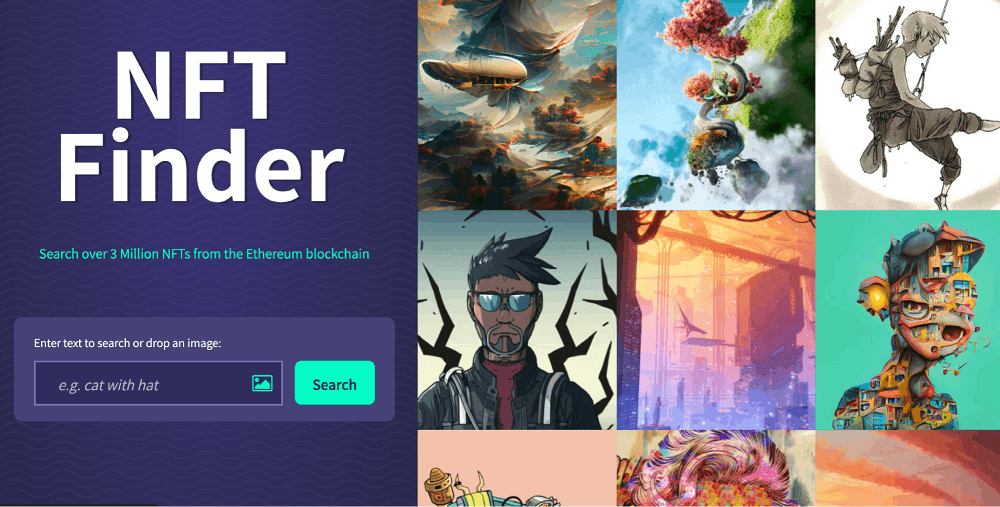
NFT image search

Nyckel’s Image Search Service

Nyckel is the lightning fast ML-platform for non-experts. We make ML functionality, such as image / text classification, object detection, and image search, accessible to developers and companies without any ML expertise.

For image search, our customers don’t want to deal with model selection, tuning, deployment, and infrastructure management and scaling. They use the following simple API, and we take care of the rest:
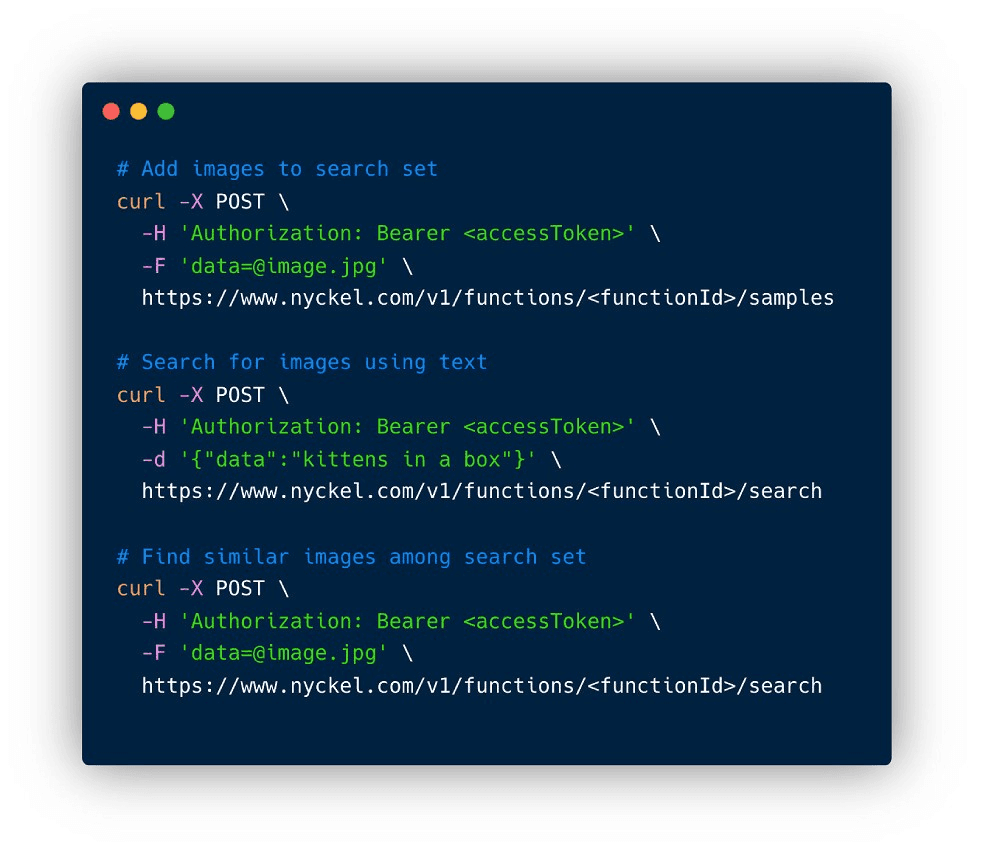
Image search API

What goes into implementing the API?

Searching within any medium requires two capabilities:

  • Extracting semantic information from the data – both the search set and query data;
  • Indexing the semantic information for fast and accurate retrieval.

Extracting Semantic Information from Images

Neural networks, such as Resnet, are good at extracting a semantic representation of an image in the form of “embeddings”: fixed-length vectors of floating point numbers. Once you have a set of images that have been mapped in this way, then you can use your vector database to index the vector embeddings. If two images have similar embeddings, meaning that they are close to one another in vector space, then they are semantically similar. Conversely, the embeddings for two dissimilar images will be far apart in vector space. You can read more about embeddings and how useful they are in Peter Gao’s blog post.

But what about cross-modal semantic search, for example when queries for image data come in the form of textual descriptions? What do we do in these cases? We could use a natural language model like BERT to get text embeddings, but these embeddings will be unrelated to the image embeddings. What this means is that the embedding for “dog catching a frisbee on the beach” is not guaranteed to be close to the embedding for an image of a dog catching a frisbee on the beach. In the next section we’ll talk about how to solve this problem.

Cross-Modal Embeddings

In order to support searching for images with a text query, we need a neural network that can provide embeddings for images and text in the same “embedding space”. OpenAI’s CLIP is one such network. It’s actually two networks: one for images and one for text, trained together to minimize “contrastive loss”. CLIP is trained on a large corpus of (image, text) pairs from the internet. With the idea that (image, text) pairs that accompany each other are likely to be semantically similar, the training objective was to minimize the distance between vector embeddings for pairs that accompany each other and maximize the distance between embeddings for unrelated pairs. You can read more about CLIP here.

The result is that CLIP’s embeddings for an image of a dog catching a frisbee on the beach, and the text “dog catching frisbee on beach” will be close together. This gives us the embeddings we need for cross-modal search.

Indexing

Once you have embeddings, searching for images becomes a problem of finding the closest vectors to the embedding for that particular query. Finding the closest vectors is a computationally challenging problem for large numbers of high-dimensional vectors. But there are relatively efficient mechanisms for finding approximate closest matches (commonly known as approximate nearest neighbors, or ANN) and several vector-database products that offer this capability. We evaluated several vector databases and picked pinecone because they are a fully managed service with low ingest latency, low query latency, on-demand and scalable provisioning and pricing, and an easy-to-use API.

Putting it together

Now that we’ve talked about all the pieces involved in semantic image search, let’s look at how Nyckel puts them together for its image search service. The sequence diagram below ignores some of the complexities and asynchronous processing, but provides a general overview of how things work:
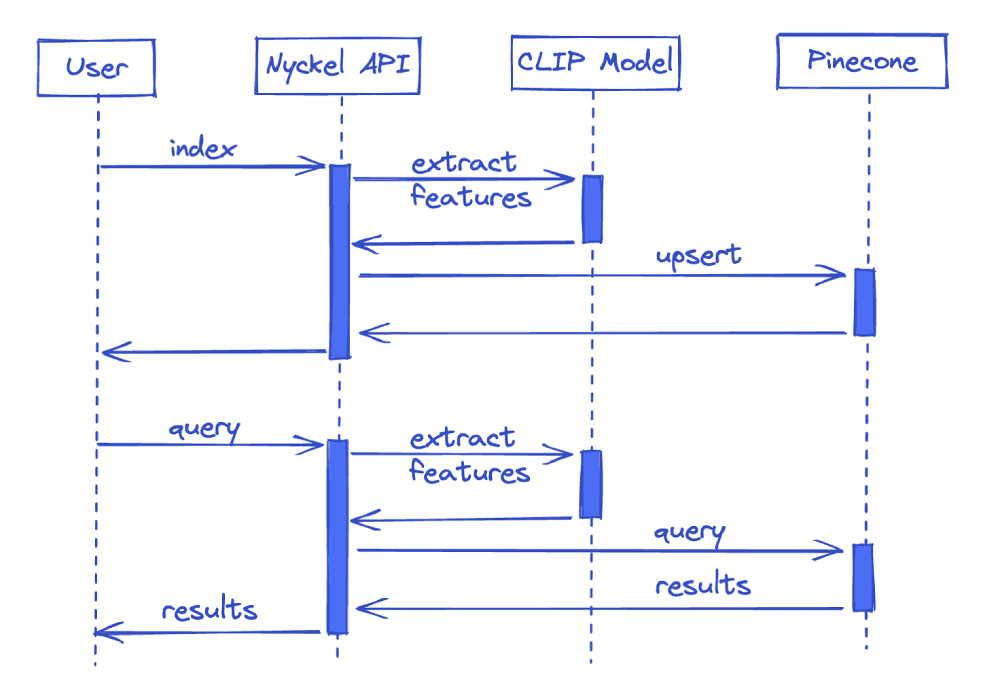
Nyckel's image search service

Future work

What we’ve described above is just the beginning and we have an exciting roadmap for image search. Here are a couple of items items on our to-do list:

  • Support multilingual text queries. CLIP currently only does well with English queries, and we want to support many more languages;
  • Model selection and fine-tuning for specialized use-cases based on search feedback. CLIP does surprisingly well for a wide range of subject matter, but in cases where the set of images is in a very narrow or specialized domain, model fine-tuning will help provide significantly better search results.

Was this article helpful?