


惯性聚合 高效追踪和阅读你感兴趣的博客、新闻、科技资讯
阅读原文 在惯性聚合中打开

推荐订阅源

博客园 - Franky
奇客Solidot–传递最新科技情报
奇客Solidot–传递最新科技情报
有赞技术团队
有赞技术团队
aimingoo的专栏
aimingoo的专栏
WordPress大学
WordPress大学
人人都是产品经理
人人都是产品经理
酷 壳 – CoolShell
酷 壳 – CoolShell
L
LangChain Blog
Blog — PlanetScale
Blog — PlanetScale
阮一峰的网络日志
阮一峰的网络日志
Microsoft Azure Blog
云风的 BLOG
云风的 BLOG
Google DeepMind News
T
The Blog of Author Tim Ferriss
G
Google Developers Blog
Hugging Face - Blog
Hugging Face - Blog
Y
Y Combinator Blog
D
DataBreaches.Net
Engineering at Meta
Engineering at Meta
MyScale Blog
MyScale Blog
大猫的无限游戏
大猫的无限游戏
S
SegmentFault 最新的问题
The GitHub Blog
The GitHub Blog
Recent Announcements

Pinecone

Pinecone Assistant: A Managed Knowledge Layer for Production AI Applications Multi-domain RAG in n8n: why one knowledge base is not enough Allspice Transforms the Culinary Experience with Semantic Search Powered by Pinecone | Pinecone Building RAG workflows in n8n: choosing the right Pinecone node Knowledge needs a meta-knowledge layer Garbage Day: How Pinecone Safely Deletes Billions of Objects at Scale When "Performance" Means Two Different Things Pinecone BYOC: Pinecone in your AWS, GCP, or Azure account, no vendor access True, Relevant, and Wrong: The Applicability Problem in RAG Use the Pinecone Plugin for Claude Code to develop AI Applications Faster Millions at Stake: How Melange's High-Recall Retrieval Prevents Litigation Collapse Powering High-stakes Patent Search at Scale: How Melange Built a Reliable AI System on Pinecone | Pinecone Pinecone Assistant Node in n8n: Turn Any Data Source Into Knowledge RAG with Access Control Pinecone Dedicated Read Nodes are now in Public Preview Inside Pinecone: Slab Architecture New Bulk Data Operations: Update, Delete, and Fetch by Metadata The Hidden Cost of Building: Lessons from Aquant Simplifying Vector Embeddings with Pinecone Integrated Inference Capabilities Pinecone joins Microsoft Marketplace as a Launch Partner GTM Engineering: Clay + Pinecone for AI-powered Sales Outbound Build an AI knowledge assistant with Google Docs and Pinecone Moving Pinecone forward with Ash Ashutosh as CEO and Edo spearheading our growing AI ambitions as Chief Scientist Pinecone Founder Edo Liberty to Spearhead Pinecone’s Growing AI Ambitions; Appoints Ash Ashutosh as CEO to Expand Vector Database Market Leadership Fast, Accurate Retrieval for Creators at Scale: Delphi’s Path Toward a Million Conversational Agents with Pinecone | Pinecone Announcing Pinecone Pioneers: A Program for Builders, Organizers, and Community Leaders What is Context Engineering? Chunking Strategies for LLM Applications Beyond the hype: Why RAG remains essential for modern AI Obviant Makes 30% More Accurate Defense Acquisition Recommendations Combining Sparse and Dense Retrieval with Pinecone | Pinecone
Introducing Canopy: An easy, free, and flexible RAG frame...
Gibbs Cullen · 2023-11-08 · via Pinecone

We’re launching Canopy (V.0.1.2) to let developers quickly and easily build GenAI applications using Retrieval Augmented Generation (RAG). Canopy is an open-source framework and context engine built on top of the Pinecone vector database so you can build and host your own production-ready chat assistant at any scale.

From chunking and embedding your text data to chat history management, query optimization, context retrieval (including prompt engineering), and augmented generation, Canopy takes on the heavy lifting so you can focus on building and experimenting with RAG. As a fully open-source framework, you can easily extend or modify each component of Canopy to accommodate your use case.

Canopy uses the Pinecone vector database for storage and retrieval, which is free for up to 100K vectors (around 15M words or 30K pages of text) and can scale to billions of embeddings on paid plans.

Watch the demo video to see Canopy in action.

Transform your text data into a RAG-powered application in under an hour

With many components to manage (e.g. LLM, embedding model, vector database) and levers to pull (e.g. chunk size, index configuration), implementing a RAG workflow from scratch can be resource and time intensive, and is often hard to evaluate. And without a certain level of AI expertise, you can get bogged down by the trial-and-error that comes with designing and building a reliable, highly effective RAG pipeline.

With Canopy, you can get a production-ready RAG-powered application up and running in under an hour. And because it’s built and backed by Pinecone, you get the same great developer experience and performance of our fully managed vector database.

For developers wanting to get started and experiment with RAG, Canopy provides a solution that is:

  • Free: Store up to 100K embeddings in Pinecone for free. That’s enough for around 15M words or 30K pages of documents. Free options for LLMs and embedding models are coming soon.
  • Easy to implement: Bring your text data in plain text (.txt), Parquet, or JSONL formats (support for PDF files coming soon), and Canopy will handle the rest. Canopy is currently compatible with any OpenAI LLM (including GPT-4 Turbo), with support for additional LLMs and embedding models, including popular open source models from Anyscale Endpoints, coming soon. (Note: You can use our notebook to easily transform your text data into JSONL format.)
#create a new Pinecone index configured for Canopy
canopy new

#upsert your data
canopy upsert /path/to/data_directory

#start the Canopy server
canopy start
  • Reliable at scale: Build fast, accurate, and reliable GenAI applications that are production-ready and backed by Pinecone’s vector database.
  • Modular and extensible: Choose to run Canopy as a web service or application via a simple REST API, or use the Canopy library to build your own custom application. Easily add Canopy to your existing OpenAI application by replacing the Chat Completions API with Canopy’s server endpoint.
  • Interactive and iterative: Chat with your text data using a simple command in the Canopy CLI. Easily compare RAG vs. non-RAG workflows side-by-side to interactively evaluate the augmented results before moving to production.
#start chatting with you data
canopy chat

#add a flag to compare RAG and non-RAG results 
canopy chat --no-rag

Getting started with Canopy is a breeze. Just bring your data, your OpenAI and Pinecone API keys, and you’re ready to start building with RAG. Watch our demo.

Get started with Canopy’s built-in server or use the underlying library

Canopy is packaged as a web service (via the Canopy Server) and a library so you can build your own custom application. The library has three components (or classes) which can be run individually or as a complete package. Each component is responsible for different parts of the RAG workflow:
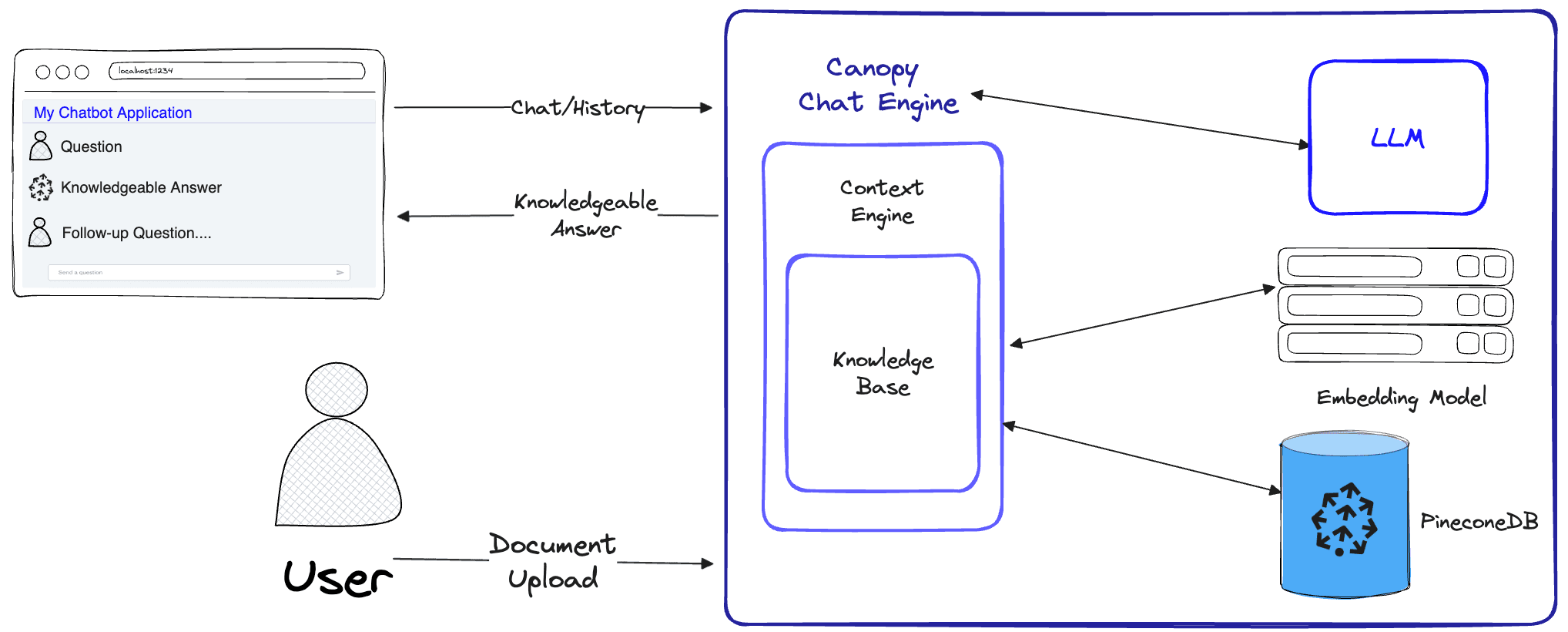
  • The Knowledge Base prepares your data for the RAG workflow. It automatically chunks and transforms your text data into text embeddings before upserting them into the Pinecone vector database.
  • The Context Engine performs the “retrieval” part of RAG. It finds the most relevant documents from Pinecone (via the Knowledge Base) and structures them as context to be used as an LLM prompt.
  • The Canopy Chat Engine implements the full RAG workflow. It understands your chat history and identifies multi-part questions, generates multiple relevant queries from one prompt, and transforms those queries into embeddings. It then uses the context generated for the LLM (via Context Engine) to present a highly relevant response to the end user.

The Canopy Chat Engine implements the full RAG workflow.

Start building today

Canopy is now available for anyone looking to build and experiment with RAG. For Pinecone users, existing indexes are currently not compatible with Canopy so you will need to create a new index using Canopy to get started.

Future versions of Canopy will support more data formats, new LLMs and embedding models, and more. Star the Canopy repo to follow our progress, make contributions, and start building today!