



惯性聚合 高效追踪和阅读你感兴趣的博客、新闻、科技资讯
阅读原文 在惯性聚合中打开

推荐订阅源

G
Google Developers Blog
freeCodeCamp Programming Tutorials: Python, JavaScript, Git & More
WordPress大学
WordPress大学
阮一峰的网络日志
阮一峰的网络日志
V
Visual Studio Blog
雷峰网
雷峰网
博客园_首页
The Cloudflare Blog
Hugging Face - Blog
Hugging Face - Blog
酷 壳 – CoolShell
酷 壳 – CoolShell
爱范儿
爱范儿
小众软件
小众软件
D
Docker
P
Proofpoint News Feed
B
Blog
Vercel News
Vercel News
B
Blog RSS Feed
U
Unit 42
月光博客
月光博客
The GitHub Blog
The GitHub Blog
Apple Machine Learning Research
Y
Y Combinator Blog
I
InfoQ
Recent Announcements

Pinecone

Pinecone Assistant: A Managed Knowledge Layer for Production AI Applications Multi-domain RAG in n8n: why one knowledge base is not enough Allspice Transforms the Culinary Experience with Semantic Search Powered by Pinecone | Pinecone Building RAG workflows in n8n: choosing the right Pinecone node Knowledge needs a meta-knowledge layer Garbage Day: How Pinecone Safely Deletes Billions of Objects at Scale When "Performance" Means Two Different Things Pinecone BYOC: Pinecone in your AWS, GCP, or Azure account, no vendor access True, Relevant, and Wrong: The Applicability Problem in RAG Use the Pinecone Plugin for Claude Code to develop AI Applications Faster Millions at Stake: How Melange's High-Recall Retrieval Prevents Litigation Collapse Powering High-stakes Patent Search at Scale: How Melange Built a Reliable AI System on Pinecone | Pinecone Pinecone Assistant Node in n8n: Turn Any Data Source Into Knowledge RAG with Access Control Pinecone Dedicated Read Nodes are now in Public Preview Inside Pinecone: Slab Architecture New Bulk Data Operations: Update, Delete, and Fetch by Metadata The Hidden Cost of Building: Lessons from Aquant Simplifying Vector Embeddings with Pinecone Integrated Inference Capabilities Pinecone joins Microsoft Marketplace as a Launch Partner GTM Engineering: Clay + Pinecone for AI-powered Sales Outbound Build an AI knowledge assistant with Google Docs and Pinecone Moving Pinecone forward with Ash Ashutosh as CEO and Edo spearheading our growing AI ambitions as Chief Scientist Pinecone Founder Edo Liberty to Spearhead Pinecone’s Growing AI Ambitions; Appoints Ash Ashutosh as CEO to Expand Vector Database Market Leadership Fast, Accurate Retrieval for Creators at Scale: Delphi’s Path Toward a Million Conversational Agents with Pinecone | Pinecone Announcing Pinecone Pioneers: A Program for Builders, Organizers, and Community Leaders What is Context Engineering? Chunking Strategies for LLM Applications Beyond the hype: Why RAG remains essential for modern AI Obviant Makes 30% More Accurate Defense Acquisition Recommendations Combining Sparse and Dense Retrieval with Pinecone | Pinecone
Explore the power of Pinecone with public collections
Gibbs Cullen · 2022-09-16 · via Pinecone

Note: Public collections are no longer supported as part of collections. Visit our documentation to learn more.

Last month, we announced a new feature in public preview: collections. Collections allow users to save vectors and metadata from an index as a snapshot, and create new indexes from any collection.

Today we are excited to announce the addition of public collections to help users quickly run a sample index pre-loaded with data and experience the power of the Pinecone vector database.

What are public collections?

For users to run a query in Pinecone, they need to upload data to an index. This takes time. Public collections make it easier to explore Pinecone by providing public data from real-world data sources that can be used to create an index in one click.

Pinecone users can now create an index from pre-loaded vector embeddings in one of three example collections. Each collection features data from Pinecone partners:

  • Glue SSTB collection from OpenAI
  • Text REtrieval Conference (TREC) question classification collection from Cohere
  • Stanford Question Answering Dataset (SQuAD) collection from Stanford

These collections contain real-world data, load in less than a minute, and have matching guides to get started:

How do they work?

The collections are available under Public Collections within the Pinecone console. You can create an index from the example collections and use the guides to get started including code snippets in Python showing how to use the particular index.
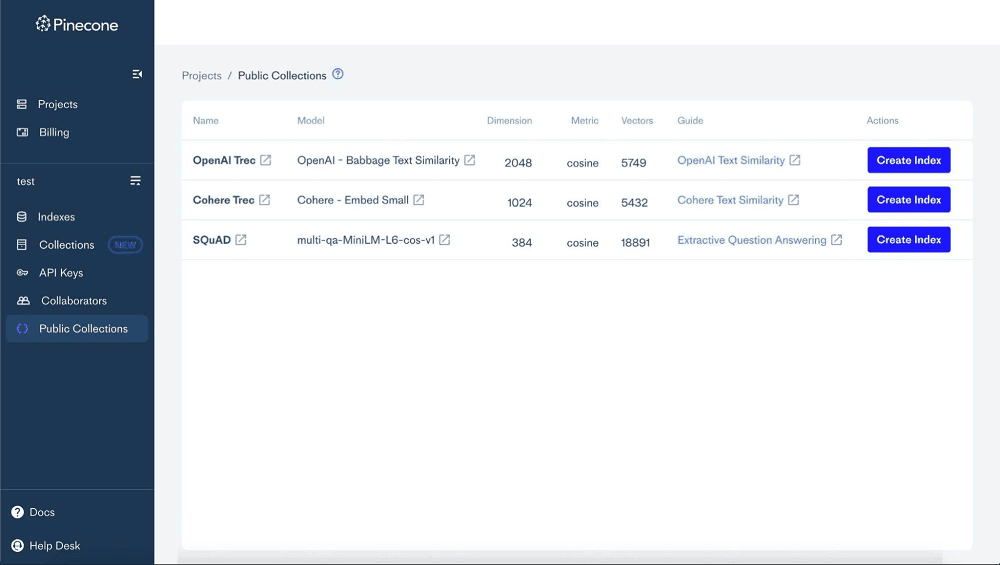
To create an index from a public collection, follow these steps:
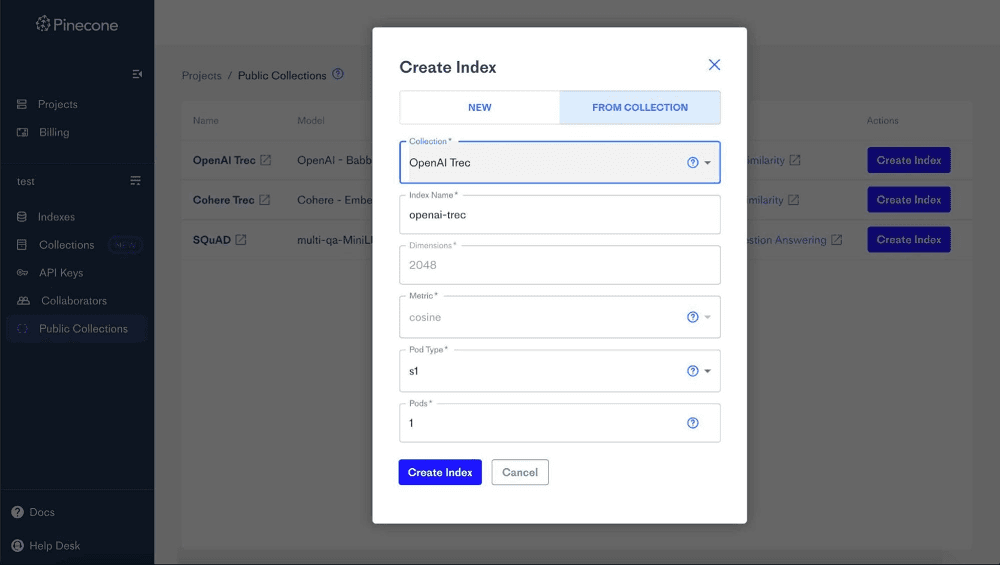
  1. Open the Pinecone console.
  2. Click the name of the project in which you want to create the index.
  3. In the left menu, click Public Collections.
  4. Find the public collection from which you want to create an index. Next to that public collection, click Create Index.
  5. When index creation is complete, a message appears stating that the index is created and that vectors are successfully upserted. The Click to View button will take you to the new index.

Get started today

If you don’t have an embedding model or ready-to-use data to start testing Pinecone, then public collections can help. All Pinecone users will have access to three example collections — Glue SSTB, TREC question classification, and SQuaD — starting today. We will add more public collections over time.

To learn more about public collections, check out the guides or try them for yourself in the console.