


惯性聚合 高效追踪和阅读你感兴趣的博客、新闻、科技资讯
阅读原文 在惯性聚合中打开

推荐订阅源

N
News and Events Feed by Topic
爱范儿
爱范儿
Blog — PlanetScale
Blog — PlanetScale
The GitHub Blog
The GitHub Blog
C
Check Point Blog
小众软件
小众软件
I
InfoQ
罗磊的独立博客
H
Hackread – Cybersecurity News, Data Breaches, AI and More
Engineering at Meta
Engineering at Meta
酷 壳 – CoolShell
酷 壳 – CoolShell
CTFtime.org: upcoming CTF events
Hugging Face - Blog
Hugging Face - Blog
博客园 - 三生石上(FineUI控件)
MyScale Blog
MyScale Blog
The Cloudflare Blog
Last Week in AI
Last Week in AI
腾讯CDC
Y
Y Combinator Blog
钛媒体:引领未来商业与生活新知
钛媒体:引领未来商业与生活新知
雷峰网
雷峰网
B
Blog
T
Tailwind CSS Blog
MongoDB | Blog
MongoDB | Blog
A
About on SuperTechFans
D
Docker
博客园 - 司徒正美
博客园_首页
Recent Announcements
D
DataBreaches.Net
阮一峰的网络日志
阮一峰的网络日志
奇客Solidot–传递最新科技情报
奇客Solidot–传递最新科技情报
G
Google Developers Blog
Microsoft Security Blog
F
Fortinet All Blogs
Stack Overflow Blog
Stack Overflow Blog
aimingoo的专栏
aimingoo的专栏
N
Netflix TechBlog - Medium
OSCHINA 社区最新新闻
OSCHINA 社区最新新闻
博客园 - 聂微东
GbyAI
GbyAI
Jina AI
Jina AI
V
V2EX
Vercel News
Vercel News
IT之家
IT之家
WordPress大学
WordPress大学
M
MIT News - Artificial intelligence
NISL@THU
NISL@THU
V
Visual Studio Blog
C
Cybersecurity and Infrastructure Security Agency CISA

Pinecone

Pinecone Assistant: A Managed Knowledge Layer for Production AI Applications Multi-domain RAG in n8n: why one knowledge base is not enough Allspice Transforms the Culinary Experience with Semantic Search Powered by Pinecone | Pinecone Building RAG workflows in n8n: choosing the right Pinecone node Knowledge needs a meta-knowledge layer Garbage Day: How Pinecone Safely Deletes Billions of Objects at Scale When "Performance" Means Two Different Things Pinecone BYOC: Pinecone in your AWS, GCP, or Azure account, no vendor access True, Relevant, and Wrong: The Applicability Problem in RAG Use the Pinecone Plugin for Claude Code to develop AI Applications Faster Millions at Stake: How Melange's High-Recall Retrieval Prevents Litigation Collapse Powering High-stakes Patent Search at Scale: How Melange Built a Reliable AI System on Pinecone | Pinecone Pinecone Assistant Node in n8n: Turn Any Data Source Into Knowledge RAG with Access Control Pinecone Dedicated Read Nodes are now in Public Preview Inside Pinecone: Slab Architecture New Bulk Data Operations: Update, Delete, and Fetch by Metadata The Hidden Cost of Building: Lessons from Aquant Simplifying Vector Embeddings with Pinecone Integrated Inference Capabilities Pinecone joins Microsoft Marketplace as a Launch Partner GTM Engineering: Clay + Pinecone for AI-powered Sales Outbound Build an AI knowledge assistant with Google Docs and Pinecone Moving Pinecone forward with Ash Ashutosh as CEO and Edo spearheading our growing AI ambitions as Chief Scientist Pinecone Founder Edo Liberty to Spearhead Pinecone’s Growing AI Ambitions; Appoints Ash Ashutosh as CEO to Expand Vector Database Market Leadership Fast, Accurate Retrieval for Creators at Scale: Delphi’s Path Toward a Million Conversational Agents with Pinecone | Pinecone Announcing Pinecone Pioneers: A Program for Builders, Organizers, and Community Leaders What is Context Engineering? Chunking Strategies for LLM Applications Beyond the hype: Why RAG remains essential for modern AI Obviant Makes 30% More Accurate Defense Acquisition Recommendations Combining Sparse and Dense Retrieval with Pinecone | Pinecone Build more knowledgeable AI applications with new LLMs and greater control in Pinecone Assistant #NYTECHWEEK 2025 Retrieval-Augmented Generation (RAG) Accurate and Efficient Metadata Filtering in Pinecone’s Serverless Vector Database | Pinecone Terminal X AI Agents, Powered by Pinecone, Turn Complex Financial Data Into Production-grade Insights at Scale | Pinecone Aquant Delivers Scalable, Expert-level Service Intelligence with Pinecone | Pinecone Cascading retrieval with multi-vector representations: balancing efficiency and effectiveness Vector databases aren't just for large-scale enterprise AI Unveiling DIME: Reproducibility, Scalability, and Formal Analysis of Dimension Importance Estimation for Dense Retrieval | Pinecone Fast and Effective Early Termination for Simple Ranking Functions | Pinecone Domain-specific AI Agents at Scale: CustomGPT.ai Serves 10,000+ Customers with Pinecone | Pinecone Using Pinecone asynchronously with FastAPI A Flexible Resource for Top-Weighted Comparisons Between Sets and Rankings | Pinecone Build secure, scalable agentic AI workflows with Rubrik Annapurna and Pinecone Tool up: Pinecone’s first MCP servers are here Add context to your agent with Pinecone Assistant MCP remote server E2Rank: Efficient and Effective Layer-wise Reranking | Pinecone ColBERT-serve: Efficient Multi-Stage Memory-Mapped Scoring | Pinecone Efficient Constant-Space Multi-Vector Retrieval | Pinecone How Vanguard Worked with Pinecone to Boost Customer Support with Faster Calls and 12% More Accurate Responses | Pinecone Pinecone Named to Fast Company's Annual List of the World's Most Innovative Companies of 2025 Launch Week: Pinecone for agents, search, recommendations, and more Optimizing Pinecone for agents (and more) Retrieval Inference for scale and performance How 1up Turns Sales Reps Into Product Experts with Pinecone | Pinecone Don’t be dense: Launching sparse indexes in Pinecone Unlock High-Precision Keyword Search with pinecone-sparse-english-v0 Evolving Pinecone's architecture to meet the demands of Knowledgeable AI Pinpoint references faster with citation highlights in Pinecone Assistant Bringing the leading vector database to your cloud Getting started with llama-text-embed-v2 Natural Language Counterfactual Explanations for Graphs Using Large Language Models | Pinecone Easily build knowledgeable chat and agent-based applications in minutes with Pinecone Assistant, now generally available How to build an agentic, chat or RAG knowledge system using Pinecone Assistant Real-time RAG with Pinecone and Estuary Flow BigQuery to Pinecone in Real-Time with Estuary Flow Stravito Turns Market and Consumer Data Into Actionable Insights with Pinecone Inference | Pinecone Accelerate prototyping and development with Pinecone Local First-of-its-kind Pinecone Knowledge Platform to Power Best-in-class Retrieval for Customers Introducing integrated inference: Embed, rerank, and retrieve your data with a single API Strengthening security and increasing control with CMEK and API key roles Introducing Pinecone Rerank V0 Introducing cascading retrieval: Unifying dense and sparse with reranking From Idea to Action: How Pinecone Assistant Meaningfully Accelerates AI Business Building AI apps on Azure with Pinecone just got a lot easier Building a reliable, curated, and accurate RAG system with Cleanlab and Pinecone Four features of the Assistant API you aren't using - but should Deploying Pinecone with Infrastructure as Code (IaC) Streamlining CI/CD with Pinecone Local September 2024 Product Update Results of the Big ANN: NeurIPS'23 competition | Pinecone Introducing import from object storage for more efficient data transfer to Pinecone serverless Simplify, enhance, and evaluate RAG development with Pinecone Assistant, now in public preview Vectors and Graphs: Better Together August 2024 Product Update Pinecone Helps Deep Talk Deliver World-Class AI Assistants with Lower Engineering Overhead | Pinecone Llama 3.1 Agent using LangGraph and Ollama Build knowledgeable AI with Pinecone serverless, now generally available on Microsoft Azure Pinecone serverless is now generally available on Google Cloud, adding knowledge to AI assistants and other applications Accelerating Legal Discovery and Analysis with Pinecone and Voyage AI Bridging Dense and Sparse Maximum Inner Product Search | Pinecone Refine Retrieval Quality with Pinecone Rerank Introducing reranking to Pinecone Inference to simplify building accurate AI July 2024 Product Update Connect to Pinecone within your platform to enable a seamless AI development experience Introducing Pinecone API Versioning RAG Brag with Inkeep Co-Founder Nick Gomez LangGraph and Research Agents Introducing Pinecone Inference to streamline your AI workflow Build Privacy-aware AI software using Pinecone
Assembled Delivers Better, Faster AI- Driven Support with Pinecone | Pinecone
2024-09-03 · via Pinecone

In our latest RAG Brag episode, we had the pleasure of speaking with John Wang, Co-founder and CTO of Assembled, who shared valuable insights into how Assembled Assist, the company's latest AI-powered tool, is transforming the world of customer support. Below, you'll find highlights from our conversation, capturing John's perspectives on the challenges and innovations in this space.

Assembled helps major companies like Stripe, Etsy, and DoorDash manage their customer support operations more efficiently. With a focus on optimizing support teams, Assembled provides solutions that help customer service agents handle everything from simple inquiries to complex problem-solving, all within an intuitive system that accelerates customer support operations.

Exceptional customer support goes beyond just having the right people answering queries; it requires quick access to accurate information— something not all support teams have. "Support operations have always been at the core of our strategy," says John Wang, Co-founder and CTO of Assembled. "We had been using data-driven approaches for workforce management and performance tracking. But there were gaps in the support journey that we wanted to fill: speeding up response times and providing more accurate answers."

An Inside Look at Assembled and Their Use of Pinecone

At the heart of Assembled customer support offerings is Assembled Assist, a powerful AI automation engine that analyzes incoming customer support tickets and generates high-quality, contextual responses. These responses can then be seamlessly integrated into the support workflow, either as suggestions for human agents to review and refine, or in some cases, automatically delivered to customers

"Assembled Assist was born out of a desire to fill the gaps in the support journey. We wanted to find ways to speed up response times and provide more accurate answers, all while keeping the human element at the core of what we do." - John Wang, Co-founder and CTO of Assembled.
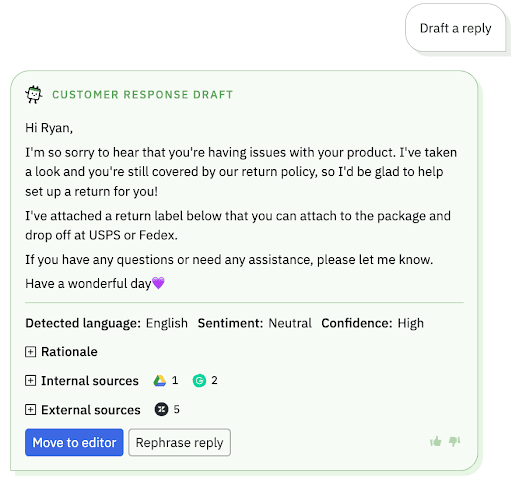
The core of Assembled Assist is built on large language models (LLMs) like those from OpenAI and Anthropic. These AI models provide the language understanding and generation capabilities that allow Assembled Assist to interpret support requests and craft relevant responses.

But Assembled doesn't stop there. They've paired vector search using Pinecone with keyword search from Algolia to optimize the accuracy and relevance of the information surfaced for each support ticket. This hybrid approach leverages the strengths of both semantic and keyword-based search, enabling the retrieval of relevant results that might otherwise be missed by either technique alone. Through the use of Reciprocal Rank Fusion, Assembled has developed a flexible and scalable method for combining these diverse search results, ensuring that the most relevant information is surfaced quickly and accurately.

The result is a customer support solution that drastically reduces response times while maintaining high-quality interactions. With Assembled Assist, tasks that once took 40 minutes are now completed in just 2 minutes — a ~95% reduction of time, freeing up human agents to focus on more complex issues.

Challenges and Lessons in Getting Started with AI

When building Assembled Assist, the team had to navigate key decisions, including whether to focus on fine-tuning language models or use a retrieval augmented generation (RAG) approach.

John explains that the Assembled team ultimately found the flexibility and speed of updates offered by RAG to be more valuable than fine-tuning. As he states, "if you're betting on LLMs improving consistently in the world, which we are, being able to update prompts, and having a pretty generalized infrastructure, we're able to update our prompts very quickly with RAG." This approach not only enables fast iteration but also makes it easier to scale across customers by focusing on data quality rather than managing multiple techniques.

Another area of focus has been on the evaluation and feedback loop. When implementing AI-powered solutions, it’s crucial to identify key business metrics and measure the impact. John describes being able to leverage the data generated solving customer support tickets as a form of “free evaluation” of their Assembled Assist product. This involves analyzing whether a customer support ticket was handled by Assembled Assist, manually written by an agent, or through a combination of both. By evaluating performance across each scenario, they gain valuable insights into the performance of their product, helping them to continuously refine and improve the quality of the responses generated by Assembled Assist.
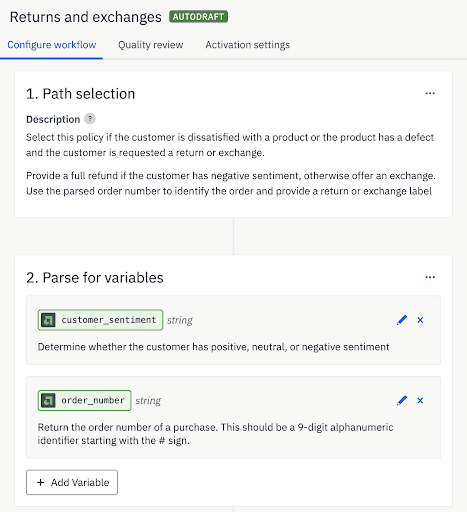
Finally, John shares some practical tips for others building AI products:

  • Practice Writing Prompts: Writing effective prompts is a critical part of the process at Assembled. Engineers with experience in crafting prompts are significantly more effective, highlighting the importance of this often underrated skill.
  • Leverage LLMs for Prompt Tuning: Assembled uses LLMs to help refine and optimize their prompts. This technique, known as "meta prompting," allows for rapid improvements by utilizing the LLMs to provide feedback and enhance prompt quality.
  • Stay Connected to the AI Research Community: Maintaining strong ties with the AI research community is vital. Engaging with experts and staying updated on the latest developments in LLMs and generative AI helps integrate cutting-edge insights and keep the team at the forefront of AI innovation.
“Pinecone was a no-brainer for us. We needed to move quickly, and Pinecone was the leader in the vector database space. Its cost-effectiveness and ease of integration have been significant advantages, allowing us to focus on delivering value rather than managing infrastructure. We can test and adjust on the fly, which is crucial for maintaining high search quality and continuously enhancing our support solutions.” - John Wang, Co-founder and CTO of Assembled.

Assembled Assist shows how AI can revolutionize customer support. By combining LLMs with a hybrid search system, Assembled has created a fast and accurate product that delivers top-quality responses to customer inquiries.

The key takeaways? Mastering AI prompt engineering, staying flexible in how data is gathered and applied, and always focusing on enhancing customer experiences. AI products will continue to evolve, and so will their applications in customer support. But the goal remains constant: making support better, faster, and more helpful.

For more insights about John and Assembled, be sure to check out the full recording of our conversation or head over to their website. We will continue the RAG Brag series with more engaging talks featuring leaders in the AI industry. So stay tuned for those upcoming episodes!