



惯性聚合 高效追踪和阅读你感兴趣的博客、新闻、科技资讯
阅读原文 在惯性聚合中打开

推荐订阅源

N
News and Events Feed by Topic
T
The Exploit Database - CXSecurity.com
P
Palo Alto Networks Blog
T
Threat Research - Cisco Blogs
Cloudbric
Cloudbric
Recent Commits to openclaw:main
I
Intezer
Attack and Defense Labs
P
Privacy International News Feed
cs.CV updates on arXiv.org
L
Lohrmann on Cybersecurity
C
Cybersecurity and Infrastructure Security Agency CISA
V2EX - 技术
V2EX - 技术
AWS News Blog
AWS News Blog
O
OpenAI News
L
LINUX DO - 最新话题
N
News | PayPal Newsroom
PCI Perspectives
PCI Perspectives
www.infosecurity-magazine.com
T
Troy Hunt's Blog
Latest news
Latest news
D
Darknet – Hacking Tools, Hacker News & Cyber Security
A
Arctic Wolf
Spread Privacy
Spread Privacy
G
GRAHAM CLULEY
T
Tor Project blog
博客园_首页
Know Your Adversary
Know Your Adversary
有赞技术团队
有赞技术团队
S
Secure Thoughts
美团技术团队
Apple Machine Learning Research
爱范儿
爱范儿
T
Tailwind CSS Blog
Application and Cybersecurity Blog
V
Visual Studio Blog
J
Java Code Geeks
Cisco Talos Blog
Cisco Talos Blog
Schneier on Security
Exploit-DB.com RSS Feed
S
Security Affairs
Jina AI
Jina AI
人人都是产品经理
人人都是产品经理
雷峰网
雷峰网
宝玉的分享
宝玉的分享
量子位
Last Week in AI
Last Week in AI
月光博客
月光博客
罗磊的独立博客
S
SegmentFault 最新的问题

Pinecone

Pinecone Assistant: A Managed Knowledge Layer for Production AI Applications Multi-domain RAG in n8n: why one knowledge base is not enough Allspice Transforms the Culinary Experience with Semantic Search Powered by Pinecone | Pinecone Building RAG workflows in n8n: choosing the right Pinecone node Knowledge needs a meta-knowledge layer Garbage Day: How Pinecone Safely Deletes Billions of Objects at Scale When "Performance" Means Two Different Things Pinecone BYOC: Pinecone in your AWS, GCP, or Azure account, no vendor access True, Relevant, and Wrong: The Applicability Problem in RAG Use the Pinecone Plugin for Claude Code to develop AI Applications Faster Millions at Stake: How Melange's High-Recall Retrieval Prevents Litigation Collapse Powering High-stakes Patent Search at Scale: How Melange Built a Reliable AI System on Pinecone | Pinecone Pinecone Assistant Node in n8n: Turn Any Data Source Into Knowledge RAG with Access Control Pinecone Dedicated Read Nodes are now in Public Preview Inside Pinecone: Slab Architecture New Bulk Data Operations: Update, Delete, and Fetch by Metadata The Hidden Cost of Building: Lessons from Aquant Simplifying Vector Embeddings with Pinecone Integrated Inference Capabilities Pinecone joins Microsoft Marketplace as a Launch Partner GTM Engineering: Clay + Pinecone for AI-powered Sales Outbound Build an AI knowledge assistant with Google Docs and Pinecone Moving Pinecone forward with Ash Ashutosh as CEO and Edo spearheading our growing AI ambitions as Chief Scientist Pinecone Founder Edo Liberty to Spearhead Pinecone’s Growing AI Ambitions; Appoints Ash Ashutosh as CEO to Expand Vector Database Market Leadership Fast, Accurate Retrieval for Creators at Scale: Delphi’s Path Toward a Million Conversational Agents with Pinecone | Pinecone Announcing Pinecone Pioneers: A Program for Builders, Organizers, and Community Leaders What is Context Engineering? Chunking Strategies for LLM Applications Beyond the hype: Why RAG remains essential for modern AI Obviant Makes 30% More Accurate Defense Acquisition Recommendations Combining Sparse and Dense Retrieval with Pinecone | Pinecone Build more knowledgeable AI applications with new LLMs and greater control in Pinecone Assistant #NYTECHWEEK 2025 Retrieval-Augmented Generation (RAG) Accurate and Efficient Metadata Filtering in Pinecone’s Serverless Vector Database | Pinecone Terminal X AI Agents, Powered by Pinecone, Turn Complex Financial Data Into Production-grade Insights at Scale | Pinecone Aquant Delivers Scalable, Expert-level Service Intelligence with Pinecone | Pinecone Cascading retrieval with multi-vector representations: balancing efficiency and effectiveness Vector databases aren't just for large-scale enterprise AI Unveiling DIME: Reproducibility, Scalability, and Formal Analysis of Dimension Importance Estimation for Dense Retrieval | Pinecone Fast and Effective Early Termination for Simple Ranking Functions | Pinecone Domain-specific AI Agents at Scale: CustomGPT.ai Serves 10,000+ Customers with Pinecone | Pinecone Using Pinecone asynchronously with FastAPI A Flexible Resource for Top-Weighted Comparisons Between Sets and Rankings | Pinecone Build secure, scalable agentic AI workflows with Rubrik Annapurna and Pinecone Tool up: Pinecone’s first MCP servers are here Add context to your agent with Pinecone Assistant MCP remote server E2Rank: Efficient and Effective Layer-wise Reranking | Pinecone ColBERT-serve: Efficient Multi-Stage Memory-Mapped Scoring | Pinecone Efficient Constant-Space Multi-Vector Retrieval | Pinecone How Vanguard Worked with Pinecone to Boost Customer Support with Faster Calls and 12% More Accurate Responses | Pinecone Pinecone Named to Fast Company's Annual List of the World's Most Innovative Companies of 2025 Launch Week: Pinecone for agents, search, recommendations, and more Optimizing Pinecone for agents (and more) Retrieval Inference for scale and performance How 1up Turns Sales Reps Into Product Experts with Pinecone | Pinecone Don’t be dense: Launching sparse indexes in Pinecone Unlock High-Precision Keyword Search with pinecone-sparse-english-v0 Evolving Pinecone's architecture to meet the demands of Knowledgeable AI Pinpoint references faster with citation highlights in Pinecone Assistant Bringing the leading vector database to your cloud Getting started with llama-text-embed-v2 Natural Language Counterfactual Explanations for Graphs Using Large Language Models | Pinecone Easily build knowledgeable chat and agent-based applications in minutes with Pinecone Assistant, now generally available How to build an agentic, chat or RAG knowledge system using Pinecone Assistant Real-time RAG with Pinecone and Estuary Flow BigQuery to Pinecone in Real-Time with Estuary Flow Stravito Turns Market and Consumer Data Into Actionable Insights with Pinecone Inference | Pinecone Accelerate prototyping and development with Pinecone Local First-of-its-kind Pinecone Knowledge Platform to Power Best-in-class Retrieval for Customers Introducing integrated inference: Embed, rerank, and retrieve your data with a single API Strengthening security and increasing control with CMEK and API key roles Introducing cascading retrieval: Unifying dense and sparse with reranking From Idea to Action: How Pinecone Assistant Meaningfully Accelerates AI Business Building AI apps on Azure with Pinecone just got a lot easier Building a reliable, curated, and accurate RAG system with Cleanlab and Pinecone Four features of the Assistant API you aren't using - but should Deploying Pinecone with Infrastructure as Code (IaC) Streamlining CI/CD with Pinecone Local September 2024 Product Update Results of the Big ANN: NeurIPS'23 competition | Pinecone Introducing import from object storage for more efficient data transfer to Pinecone serverless Simplify, enhance, and evaluate RAG development with Pinecone Assistant, now in public preview Vectors and Graphs: Better Together August 2024 Product Update Pinecone Helps Deep Talk Deliver World-Class AI Assistants with Lower Engineering Overhead | Pinecone Assembled Delivers Better, Faster AI- Driven Support with Pinecone | Pinecone Llama 3.1 Agent using LangGraph and Ollama Build knowledgeable AI with Pinecone serverless, now generally available on Microsoft Azure Pinecone serverless is now generally available on Google Cloud, adding knowledge to AI assistants and other applications Accelerating Legal Discovery and Analysis with Pinecone and Voyage AI Bridging Dense and Sparse Maximum Inner Product Search | Pinecone Refine Retrieval Quality with Pinecone Rerank Introducing reranking to Pinecone Inference to simplify building accurate AI July 2024 Product Update Connect to Pinecone within your platform to enable a seamless AI development experience Introducing Pinecone API Versioning RAG Brag with Inkeep Co-Founder Nick Gomez LangGraph and Research Agents Introducing Pinecone Inference to streamline your AI workflow Build Privacy-aware AI software using Pinecone
Introducing Pinecone Rerank V0
Cesare Campagnano, Antonio Mallia, Jack Pertschuk, Gareth Jones · 2024-12-02 · via Pinecone

Today, we're excited to announce that our reranking model — pinecone-rerank-v0 — is now available in public preview.

Designed to significantly enhance enterprise search and retrieval augmented generation (RAG) systems, this new model provides a powerful boost in relevance and accuracy, ensuring that your search results and AI-generated content are grounded in the most relevant and contextually precise information.

Whether you're looking to improve internal search capabilities or strengthen your RAG pipelines, our new reranker is built to meet the demands of modern, large-scale applications while delivering top-tier performance.

Below, we’ll quickly cover:

  • Why retrieval quality matters in the context of RAG systems
  • How you can get started, quickly and easily, with pinecone-rerank-v0
  • The results of putting pinecone-rerank-v0 to the test against alternative models

Why RAG matters

Large language models (LLMs) are powerful tools, but they have limitations that can affect response accuracy and relevance in real-world applications. RAG addresses this by providing the LLM with only the most relevant information, resulting in responses that are grounded in contextually precise, up-to-date data.

LLMs trained on broad datasets can’t directly access proprietary or domain-specific information, which often leads them to generate answers that may sound plausible but lack accuracy. RAG fills this gap by retrieving the right data when it’s needed, so the model’s responses are informed by specific, relevant information. At the same time, more context isn’t always better. Large input windows can lead to information overload, where key details get diluted. By retrieving only what’s essential, RAG keeps responses focused and reduces the “lost in the middle” effect that can impact output quality.

This targeted retrieval approach also reduces token costs—an important factor in production environments where tokens are a primary cost driver. By cutting token usage by 5-10x, RAG makes high-quality responses more scalable and cost-effective. Finally, retrieval accuracy is key for RAG to work as intended. Purpose-built neural retrieval models ensure that only the most relevant information reaches the model, enabling RAG to deliver responses that meet real-world demands for precision.

Note: Our in-depth article provides a closer look at how RAG overcomes LLM limitations and optimizes cost.

What is a reranker?

In retrieval systems, rerankers add an extra layer of precision to ensure that only the most relevant information reaches the model. After the initial retrieval — where an embedding model and vector database pull a broad set of potentially useful documents — rerankers refine this set by re-evaluating the results with a more sophisticated model. This step sharpens the relevance of the selected documents, so the generative model receives only high-quality, context-rich input.
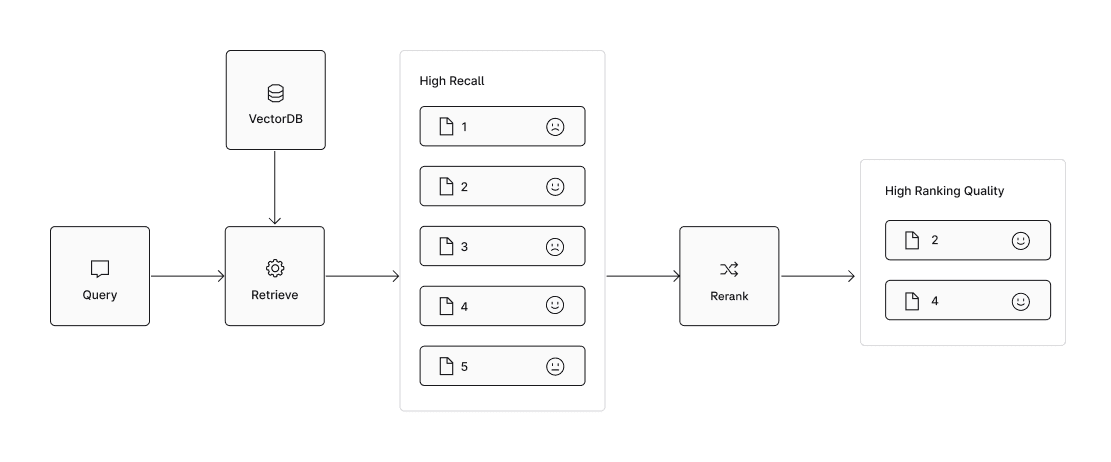
rag rerank diagram

This precision is essential within RAG frameworks. Since the generative model’s output relies on the quality of its input, rerankers help ensure responses are both accurate and grounded. By combining the broad reach of neural retrieval with the targeted precision of rerankers, RAG systems can deliver more reliable and relevant answers — especially important in applications where precision matters most.

Introducing Pinecone's reranker

Our latest model, pinecone-rerank-v0, is optimized for precision in reranking tasks using a cross-encoder architecture. Unlike embedding models, the cross-encoder processes the query and document together, allowing it to capture fine-grained relevance more effectively.

The model assigns a relevance score from 0 to 1 for each query-document pair, with higher scores indicating a stronger match. To maintain accuracy, we’ve set the model’s maximum context length to 512 tokens—an optimal limit for preserving ranking quality in reranking tasks.

Putting the reranker to the test

To quantify — as objectively as possible — the improved effectiveness of our new reranker model, we performed an evaluation on several datasets:

  • The BEIR benchmark is a widely used evaluation suite designed to assess retrieval models across various domains and tasks. It includes 18 different datasets covering a range of real-world information retrieval scenarios, allowing models to be tested on diverse challenges like biomedical search, fact-checking, and question-answering.
  • TREC Deep Learning is an annual competition hosted by the National Institute of Standards and Technology (NIST), focused on web search queries across a diverse web corpus.
  • Novel datasets Financebench-RAG and Pinecone-RAG (proprietary) that reflect real-world RAG interactions.

For both TREC Deep Learning and BEIR, we retrieved and reranked 200 documents and finally measured Normalized Discounted Cumulative Gain (specifically, NDCG@10). For Pinecone-RAG and Financebench-RAG, we retrieved and reranked up to 100 documents (some collections were smaller than this) and finally measured Mean Reciprocal Rank (specifically, MRR@10).

MRR@10 and NDCG@10 were calculated with the respective metrics (MRR and NDCG) considering only the top 10 ranked candidates.

We compared with an extremely large set of reranking models, but here we present a selection of those that we consider more competitive:

The models for Cohere, Voyage AI, and Google were tested using the official APIs, while the models from Jina AI and BAAI were hosted locally since they are publicly available.

BEIR

For the BEIR benchmark, we focused on 12 datasets, excluding the four that are not publicly available to ensure reproducibility. We also excluded MS MARCO, as it is evaluated separately, and ArguAna, since its task of finding counter-arguments to the query contrasts with the purpose of a reranker.
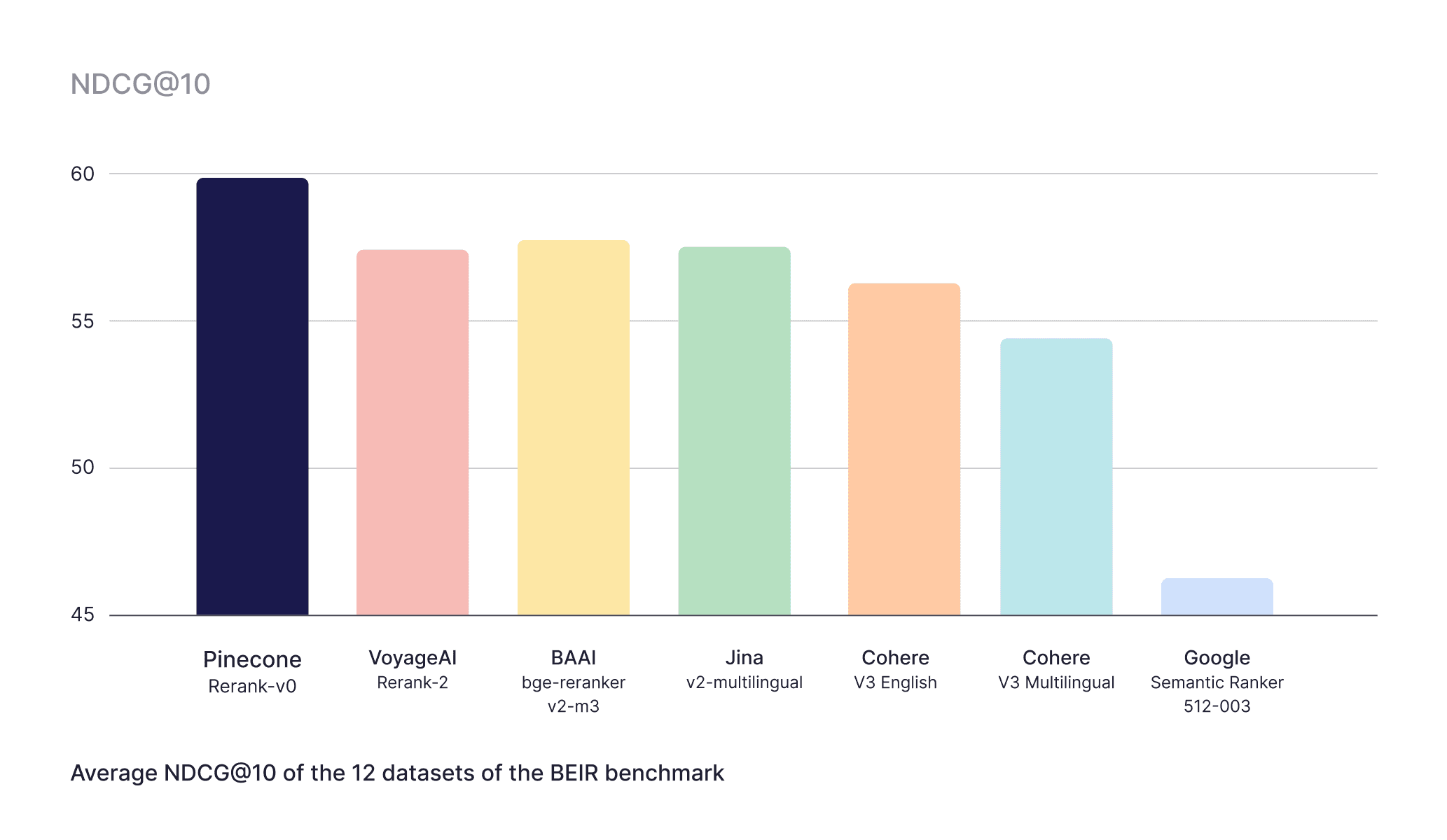
  • Pinecone-rerank-v0 had the highest average NDCG@10, notably higher than the alternatives
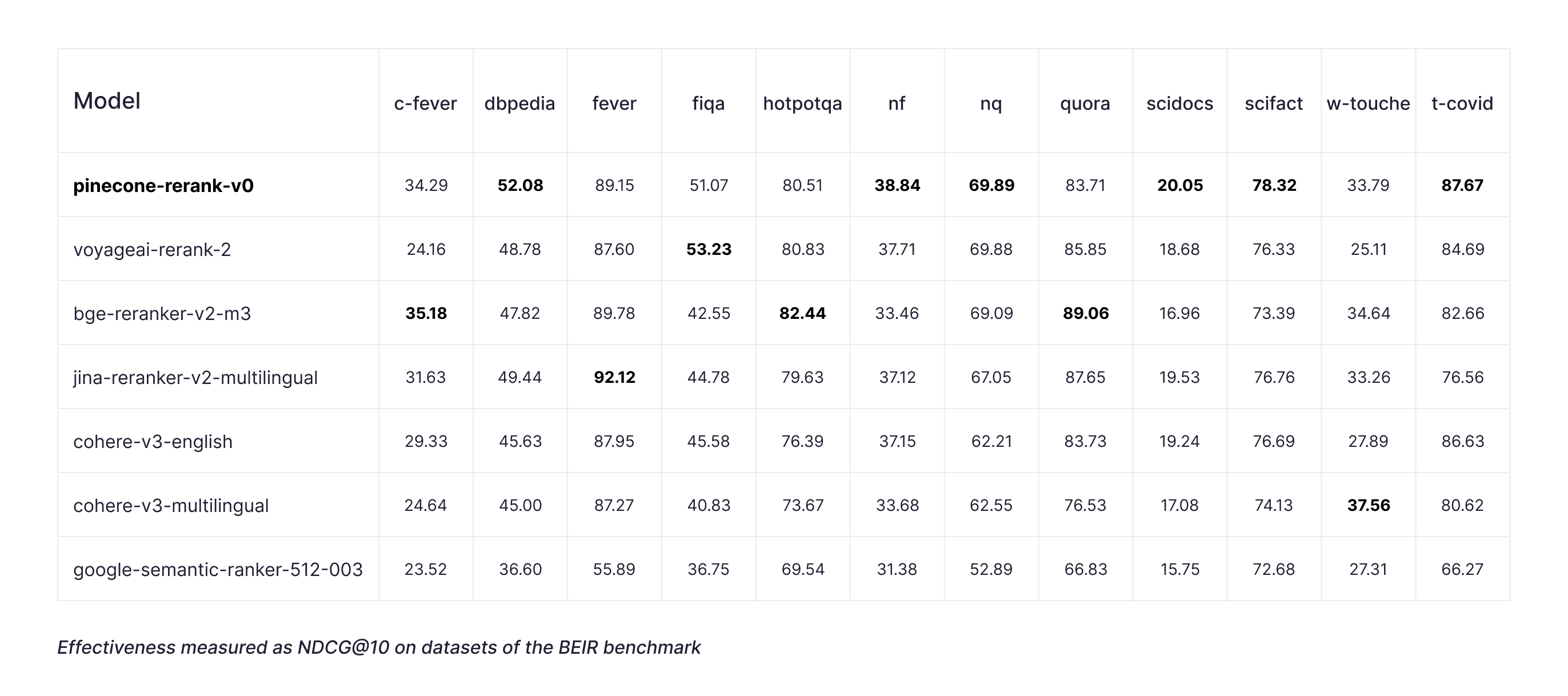
  • Pinecone-rerank-v0 performed the best on 6 out of the 12 datasets; the second-best reranking model performed the best on only 3

Pinecone-rerank-v0 demonstrates significant improvements in search accuracy (NDCG@10) in various scenarios, achieving up to a 60% boost on the Fever dataset compared to Google Semantic Ranker, over 40% on the Climate-Fever dataset relative to cohere-v3-multilingual or voyageai-rerank-2, and 20% on FiQA compared to bge-reranker-v2-m3. On average, Pinecone-rerank-v0 outperforms industry-leading models by 9% for NDCG@10.
TREC

For our TREC evaluation, we merged the datasets from the 2019 and 2020 editions, resulting in a total of 97 queries tested against a collection of 8.8 million documents. Once again, pinecone-rerank-v0 outperformed the other reranking models.

ModelNDCG@10
pinecone-rerank-v076.51
voyageai-rerank-276.33
bge-reranker-v2-m375.51
jina-reranker-v2-multilingual75.72
cohere-v3-english72.22
cohere-v3-multilingual74.93
google-semantic-ranker-512-00364.89

Financebench-RAG

The Financebench-RAG dataset is generated from the open-source financebench question-answering dataset. Text is extracted from the raw PDFs with pypdf, and then split into chunks of up to 400 tokens prior to embedding.

The initial retrieval stage is done using openai-large-3 embeddings scored with dot product. The top 100 candidates from the first retrieval stage are then reranked, and chunks are expanded out to the entire page. If multiple chunks from the same page are retrieved, the page’s score is taken to be the average of the chunks on it. These pages are then ranked based on score.
Pinecone-RAG

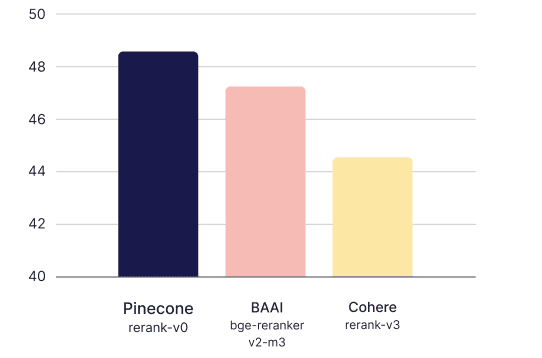
The Pinecone-RAG dataset reflects real-world RAG interactions and is annotated by Pinecone. This data is not publicly available and was not used in training, thus showcasing the model's 0-shot performance.

After reranking the final candidates with the corresponding reranker, we calculate the standard MRR@10 metric (described above) based on the final rank of the top 10 final candidate documents after reranking.
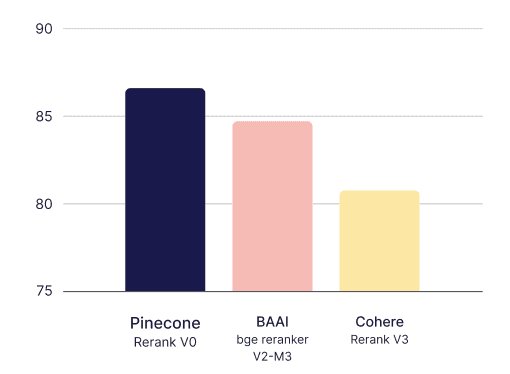
MRR@10 on Pinecone-RAG

Getting started

Pinecone-rerank-v0 is accessible through Pinecone inference and is now available to all users in public preview.

Note that this endpoint is intended for development. For improved performance, contact us directly for an optimized production deployment.

from pinecone import Pinecone

pc = Pinecone("PINECONE-API-KEY")
query = "Tell me about Apple's products"
documents = [
    "Apple is a popular fruit known for its sweetness and crisp texture.",
    "Apple is known for its innovative products like the iPhone.",
    "Many people enjoy eating apples as a healthy snack.",
    "Apple Inc. has revolutionized the tech industry with its sleek designs and user-friendly interfaces.",
    "An apple a day keeps the doctor away, as the saying goes."
]

results = pc.inference.rerank(
    model="pinecone-rerank-v0",
    query=query,
    documents=documents,
    top_n=3,
    return_documents=True
)

for r in results.data:
    print(r.score, r.document.text)