

惯性聚合 高效追踪和阅读你感兴趣的博客、新闻、科技资讯
阅读原文 在惯性聚合中打开

推荐订阅源

cs.CL updates on arXiv.org
GbyAI
GbyAI
F
Fortinet All Blogs
Y
Y Combinator Blog
I
InfoQ
Microsoft Azure Blog
C
Cyber Attacks, Cyber Crime and Cyber Security
Vercel News
Vercel News
T
The Blog of Author Tim Ferriss
P
Proofpoint News Feed
S
Schneier on Security
NISL@THU
NISL@THU
The Hacker News
The Hacker News
Simon Willison's Weblog
The GitHub Blog
The GitHub Blog
MyScale Blog
MyScale Blog
Cisco Talos Blog
Cisco Talos Blog
F
Full Disclosure
P
Palo Alto Networks Blog
T
The Exploit Database - CXSecurity.com
Know Your Adversary
Know Your Adversary
A
About on SuperTechFans
The Cloudflare Blog
T
Threat Research - Cisco Blogs
M
MIT News - Artificial intelligence
宝玉的分享
宝玉的分享
雷峰网
雷峰网
Hugging Face - Blog
Hugging Face - Blog
博客园 - 三生石上(FineUI控件)
D
DataBreaches.Net
Martin Fowler
Martin Fowler
H
Help Net Security
B
Blog RSS Feed
B
Blog
爱范儿
爱范儿
V
V2EX
I
Intezer
L
LangChain Blog
WordPress大学
WordPress大学
小众软件
小众软件
美团技术团队
Latest news
Latest news
H
Hackread – Cybersecurity News, Data Breaches, AI and More
T
Tor Project blog
L
Lohrmann on Cybersecurity
Cyberwarzone
Cyberwarzone
Last Week in AI
Last Week in AI
Project Zero
Project Zero
C
Cybersecurity and Infrastructure Security Agency CISA
V
Visual Studio Blog

Pinecone

Pinecone Assistant: A Managed Knowledge Layer for Production AI Applications Multi-domain RAG in n8n: why one knowledge base is not enough Allspice Transforms the Culinary Experience with Semantic Search Powered by Pinecone | Pinecone Building RAG workflows in n8n: choosing the right Pinecone node Knowledge needs a meta-knowledge layer Garbage Day: How Pinecone Safely Deletes Billions of Objects at Scale When "Performance" Means Two Different Things Pinecone BYOC: Pinecone in your AWS, GCP, or Azure account, no vendor access True, Relevant, and Wrong: The Applicability Problem in RAG Use the Pinecone Plugin for Claude Code to develop AI Applications Faster Millions at Stake: How Melange's High-Recall Retrieval Prevents Litigation Collapse Powering High-stakes Patent Search at Scale: How Melange Built a Reliable AI System on Pinecone | Pinecone Pinecone Assistant Node in n8n: Turn Any Data Source Into Knowledge RAG with Access Control Pinecone Dedicated Read Nodes are now in Public Preview Inside Pinecone: Slab Architecture New Bulk Data Operations: Update, Delete, and Fetch by Metadata The Hidden Cost of Building: Lessons from Aquant Simplifying Vector Embeddings with Pinecone Integrated Inference Capabilities Pinecone joins Microsoft Marketplace as a Launch Partner GTM Engineering: Clay + Pinecone for AI-powered Sales Outbound Build an AI knowledge assistant with Google Docs and Pinecone Moving Pinecone forward with Ash Ashutosh as CEO and Edo spearheading our growing AI ambitions as Chief Scientist Pinecone Founder Edo Liberty to Spearhead Pinecone’s Growing AI Ambitions; Appoints Ash Ashutosh as CEO to Expand Vector Database Market Leadership Fast, Accurate Retrieval for Creators at Scale: Delphi’s Path Toward a Million Conversational Agents with Pinecone | Pinecone Announcing Pinecone Pioneers: A Program for Builders, Organizers, and Community Leaders What is Context Engineering? Chunking Strategies for LLM Applications Beyond the hype: Why RAG remains essential for modern AI Obviant Makes 30% More Accurate Defense Acquisition Recommendations Combining Sparse and Dense Retrieval with Pinecone | Pinecone Build more knowledgeable AI applications with new LLMs and greater control in Pinecone Assistant #NYTECHWEEK 2025 Retrieval-Augmented Generation (RAG) Accurate and Efficient Metadata Filtering in Pinecone’s Serverless Vector Database | Pinecone Terminal X AI Agents, Powered by Pinecone, Turn Complex Financial Data Into Production-grade Insights at Scale | Pinecone Aquant Delivers Scalable, Expert-level Service Intelligence with Pinecone | Pinecone Cascading retrieval with multi-vector representations: balancing efficiency and effectiveness Vector databases aren't just for large-scale enterprise AI Unveiling DIME: Reproducibility, Scalability, and Formal Analysis of Dimension Importance Estimation for Dense Retrieval | Pinecone Fast and Effective Early Termination for Simple Ranking Functions | Pinecone Domain-specific AI Agents at Scale: CustomGPT.ai Serves 10,000+ Customers with Pinecone | Pinecone Using Pinecone asynchronously with FastAPI A Flexible Resource for Top-Weighted Comparisons Between Sets and Rankings | Pinecone Build secure, scalable agentic AI workflows with Rubrik Annapurna and Pinecone Tool up: Pinecone’s first MCP servers are here Add context to your agent with Pinecone Assistant MCP remote server E2Rank: Efficient and Effective Layer-wise Reranking | Pinecone ColBERT-serve: Efficient Multi-Stage Memory-Mapped Scoring | Pinecone Efficient Constant-Space Multi-Vector Retrieval | Pinecone How Vanguard Worked with Pinecone to Boost Customer Support with Faster Calls and 12% More Accurate Responses | Pinecone Pinecone Named to Fast Company's Annual List of the World's Most Innovative Companies of 2025 Launch Week: Pinecone for agents, search, recommendations, and more Optimizing Pinecone for agents (and more) How 1up Turns Sales Reps Into Product Experts with Pinecone | Pinecone Don’t be dense: Launching sparse indexes in Pinecone Unlock High-Precision Keyword Search with pinecone-sparse-english-v0 Evolving Pinecone's architecture to meet the demands of Knowledgeable AI Pinpoint references faster with citation highlights in Pinecone Assistant Bringing the leading vector database to your cloud Getting started with llama-text-embed-v2 Natural Language Counterfactual Explanations for Graphs Using Large Language Models | Pinecone Easily build knowledgeable chat and agent-based applications in minutes with Pinecone Assistant, now generally available How to build an agentic, chat or RAG knowledge system using Pinecone Assistant Real-time RAG with Pinecone and Estuary Flow BigQuery to Pinecone in Real-Time with Estuary Flow Stravito Turns Market and Consumer Data Into Actionable Insights with Pinecone Inference | Pinecone Accelerate prototyping and development with Pinecone Local First-of-its-kind Pinecone Knowledge Platform to Power Best-in-class Retrieval for Customers Introducing integrated inference: Embed, rerank, and retrieve your data with a single API Strengthening security and increasing control with CMEK and API key roles Introducing Pinecone Rerank V0 Introducing cascading retrieval: Unifying dense and sparse with reranking From Idea to Action: How Pinecone Assistant Meaningfully Accelerates AI Business Building AI apps on Azure with Pinecone just got a lot easier Building a reliable, curated, and accurate RAG system with Cleanlab and Pinecone Four features of the Assistant API you aren't using - but should Deploying Pinecone with Infrastructure as Code (IaC) Streamlining CI/CD with Pinecone Local September 2024 Product Update Results of the Big ANN: NeurIPS'23 competition | Pinecone Introducing import from object storage for more efficient data transfer to Pinecone serverless Simplify, enhance, and evaluate RAG development with Pinecone Assistant, now in public preview Vectors and Graphs: Better Together August 2024 Product Update Pinecone Helps Deep Talk Deliver World-Class AI Assistants with Lower Engineering Overhead | Pinecone Assembled Delivers Better, Faster AI- Driven Support with Pinecone | Pinecone Llama 3.1 Agent using LangGraph and Ollama Build knowledgeable AI with Pinecone serverless, now generally available on Microsoft Azure Pinecone serverless is now generally available on Google Cloud, adding knowledge to AI assistants and other applications Accelerating Legal Discovery and Analysis with Pinecone and Voyage AI Bridging Dense and Sparse Maximum Inner Product Search | Pinecone Refine Retrieval Quality with Pinecone Rerank Introducing reranking to Pinecone Inference to simplify building accurate AI July 2024 Product Update Connect to Pinecone within your platform to enable a seamless AI development experience Introducing Pinecone API Versioning RAG Brag with Inkeep Co-Founder Nick Gomez LangGraph and Research Agents Introducing Pinecone Inference to streamline your AI workflow Build Privacy-aware AI software using Pinecone
Retrieval Inference for scale and performance
Silas Smith, Adam Kelch, Rajat Tripathi, Gareth Jones · 2025-03-12 · via Pinecone

Accurate retrieval involves multiple steps, including embedding generation, vector search, and reranking. Each step involves trade-offs among accuracy, efficiency, and complexity. At Pinecone, we're building an inference system to run state of the art models to match the capabilities of the vector database. This post explores how our optimized embedding and reranking inference uniquely enhances retrieval quality, simplifies the developer experience, and reduces the operational footprint of modern retrieval applications.

Understanding Retrieval Inference

Retrieval inference operates differently from traditional LLM inference. While LLMs primarily generate text from prompts, retrieval inference focuses on the needs of transforming data for embedding and reranking.

Embedding Generation

Embedding models convert data into numerical vectors that capture semantic meaning. In production environments, these models typically handle two distinct workloads:

  • Document Processing: Converting your content library into vectors for indexing. This typically involves processing longer text segments (200-600 tokens) and can be done as a batch operation.
  • Query Processing: Transforming user queries into the same vector space in real-time. These are usually shorter (around 20 tokens) but require consistent, low-latency responses.

Reranking

Reranking refines search quality by taking a closer look at initial results. After vector search identifies potential matches, reranking models examine each query-document pair together, considering contextual relationships that vector similarity alone might miss. This deeper analysis improves result accuracy, though it requires additional computation time. Effective retrieval systems carefully consider this trade-off between relevance and performance.

When embedding generation and reranking are viewed as components of a unified retrieval inference system, opportunities emerge for optimizations that might otherwise be overlooked when these processes are managed separately.

How Pinecone optimizes Retrieval Inference

Pinecone optimizes retrieval inference by carefully tuning models, hardware, and serving infrastructure to handle distinct workloads effectively.

Model optimization with NVIDIA TensorRT

To optimize model performance, Pinecone develops specialized inference profiles tailored to embedding and reranking workloads. These profiles consider the specific architecture, size, and performance objectives of each model. We leverage NVIDIA TensorRT to enhance performance through techniques like

  • Kernel Tuning: Selecting optimal CUDA kernels based on hardware and tensor shapes.
  • Layer Fusion: Merging consecutive operations (e.g., matrix multiplications with activation functions)
  • Dynamic Tensor Optimization: Adjusting computation dynamically based on input length to minimize unnecessary padding.
  • Precision Reduction: Reducing numerical precision (e.g., from FP32 to FP16 or INT8) to enhance performance with minimal impact on accuracy.

Hardware selection significantly impacts performance. For each model we test multiple GPU configurations (e.g., NVIDIA T4, L4, A10, L40s) to identify optimal combinations of cost and performance. By decoupling query and passage workloads, we can independently select hardware that best suits each workload, resulting in notable improvements in both latency and throughput compared to baseline models.

The impact of these optimizations is demonstrated by our results with the bge-reranker-v2-m3 model. Reducing precision from FP32 to FP16 nearly doubled throughput, and converting from FP16 ONNX to a TensorRT-optimized engine delivered an additional 60% improvement. Combined, these steps increased throughput by almost 3X compared to the original FP32 baseline.
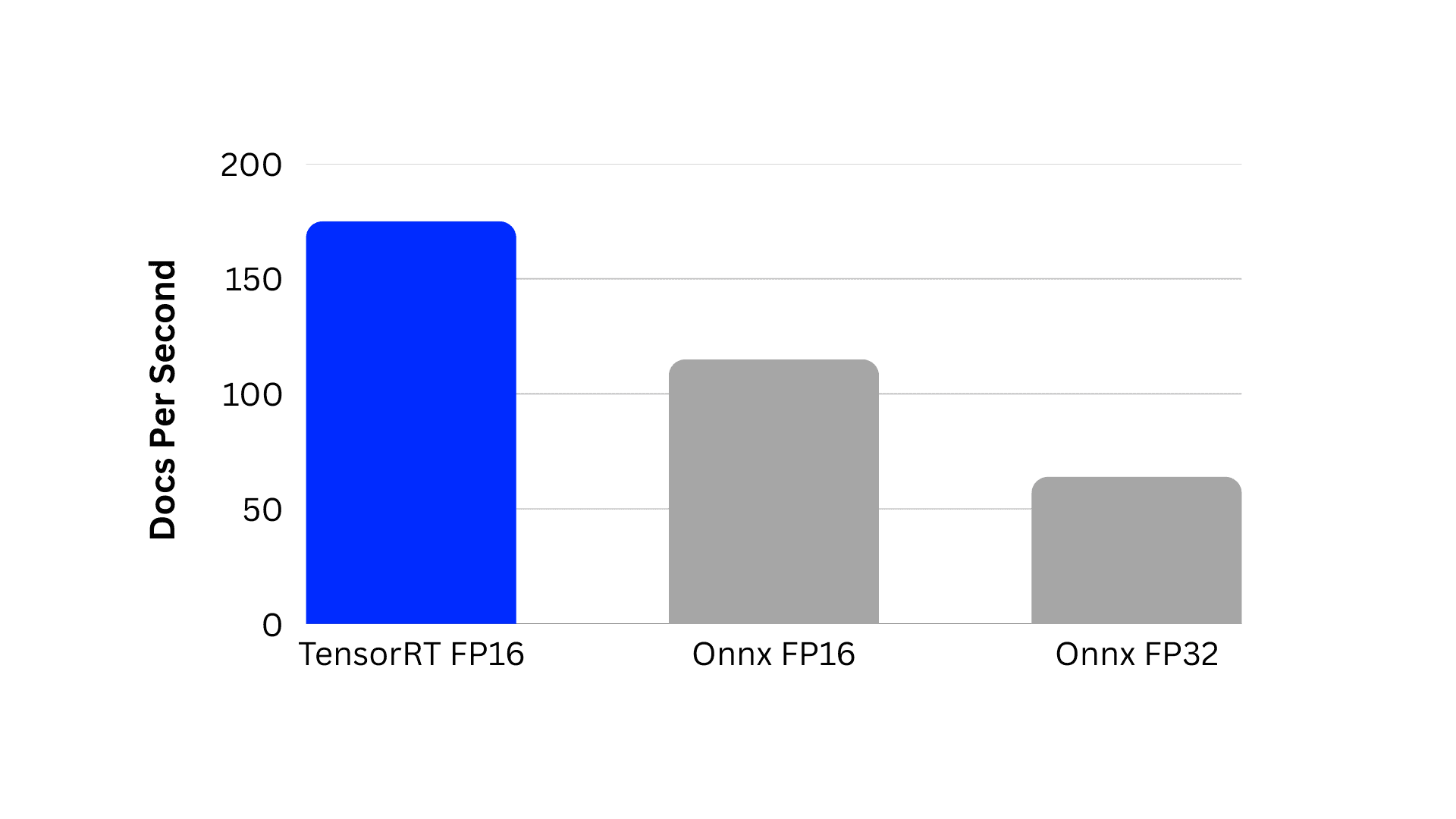
Document reranking speed under different optimization schemes.

Maximizing GPU utilization with Triton dynamic batching

Once models are optimized, we deploy them using NVIDIA Triton Inference Server on Kubernetes. Triton's dynamic batching significantly enhances GPU utilization by efficiently consolidating numerous smaller inference requests into larger, more resource-effective batches.
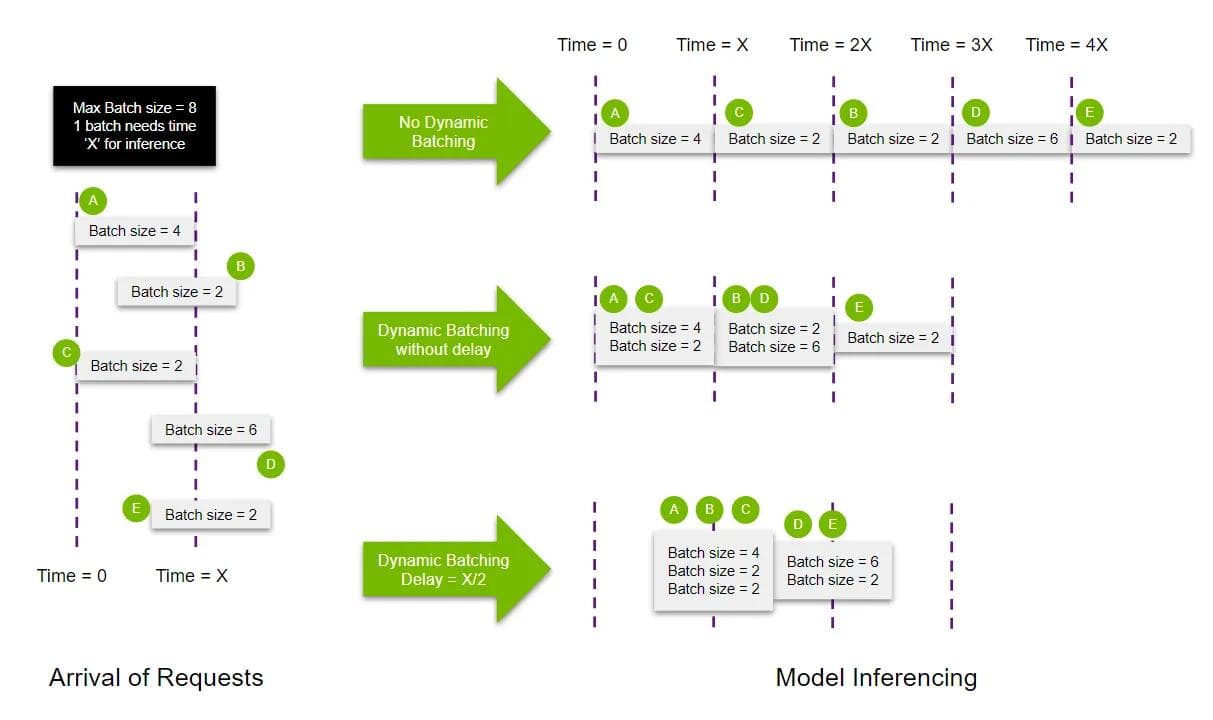
Source: https://github.com/triton-inference-server/tutorials/blob/main/Conceptual_Guide/Part_2-improving_resource_utilization/README.md

Dynamic batching collects incoming requests during a short configurable delay period, then processes them together once either the batch reaches its maximum configured size or the delay expires. This approach reduces inference overhead and maximizes GPU utilization, particularly beneficial in Pinecone’s multi-tenant environment, where customer workloads can vary significantly in batch size and frequency.

The configuration is customized for each model and workload type. For example, multilingual-e5-large has the following configurations:

Query ModelPassage Model
Target Batch Size<1696
Delay Window10ms30ms

The query model uses a shorter delay window to minimize latency for fast, real-time responses, while the passage model employs longer delay windows to accommodate larger batch sizes and maximize throughput for high-volume requests.

Scaling with dedicated query and passage infrastructure

Pinecone deploys separate inference servers for query and passage workloads across most embedding models. This separation ensures real-time query requests—which require consistently low latency—are never delayed by resource-intensive batch passage embedding operations optimized for throughput. By isolating these workloads, each infrastructure path can scale independently, minimizing resource contention and maintaining predictable performance.
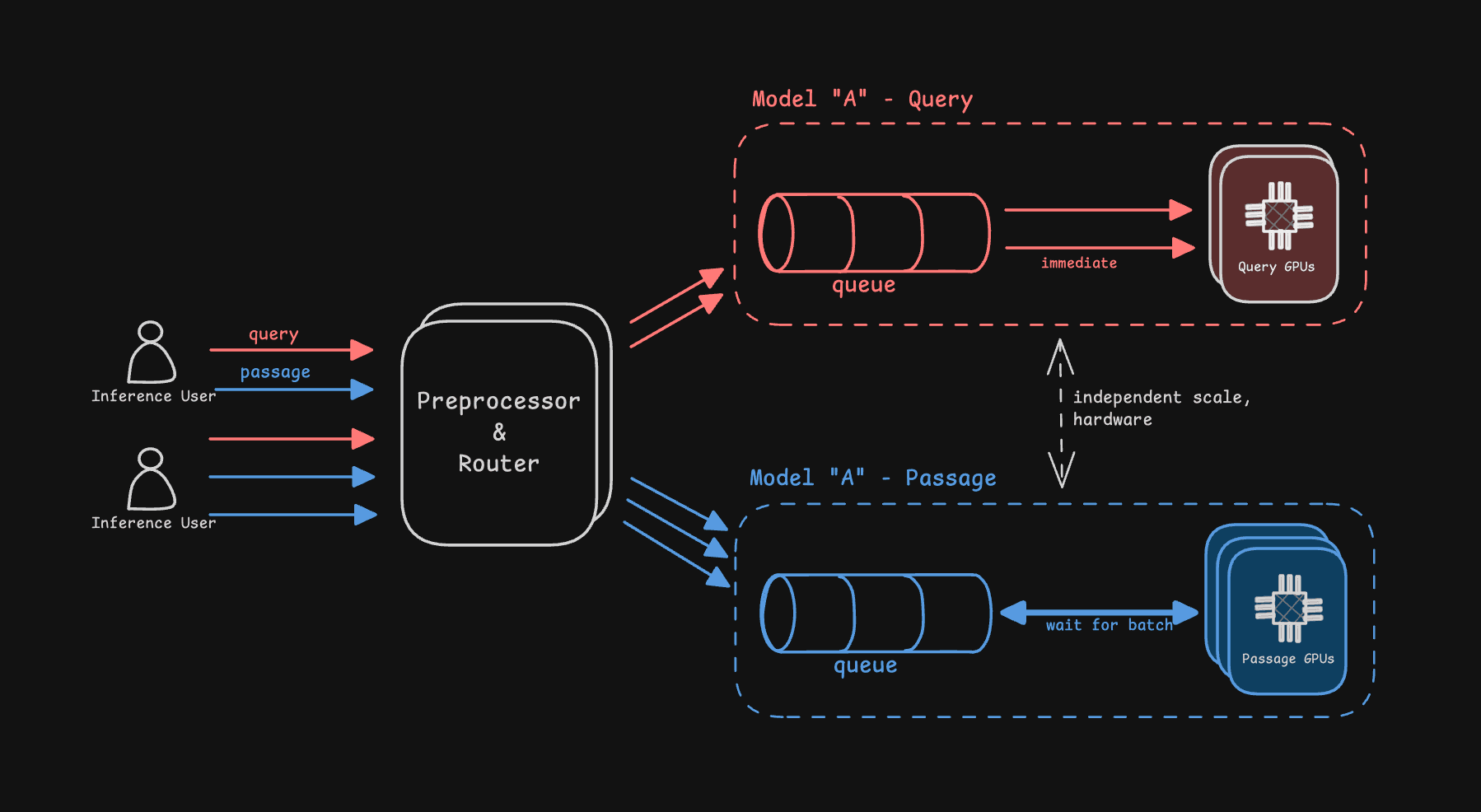
Inference requests are automatically routed to the appropriate infrastructure based on user-defined parameters, including the input_type, number of input sequences, and token length. For instance, a real-time query request configured as follows would be processed on the optimized query infrastructure:

POST https://api.pinecone.io/embed
{
    "model": "llama-text-embed-v2",
    "parameters": {"input_type": "query"},
    "inputs": [
        {"text": "What is the tastiest apple?"}
    ]
}

This dedicated approach enables precise performance tuning—passage processing optimized for maximum throughput and query processing optimized for minimal latency—ensuring efficient resource allocation tailored to each workload.

We can observe the query and passage path separation by comparing the latencies of query requests to those of passage requests under load. This test simulates a large passage embedding job being started while the system is serving 80 queries per second (QPS) in a constant time of <~150ms (measured at client). For simplicity, this test was performed on a single pair of GPUs (1 query, 1 passage) with scaling disabled.
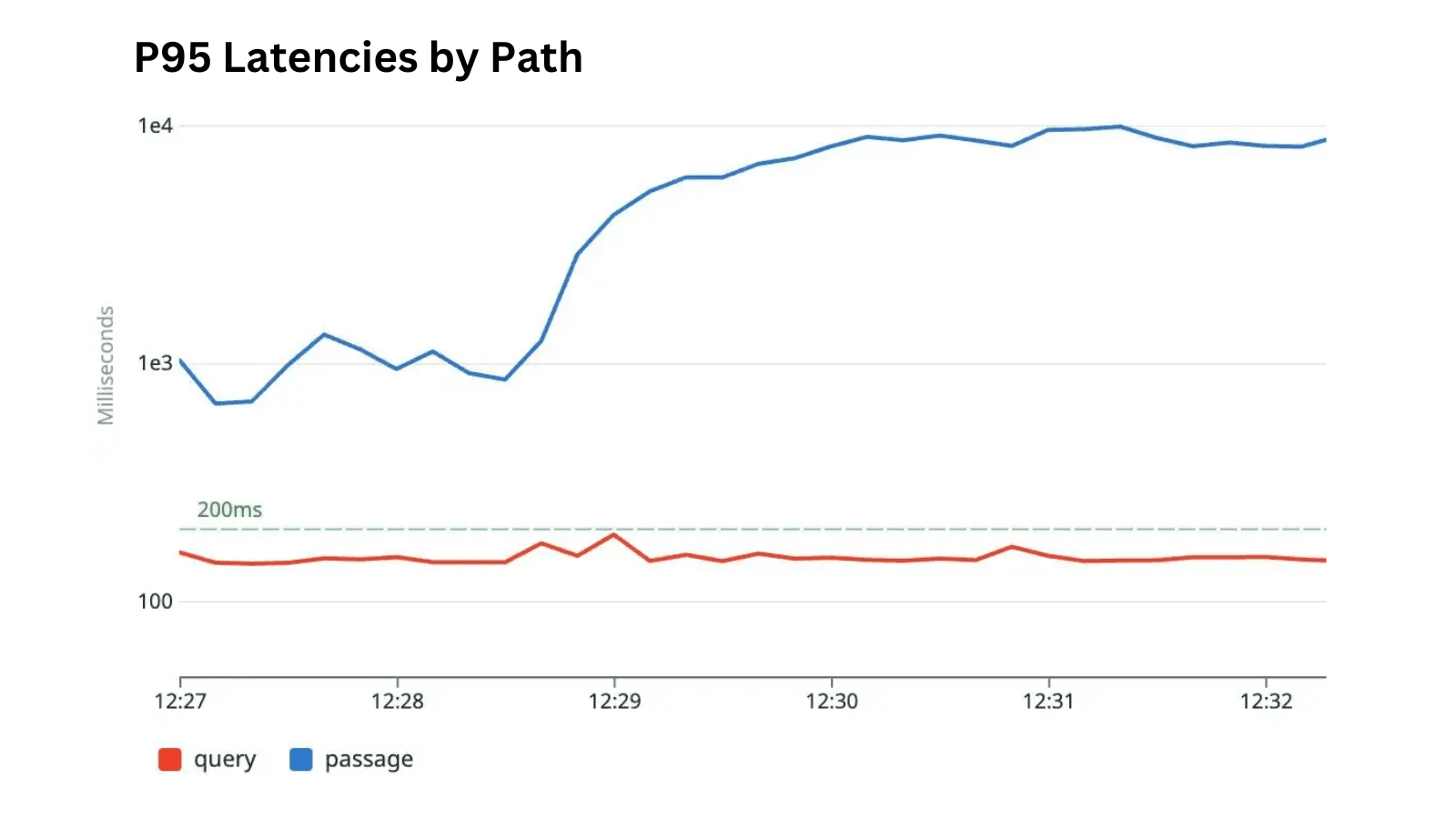
Stable query embedding performance with ramping backfill passage usage.

Importantly, as passage request latencies rise—reflecting the queueing of those additional requests—query path latencies remain steady.

Eliminating complexity with integrated inference

Building Retrieval-Augmented Generation (RAG) and agent-based applications traditionally requires multiple distinct inference and database operations across different service providers. This distributed approach often needs five or more separate API calls per query, introducing integration overhead, increased latency from network calls, and potential security concerns from data movement between services.
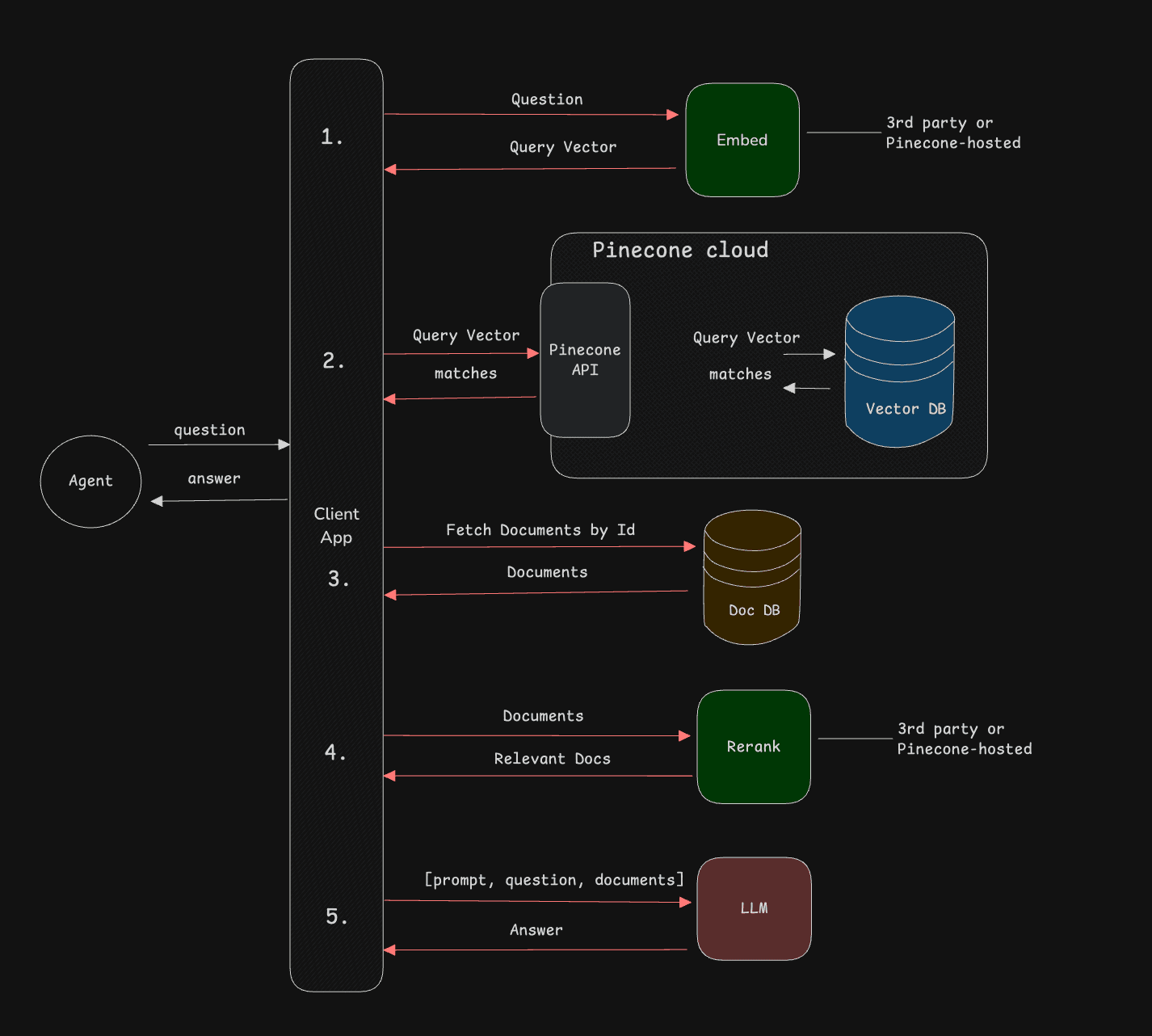
Pinecone’s integrated inference simplifies retrieval application development by consolidating embedding generation, vector search, and reranking into fewer, streamlined API calls. With direct support for state-of-the-art models like llama-text-embed-v2 and cohere-rerank-3.5, developers can achieve advanced retrieval quality without relying on external inference providers. This integration significantly reduces complexity, allowing developers to build high-performing RAG and agent-based applications efficiently using their own data.
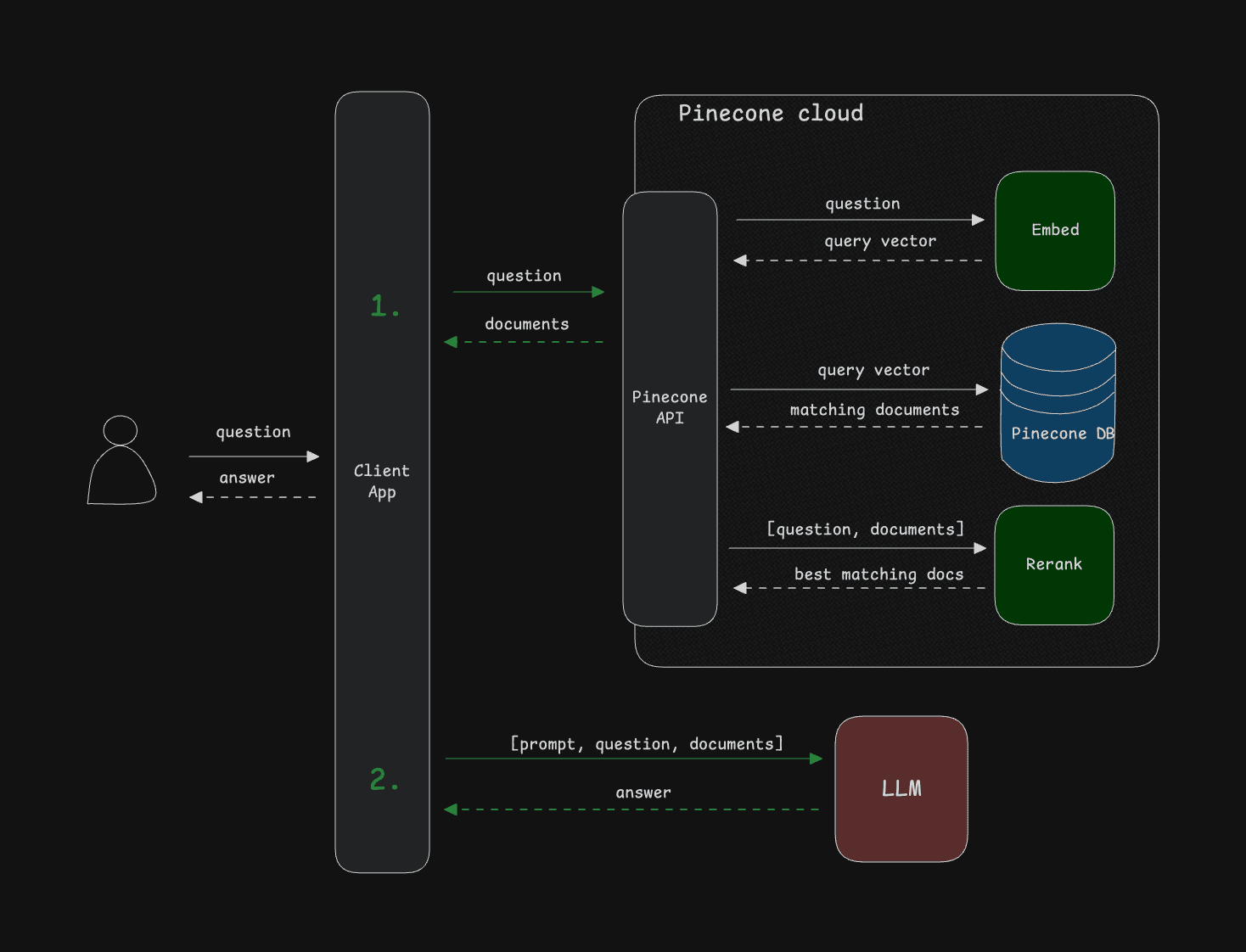
What’s in store

Performance will remain our top priority as we pursue our mission to deliver high-quality, accurate, and fast retrieval. We will deepen our investment in integrated inference by incorporating more advanced retrieval workflows, including Cascading Retrieval, bulk embedding, and expanded support for additional modalities like images.

We'll have lots more to share about all the things we’ve been working on during our upcoming Launch Week, March 17-21. Stay tuned!