





A vector database indexes and stores vector embeddings for fast retrieval and similarity search, with capabilities like CRUD operations, metadata filtering, horizontal scaling, and serverless.
We’re in the midst of the AI revolution. It’s upending any industry it touches, promising great innovations - but it also introduces new challenges. Efficient data processing has become more crucial than ever for applications that involve large language models, generative AI, and semantic search.
All of these new applications rely on vector embeddings, a type of vector data representation that carries within it semantic information that’s critical for the AI to gain understanding and maintain a long-term memory they can draw upon when executing complex tasks.
Embeddings are generated by AI models (such as Large Language Models) and have many attributes or features, making their representation challenging to manage. In the context of AI and machine learning, these features represent different dimensions of the data that are essential for understanding patterns, relationships, and underlying structures.
That is why we need a specialized database designed specifically for handling this data type. Vector databases like Pinecone fulfill this requirement by offering optimized storage and querying capabilities for embeddings. Vector databases have the capabilities of a traditional database that are absent in standalone vector indexes and the specialization of dealing with vector embeddings, which traditional scalar-based databases lack.
The challenge of working with vector data is that traditional scalar-based databases can’t keep up with the complexity and scale of such data, making it difficult to extract insights and perform real-time analysis. That’s where vector databases come into play – they are intentionally designed to handle this type of data and offer the performance, scalability, and flexibility you need to make the most out of your data.
We are seeing the next generation of vector databases introduce more sophisticated architectures to handle the efficient cost and scaling of intelligence. This ability is handled by serverless vector databases, that can separate the cost of storage and compute to enable low-cost knowledge support for AI.
With a vector database, we can add knowledge to our AIs, like semantic information retrieval, long-term memory, and more. The diagram below gives us a better understanding of the role of vector databases in this type of application:
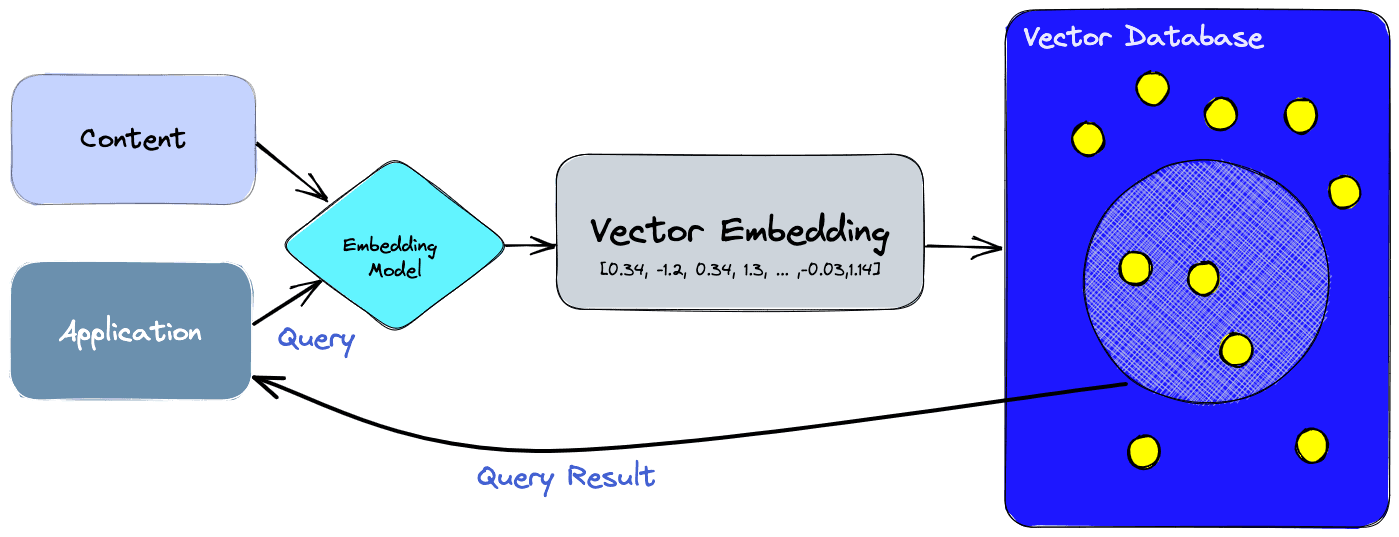
Let’s break this down:
Standalone vector indices like FAISS (Facebook AI Similarity Search) can significantly improve the search and retrieval of vector embeddings, but they lack capabilities that exist in any database. Vector databases, on the other hand, are purpose-built to manage vector embeddings, providing several advantages over using standalone vector indices:
In short, a vector database provides a superior solution for handling vector embeddings by addressing the limitations of standalone vector indices, such as scalability challenges, cumbersome integration processes, and the absence of real-time updates and built-in security measures, ensuring a more effective and streamlined data management experience.
Start using Pinecone for free
Pinecone is the developer-favorite vector database that's fast and easy to use at any scale.
We all know how traditional databases work (more or less)—they store strings, numbers, and other types of scalar data in rows and columns. On the other hand, a vector database operates on vectors, so the way it’s optimized and queried is quite different.
In traditional databases, we are usually querying for rows in the database where the value usually exactly matches our query. In vector databases, we apply a similarity metric to find a vector that is the most similar to our query.
A vector database uses a combination of different algorithms that all participate in Approximate Nearest Neighbor (ANN) search. These algorithms optimize the search through hashing, quantization, or graph-based search.
These algorithms are assembled into a pipeline that provides fast and accurate retrieval of the neighbors of a queried vector. Since the vector database provides approximate results, the main trade-offs we consider are between accuracy and speed. The more accurate the result, the slower the query will be. However, a good system can provide ultra-fast search with near-perfect accuracy.
Here’s a common pipeline for a vector database:

Serverless represents the next evolution of vector databases. The above architectures get us to a vector database architecture that is accurate, fast, scalable, but expensive. This architecture is what we see in first-generation vector DBs. With the rise of AI use cases where cost and elasticity are increasingly important, a second generation of serverless vector databases is needed.
First-generation vector DBs have three critical pain points that a serverless vector database solves:
To separate storage from compute highly sophisticated geometric partitioning algorithms can break an index into sub-indices, allowing us to focus the search on specific partitions:
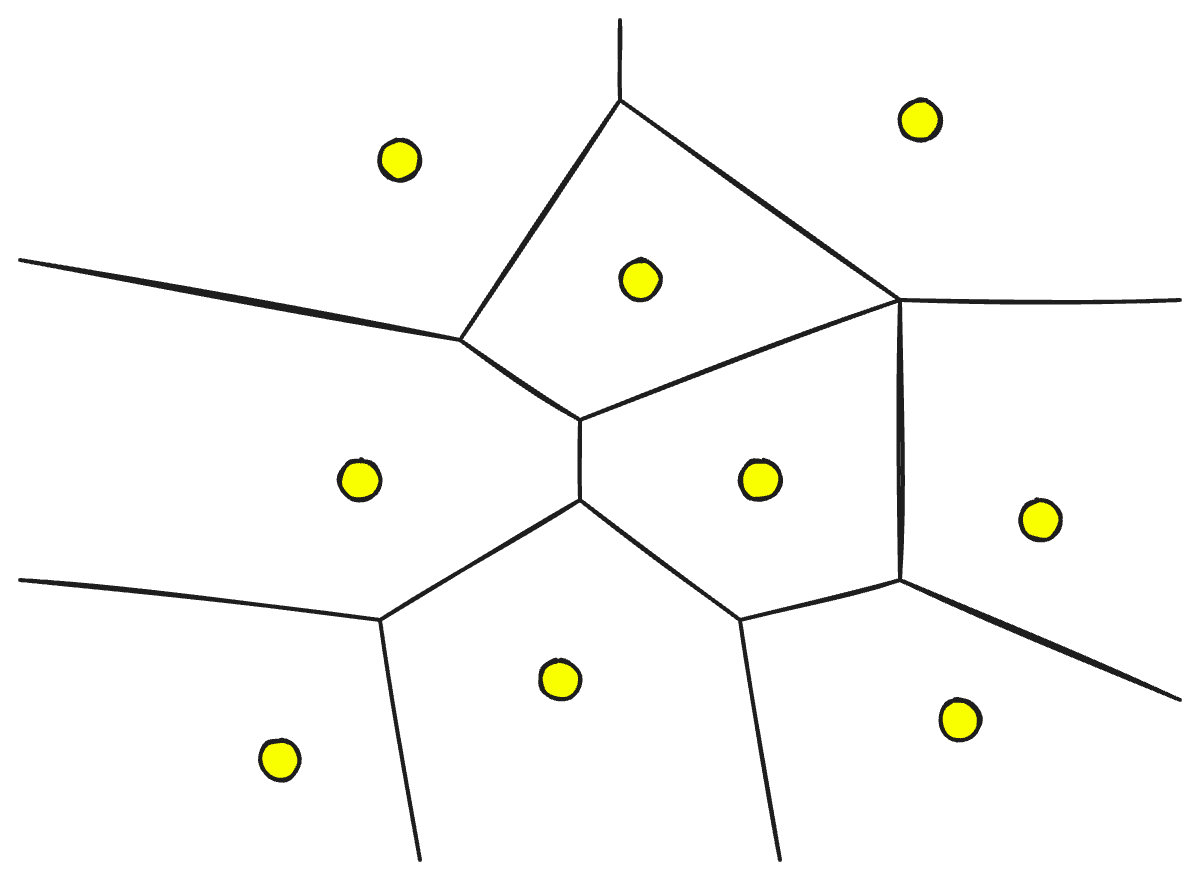
Partitioning of the search space
With these partitions, the search space of a query can focus on just a few parts of a vector index rather than the full search space. Typical search behaviors will show that certain partitions are accessed more frequently than others, allowing us to dial between compute costs and cold startup times to find an optimal balance between cost and latency.
When we do this partitioning, we solve the separation of compute and storage problem. However, geometric partitioning is a slower process at index build time. Meaning we can run into freshness problems as we must wait for new data to be correctly stored in the index.
To solve this problem, a vector database needs another separate layer called a freshness layer. The freshness layer acts as a temporary “cache” of vectors that can be queried. At the same time, we wait for an index builder to place new vectors into the geometrically partitioned index.
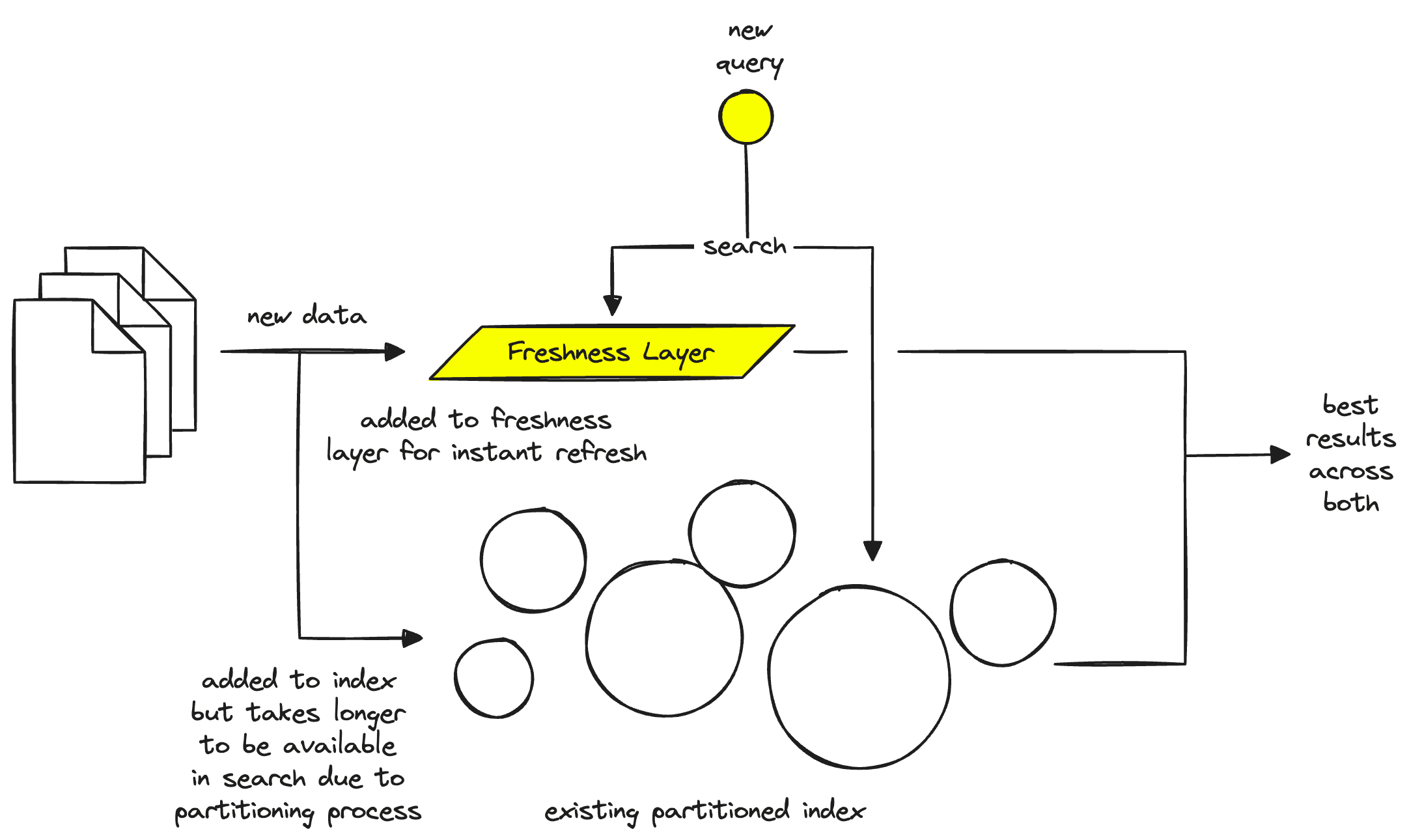
The freshness layer keeps our data up to date so we can begin querying quickly.
During this process, a query router can send queries to both the index and the freshness layer — solving the freshness problem. However, it’s worth noting that the freshness layer exists in compute instances, so we cannot store the full index there. Instead, we wait for the new vectors to be inserted into the index — once complete, they are removed from the freshness layer.
Finally, there is the problem of multi tenancy. Many first-generation vector DBs handle multi tenancy and have done so for a long time. However, multitenancy in a serverless architecture is more complex.
We must avoid colocating different types of users on the same hardware to keep costs and latencies low. If we have user A, who makes 20 queries a second almost every day on the same hardware as user B who makes 20 queries a month, user B will be stuck on compute hardware 24/7 as that is required for the constantly low latencies that user A needs.
To cover this problem, a vector database must be able to identify users with similar usage and colocate them while keeping full separation between them. Again, this can be done based on user usage metrics and automatic allocation of hot/cold infrastructure based on usage.
Taking a first-generation vector database and adding separation of storage from computing, multitenancy, and freshness gives us a new generation of modern vector databases. This architecture (paired with vector DB fundamentals) is preferred for the modern AI stack.
In the following sections, we will discuss a few of the algorithms behind the fundamentals of vector DBs and explain how they contribute to the overall performance of our database.
Several algorithms can facilitate the creation of a vector index. Their common goal is to enable fast querying by creating a data structure that can be traversed quickly. They will commonly transform the representation of the original vector into a compressed form to optimize the query process.
However, as a user of Pinecone, you don’t need to worry about the intricacies and selection of these various algorithms. Pinecone is designed to handle all the complexities and algorithmic decisions behind the scenes, ensuring you get the best performance and results without any hassle. By leveraging Pinecone’s expertise, you can focus on what truly matters – extracting valuable insights and delivering powerful AI solutions.
The following sections will explore several algorithms and their unique approaches to handling vector embeddings. This knowledge will empower you to make informed decisions and appreciate the seamless performance Pinecone delivers as you unlock the full potential of your application.
The basic idea behind random projection is to project the high-dimensional vectors to a lower-dimensional space using a random projection matrix. We create a matrix of random numbers. The size of the matrix is going to be the target low-dimension value we want. We then calculate the dot product of the input vectors and the matrix, which results in a projected matrix that has fewer dimensions than our original vectors but still preserves their similarity.
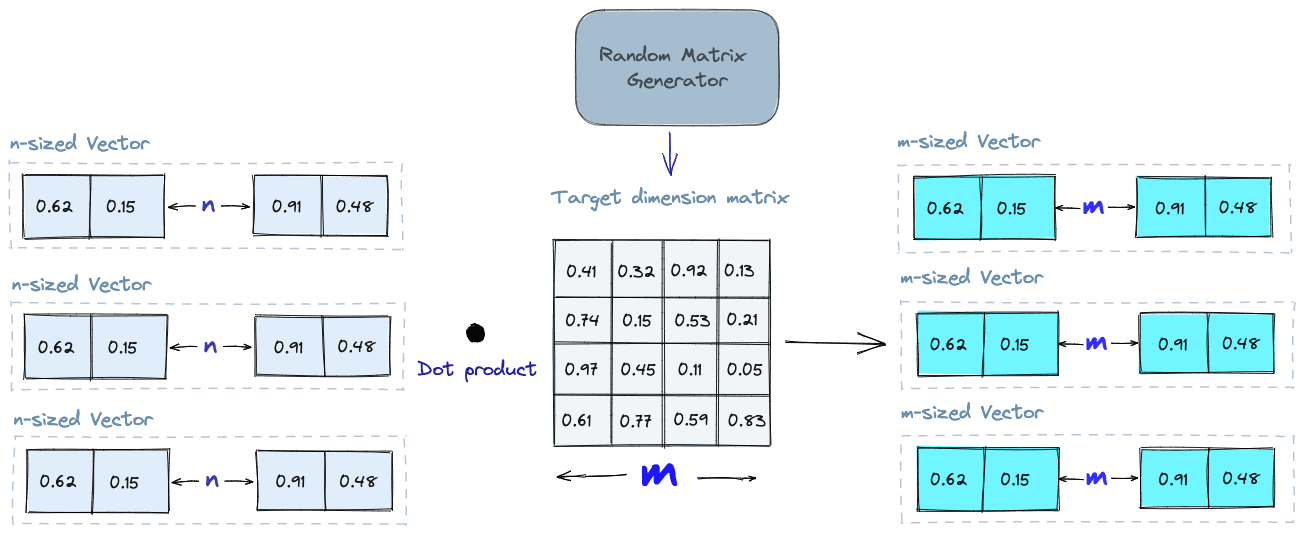
When we query, we use the same projection matrix to project the query vector onto the lower-dimensional space. Then, we compare the projected query vector to the projected vectors in the database to find the nearest neighbors. Since the dimensionality of the data is reduced, the search process is significantly faster than searching the entire high-dimensional space.
Just keep in mind that random projection is an approximate method, and the projection quality depends on the properties of the projection matrix. In general, the more random the projection matrix is, the better the quality of the projection will be. But generating a truly random projection matrix can be computationally expensive, especially for large datasets. Learn more about random projection.
Another way to build an index is product quantization (PQ), which is a lossy compression technique for high-dimensional vectors (like vector embeddings). It takes the original vector, breaks it up into smaller chunks, simplifies the representation of each chunk by creating a representative “code” for each chunk, and then puts all the chunks back together - without losing information that is vital for similarity operations. The process of PQ can be broken down into four steps: splitting, training, encoding, and querying.
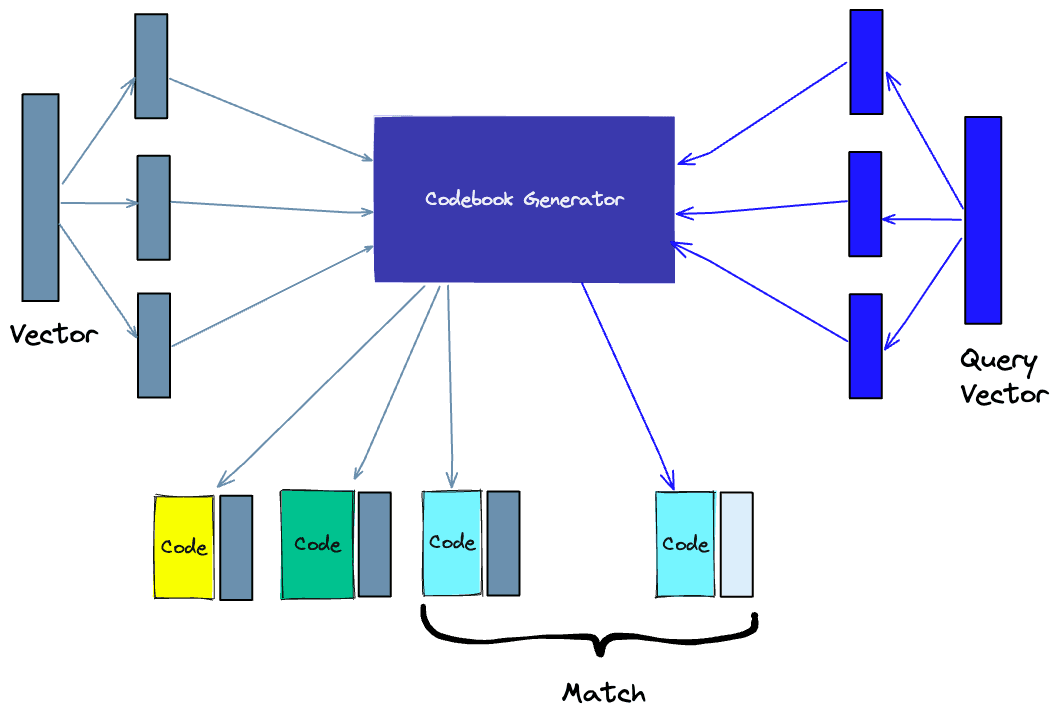
The number of representative vectors in the codebook is a trade-off between the accuracy of the representation and the computational cost of searching the codebook. The more representative vectors in the codebook, the more accurate the representation of the vectors in the subspace, but the higher the computational cost to search the codebook. By contrast, the fewer representative vectors in the codebook, the less accurate the representation, but the lower the computational cost. Learn more about PQ.
Locality-Sensitive Hashing (LSH) is a technique for indexing in the context of an approximate nearest-neighbor search. It is optimized for speed while still delivering an approximate, non-exhaustive result. LSH maps similar vectors into “buckets” using a set of hashing functions, as seen below:
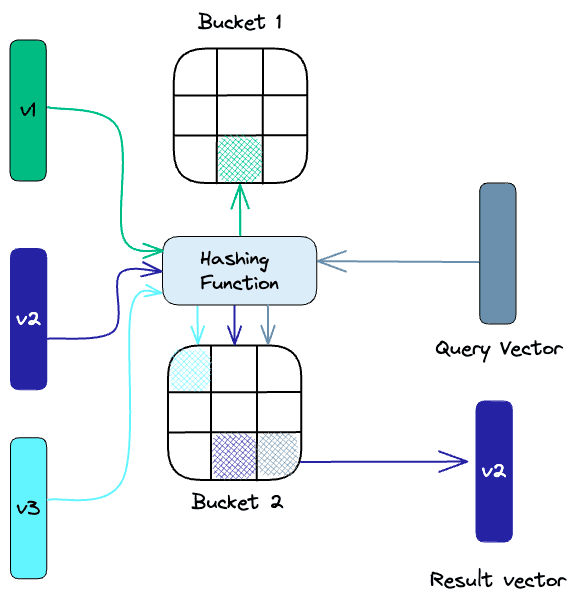
To find the nearest neighbors for a given query vector, we use the same hashing functions used to “bucket” similar vectors into hash tables. The query vector is hashed to a particular table and then compared with the other vectors in that same table to find the closest matches. This method is much faster than searching through the entire dataset because there are far fewer vectors in each hash table than in the whole space.
It’s important to remember that LSH is an approximate method, and the quality of the approximation depends on the properties of the hash functions. In general, the more hash functions used, the better the approximation quality will be. However, using a large number of hash functions can be computationally expensive and may not be feasible for large datasets. Learn more about LSH.
Start using Pinecone
Pinecone is the developer-favorite vector database that's fast and easy to use at any scale.
HNSW creates a hierarchical, tree-like structure where each node of the tree represents a set of vectors. The edges between the nodes represent the similarity between the vectors. The algorithm starts by creating a set of nodes, each with a small number of vectors. This could be done randomly or by clustering the vectors with algorithms like k-means, where each cluster becomes a node.
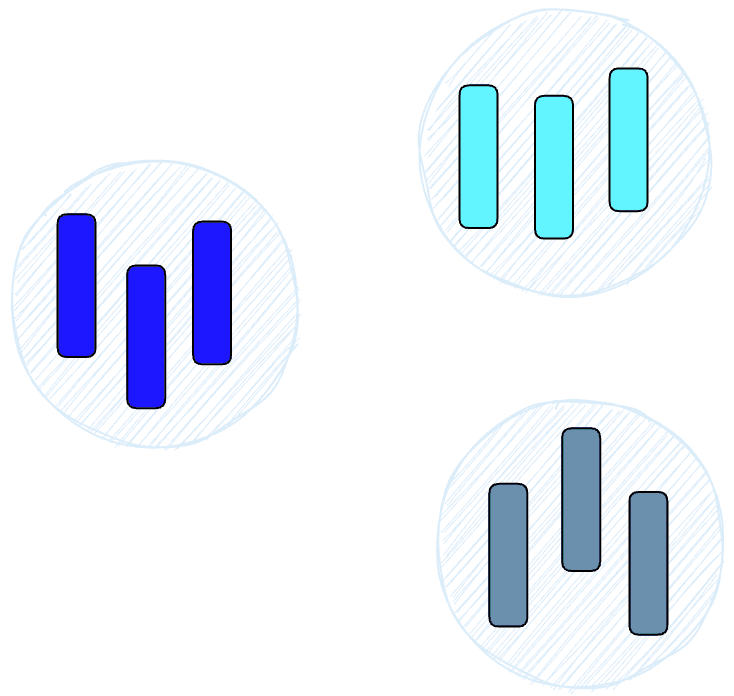
The algorithm then examines the vectors of each node and draws an edge between that node and the nodes that have the most similar vectors to the one it has.
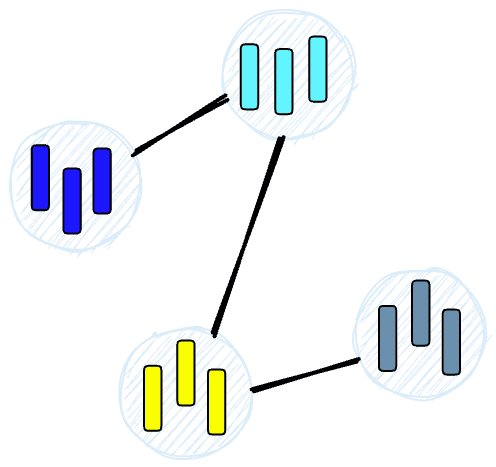
When we query an HNSW index, it uses this graph to navigate through the tree, visiting the nodes that are most likely to contain the closest vectors to the query vector. Learn more about HNSW.
Building on the previously discussed algorithms, we need to understand the role of similarity measures in vector databases. These measures are the foundation of how a vector database compares and identifies the most relevant results for a given query.
Similarity measures are mathematical methods for determining how similar two vectors are in a vector space. Similarity measures are used in vector databases to compare the vectors stored in the database and find the ones that are most similar to a given query vector.
Several similarity measures can be used, including:
The choice of similarity measure will have an effect on the results obtained from a vector database. It is also important to note that each similarity measure has its own advantages and disadvantages, and it is important to choose the right one depending on the use case and requirements. Learn more about similarity measures.
Every vector stored in the database also includes metadata. In addition to the ability to query for similar vectors, vector databases can also filter the results based on a metadata query. To do this, the vector database usually maintains two indexes: a vector index and a metadata index. It then performs the metadata filtering either before or after the vector search itself, but in either case, there are difficulties that cause the query process to slow down.
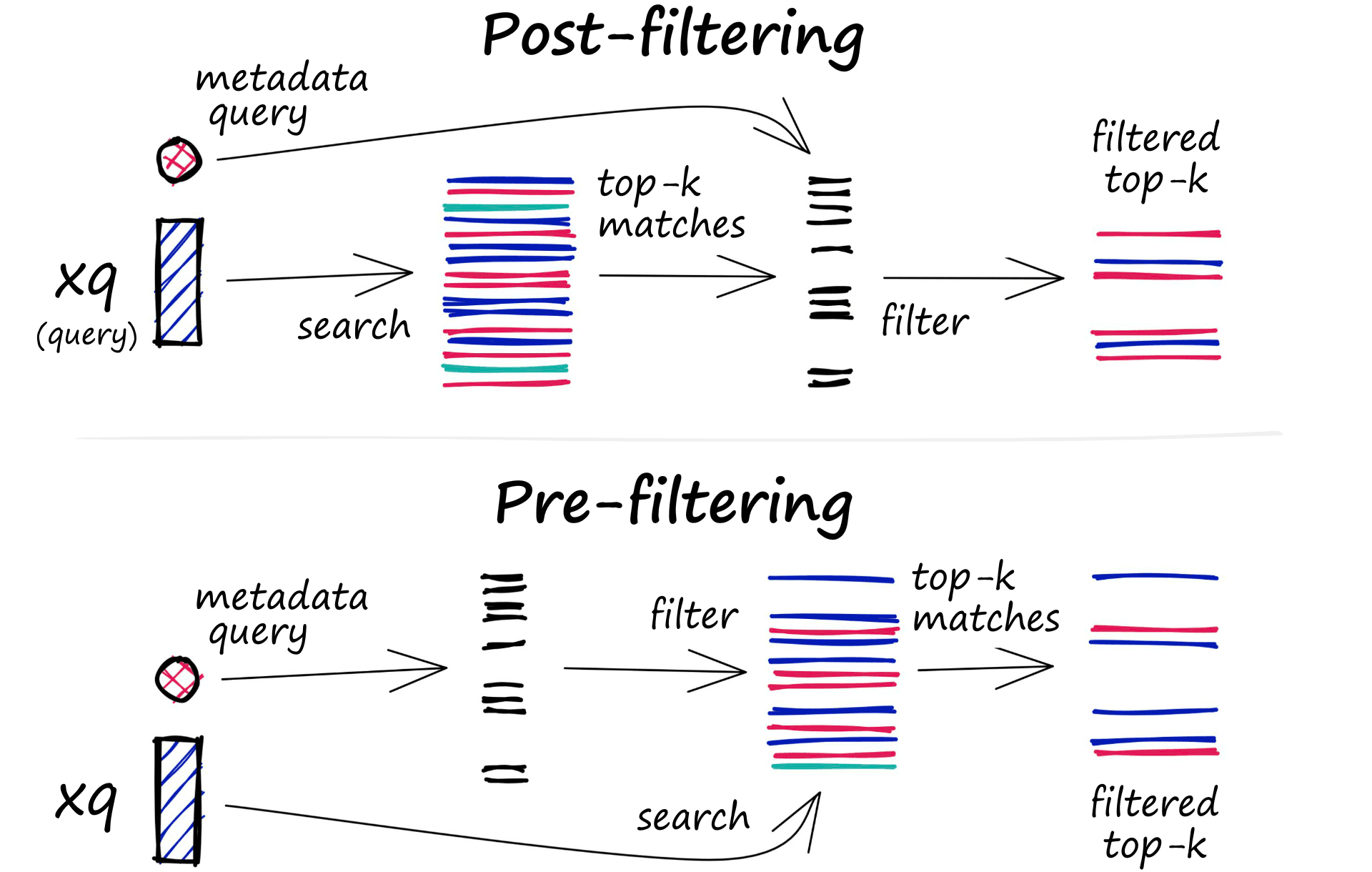
The filtering process can be performed either before or after the vector search itself, but each approach has its own challenges that may impact the query performance:
To optimize the filtering process, vector databases use various techniques, such as leveraging advanced indexing methods for metadata or using parallel processing to speed up the filtering tasks. Balancing the trade-offs between search performance and filtering accuracy is essential for providing efficient and relevant query results in vector databases. Learn more about vector search filtering.
Unlike vector indexes, vector databases are equipped with a set of capabilities that makes them better qualified to be used in high scale production settings. Let’s take a look at an overall overview of the components that are involved in operating the database.
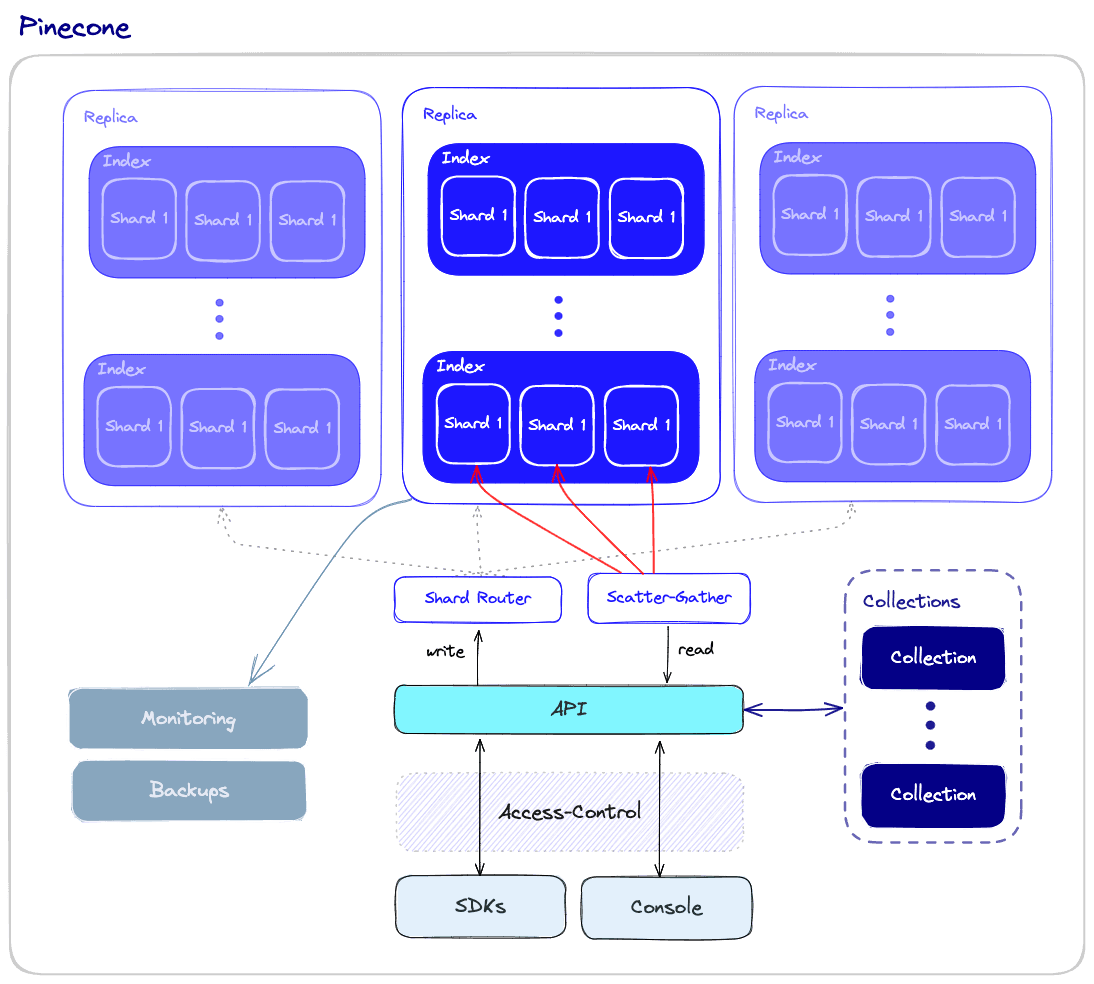
Performance and fault tolerance are tightly related. The more data we have, the more nodes that are required - and the bigger chance for errors and failures. As is the case with other types of databases, we want to ensure that queries are executed as quickly as possible even if some of the underlying nodes fail. This could be due to hardware failures, network failures, or other types of technical bugs. This kind of failure could result in downtime or even incorrect query results.
To ensure both high performance and fault tolerance, vector databases use sharding and replication apply the following:
To effectively manage and maintain a vector database, we need a robust monitoring system that tracks the important aspects of the database’s performance, health, and overall status. Monitoring is critical for detecting potential problems, optimizing performance, and ensuring smooth production operations. Some aspects of monitoring a vector database include the following:
Access control is the process of managing and regulating user access to data and resources. It is a vital component of data security, ensuring that only authorized users have the ability to view, modify, or interact with sensitive data stored within the vector database.
Access control is important for several reasons:
When all else fails, vector databases offer the ability to rely on regularly created backups. These backups can be stored on external storage systems or cloud-based storage services, ensuring the safety and recoverability of the data. In case of data loss or corruption, these backups can be used to restore the database to a previous state, minimizing downtime and impact on the overall system. With Pinecone, users can choose to back up specific indexes as well and save them as “collections,” which can later be used to populate new indexes.
This is where the rubber meets the road: Developers who interact with the database want to do so with an easy-to-use API, using a toolset that is familiar and comfortable. By providing a user-friendly interface, the vector database API layer simplifies the development of high-performance vector search applications.
In addition to the API, vector databases would often provide programming language specific SDKs that wrap the API. The SDKs make it even easier for developers to interact with the database in their applications. This allows developers to concentrate on their specific use cases, such as semantic text search, generative question-answering, hybrid search, image similarity search, or product recommendations, without having to worry about the underlying infrastructure complexities.
The exponential growth of vector embeddings in fields such as NLP, computer vision, and other AI applications has resulted in the emergence of vector databases as the computation engine that allows us to interact effectively with vector embeddings in our applications.
Vector databases are purpose-built databases that are specialized to tackle the problems that arise when managing vector embeddings in production scenarios. For that reason, they offer significant advantages over traditional scalar-based databases and standalone vector indexes.
In this post, we reviewed the key aspects of a vector database, including how it works, what algorithms it uses, and the additional features that make it operationally ready for production scenarios. We hope this helps you understand the inner workings of vector databases. Luckily, this isn’t something you must know to use Pinecone. Pinecone takes care of all of these considerations (and then some) and frees you to focus on the rest of your application.
Vector databases are foundational infrastructure. For the agent-era category that runs on top of them, see knowledge engine architecture.
此内容由惯性聚合(RSS阅读器)自动聚合整理,仅供阅读参考。 原文来自 — 版权归原作者所有。