





Oded Sagie is VP of R&D for Aquant, an agentic AI platform purpose-built for professionals servicing complex equipment at large manufacturing companies. He has spent nearly two decades leading teams that transform data into intelligent, scalable systems. While his engineering instincts drive him to build, his leadership experience has taught him when building becomes a distraction from creating business value.
When Aquant began scaling its AI-driven service solutions, Oded faced a decision that every technical leader eventually confronts: Should we build our own vector database, or buy one?
We used to build our own vector DB. But you end up with an elephant you’re stuck with for years. — Oded Sagie, vice president of product and R&D at Aquant
That single sentence captures a truth many AI teams discover too late: what feels like freedom at the start — building your own stack — can become a long-term liability when the system succeeds.
At first glance, building seems like the obvious choice. Open-source vector databases are available, seemingly for free, and every engineer wants to tailor systems precisely to their needs.
But there’s a gap between standing something up and running it in production at scale.
Building your own means taking responsibility for:
For most teams, these tasks add up to at least one full-time engineer (~$200K/year), and that’s before counting opportunity cost. Every hour spent debugging distributed search is an hour not spent improving the product.
You can only get so far when you’re developing something that’s not your core business. Our real innovation happens when our engineers are free to focus on problems unique to our domain — not reinventing infrastructure. — Oded Sagie, vice president of product and R&D at Aquant
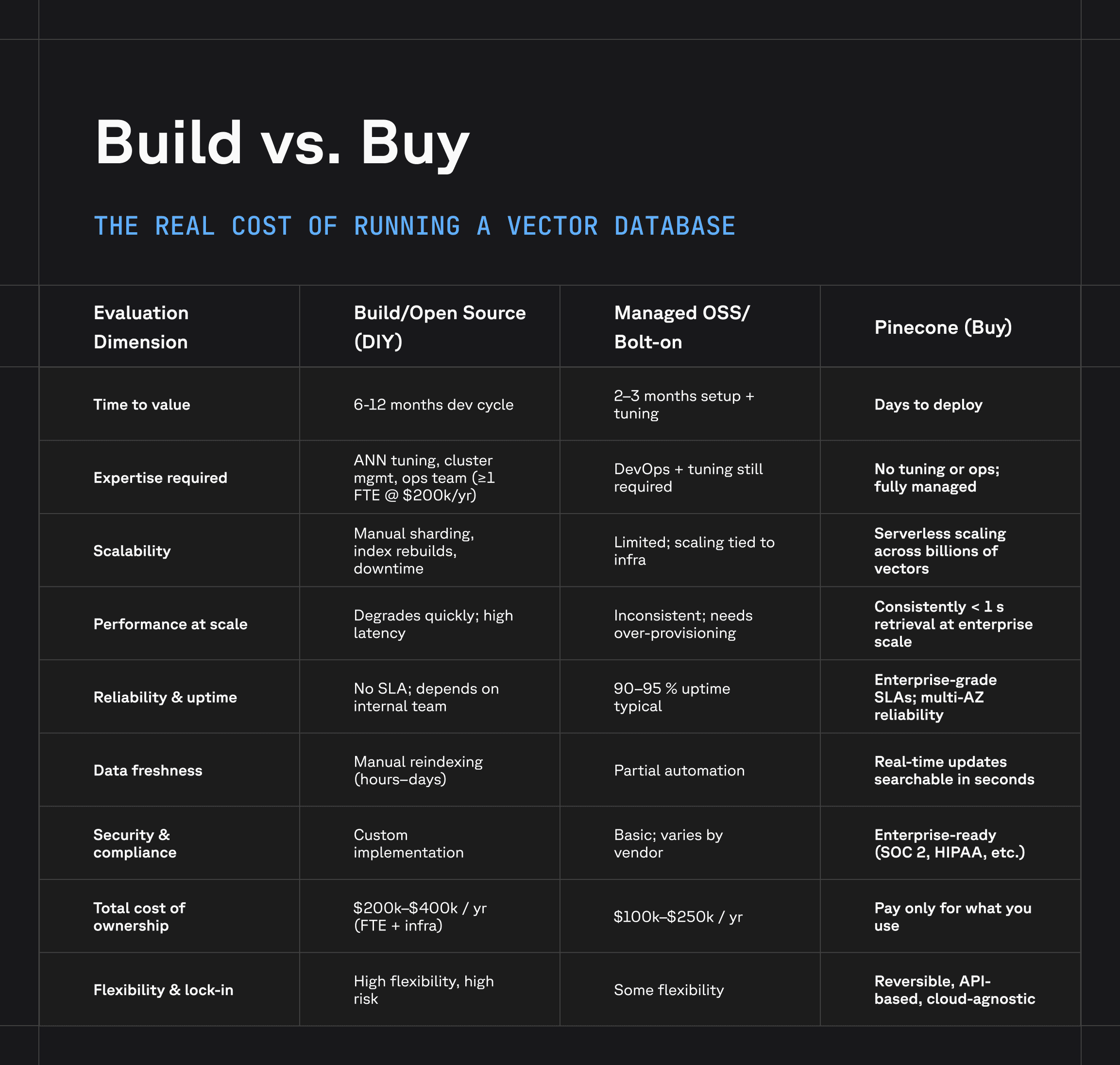
In the early stages, the cost of building seems manageable. But as workloads grow, those costs compound invisibly:
Eventually, what began as a small internal project evolves into what Oded calls “an elephant” that’s large, immovable, and expensive to feed.
At enterprise scale, these burdens directly impact business performance. Retrieval latency rises, engineering agility drops, and customer-facing AI experiences degrade.
Open-source systems are rarely free. They simply move the cost from a vendor invoice to a payroll line item.
For Aquant, and many others, this realization came when they ran the numbers:
The total cost of ownership is only visible after you pick the solution, pilot it, and deploy it. Then you start to see what it really costs to maintain. The challenge — and opportunity — is to see those patterns early and make data-driven platform decisions before scale magnifies the pain. — Oded Sagie, vice president of product and R&D at Aquant
In contrast, buying a managed vector database shifts those hidden costs into a predictable, usage-based model. You pay for what you use, not for the expertise and infrastructure you have to maintain yourself.
Oded isn’t dogmatic. Aquant still builds where it makes sense, especially for small, non-core components that don’t risk production reliability.
When the feature isn’t significant to the infrastructure, open source is perfect. But for foundational building blocks, I’d rather trust an enterprise-ready tool. That balance — knowing what to build, what to buy, and when to pivot is one of the most critical calls in scaling AI systems. — Oded Sagie, vice president of product and R&D at Aquant
That’s how Aquant came to see Pinecone as an exception. It’s one of the few “table-stakes” vendors they trust at the foundation of their AI stack.
By partnering with Pinecone, Aquant’s team shifted its focus back to what truly differentiates their business: applying nearly a decade of service AI expertise to deliver faster answers and smarter recommendations for customers.
Aquant’s decision isn’t unique. Across industries, teams that begin with open source often reach the same inflection point:
That’s when buying becomes not just easier, but smarter.
When choosing infrastructure for AI workloads, cost isn’t only measured in dollars. It’s measured in time, expertise, opportunity, and momentum.
The hidden cost of building is the distance between where your engineers spend their time and where your business creates value.
And as Aquant learned, that distance can be the difference between an AI prototype and an AI-powered product that scales.
Building feels empowering, until it’s all you’re doing.
The fastest way to create value from your data is to partner with those who’ve already solved the hardest problems.
此内容由惯性聚合(RSS阅读器)自动聚合整理,仅供阅读参考。 原文来自 — 版权归原作者所有。