

惯性聚合 高效追踪和阅读你感兴趣的博客、新闻、科技资讯
阅读原文 在惯性聚合中打开

推荐订阅源

云风的 BLOG
云风的 BLOG
IT之家
IT之家
OSCHINA 社区最新新闻
OSCHINA 社区最新新闻
V
Visual Studio Blog
博客园 - 司徒正美
美团技术团队
Last Week in AI
Last Week in AI
月光博客
月光博客
博客园 - 叶小钗
MongoDB | Blog
MongoDB | Blog
U
Unit 42
T
Tailwind CSS Blog
GbyAI
GbyAI
T
The Blog of Author Tim Ferriss
CTFtime.org: upcoming CTF events
H
Hackread – Cybersecurity News, Data Breaches, AI and More
酷 壳 – CoolShell
酷 壳 – CoolShell
Google DeepMind News
H
Help Net Security
Hugging Face - Blog
Hugging Face - Blog
爱范儿
爱范儿
freeCodeCamp Programming Tutorials: Python, JavaScript, Git & More
N
Netflix TechBlog - Medium
B
Blog RSS Feed
大猫的无限游戏
大猫的无限游戏
aimingoo的专栏
aimingoo的专栏
A
About on SuperTechFans
Y
Y Combinator Blog
罗磊的独立博客
D
DataBreaches.Net
有赞技术团队
有赞技术团队
MyScale Blog
MyScale Blog
博客园_首页
博客园 - 三生石上(FineUI控件)
G
Google Developers Blog
让小产品的独立变现更简单 - ezindie.com
雷峰网
雷峰网
博客园 - 【当耐特】
Engineering at Meta
Engineering at Meta
博客园 - Franky
M
MIT News - Artificial intelligence
B
Blog
The Cloudflare Blog
Apple Machine Learning Research
I
InfoQ
S
SegmentFault 最新的问题
F
Fortinet All Blogs
阮一峰的网络日志
阮一峰的网络日志
Stack Overflow Blog
Stack Overflow Blog
Microsoft Security Blog

Pinecone

Pinecone Assistant: A Managed Knowledge Layer for Production AI Applications Multi-domain RAG in n8n: why one knowledge base is not enough Allspice Transforms the Culinary Experience with Semantic Search Powered by Pinecone | Pinecone Building RAG workflows in n8n: choosing the right Pinecone node Knowledge needs a meta-knowledge layer Garbage Day: How Pinecone Safely Deletes Billions of Objects at Scale When "Performance" Means Two Different Things Pinecone BYOC: Pinecone in your AWS, GCP, or Azure account, no vendor access True, Relevant, and Wrong: The Applicability Problem in RAG Use the Pinecone Plugin for Claude Code to develop AI Applications Faster Millions at Stake: How Melange's High-Recall Retrieval Prevents Litigation Collapse Powering High-stakes Patent Search at Scale: How Melange Built a Reliable AI System on Pinecone | Pinecone Pinecone Assistant Node in n8n: Turn Any Data Source Into Knowledge RAG with Access Control Pinecone Dedicated Read Nodes are now in Public Preview Inside Pinecone: Slab Architecture New Bulk Data Operations: Update, Delete, and Fetch by Metadata The Hidden Cost of Building: Lessons from Aquant Simplifying Vector Embeddings with Pinecone Integrated Inference Capabilities Pinecone joins Microsoft Marketplace as a Launch Partner GTM Engineering: Clay + Pinecone for AI-powered Sales Outbound Build an AI knowledge assistant with Google Docs and Pinecone Moving Pinecone forward with Ash Ashutosh as CEO and Edo spearheading our growing AI ambitions as Chief Scientist Pinecone Founder Edo Liberty to Spearhead Pinecone’s Growing AI Ambitions; Appoints Ash Ashutosh as CEO to Expand Vector Database Market Leadership Fast, Accurate Retrieval for Creators at Scale: Delphi’s Path Toward a Million Conversational Agents with Pinecone | Pinecone Announcing Pinecone Pioneers: A Program for Builders, Organizers, and Community Leaders What is Context Engineering? Chunking Strategies for LLM Applications Beyond the hype: Why RAG remains essential for modern AI Obviant Makes 30% More Accurate Defense Acquisition Recommendations Combining Sparse and Dense Retrieval with Pinecone | Pinecone Build more knowledgeable AI applications with new LLMs and greater control in Pinecone Assistant #NYTECHWEEK 2025 Retrieval-Augmented Generation (RAG) Accurate and Efficient Metadata Filtering in Pinecone’s Serverless Vector Database | Pinecone Terminal X AI Agents, Powered by Pinecone, Turn Complex Financial Data Into Production-grade Insights at Scale | Pinecone Aquant Delivers Scalable, Expert-level Service Intelligence with Pinecone | Pinecone Cascading retrieval with multi-vector representations: balancing efficiency and effectiveness Vector databases aren't just for large-scale enterprise AI Unveiling DIME: Reproducibility, Scalability, and Formal Analysis of Dimension Importance Estimation for Dense Retrieval | Pinecone Fast and Effective Early Termination for Simple Ranking Functions | Pinecone Domain-specific AI Agents at Scale: CustomGPT.ai Serves 10,000+ Customers with Pinecone | Pinecone Using Pinecone asynchronously with FastAPI A Flexible Resource for Top-Weighted Comparisons Between Sets and Rankings | Pinecone Build secure, scalable agentic AI workflows with Rubrik Annapurna and Pinecone Tool up: Pinecone’s first MCP servers are here Add context to your agent with Pinecone Assistant MCP remote server E2Rank: Efficient and Effective Layer-wise Reranking | Pinecone ColBERT-serve: Efficient Multi-Stage Memory-Mapped Scoring | Pinecone Efficient Constant-Space Multi-Vector Retrieval | Pinecone How Vanguard Worked with Pinecone to Boost Customer Support with Faster Calls and 12% More Accurate Responses | Pinecone Pinecone Named to Fast Company's Annual List of the World's Most Innovative Companies of 2025 Launch Week: Pinecone for agents, search, recommendations, and more Optimizing Pinecone for agents (and more) Retrieval Inference for scale and performance How 1up Turns Sales Reps Into Product Experts with Pinecone | Pinecone Don’t be dense: Launching sparse indexes in Pinecone Unlock High-Precision Keyword Search with pinecone-sparse-english-v0 Evolving Pinecone's architecture to meet the demands of Knowledgeable AI Pinpoint references faster with citation highlights in Pinecone Assistant Bringing the leading vector database to your cloud Getting started with llama-text-embed-v2 Natural Language Counterfactual Explanations for Graphs Using Large Language Models | Pinecone Easily build knowledgeable chat and agent-based applications in minutes with Pinecone Assistant, now generally available How to build an agentic, chat or RAG knowledge system using Pinecone Assistant Real-time RAG with Pinecone and Estuary Flow BigQuery to Pinecone in Real-Time with Estuary Flow Stravito Turns Market and Consumer Data Into Actionable Insights with Pinecone Inference | Pinecone Accelerate prototyping and development with Pinecone Local First-of-its-kind Pinecone Knowledge Platform to Power Best-in-class Retrieval for Customers Introducing integrated inference: Embed, rerank, and retrieve your data with a single API Strengthening security and increasing control with CMEK and API key roles Introducing Pinecone Rerank V0 Introducing cascading retrieval: Unifying dense and sparse with reranking From Idea to Action: How Pinecone Assistant Meaningfully Accelerates AI Business Building AI apps on Azure with Pinecone just got a lot easier Building a reliable, curated, and accurate RAG system with Cleanlab and Pinecone Four features of the Assistant API you aren't using - but should Deploying Pinecone with Infrastructure as Code (IaC) Streamlining CI/CD with Pinecone Local September 2024 Product Update Results of the Big ANN: NeurIPS'23 competition | Pinecone Introducing import from object storage for more efficient data transfer to Pinecone serverless Simplify, enhance, and evaluate RAG development with Pinecone Assistant, now in public preview Vectors and Graphs: Better Together August 2024 Product Update Pinecone Helps Deep Talk Deliver World-Class AI Assistants with Lower Engineering Overhead | Pinecone Assembled Delivers Better, Faster AI- Driven Support with Pinecone | Pinecone Llama 3.1 Agent using LangGraph and Ollama Build knowledgeable AI with Pinecone serverless, now generally available on Microsoft Azure Pinecone serverless is now generally available on Google Cloud, adding knowledge to AI assistants and other applications Accelerating Legal Discovery and Analysis with Pinecone and Voyage AI Bridging Dense and Sparse Maximum Inner Product Search | Pinecone Refine Retrieval Quality with Pinecone Rerank Introducing reranking to Pinecone Inference to simplify building accurate AI July 2024 Product Update Connect to Pinecone within your platform to enable a seamless AI development experience Introducing Pinecone API Versioning RAG Brag with Inkeep Co-Founder Nick Gomez LangGraph and Research Agents Introducing Pinecone Inference to streamline your AI workflow
Benchmarking AI Assistants
Nathan Cordeiro, Roy Miara, Amnon Catav · 2024-06-25 · via Pinecone

Pinecone Assistant is a fully managed service that abstracts away the many systems and steps required to build an AI assistant for knowledge-intensive tasks over private data.

Our focus is on delivering the highest-quality and dependable answers over private data. As with every R&D effort, we needed a benchmark. Both for tracking internal progress and comparing with alternative approaches. There was just one problem: How do you measure the answer quality of an AI assistant, which itself is made up of interconnected components that don’t all have established benchmarks?

For context, here are just some of the many parts that power Pinecone Assistant under the hood.
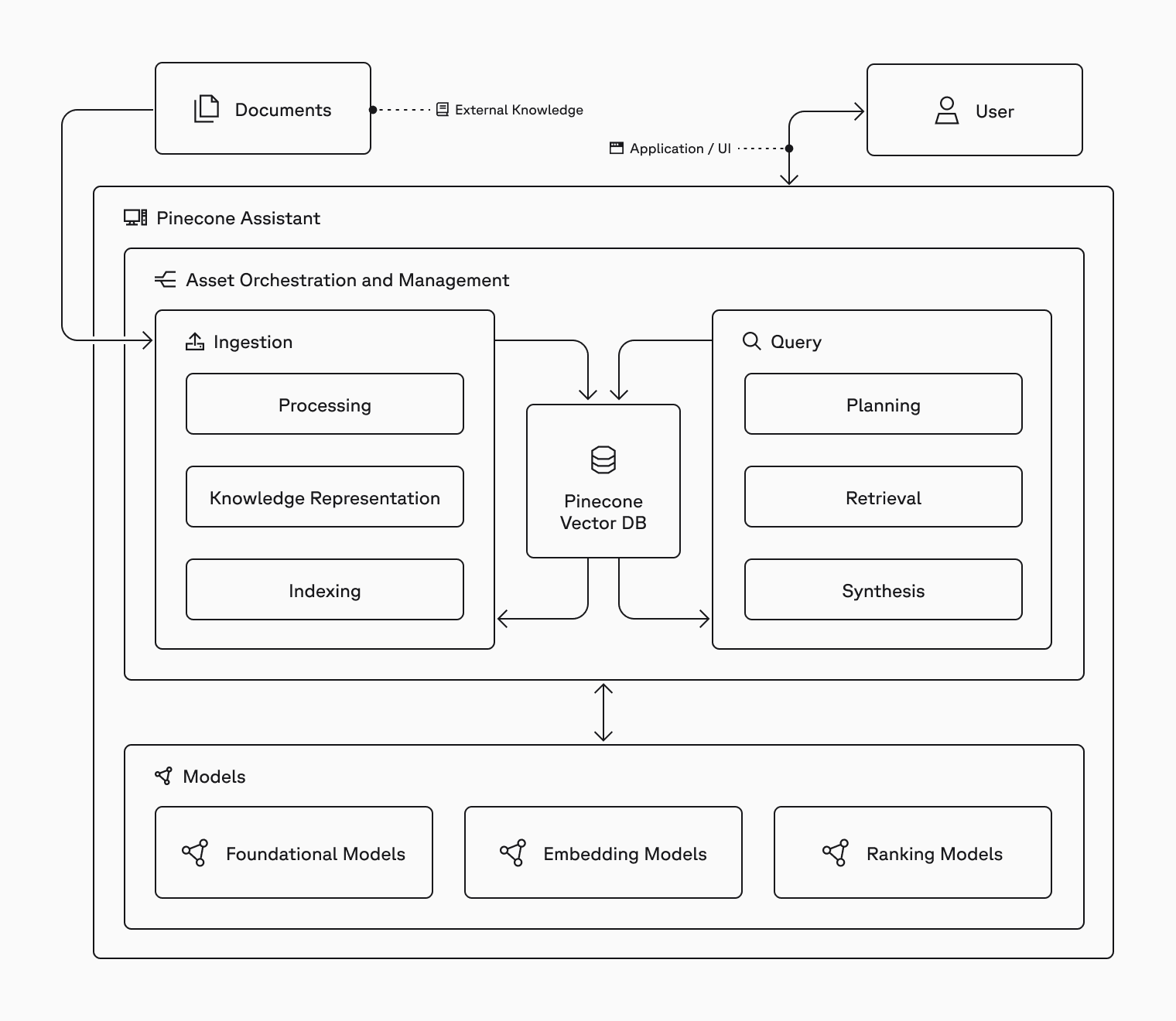
Fig 1: Pinecone Assistant Architecture Diagram

Let’s look at where existing evaluation metrics fall short, the metric we propose for evaluating AI assistants, and how Pinecone Assistant performs across three benchmark datasets.

For a comprehensive look at RAG pipeline performance evaluation metrics and frameworks, see RAG Evaluation: Don't let customers tell you first.

Answer Alignment Score

Evaluating generative AI answers is challenging due to their free-form nature. Compared to structured responses, generative AI outputs can vary significantly in style, structure, and content, making it hard to apply consistent evaluation metrics. Additionally, verifying the facts is difficult, as it often requires checking against reliable sources. This variability and the need for detailed judgment make it challenging to measure quality in a meaningful and quantifiable way.

Many frameworks and metrics have been developed to address this issue. Most of them are unsupervised and use state-of-the-art LLMs to evaluate answers against the context provided by the information retrieval system. When we analyzed the results, we found that for many datasets, unsupervised metrics and human judgment are not aligned.

For example, when comparing the RAGAS evaluation library on FinanceBench, we get a false-positive rate of 0.94 (lower is better). This approach means the metric does not always capture hallucination.

Table 1: Confusion matrix for the RAGAS groundness and answer relevance. We calculate the Answer Alignment Score (formerly the F1 metric) by combining RAGAS groundedness and answer relevance and then assigning negative as an Answer Alignment Score <0.5. For this experiment, we used default values provided by RAGAS and used GPT-4o as the judging model to increase quality.

This issue led us to research alternative metrics, resulting in the development of new, supervised, correctness-completeness metrics using the following protocol:

  1. Extracting a list of atomic facts from the ground truth answer.
  2. Using an LLM, match the generated answer provided by the assistant with every fact extracted in Step 1
  3. For every generated answer, we classify each fact extracted in Step 1 with one of the following: “Entailed” - fact was provided and supported by the assistant’s answer; “Contradicts” - the assistant’s answer provided information that contradicts the fact; “Neutral” - the fact is not validated nor contradicted by the assistant’s answer.

We then aggregate, per question, and calculate Correctness-Completeness (formerly Precision-Recall) as follows:
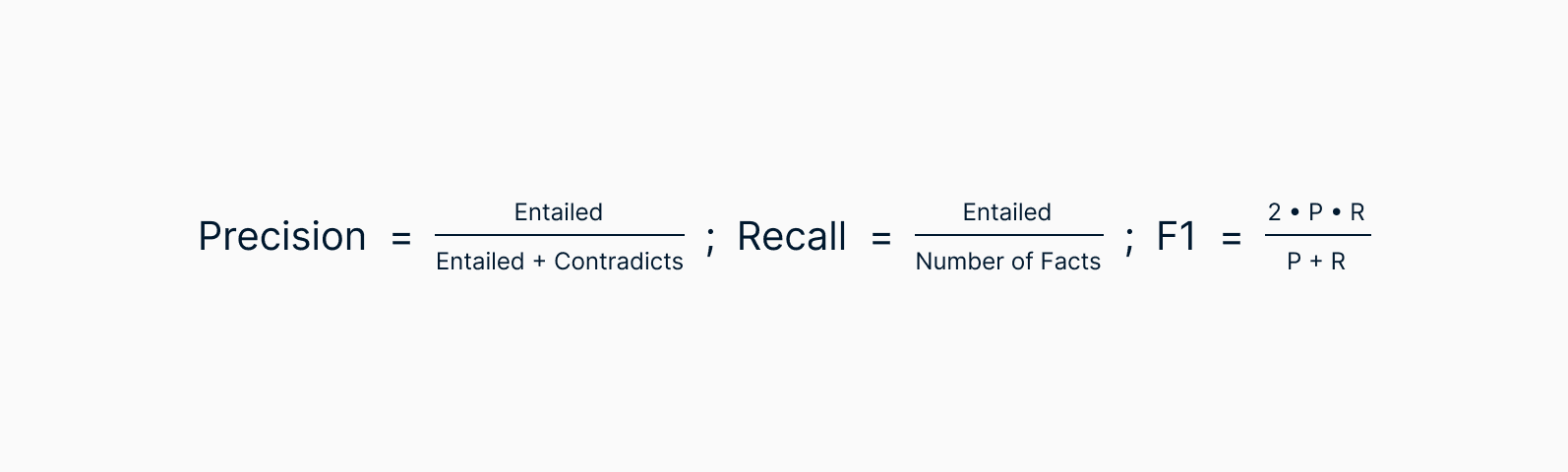
When using our developed metrics, we see much higher accordance with human judgment—we reduced the false-positive rate from 0.94 to 0.027 while maintaining a low false-negative rate. These metrics can also capture hallucinations much more effectively.
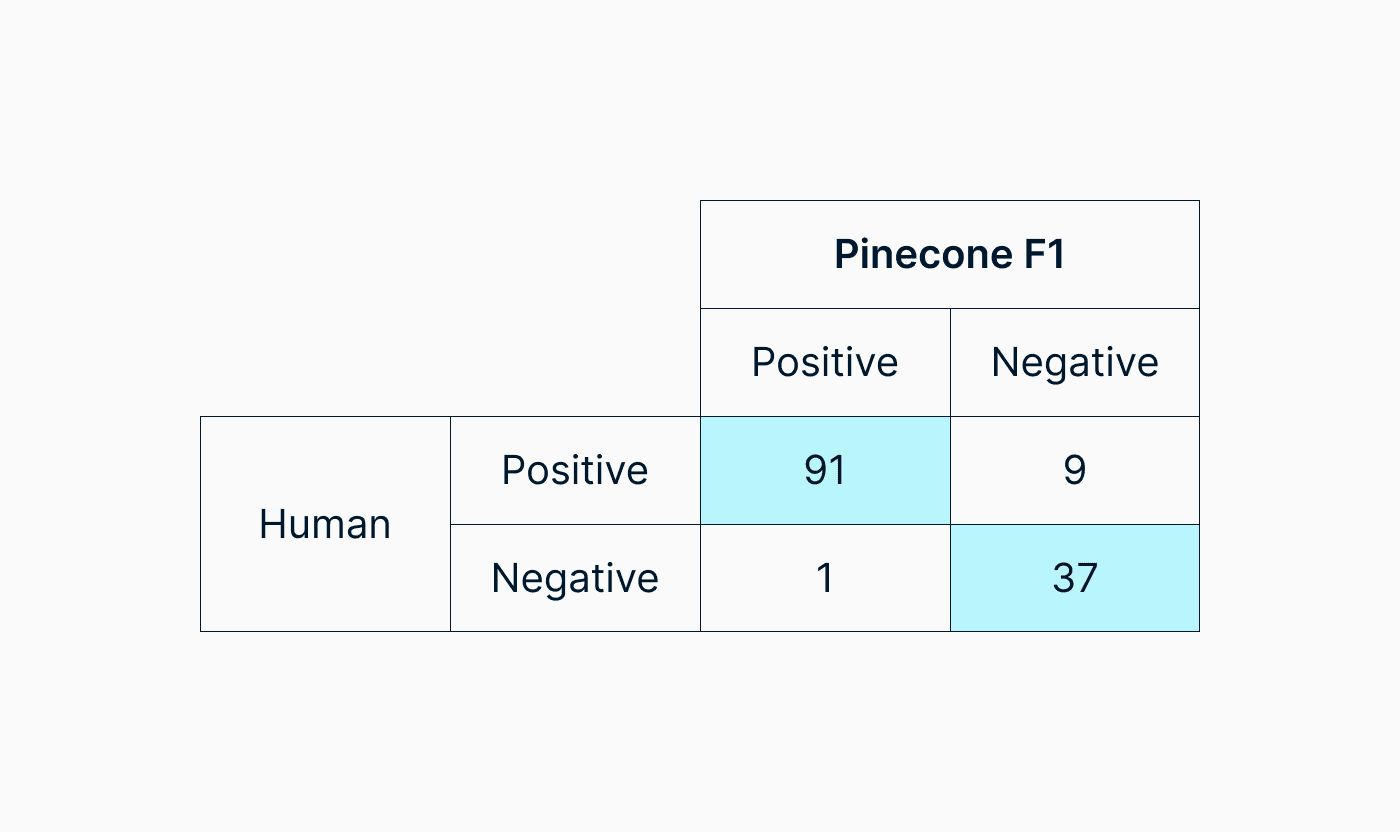
Table 2: Confusion matrix for the Pinecone Correctness-Completeness metrics. Results show much higher alignment to human evaluation. GPT-4o was used to evaluate.

Gathering ground truth answers is a resource-intensive task. However, we think that alignment is the most important trait of an evaluation system, even with the complex process of gathering the datasets. We also continue our research on partially synthetic annotations and implicit annotations from human feedback, with additional updates to follow.

Datasets

To evaluate a knowledge-intensive assistant, we gathered different datasets, each focusing on various aspects of retrieval and generation. First, we began with different domains and found that a typical pattern among developers today was to use retrieval and language models to analyze financial and legal documents and to build general Q&A systems built on private data. The table below provides an overview of the 3 datasets we used for evaluation.

Dataset NameFinanceBenchOpen Australian Legal NQ-HARD
DomainFinancial AnalysisLegalGeneral Q&A
Type of TaskMulti step, complex reasoningLong form documents needle-in-the-haystackLong form documents (non self-contained)
Description10K, 10Q and other filings of American corporations. Questions involve information retrieval from multiple pages and complex reasoning.A sample* of 300 questions and answers out of 2124 synthesized by gpt-4 from the Open Australian Legal Corpus.A sample* of 301 questions from 479 originated from the Natural Questions dataset and selected such that multiple retrievers score zero NDCG@10 and questions are not self-contained in a single passage.
Number of Documents/pages79 / 23K5,300* / 110K9,705*/ 100K
Number of Queries138300300
Ground Truth OriginHumanGPT-4Human
SourceSEC FilingPublic InformationWikipedia

Table 3: evaluation datasets, including FinanceBench, Open Australian Legal, and NQ-HARD.

* Datasets were sampled down in order to fit within OpenAI Assistants max file limits.

** While the original paper notes 150 questions, 12 questions have broken URLs and could not be used in this evaluation

*** We used only questions containing short answers (see NQ paper).
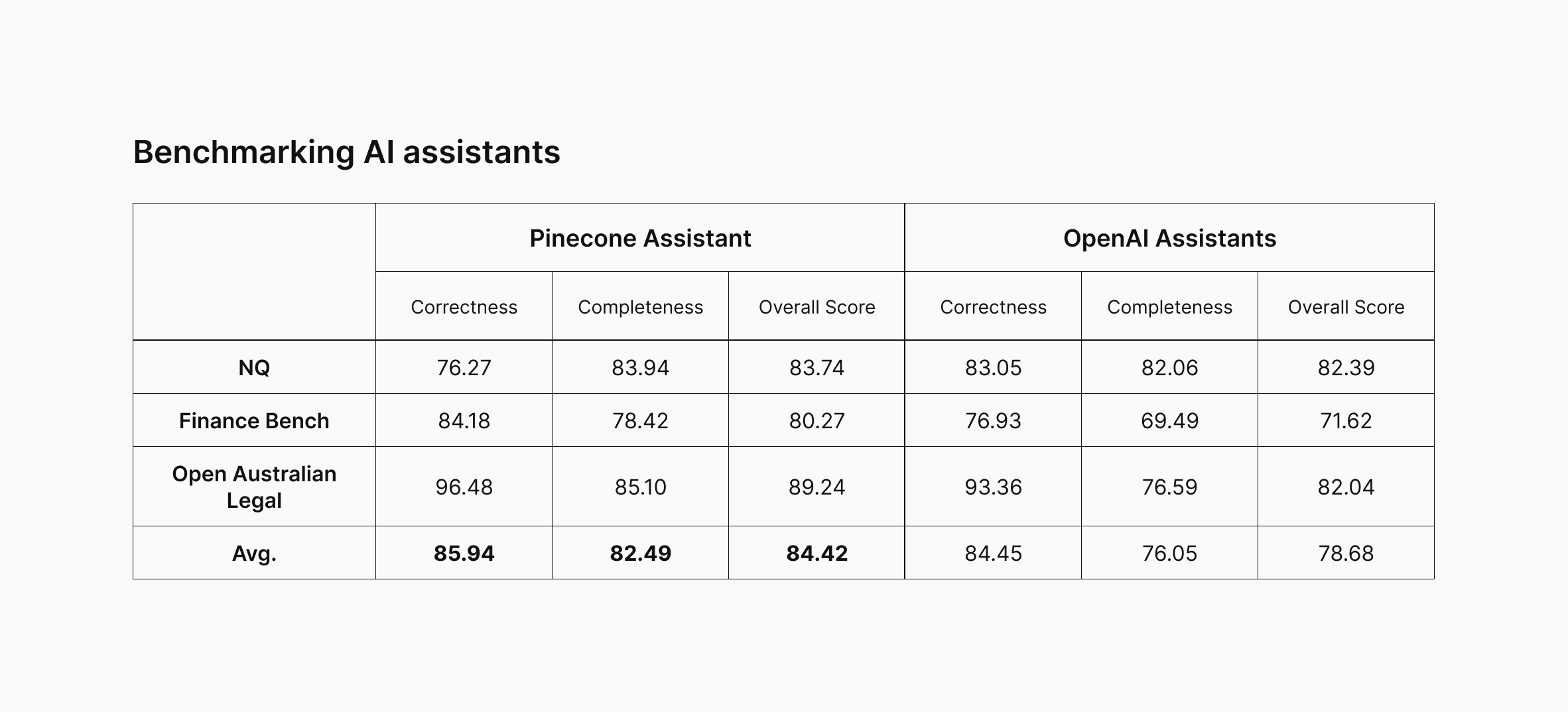
Results

Table 4. Correctness, completeness and answer alignment score results on NQ, Finance Bench and Open Australian Legal datasets, comparing Pinecone Assistant and OpenAI assistants. For all datasets and metrics Pinecone Assistant outperforms OpenAI. * Note: The overall score — the Answer Alignment Score — is computed point-wise, so it cannot be directly inferred from the correctness and completeness presented in the table.

What’s next

The Pinecone Assistant architecture includes a new benchmarking scheme that provides a way to measure generated answers for a dataset in a way that strongly correlates with human preferences. Future directions for this research are to expand the number of datasets, with a goal of generating automated benchmark results using the Answer Alignment Score metric for an arbitrary or user-defined dataset, without the need for expensive ground truth collection.