




惯性聚合 高效追踪和阅读你感兴趣的博客、新闻、科技资讯
阅读原文 在惯性聚合中打开

推荐订阅源

Stack Overflow Blog
Stack Overflow Blog
T
Tor Project blog
Hacker News - Newest:
Hacker News - Newest: "LLM"
cs.CL updates on arXiv.org
Threat Intelligence Blog | Flashpoint
P
Palo Alto Networks Blog
T
The Exploit Database - CXSecurity.com
P
Privacy International News Feed
C
Cybersecurity and Infrastructure Security Agency CISA
MyScale Blog
MyScale Blog
D
DataBreaches.Net
I
Intezer
GbyAI
GbyAI
Jina AI
Jina AI
The GitHub Blog
The GitHub Blog
S
Security @ Cisco Blogs
C
Cyber Attacks, Cyber Crime and Cyber Security
NISL@THU
NISL@THU
Project Zero
Project Zero
博客园_首页
Martin Fowler
Martin Fowler
A
About on SuperTechFans
J
Java Code Geeks
AI
AI
WordPress大学
WordPress大学
cs.AI updates on arXiv.org
L
LINUX DO - 热门话题
云风的 BLOG
云风的 BLOG
腾讯CDC
酷 壳 – CoolShell
酷 壳 – CoolShell
C
Cisco Blogs
L
LangChain Blog
Google Online Security Blog
AWS News Blog
AWS News Blog
Help Net Security
Help Net Security
Application and Cybersecurity Blog
D
Docker
N
Netflix TechBlog - Medium
Know Your Adversary
Know Your Adversary
D
Darknet – Hacking Tools, Hacker News & Cyber Security
S
Secure Thoughts
H
Heimdal Security Blog
Recent Commits to openclaw:main
O
OpenAI News
S
Security Affairs
freeCodeCamp Programming Tutorials: Python, JavaScript, Git & More
博客园 - 【当耐特】
雷峰网
雷峰网
V
Visual Studio Blog
T
Threat Research - Cisco Blogs

Pinecone

Pinecone Assistant: A Managed Knowledge Layer for Production AI Applications Multi-domain RAG in n8n: why one knowledge base is not enough Building RAG workflows in n8n: choosing the right Pinecone node Knowledge needs a meta-knowledge layer Garbage Day: How Pinecone Safely Deletes Billions of Objects at Scale When "Performance" Means Two Different Things Pinecone BYOC: Pinecone in your AWS, GCP, or Azure account, no vendor access True, Relevant, and Wrong: The Applicability Problem in RAG Use the Pinecone Plugin for Claude Code to develop AI Applications Faster Millions at Stake: How Melange's High-Recall Retrieval Prevents Litigation Collapse Powering High-stakes Patent Search at Scale: How Melange Built a Reliable AI System on Pinecone | Pinecone Pinecone Assistant Node in n8n: Turn Any Data Source Into Knowledge RAG with Access Control Pinecone Dedicated Read Nodes are now in Public Preview Inside Pinecone: Slab Architecture New Bulk Data Operations: Update, Delete, and Fetch by Metadata The Hidden Cost of Building: Lessons from Aquant Simplifying Vector Embeddings with Pinecone Integrated Inference Capabilities Pinecone joins Microsoft Marketplace as a Launch Partner GTM Engineering: Clay + Pinecone for AI-powered Sales Outbound Build an AI knowledge assistant with Google Docs and Pinecone Moving Pinecone forward with Ash Ashutosh as CEO and Edo spearheading our growing AI ambitions as Chief Scientist Pinecone Founder Edo Liberty to Spearhead Pinecone’s Growing AI Ambitions; Appoints Ash Ashutosh as CEO to Expand Vector Database Market Leadership Fast, Accurate Retrieval for Creators at Scale: Delphi’s Path Toward a Million Conversational Agents with Pinecone | Pinecone Announcing Pinecone Pioneers: A Program for Builders, Organizers, and Community Leaders What is Context Engineering? Chunking Strategies for LLM Applications Beyond the hype: Why RAG remains essential for modern AI Obviant Makes 30% More Accurate Defense Acquisition Recommendations Combining Sparse and Dense Retrieval with Pinecone | Pinecone Build more knowledgeable AI applications with new LLMs and greater control in Pinecone Assistant #NYTECHWEEK 2025 Retrieval-Augmented Generation (RAG) Accurate and Efficient Metadata Filtering in Pinecone’s Serverless Vector Database | Pinecone Terminal X AI Agents, Powered by Pinecone, Turn Complex Financial Data Into Production-grade Insights at Scale | Pinecone Aquant Delivers Scalable, Expert-level Service Intelligence with Pinecone | Pinecone Cascading retrieval with multi-vector representations: balancing efficiency and effectiveness Vector databases aren't just for large-scale enterprise AI Unveiling DIME: Reproducibility, Scalability, and Formal Analysis of Dimension Importance Estimation for Dense Retrieval | Pinecone Fast and Effective Early Termination for Simple Ranking Functions | Pinecone Domain-specific AI Agents at Scale: CustomGPT.ai Serves 10,000+ Customers with Pinecone | Pinecone Using Pinecone asynchronously with FastAPI A Flexible Resource for Top-Weighted Comparisons Between Sets and Rankings | Pinecone Build secure, scalable agentic AI workflows with Rubrik Annapurna and Pinecone Tool up: Pinecone’s first MCP servers are here Add context to your agent with Pinecone Assistant MCP remote server E2Rank: Efficient and Effective Layer-wise Reranking | Pinecone ColBERT-serve: Efficient Multi-Stage Memory-Mapped Scoring | Pinecone Efficient Constant-Space Multi-Vector Retrieval | Pinecone How Vanguard Worked with Pinecone to Boost Customer Support with Faster Calls and 12% More Accurate Responses | Pinecone Pinecone Named to Fast Company's Annual List of the World's Most Innovative Companies of 2025 Launch Week: Pinecone for agents, search, recommendations, and more Optimizing Pinecone for agents (and more) Retrieval Inference for scale and performance How 1up Turns Sales Reps Into Product Experts with Pinecone | Pinecone Don’t be dense: Launching sparse indexes in Pinecone Unlock High-Precision Keyword Search with pinecone-sparse-english-v0 Evolving Pinecone's architecture to meet the demands of Knowledgeable AI Pinpoint references faster with citation highlights in Pinecone Assistant Bringing the leading vector database to your cloud Getting started with llama-text-embed-v2 Natural Language Counterfactual Explanations for Graphs Using Large Language Models | Pinecone Easily build knowledgeable chat and agent-based applications in minutes with Pinecone Assistant, now generally available How to build an agentic, chat or RAG knowledge system using Pinecone Assistant Real-time RAG with Pinecone and Estuary Flow BigQuery to Pinecone in Real-Time with Estuary Flow Stravito Turns Market and Consumer Data Into Actionable Insights with Pinecone Inference | Pinecone Accelerate prototyping and development with Pinecone Local First-of-its-kind Pinecone Knowledge Platform to Power Best-in-class Retrieval for Customers Introducing integrated inference: Embed, rerank, and retrieve your data with a single API Strengthening security and increasing control with CMEK and API key roles Introducing Pinecone Rerank V0 Introducing cascading retrieval: Unifying dense and sparse with reranking From Idea to Action: How Pinecone Assistant Meaningfully Accelerates AI Business Building AI apps on Azure with Pinecone just got a lot easier Building a reliable, curated, and accurate RAG system with Cleanlab and Pinecone Four features of the Assistant API you aren't using - but should Deploying Pinecone with Infrastructure as Code (IaC) Streamlining CI/CD with Pinecone Local September 2024 Product Update Results of the Big ANN: NeurIPS'23 competition | Pinecone Introducing import from object storage for more efficient data transfer to Pinecone serverless Simplify, enhance, and evaluate RAG development with Pinecone Assistant, now in public preview Vectors and Graphs: Better Together August 2024 Product Update Pinecone Helps Deep Talk Deliver World-Class AI Assistants with Lower Engineering Overhead | Pinecone Assembled Delivers Better, Faster AI- Driven Support with Pinecone | Pinecone Llama 3.1 Agent using LangGraph and Ollama Build knowledgeable AI with Pinecone serverless, now generally available on Microsoft Azure Pinecone serverless is now generally available on Google Cloud, adding knowledge to AI assistants and other applications Accelerating Legal Discovery and Analysis with Pinecone and Voyage AI Bridging Dense and Sparse Maximum Inner Product Search | Pinecone Refine Retrieval Quality with Pinecone Rerank Introducing reranking to Pinecone Inference to simplify building accurate AI July 2024 Product Update Connect to Pinecone within your platform to enable a seamless AI development experience Introducing Pinecone API Versioning RAG Brag with Inkeep Co-Founder Nick Gomez LangGraph and Research Agents Introducing Pinecone Inference to streamline your AI workflow Build Privacy-aware AI software using Pinecone
Allspice Transforms the Culinary Experience with Semantic Search Powered by Pinecone | Pinecone
2026-03-25 · via Pinecone

Allspice is a food technology company building a comprehensive "kitchen operating system". Serving both consumers (B2C) and recipe publishers (B2B), the platform helps home cooks discover recipes, manage pantry inventory, and generate automated, deduplicated shopping lists. For publishers, Allspice provides interactive tools that enhance user engagement and unlock new revenue streams beyond traditional display advertising.

At the heart of this experience is the ability to understand food the way a human does, recognizing that "one bunch of cilantro" and "fresh cilantro, chopped" refer to the same item despite the different wording. The platform works with structured and semi-structured data at its core. Recipe ingestion begins with RecipeLD JSON extracted from scraped HTML pages, processed through a proprietary pipeline into Allspice's internal schema. Underneath it all is a proprietary ingredient database that powers ingredient matching, pantry tracking, shopping list generation, and recipe intelligence. That ingredient data layer is central to nearly everything the platform does.

As Allspice expanded recipe importing into a primary feature, the company hit a wall: matching ingredients reliably across thousands of recipes required a level of semantic understanding that its existing search infrastructure could not deliver.

Challenge

Traditional search couldn't handle how people talk about food

Before Pinecone, Allspice ran a fully NoSQL stack: Google Cloud Firestore for document storage and Typesense for recipe and content search across the platform.

Typesense worked well for traditional search. But once recipe importing became a core product feature, the team ran into a fundamental problem: ingredient matching. Ingredient data is inherently messy. Variations in descriptions, misspellings, parsing inconsistencies, and modifier-heavy phrases (like "large farm-fresh eggs, beaten") make deterministic matching difficult. Traditional text search, even with synonym handling, could not reliably bridge the gap between how ingredients appear in source recipes and how they are represented in Allspice's structured database.

The team also discovered performance limitations when attempting to use Typesense's vector support. Storing large embeddings alongside relatively small documents created inefficiencies. Because document size significantly impacts performance in that model, embedding vectors directly into search documents slowed parts of the system that were otherwise lightweight.

Allspice needed a dedicated semantic layer — one that could introduce fuzziness while preserving accuracy, without degrading the performance of the rest of the search stack. Without reliable ingredient matching, Allspice could not launch recipe importing, one of its core product features, blocking a key revenue stream for publishers and stalling platform growth. Every failed match meant a recipe that couldn't be imported, a user who couldn't generate a shopping list, and a publisher missing out on engagement and monetization. The longer the problem persisted, the more it constrained the company's ability to expand its publisher network and deliver on its B2B value proposition.

Solution

A semantic layer that bridges messy language and structured data

When Allspice determined it needed a dedicated vector database, the team turned to Pinecone. A key requirement was developer friendliness and speed of implementation. The team was in a phase where rapidly testing ideas and moving from prototype to validation was critical. Pinecone's documentation and setup workflows made it easy to integrate vector search into the existing architecture and begin experimenting immediately.

The benefit of vectors has always been flexibility. Instead of carefully managing search params in Typesense, trying to balance always receiving a result with only receiving relevant results, Pinecone removes all that complexity with a simple query. — William Templeton, co-founder and CTO at Allspice

Unlike bolt-on vector capabilities in traditional search engines, where storing large embeddings alongside small documents degrades overall system performance, Pinecone's purpose-built, serverless vector infrastructure keeps semantic search fully decoupled from the rest of Allspice's stack. This meant the team could scale vector workloads independently without rearchitecting their existing search and storage layers.

The first implementation focused on ingredient embeddings within the recipe-matching flow. This served as a proof of concept for vector search in the architecture. Using OpenAI's text-embedding-3-large model, the team embedded their proprietary ingredient database — approximately 10,000 ingredient embeddings — and immediately saw results that validated the approach.

From there, adoption expanded iteratively across the platform:

  • Ingredient matching and recipe similarity: The foundational use case. These systems would not function without embeddings. A "more recipes like this" experience using recipe-level embeddings was straightforward to build and immediately resonated with users.
  • Fuzzy recipe search: Pinecone acts as a complementary layer alongside traditional filtering and structured search, providing the most flexible retrieval experience when user intent is less precise. The platform now indexes approximately 100,000 recipe embeddings.
  • Chatbot data normalization: For AI chatbot function calls, Pinecone maps free-form user inputs, such as diet preferences, to structured internal representations. This reduces input variability and cardinality. The team is also experimenting with Pinecone-hosted Llama embeddings for chat workflows, complementing the OpenAI embeddings used for ingredients and recipes.
  • FAQ classification and retrieval: Early exploration of matching user questions against publisher-approved FAQ content and returning relevant answers, improving both chatbot reliability and publisher value.

Responsibilities are cleanly split across the stack: GCP handles Firestore, Cloud Run services, the recipe ingestion pipeline, chatbot backend, and deployment infrastructure. Pinecone handles vector storage and similarity search. Allspice's engineering team owns embeddings generation, normalization logic, ingredient intelligence, and retrieval workflows. Pinecone sits alongside multiple LLM providers in Allspice's stack, including Gemini 2.5 for the chatbot and a mix of GPT-4.1-mini and Gemini 2.5 for recipe processing, functioning as a model-agnostic retrieval layer that doesn't lock the team into a single AI provider.

Pinecone helps bridge a fundamental gap in modern AI systems between strictly structured data types and unstructured natural language input. It provides a semantic layer between those two worlds, allowing us to measure similarity and meaning without requiring exact matches or rigid schemas. This is especially valuable in domains like cooking, where users may describe ingredients, diets, or recipes in many different ways. — William Templeton, co-founder and CTO at Allspice

result

From 20% accuracy to a production-ready platform

The move to Pinecone fundamentally changed Allspice’s product viability. The most significant outcome was straightforward: Pinecone enabled Allspice's recipe importing pipeline to work. Without Pinecone’s vector search capabilities, the company would not have been able to launch one of its core product features. Before Pinecone, ingredient matching accuracy sat at roughly 20% — far too low to support a production feature. After implementation, accuracy jumped to 97%, with Pinecone serving as the core enabling piece of the matching system. The pipeline went from unusable to production-ready.
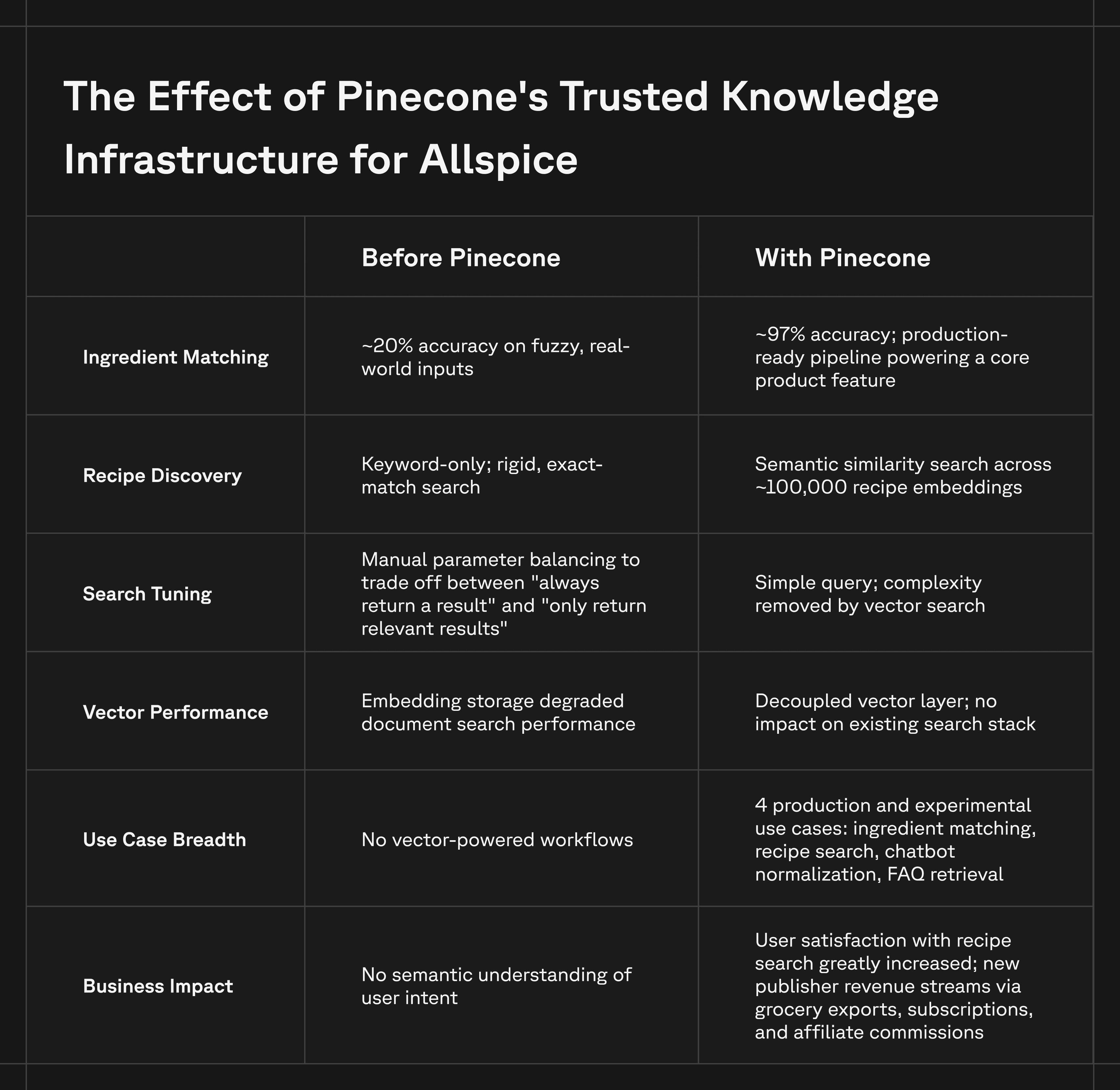
trusted knowledge, pinecone, allspice, ai infrastructure

Beyond that foundational use case, Pinecone has become a semantic infrastructure layer across the Allspice platform. Their performance and ability to scale significantly improved: the platform now manages a growing library of 110,000 total embeddings with the flexibility to expand to billions as their publisher network grows. Users reported significantly improved satisfaction with recipe search. By reducing input variability and mapping messy real-world language into structured representations, Allspice built a tool that feels flexible to the consumer but remains reliable under the hood.

The team went from a single targeted workflow to multiple production and experimental use cases — spanning search, recommendations, data normalization, and conversational AI — without adding operational complexity. This enabled Allspice publishers to generate revenue directly from recipe interactions through mechanisms like grocery exports, subscriptions, and affiliate commissions. It also introduced new engagement surfaces for publishers, increasing time on site and overall revenue opportunities. Additionally, Allspice now provides analytics and data collection tools that help publishers better understand how users interact with their recipes.

Speed of iteration has been a key benefit for Allspice. Pinecone’s managed, serverless model meant the team could set up Pinecone in an afternoon, get a basic pipeline working, and evaluate the effectiveness of the solution against real problems. That speed was essential for a startup where validating ideas quickly determines what ships and what doesn't.

Now more than ever, it is crucial to iterate quickly. I would have never tried Pinecone without a cloud-hosted, serverless option. I needed something that I could set up in an afternoon and get working in a basic pipeline to evaluate the effectiveness of my solution to my problems. — William Templeton, co-founder and CTO at Allspice

Expanding Pinecone into AI agents and conversational cooking

Looking ahead, Allspice plans to expand Pinecone's role in its AI and chatbot systems. One key focus area is using Pinecone to support tool-driven normalization flows within the chatbot, where free-form language must be mapped to structured internal data reliably. The team is also building out FAQ classification and retrieval to match user questions against publisher-approved content, ensuring chatbot reliability and increasing value for B2B partners.

More broadly, Allspice plans to continue experimenting with Pinecone across its chatbot architecture to improve response quality, reduce operational and inference costs, and enhance the user experience. As chatbot query volume grows, the team expects vector retrieval to play a direct role in controlling LLM spend by reducing unnecessary token usage and improving the precision of context passed to models. Ultimately, with Allspice’s conversational systems maturing, Pinecone’s trusted knowledge infrastructure will become an increasingly important part of how users interact with recipes, cooking knowledge, and publisher content.