



惯性聚合 高效追踪和阅读你感兴趣的博客、新闻、科技资讯
阅读原文 在惯性聚合中打开

推荐订阅源

SecWiki News
SecWiki News
OSCHINA 社区最新新闻
OSCHINA 社区最新新闻
V
Visual Studio Blog
博客园 - 叶小钗
S
SegmentFault 最新的问题
IT之家
IT之家
大猫的无限游戏
大猫的无限游戏
博客园_首页
Apple Machine Learning Research
钛媒体:引领未来商业与生活新知
钛媒体:引领未来商业与生活新知
月光博客
月光博客
酷 壳 – CoolShell
酷 壳 – CoolShell
腾讯CDC
D
Darknet – Hacking Tools, Hacker News & Cyber Security
V
V2EX
阮一峰的网络日志
阮一峰的网络日志
L
Lohrmann on Cybersecurity
量子位
C
Cyber Attacks, Cyber Crime and Cyber Security
T
Tor Project blog
J
Java Code Geeks
cs.CL updates on arXiv.org
博客园 - 三生石上(FineUI控件)
Attack and Defense Labs
AI
AI
The Cloudflare Blog
T
Tailwind CSS Blog
S
Schneier on Security
爱范儿
爱范儿
PCI Perspectives
PCI Perspectives
Stack Overflow Blog
Stack Overflow Blog
S
Secure Thoughts
Exploit-DB.com RSS Feed
T
The Exploit Database - CXSecurity.com
博客园 - 【当耐特】
V2EX - 技术
V2EX - 技术
S
Securelist
P
Proofpoint News Feed
T
Threat Research - Cisco Blogs
Help Net Security
Help Net Security
C
Cisco Blogs
N
News and Events Feed by Topic
人人都是产品经理
人人都是产品经理
B
Blog RSS Feed
K
Kaspersky official blog
T
The Blog of Author Tim Ferriss
G
Google Developers Blog
S
Security Affairs
freeCodeCamp Programming Tutorials: Python, JavaScript, Git & More
Simon Willison's Weblog

Pinecone

Pinecone Assistant: A Managed Knowledge Layer for Production AI Applications Multi-domain RAG in n8n: why one knowledge base is not enough Allspice Transforms the Culinary Experience with Semantic Search Powered by Pinecone | Pinecone Building RAG workflows in n8n: choosing the right Pinecone node Knowledge needs a meta-knowledge layer Garbage Day: How Pinecone Safely Deletes Billions of Objects at Scale When "Performance" Means Two Different Things Pinecone BYOC: Pinecone in your AWS, GCP, or Azure account, no vendor access True, Relevant, and Wrong: The Applicability Problem in RAG Use the Pinecone Plugin for Claude Code to develop AI Applications Faster Millions at Stake: How Melange's High-Recall Retrieval Prevents Litigation Collapse Powering High-stakes Patent Search at Scale: How Melange Built a Reliable AI System on Pinecone | Pinecone Pinecone Assistant Node in n8n: Turn Any Data Source Into Knowledge RAG with Access Control Pinecone Dedicated Read Nodes are now in Public Preview Inside Pinecone: Slab Architecture New Bulk Data Operations: Update, Delete, and Fetch by Metadata The Hidden Cost of Building: Lessons from Aquant Simplifying Vector Embeddings with Pinecone Integrated Inference Capabilities Pinecone joins Microsoft Marketplace as a Launch Partner GTM Engineering: Clay + Pinecone for AI-powered Sales Outbound Build an AI knowledge assistant with Google Docs and Pinecone Moving Pinecone forward with Ash Ashutosh as CEO and Edo spearheading our growing AI ambitions as Chief Scientist Pinecone Founder Edo Liberty to Spearhead Pinecone’s Growing AI Ambitions; Appoints Ash Ashutosh as CEO to Expand Vector Database Market Leadership Fast, Accurate Retrieval for Creators at Scale: Delphi’s Path Toward a Million Conversational Agents with Pinecone | Pinecone Announcing Pinecone Pioneers: A Program for Builders, Organizers, and Community Leaders What is Context Engineering? Chunking Strategies for LLM Applications Beyond the hype: Why RAG remains essential for modern AI Obviant Makes 30% More Accurate Defense Acquisition Recommendations Combining Sparse and Dense Retrieval with Pinecone | Pinecone Build more knowledgeable AI applications with new LLMs and greater control in Pinecone Assistant #NYTECHWEEK 2025 Retrieval-Augmented Generation (RAG) Accurate and Efficient Metadata Filtering in Pinecone’s Serverless Vector Database | Pinecone Terminal X AI Agents, Powered by Pinecone, Turn Complex Financial Data Into Production-grade Insights at Scale | Pinecone Aquant Delivers Scalable, Expert-level Service Intelligence with Pinecone | Pinecone Cascading retrieval with multi-vector representations: balancing efficiency and effectiveness Vector databases aren't just for large-scale enterprise AI Unveiling DIME: Reproducibility, Scalability, and Formal Analysis of Dimension Importance Estimation for Dense Retrieval | Pinecone Fast and Effective Early Termination for Simple Ranking Functions | Pinecone Domain-specific AI Agents at Scale: CustomGPT.ai Serves 10,000+ Customers with Pinecone | Pinecone Using Pinecone asynchronously with FastAPI A Flexible Resource for Top-Weighted Comparisons Between Sets and Rankings | Pinecone Build secure, scalable agentic AI workflows with Rubrik Annapurna and Pinecone Tool up: Pinecone’s first MCP servers are here Add context to your agent with Pinecone Assistant MCP remote server E2Rank: Efficient and Effective Layer-wise Reranking | Pinecone ColBERT-serve: Efficient Multi-Stage Memory-Mapped Scoring | Pinecone Efficient Constant-Space Multi-Vector Retrieval | Pinecone How Vanguard Worked with Pinecone to Boost Customer Support with Faster Calls and 12% More Accurate Responses | Pinecone Pinecone Named to Fast Company's Annual List of the World's Most Innovative Companies of 2025 Launch Week: Pinecone for agents, search, recommendations, and more Optimizing Pinecone for agents (and more) Retrieval Inference for scale and performance How 1up Turns Sales Reps Into Product Experts with Pinecone | Pinecone Don’t be dense: Launching sparse indexes in Pinecone Unlock High-Precision Keyword Search with pinecone-sparse-english-v0 Evolving Pinecone's architecture to meet the demands of Knowledgeable AI Pinpoint references faster with citation highlights in Pinecone Assistant Bringing the leading vector database to your cloud Getting started with llama-text-embed-v2 Natural Language Counterfactual Explanations for Graphs Using Large Language Models | Pinecone Easily build knowledgeable chat and agent-based applications in minutes with Pinecone Assistant, now generally available How to build an agentic, chat or RAG knowledge system using Pinecone Assistant Real-time RAG with Pinecone and Estuary Flow BigQuery to Pinecone in Real-Time with Estuary Flow Stravito Turns Market and Consumer Data Into Actionable Insights with Pinecone Inference | Pinecone Accelerate prototyping and development with Pinecone Local First-of-its-kind Pinecone Knowledge Platform to Power Best-in-class Retrieval for Customers Introducing integrated inference: Embed, rerank, and retrieve your data with a single API Strengthening security and increasing control with CMEK and API key roles Introducing Pinecone Rerank V0 Introducing cascading retrieval: Unifying dense and sparse with reranking From Idea to Action: How Pinecone Assistant Meaningfully Accelerates AI Business Building AI apps on Azure with Pinecone just got a lot easier Building a reliable, curated, and accurate RAG system with Cleanlab and Pinecone Four features of the Assistant API you aren't using - but should Deploying Pinecone with Infrastructure as Code (IaC) Streamlining CI/CD with Pinecone Local September 2024 Product Update Results of the Big ANN: NeurIPS'23 competition | Pinecone Introducing import from object storage for more efficient data transfer to Pinecone serverless Simplify, enhance, and evaluate RAG development with Pinecone Assistant, now in public preview Vectors and Graphs: Better Together August 2024 Product Update Pinecone Helps Deep Talk Deliver World-Class AI Assistants with Lower Engineering Overhead | Pinecone Assembled Delivers Better, Faster AI- Driven Support with Pinecone | Pinecone Llama 3.1 Agent using LangGraph and Ollama Build knowledgeable AI with Pinecone serverless, now generally available on Microsoft Azure Pinecone serverless is now generally available on Google Cloud, adding knowledge to AI assistants and other applications Accelerating Legal Discovery and Analysis with Pinecone and Voyage AI Bridging Dense and Sparse Maximum Inner Product Search | Pinecone Refine Retrieval Quality with Pinecone Rerank Introducing reranking to Pinecone Inference to simplify building accurate AI July 2024 Product Update Connect to Pinecone within your platform to enable a seamless AI development experience Introducing Pinecone API Versioning RAG Brag with Inkeep Co-Founder Nick Gomez LangGraph and Research Agents Introducing Pinecone Inference to streamline your AI workflow
What is Similarity Search?
Rajat Tripathi · 2023-06-30 · via Pinecone

Pinecone is a vector database that makes it easy to add similarity search to any application. Try it free, and continue reading to learn what makes similarity search so useful.

Introduction

Searching through data for similar items is a common operation in databases, search engines, and many other applications. Finding similar items based on fixed numeric criteria is very straightforward using a query language when we are dealing with traditional databases. For example, finding employees in a database within a fixed salary range.

But sometimes we have to answer questions like “Which objects in our inventory are similar to what a user searched for?” The search terms can be vague and can have a lot of variations. For example, a user can search for something generic like “shoes”,“black shoes” or something more precise like “Nike AF-1 LV8”.

Queries can be vague and varied

Our system must be able to discern between these terms and must understand how a black shoe differs from other shoes. To handle such queries we need a representation that captures the deeper conceptual meaning of the objects. On top of that, in scenarios like these, we might have to work with data to the scale of billions of objects.

When dealing with data in this scale & context, this problem is quite unlike searching through traditional databases containing symbolic object representations. Hence we need something more powerful that can allow us to search through semantic representations efficiently.

With similarity search, we can work with semantic representations of our data and find similar items fast. And in the sections below we will discuss how exactly it works.

What Are Vector Representations?

In the passage above, we talked about representing objects in a way that captures their deeper meanings. In machine learning, we often represent real-world objects and concepts as a set of continuous numbers, also known as vector embeddings. This very neat method allows us to translate the similarity between objects as perceived by us into a vector space.

This means when we represent images or pieces of text as vector embeddings, their semantic similarity is represented by how close their vectors are in the vector space. Hence, what we want to look at is the distance between vectors of the objects.

These vector representations (embeddings) are often created by training models according to the input data and task. Word2Vec,GLoVE, USE etc. are popular models for generating embeddings from text data while CNN models like VGG are often used to create image embeddings.
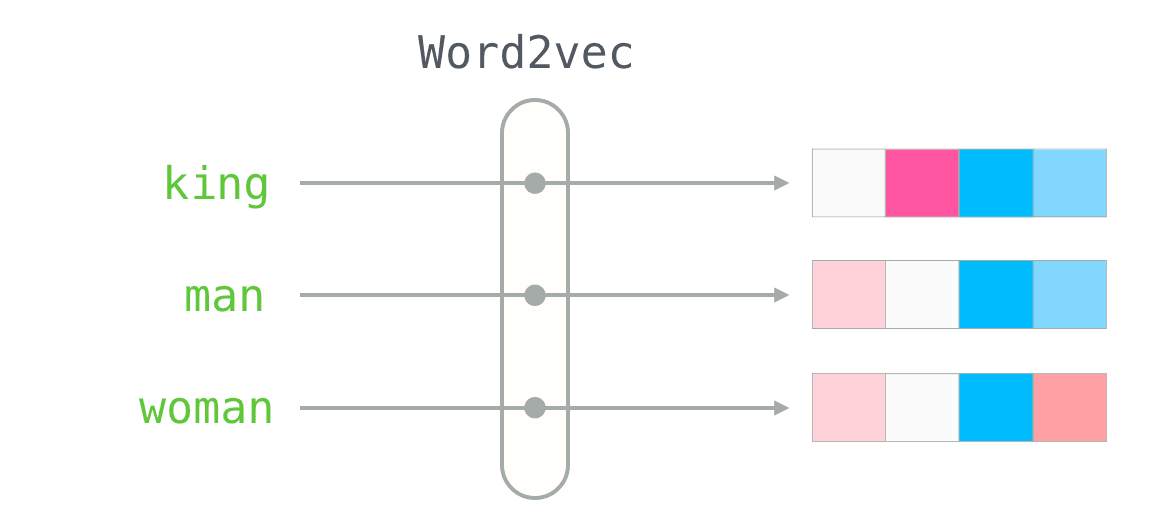
Word2Vec illustration

The figure above from this great article on word2vec, can help us visualize how the model can generate similar representations of similar words and is able to capture the semantic meaning.

This concept can be extended to more complex objects. We can combine information from features in the dataset to create embeddings for every row in the dataset. This is something leveraged by many search & recommendation based algorithms. The point that I want to make is, training a machine learning model on any data can transform the broad abstract concept it can have to something on which we can perform mathematical operations that can give us the insights we need.

Distance Between Vectors

We mentioned earlier that we find similarities between objects by calculating the distance between their vectors. We can calculate the distance between these vectors in the vectors space according to the distance metric that fits our problem the best.

Some of the commonly used distance metrics in ML are Euclidean, Manhattan, Cosine, and Chebyshev. The image below will help us understand the intuition behind each of these methods.
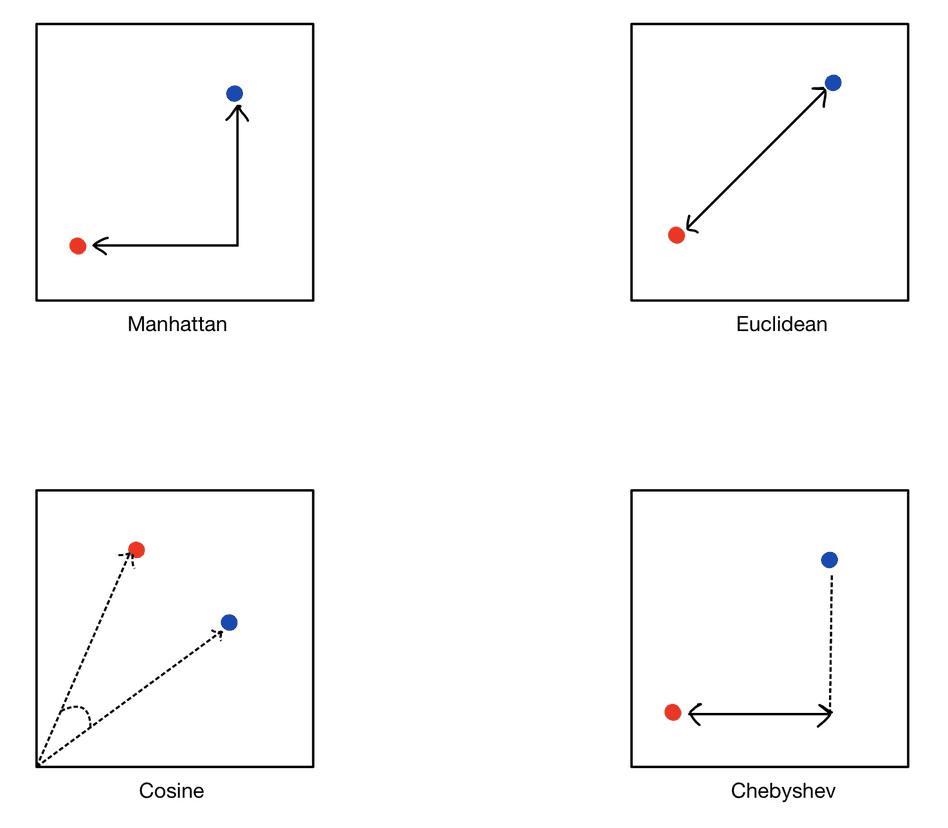
Similarity search distance metrics

The choice of distance metric depends on the use case. A great guide to learn more about distance metrics is here.

Now we know we can use vector embeddings to represent our objects, and the distances between vectors represent the similarity between the objects themselves.

This is where the similarity search, or vector search, kicks in. Given a set of vectors and a query vector, we need to find the most similar items in our set for the query. We call this task nearest neighbor search.

K Nearest Neighbors

K nearest neighbors or k-NN is a very popular algorithm to find nearest vectors in a space for a given query vector. The k here is a hyperparameter set by us which denotes how many nearest neighbors we want to retrieve.

We can perform k-NN on the vectors we have for our data and retrieve the nearest neighbors for our query vector depending on the distance between the vectors.
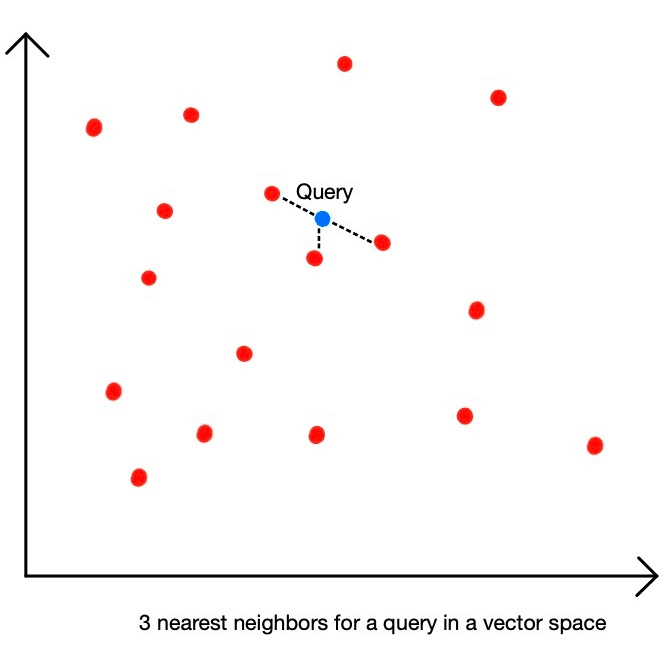
Similarity search with k-NN

A major drawback of k-NN is that to find the nearest vectors for our query we will have to calculate its distance with every vector we have in our database. This will be very inefficient if we have to search through millions of vectors.

To reduce the computation complexity added by an exhaustive search like kNN we make use of approximate neighbor search.

Instead of checking distances between each vector in the database, we retrieve a “good guess” of the nearest neighbor. In some use cases, we would rather lose some accuracy in favor of performance gain, thus allowing us to scale our search. ANN allows us to get a massive performance boost on similarity search when dealing with huge datasets.

In approximately nearest neighbors (ANN), we build index structures that narrow down the search space and improve lookup times. Apart from that, most ML models produce vectors that have high dimensionality which is another hurdle to overcome. Approximate search relies on the fact that even though data is represented in a large number of dimensions, their actual complexity is low. It tries to work with the true intrinsic dimensionality of data. Hashing is a good example of a method that allows us to do it and is used widely for many applications. There are various algorithms to solve the approximate search problem and to actually dive into how approximate search works warrants another article of its own. I suggest going through this three-part series of articles to understand ANN better.

As an overview, it is sufficient to understand that ANN algorithms make use of techniques like indexing, clustering, hashing, and quantization to significantly improve computation and storage at the cost of some loss in accuracy.

Conclusion

While we have barely scratched the surface of the complexities of similarity search — also known as vector search — with this article, the intent was to introduce some basic concepts and provide resources for a detailed reading on the topic. An increasing number of applications make use of similarity search to untangle problems in search & other domains, I highly encourage diving deeper into some of these concepts to learn more!

While you are on the website, why not have a look at how easy it is to build a scalable similarity search system in just a few lines of code? You can find a few example notebooks that use Pinecone for solving similarity search and related problems. Grab your free API key and we will be happy to help you along the way!