




惯性聚合 高效追踪和阅读你感兴趣的博客、新闻、科技资讯
阅读原文 在惯性聚合中打开

推荐订阅源

TaoSecurity Blog
TaoSecurity Blog
L
LINUX DO - 最新话题
Help Net Security
Help Net Security
N
News | PayPal Newsroom
www.infosecurity-magazine.com
cs.AI updates on arXiv.org
The Last Watchdog
The Last Watchdog
S
Security @ Cisco Blogs
W
WeLiveSecurity
C
CXSECURITY Database RSS Feed - CXSecurity.com
Webroot Blog
Webroot Blog
T
Troy Hunt's Blog
V
Vulnerabilities – Threatpost
Google Online Security Blog
N
News and Events Feed by Topic
T
Threat Research - Cisco Blogs
Security Archives - TechRepublic
钛媒体:引领未来商业与生活新知
钛媒体:引领未来商业与生活新知
T
Tor Project blog
freeCodeCamp Programming Tutorials: Python, JavaScript, Git & More
D
Darknet – Hacking Tools, Hacker News & Cyber Security
PCI Perspectives
PCI Perspectives
Google DeepMind News
T
Tailwind CSS Blog
让小产品的独立变现更简单 - ezindie.com
Apple Machine Learning Research
IT之家
IT之家
S
SegmentFault 最新的问题
J
Java Code Geeks
P
Privacy & Cybersecurity Law Blog
Threat Intelligence Blog | Flashpoint
博客园 - 【当耐特】
博客园_首页
H
Hacker News: Front Page
T
Threatpost
Jina AI
Jina AI
博客园 - Franky
月光博客
月光博客
L
LINUX DO - 热门话题
The Cloudflare Blog
H
Heimdal Security Blog
博客园 - 司徒正美
酷 壳 – CoolShell
酷 壳 – CoolShell
Cloudbric
Cloudbric
雷峰网
雷峰网
Hugging Face - Blog
Hugging Face - Blog
S
Secure Thoughts
T
Tenable Blog
I
Intezer
OSCHINA 社区最新新闻
OSCHINA 社区最新新闻

Pinecone

Pinecone Assistant: A Managed Knowledge Layer for Production AI Applications Multi-domain RAG in n8n: why one knowledge base is not enough Allspice Transforms the Culinary Experience with Semantic Search Powered by Pinecone | Pinecone Building RAG workflows in n8n: choosing the right Pinecone node Knowledge needs a meta-knowledge layer Garbage Day: How Pinecone Safely Deletes Billions of Objects at Scale When "Performance" Means Two Different Things Pinecone BYOC: Pinecone in your AWS, GCP, or Azure account, no vendor access True, Relevant, and Wrong: The Applicability Problem in RAG Use the Pinecone Plugin for Claude Code to develop AI Applications Faster Millions at Stake: How Melange's High-Recall Retrieval Prevents Litigation Collapse Powering High-stakes Patent Search at Scale: How Melange Built a Reliable AI System on Pinecone | Pinecone Pinecone Assistant Node in n8n: Turn Any Data Source Into Knowledge RAG with Access Control Pinecone Dedicated Read Nodes are now in Public Preview Inside Pinecone: Slab Architecture New Bulk Data Operations: Update, Delete, and Fetch by Metadata The Hidden Cost of Building: Lessons from Aquant Simplifying Vector Embeddings with Pinecone Integrated Inference Capabilities Pinecone joins Microsoft Marketplace as a Launch Partner GTM Engineering: Clay + Pinecone for AI-powered Sales Outbound Build an AI knowledge assistant with Google Docs and Pinecone Moving Pinecone forward with Ash Ashutosh as CEO and Edo spearheading our growing AI ambitions as Chief Scientist Pinecone Founder Edo Liberty to Spearhead Pinecone’s Growing AI Ambitions; Appoints Ash Ashutosh as CEO to Expand Vector Database Market Leadership Fast, Accurate Retrieval for Creators at Scale: Delphi’s Path Toward a Million Conversational Agents with Pinecone | Pinecone Announcing Pinecone Pioneers: A Program for Builders, Organizers, and Community Leaders What is Context Engineering? Chunking Strategies for LLM Applications Beyond the hype: Why RAG remains essential for modern AI Obviant Makes 30% More Accurate Defense Acquisition Recommendations Combining Sparse and Dense Retrieval with Pinecone | Pinecone Build more knowledgeable AI applications with new LLMs and greater control in Pinecone Assistant #NYTECHWEEK 2025 Retrieval-Augmented Generation (RAG) Accurate and Efficient Metadata Filtering in Pinecone’s Serverless Vector Database | Pinecone Terminal X AI Agents, Powered by Pinecone, Turn Complex Financial Data Into Production-grade Insights at Scale | Pinecone Aquant Delivers Scalable, Expert-level Service Intelligence with Pinecone | Pinecone Cascading retrieval with multi-vector representations: balancing efficiency and effectiveness Vector databases aren't just for large-scale enterprise AI Unveiling DIME: Reproducibility, Scalability, and Formal Analysis of Dimension Importance Estimation for Dense Retrieval | Pinecone Fast and Effective Early Termination for Simple Ranking Functions | Pinecone Domain-specific AI Agents at Scale: CustomGPT.ai Serves 10,000+ Customers with Pinecone | Pinecone Using Pinecone asynchronously with FastAPI A Flexible Resource for Top-Weighted Comparisons Between Sets and Rankings | Pinecone Build secure, scalable agentic AI workflows with Rubrik Annapurna and Pinecone Tool up: Pinecone’s first MCP servers are here Add context to your agent with Pinecone Assistant MCP remote server E2Rank: Efficient and Effective Layer-wise Reranking | Pinecone ColBERT-serve: Efficient Multi-Stage Memory-Mapped Scoring | Pinecone Efficient Constant-Space Multi-Vector Retrieval | Pinecone How Vanguard Worked with Pinecone to Boost Customer Support with Faster Calls and 12% More Accurate Responses | Pinecone Pinecone Named to Fast Company's Annual List of the World's Most Innovative Companies of 2025 Launch Week: Pinecone for agents, search, recommendations, and more Retrieval Inference for scale and performance How 1up Turns Sales Reps Into Product Experts with Pinecone | Pinecone Don’t be dense: Launching sparse indexes in Pinecone Unlock High-Precision Keyword Search with pinecone-sparse-english-v0 Evolving Pinecone's architecture to meet the demands of Knowledgeable AI Pinpoint references faster with citation highlights in Pinecone Assistant Bringing the leading vector database to your cloud Getting started with llama-text-embed-v2 Natural Language Counterfactual Explanations for Graphs Using Large Language Models | Pinecone Easily build knowledgeable chat and agent-based applications in minutes with Pinecone Assistant, now generally available How to build an agentic, chat or RAG knowledge system using Pinecone Assistant Real-time RAG with Pinecone and Estuary Flow BigQuery to Pinecone in Real-Time with Estuary Flow Stravito Turns Market and Consumer Data Into Actionable Insights with Pinecone Inference | Pinecone Accelerate prototyping and development with Pinecone Local First-of-its-kind Pinecone Knowledge Platform to Power Best-in-class Retrieval for Customers Introducing integrated inference: Embed, rerank, and retrieve your data with a single API Strengthening security and increasing control with CMEK and API key roles Introducing Pinecone Rerank V0 Introducing cascading retrieval: Unifying dense and sparse with reranking From Idea to Action: How Pinecone Assistant Meaningfully Accelerates AI Business Building AI apps on Azure with Pinecone just got a lot easier Building a reliable, curated, and accurate RAG system with Cleanlab and Pinecone Four features of the Assistant API you aren't using - but should Deploying Pinecone with Infrastructure as Code (IaC) Streamlining CI/CD with Pinecone Local September 2024 Product Update Results of the Big ANN: NeurIPS'23 competition | Pinecone Introducing import from object storage for more efficient data transfer to Pinecone serverless Simplify, enhance, and evaluate RAG development with Pinecone Assistant, now in public preview Vectors and Graphs: Better Together August 2024 Product Update Pinecone Helps Deep Talk Deliver World-Class AI Assistants with Lower Engineering Overhead | Pinecone Assembled Delivers Better, Faster AI- Driven Support with Pinecone | Pinecone Llama 3.1 Agent using LangGraph and Ollama Build knowledgeable AI with Pinecone serverless, now generally available on Microsoft Azure Pinecone serverless is now generally available on Google Cloud, adding knowledge to AI assistants and other applications Accelerating Legal Discovery and Analysis with Pinecone and Voyage AI Bridging Dense and Sparse Maximum Inner Product Search | Pinecone Refine Retrieval Quality with Pinecone Rerank Introducing reranking to Pinecone Inference to simplify building accurate AI July 2024 Product Update Connect to Pinecone within your platform to enable a seamless AI development experience Introducing Pinecone API Versioning RAG Brag with Inkeep Co-Founder Nick Gomez LangGraph and Research Agents Introducing Pinecone Inference to streamline your AI workflow Build Privacy-aware AI software using Pinecone
Optimizing Pinecone for agents (and more)
Edo Liberty, Nathan Cordeiro · 2025-03-17 · via Pinecone

Over the past year, demand for large-scale agentic workloads surged significantly. We observed these workloads, gained insights into their needs, and evolved our serverless architecture accordingly.

This post describes what we mean by agentic workloads, their patterns, and how our new system optimizes for them. We also describe how we improved performance for our search and recommendation systems workloads.

Starting this week, new users on Pinecone will run on our most advanced architecture. We will update the community as we roll this out to everyone. Companies with large-scale workloads who need access to the new architecture today are encouraged to reach out to us.

The rise of agentic workloads

As discussed by our CTO, Ram Sriharsha, in our recent blog post, we’ve observed a significant increase in agentic workloads across our customer base. These workloads differ fundamentally from traditional use cases, such as semantic search, in both their data structure and access patterns.

Unlike Search and Recommendation systems, agentic workloads typically involve:

  • Millions of namespaces. Each can correspond to an individual user, a set of meetings or conversations, documents in a single folder, emails in one inbox, etc.
  • Small namespace sizes. Typically, these namespaces are quite small, with fewer than 100k vectors in a namespace being quite common.
  • Sporadic and bursty query patterns. Each individual namespace might not be accessed at all for hours, days, or months. And then, it might be queried ten or a hundred times in quick succession.

The technical challenge of agentic workloads

Supporting agentic workloads effectively in a vector database presents a unique set of technical challenges that require us to meaningfully evolve our architecture.

Millions of namespaces: With potentially millions of namespaces to manage, the system can afford very little overhead per namespace. This applies to both space efficiency, where manifests, queues, file handling, and other metadata must be extremely lightweight, and compute efficiency, where indexing must scale effectively across many small collections without excessive resource consumption.

Storage/compute disparity: Agentic workloads also create a vast disparity between storage and compute needs. While the aggregate storage requirements across all namespaces can be enormous, the compute needs for any single namespace at a given moment are relatively minimal since most namespaces are small and infrequently accessed.

At the same time, these workloads also offer some simplifications that we could leverage in our design.

Small collections: Since each namespace typically holds no more than 100k vectors (and usually many fewer), they don't require elaborate indexing structures that might be necessary for larger datasets. This can save on indexing compute time. Additionally, the system can fetch and cache small amounts of data from blob storage in real-time, providing more flexibility in storage allocation and a significant reduction in costs.

Architectural innovations

To effectively support these demanding workloads, we implemented several key architectural changes to Pinecone.

Write path changes

We completely redesigned our write path with an adaptive indexing approach based on log-structured merge trees. This approach allows us to handle both small, numerous collections and larger, more demanding workloads with appropriate optimizations for each.

For small slabs (i.e., small vectorsets), which are common in agentic workloads, we prioritize writing quickly with minimal overhead. This means virtually no compute is spent on complex indexing, and we maintain minimal storage overhead for index data structures. We employ fast indexing techniques like scalar quantization or random projections that provide good performance with minimal resource requirements.

As collections grow, larger slabs receive more elaborate indexing during compaction. When a set of slabs reaches a size threshold, it is merged into larger ones. During this process, we build more computationally intensive partition-based indexes that provide better performance at scale. This approach allows us to amortize indexing costs throughout the lifetime of serving these slabs, providing an optimal balance of performance and resource utilization.

By applying the right indexing strategy at the right scale, this adaptive approach efficiently delivers excellent performance across diverse workloads without requiring manual tuning or configuration.
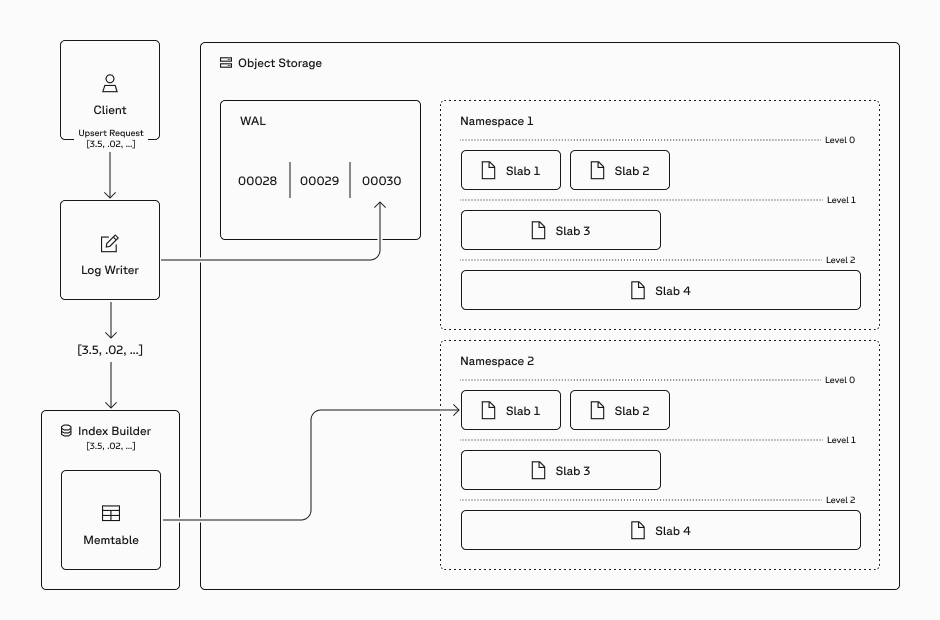
Pinecone write path

Query path changes

We've also reimagined our query path to efficiently handle millions of namespaces without sacrificing performance or cost-effectiveness.

We completely persist data on blob storage for small namespaces, which represent the majority of agentic workloads. When a query arrives, relevant data is fetched and cached on-demand. This approach effectively decouples the amount of compute and SSD needed from the total data size, solving storage limitations for massive multi-tenant systems. Note that once the slab is cached, all subsequent queries are much faster because they don’t need to be fetched from blob storage.

Larger indexes take a hybrid approach where only index structures persist on SSD and RAM caches, with range queries to blob storage fetching raw data when needed. This balances performance requirements with cost constraints.

Our system also implements adaptive caching that automatically optimizes for different access patterns. Active namespaces are persisted higher in the storage stack, providing low latency for bursty query patterns. For small namespaces, fast linear scans deliver response times of approximately 10ms, ensuring an excellent user experience.
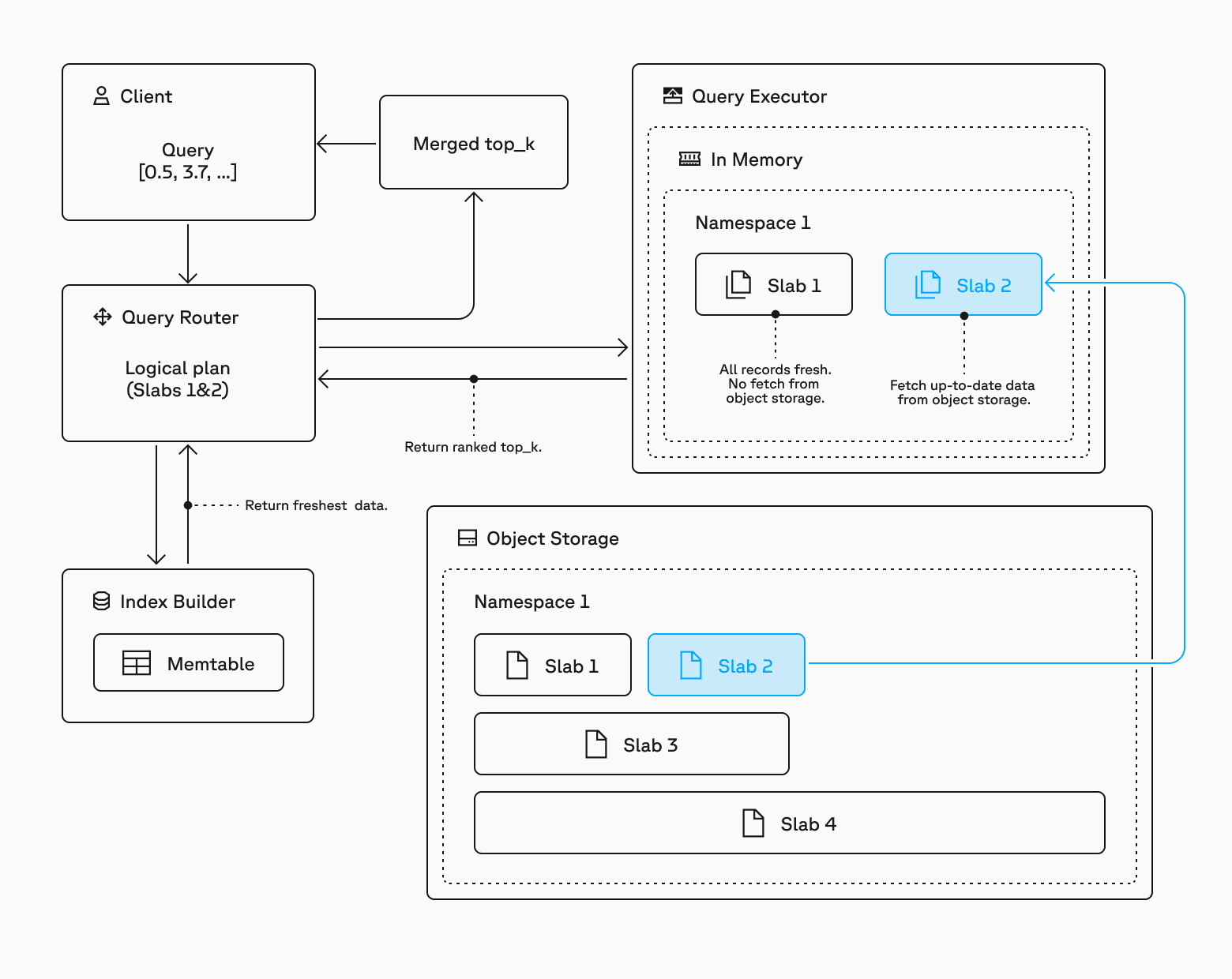
Pinecone read path

Improving search workloads too

Beyond agentic systems, we've also significantly enhanced our architecture for traditional search workloads with demanding requirements. These workloads often involve billions of vectors in a single namespace, require consistently low tail latencies, need support for complex and selective filtering, and increasingly demand lexical search capabilities alongside semantic search.

Enhanced metadata filtering

Metadata filtering is commonly used alongside vector search. It improves relevance by specifying which records to include or exclude from the search. Pinecone’s new disk-based metadata filtering allows for scaling metadata filtering while reducing the overall memory footprint. In addition to reducing memory usage, disk-based metadata filters enable high cardinality filters to be applied efficiently, improving recall.
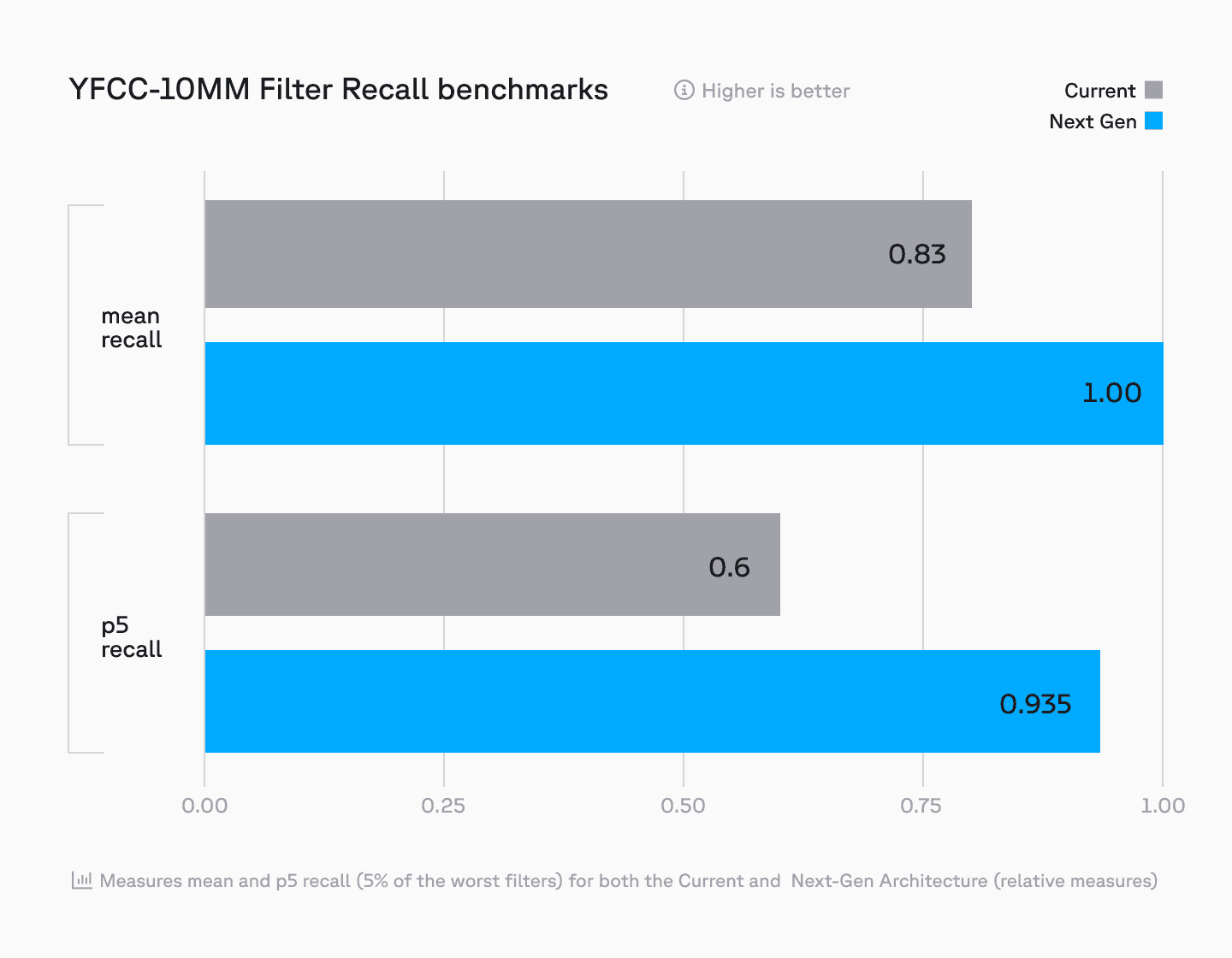
Improved performance of metadata filtering in Pinecone. For high cardinality metadata, the filters are applied much more efficiently boosting recall.

We've introduced high-performance sparse-only indexes specifically optimized for keyword and lexical search use cases. These sparse indexes efficiently represent text data and complement semantic search powered by dense vectors.

Pinecone's performance for sparse search outperforms existing search systems such as OpenSearch. Using sparse embeddings produced by the pinecone-sparse-english-v0 model for the MS Marco DL19 dataset of 8.9M vectors, we performed the following benchmarks on an OpenSearch cluster running a single r7g.large.search node. We compared these to the newly available Pinecone sparse vector index type running on similar hardware.
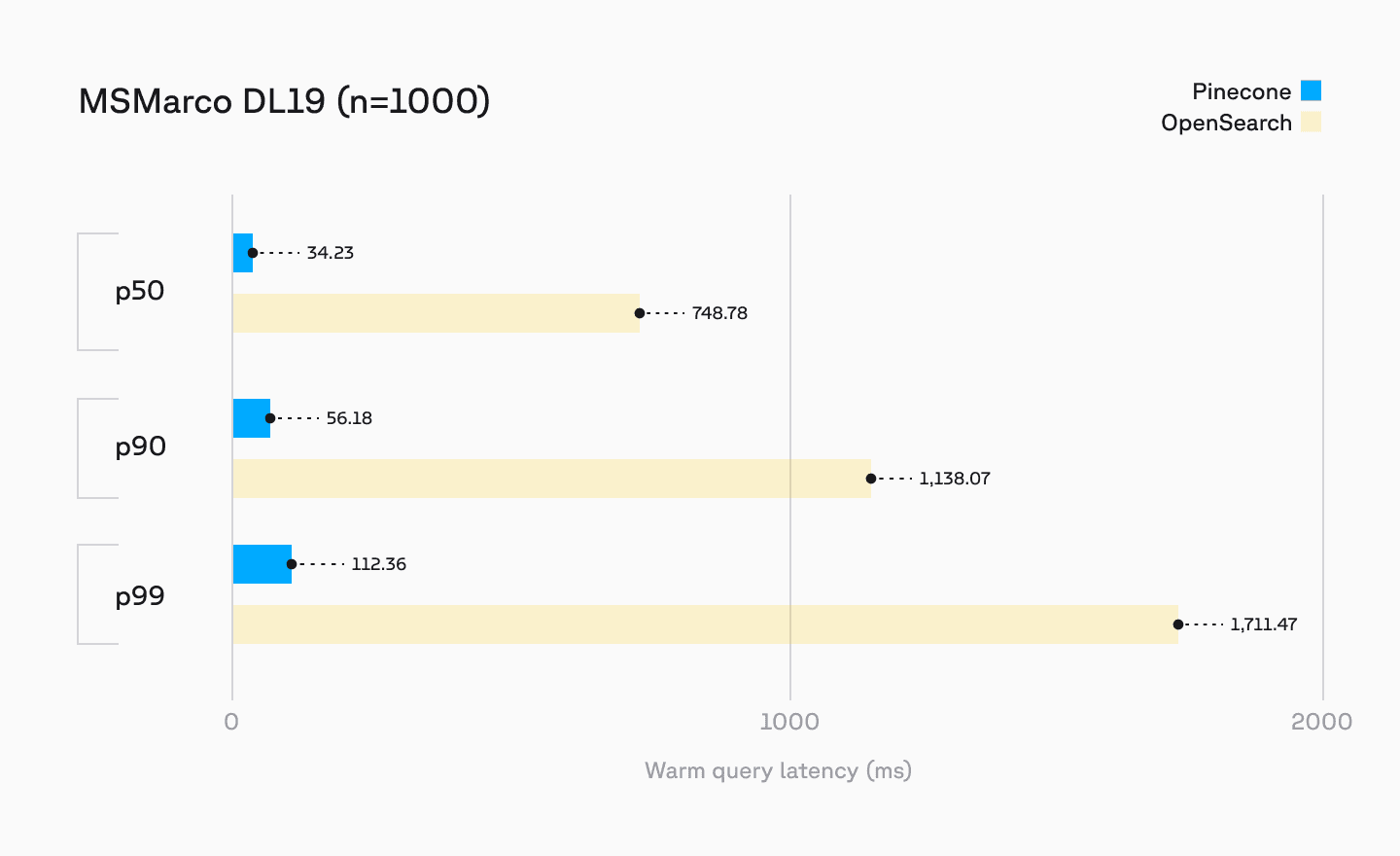
Pinecone sparse retrieval latency vs. OpenSearch. Learn more in our sparse retrieval deep dive.

Improved support for recommender systems

Finally, we've optimized our architecture to handle the unique demands of high-throughput recommender system workloads. These systems typically require processing thousands of queries per second across medium-sized namespaces (often containing tens of millions of vectors) while maintaining consistently low latency at scale.

Our solution implements automatic replication at high QPS without requiring manual index management. Soon, we'll introduce provisioned capacity options for even more predictable performance. We've also optimized our underlying algorithms, including IVF and Fast Scan implementations, to deliver exceptional throughput for these demanding workloads.

Pinecone serverless provides low latency even when operating at scales over 100M vectors, at query levels exceeding 1000 QPS. We benchmarked on a real-world use case – recommendations based on user-generated reviews at a 100m record scale. Here we compared Pinecone serverless against an OpenSearch cluster comprised of 6 r5.12xlarge nodes, with 48 vCPU and 384 GB of memory per node. This cluster translates to roughly twice the size of the Pinecone instance, with Pinecone serverless still showing better performance on an absolute scale.
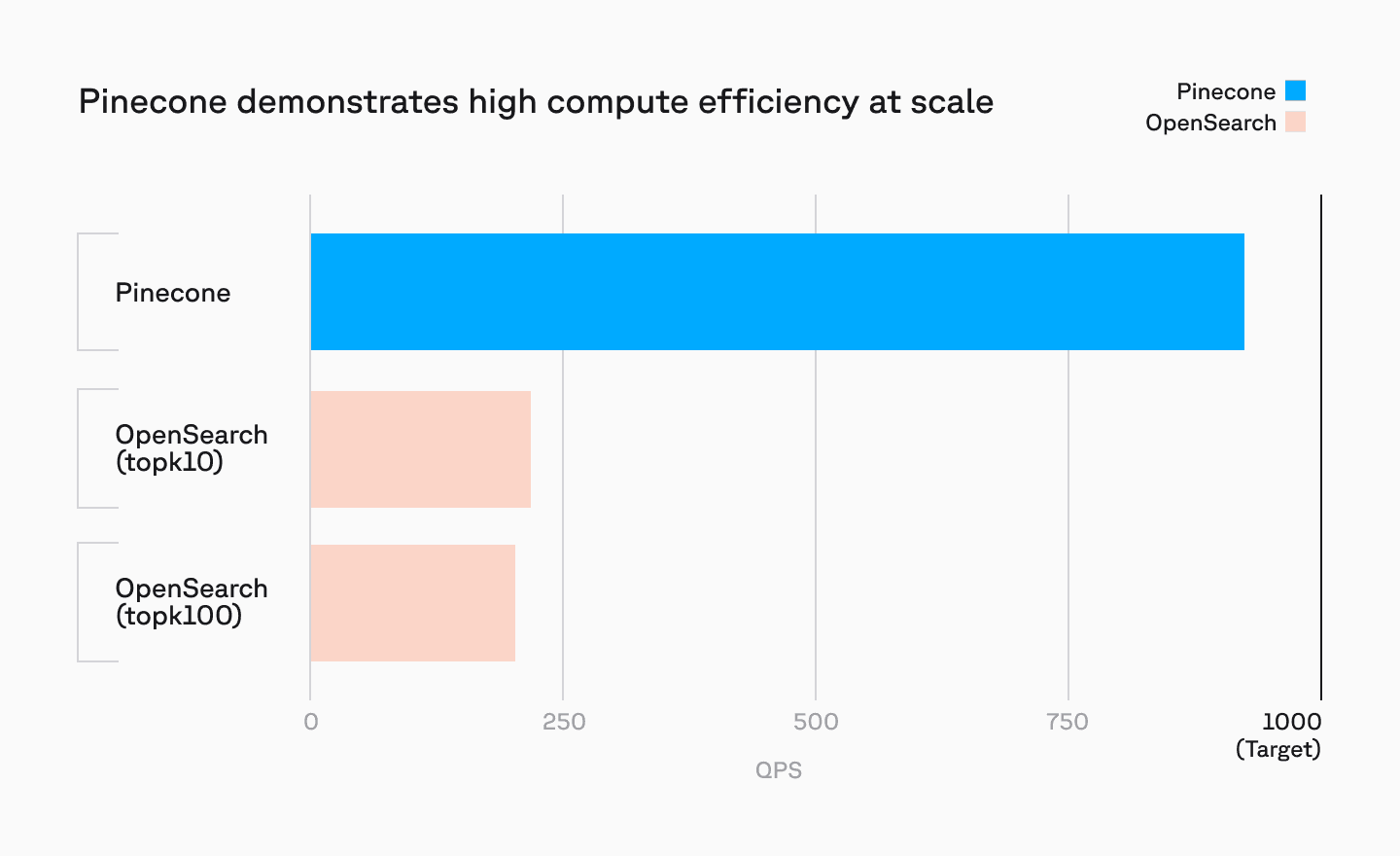
When pushing for a QPS of 1000 with no filters, we achieve 90% of the target vs less than 25% for OpenSearch despite OpenSearch using roughly 2x the compute allocation.
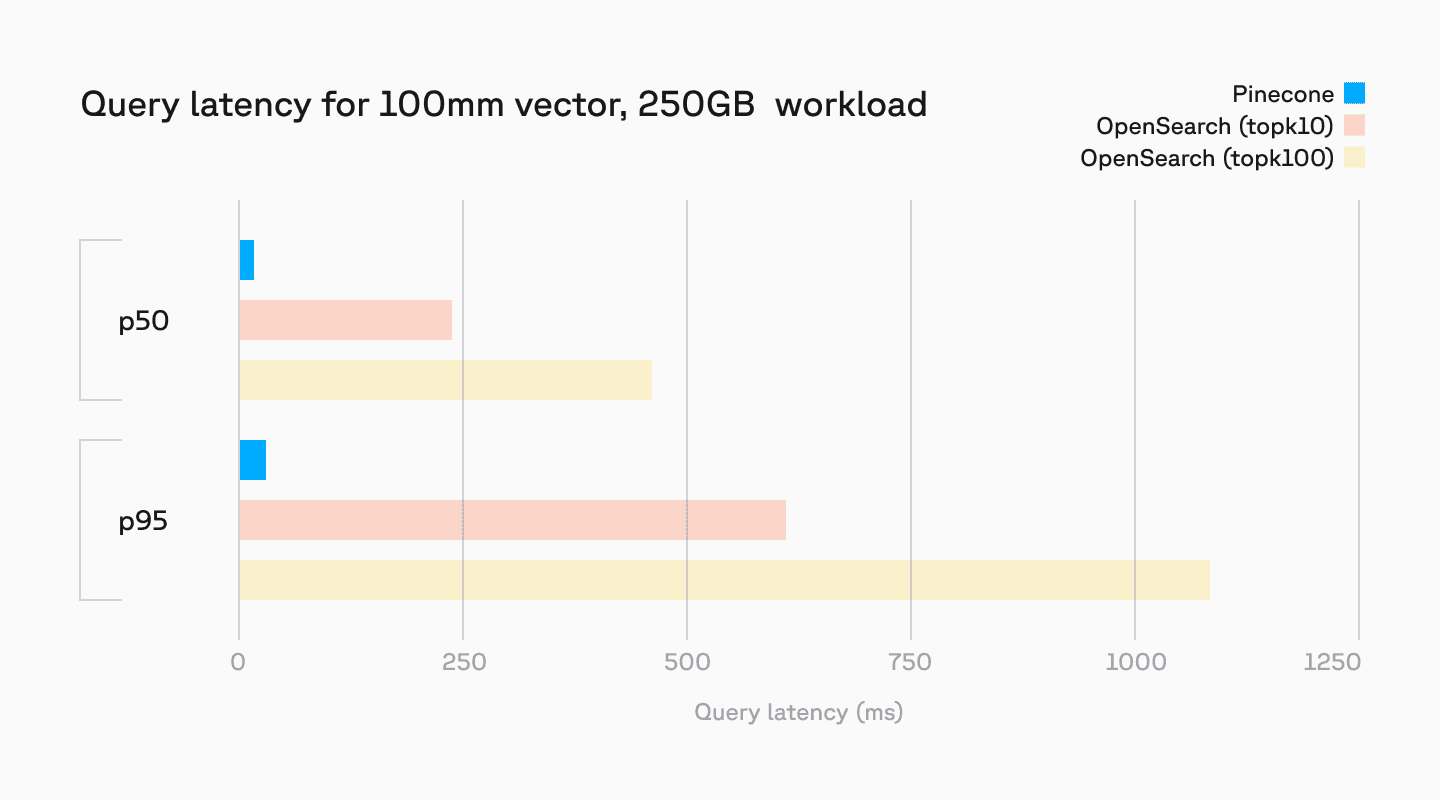
Pinecone serverless can serve 4x as many queries with roughly 1/8th the latency, on half the compute footprint. In this benchmark, Pinecone produces similar latencies with top-k=1,100.

Achieving similar scale and performance as Pinecone serverless would require OpenSearch clusters scaled 10x to 100x. Pinecone handles this natively at scales from thousands to billions of vectors.

Start building today

Our latest serverless architecture is rolling out this week to new users and to existing users over the next month.

In the coming months, we'll introduce additional capabilities including delete by metadata operations, expanded provisioned read capacity options, and increased namespace limits. Please contact us if you’re interested in early access to these features.