


惯性聚合 高效追踪和阅读你感兴趣的博客、新闻、科技资讯
阅读原文 在惯性聚合中打开

推荐订阅源

OSCHINA 社区最新新闻
OSCHINA 社区最新新闻
L
LINUX DO - 热门话题
Blog — PlanetScale
Blog — PlanetScale
博客园 - Franky
J
Java Code Geeks
腾讯CDC
博客园 - 聂微东
The Cloudflare Blog
钛媒体:引领未来商业与生活新知
钛媒体:引领未来商业与生活新知
博客园 - 司徒正美
Last Week in AI
Last Week in AI
量子位
Stack Overflow Blog
Stack Overflow Blog
Microsoft Security Blog
Google DeepMind News
K
KPMG report finds enterprise disconnect between AI and its ROI | CIO
S
Schneier on Security
C
CERT Recently Published Vulnerability Notes
Latest news
Latest news
Threat Intelligence Blog | Flashpoint
有赞技术团队
有赞技术团队
让小产品的独立变现更简单 - ezindie.com
S
Securelist
AWS News Blog
AWS News Blog
GbyAI
GbyAI
L
LINUX DO - 最新话题
大猫的无限游戏
大猫的无限游戏
Forbes - Security
Forbes - Security
H
Hackread – Cybersecurity News, Data Breaches, AI and More
Attack and Defense Labs
C
CXSECURITY Database RSS Feed - CXSecurity.com
Y
Y Combinator Blog
W
WeLiveSecurity
T
Threatpost
cs.CV updates on arXiv.org
P
Proofpoint News Feed
D
DataBreaches.Net
博客园 - 三生石上(FineUI控件)
V
V2EX
N
News and Events Feed by Topic
Google DeepMind News
D
Docker
The Hacker News
The Hacker News
A
About on SuperTechFans
Security Latest
Security Latest
NISL@THU
NISL@THU
cs.AI updates on arXiv.org
Cisco Talos Blog
Cisco Talos Blog
博客园_首页
H
Hacker News: Front Page

Pinecone

Pinecone Assistant: A Managed Knowledge Layer for Production AI Applications Multi-domain RAG in n8n: why one knowledge base is not enough Allspice Transforms the Culinary Experience with Semantic Search Powered by Pinecone | Pinecone Building RAG workflows in n8n: choosing the right Pinecone node Knowledge needs a meta-knowledge layer Garbage Day: How Pinecone Safely Deletes Billions of Objects at Scale When "Performance" Means Two Different Things Pinecone BYOC: Pinecone in your AWS, GCP, or Azure account, no vendor access True, Relevant, and Wrong: The Applicability Problem in RAG Use the Pinecone Plugin for Claude Code to develop AI Applications Faster Millions at Stake: How Melange's High-Recall Retrieval Prevents Litigation Collapse Powering High-stakes Patent Search at Scale: How Melange Built a Reliable AI System on Pinecone | Pinecone Pinecone Assistant Node in n8n: Turn Any Data Source Into Knowledge RAG with Access Control Pinecone Dedicated Read Nodes are now in Public Preview Inside Pinecone: Slab Architecture New Bulk Data Operations: Update, Delete, and Fetch by Metadata The Hidden Cost of Building: Lessons from Aquant Simplifying Vector Embeddings with Pinecone Integrated Inference Capabilities Pinecone joins Microsoft Marketplace as a Launch Partner GTM Engineering: Clay + Pinecone for AI-powered Sales Outbound Build an AI knowledge assistant with Google Docs and Pinecone Moving Pinecone forward with Ash Ashutosh as CEO and Edo spearheading our growing AI ambitions as Chief Scientist Pinecone Founder Edo Liberty to Spearhead Pinecone’s Growing AI Ambitions; Appoints Ash Ashutosh as CEO to Expand Vector Database Market Leadership Fast, Accurate Retrieval for Creators at Scale: Delphi’s Path Toward a Million Conversational Agents with Pinecone | Pinecone Announcing Pinecone Pioneers: A Program for Builders, Organizers, and Community Leaders What is Context Engineering? Chunking Strategies for LLM Applications Beyond the hype: Why RAG remains essential for modern AI Obviant Makes 30% More Accurate Defense Acquisition Recommendations Combining Sparse and Dense Retrieval with Pinecone | Pinecone Build more knowledgeable AI applications with new LLMs and greater control in Pinecone Assistant #NYTECHWEEK 2025 Retrieval-Augmented Generation (RAG) Accurate and Efficient Metadata Filtering in Pinecone’s Serverless Vector Database | Pinecone Terminal X AI Agents, Powered by Pinecone, Turn Complex Financial Data Into Production-grade Insights at Scale | Pinecone Aquant Delivers Scalable, Expert-level Service Intelligence with Pinecone | Pinecone Cascading retrieval with multi-vector representations: balancing efficiency and effectiveness Vector databases aren't just for large-scale enterprise AI Unveiling DIME: Reproducibility, Scalability, and Formal Analysis of Dimension Importance Estimation for Dense Retrieval | Pinecone Fast and Effective Early Termination for Simple Ranking Functions | Pinecone Domain-specific AI Agents at Scale: CustomGPT.ai Serves 10,000+ Customers with Pinecone | Pinecone Using Pinecone asynchronously with FastAPI A Flexible Resource for Top-Weighted Comparisons Between Sets and Rankings | Pinecone Build secure, scalable agentic AI workflows with Rubrik Annapurna and Pinecone Tool up: Pinecone’s first MCP servers are here Add context to your agent with Pinecone Assistant MCP remote server E2Rank: Efficient and Effective Layer-wise Reranking | Pinecone ColBERT-serve: Efficient Multi-Stage Memory-Mapped Scoring | Pinecone Efficient Constant-Space Multi-Vector Retrieval | Pinecone How Vanguard Worked with Pinecone to Boost Customer Support with Faster Calls and 12% More Accurate Responses | Pinecone Pinecone Named to Fast Company's Annual List of the World's Most Innovative Companies of 2025 Launch Week: Pinecone for agents, search, recommendations, and more Optimizing Pinecone for agents (and more) Retrieval Inference for scale and performance How 1up Turns Sales Reps Into Product Experts with Pinecone | Pinecone Don’t be dense: Launching sparse indexes in Pinecone Unlock High-Precision Keyword Search with pinecone-sparse-english-v0 Evolving Pinecone's architecture to meet the demands of Knowledgeable AI Pinpoint references faster with citation highlights in Pinecone Assistant Bringing the leading vector database to your cloud Getting started with llama-text-embed-v2 Natural Language Counterfactual Explanations for Graphs Using Large Language Models | Pinecone Easily build knowledgeable chat and agent-based applications in minutes with Pinecone Assistant, now generally available How to build an agentic, chat or RAG knowledge system using Pinecone Assistant Real-time RAG with Pinecone and Estuary Flow BigQuery to Pinecone in Real-Time with Estuary Flow Stravito Turns Market and Consumer Data Into Actionable Insights with Pinecone Inference | Pinecone Accelerate prototyping and development with Pinecone Local First-of-its-kind Pinecone Knowledge Platform to Power Best-in-class Retrieval for Customers Introducing integrated inference: Embed, rerank, and retrieve your data with a single API Strengthening security and increasing control with CMEK and API key roles Introducing Pinecone Rerank V0 Introducing cascading retrieval: Unifying dense and sparse with reranking From Idea to Action: How Pinecone Assistant Meaningfully Accelerates AI Business Building AI apps on Azure with Pinecone just got a lot easier Building a reliable, curated, and accurate RAG system with Cleanlab and Pinecone Four features of the Assistant API you aren't using - but should Deploying Pinecone with Infrastructure as Code (IaC) Streamlining CI/CD with Pinecone Local September 2024 Product Update Results of the Big ANN: NeurIPS'23 competition | Pinecone Introducing import from object storage for more efficient data transfer to Pinecone serverless Simplify, enhance, and evaluate RAG development with Pinecone Assistant, now in public preview Vectors and Graphs: Better Together August 2024 Product Update Pinecone Helps Deep Talk Deliver World-Class AI Assistants with Lower Engineering Overhead | Pinecone Assembled Delivers Better, Faster AI- Driven Support with Pinecone | Pinecone Llama 3.1 Agent using LangGraph and Ollama Build knowledgeable AI with Pinecone serverless, now generally available on Microsoft Azure Pinecone serverless is now generally available on Google Cloud, adding knowledge to AI assistants and other applications Accelerating Legal Discovery and Analysis with Pinecone and Voyage AI Bridging Dense and Sparse Maximum Inner Product Search | Pinecone Introducing reranking to Pinecone Inference to simplify building accurate AI July 2024 Product Update Connect to Pinecone within your platform to enable a seamless AI development experience Introducing Pinecone API Versioning RAG Brag with Inkeep Co-Founder Nick Gomez LangGraph and Research Agents Introducing Pinecone Inference to streamline your AI workflow Build Privacy-aware AI software using Pinecone
Refine Retrieval Quality with Pinecone Rerank
Arjun Patel · 2024-08-15 · via Pinecone

Improving retrieval quality can be difficult when building vector search or retrieval augmented generation (RAG) at scale. Every increase in quality matters for a great user experience.

Using a reranker allows for further refinement of retrieved documents during search, increasing relevance to user queries.

In most cases, rerankers require only a few lines of code and a bit of latency in exchange for significantly more relevant results. And with Pinecone's new Rerank offering, it's as easy as one more API call.

In this article, we will delve into the mechanics of rerankers, demonstrate how to integrate Pinecone Rerank into your search and RAG workflows and discuss optimal strategies for applying rerankers to your applications.
What do Rerankers Do?

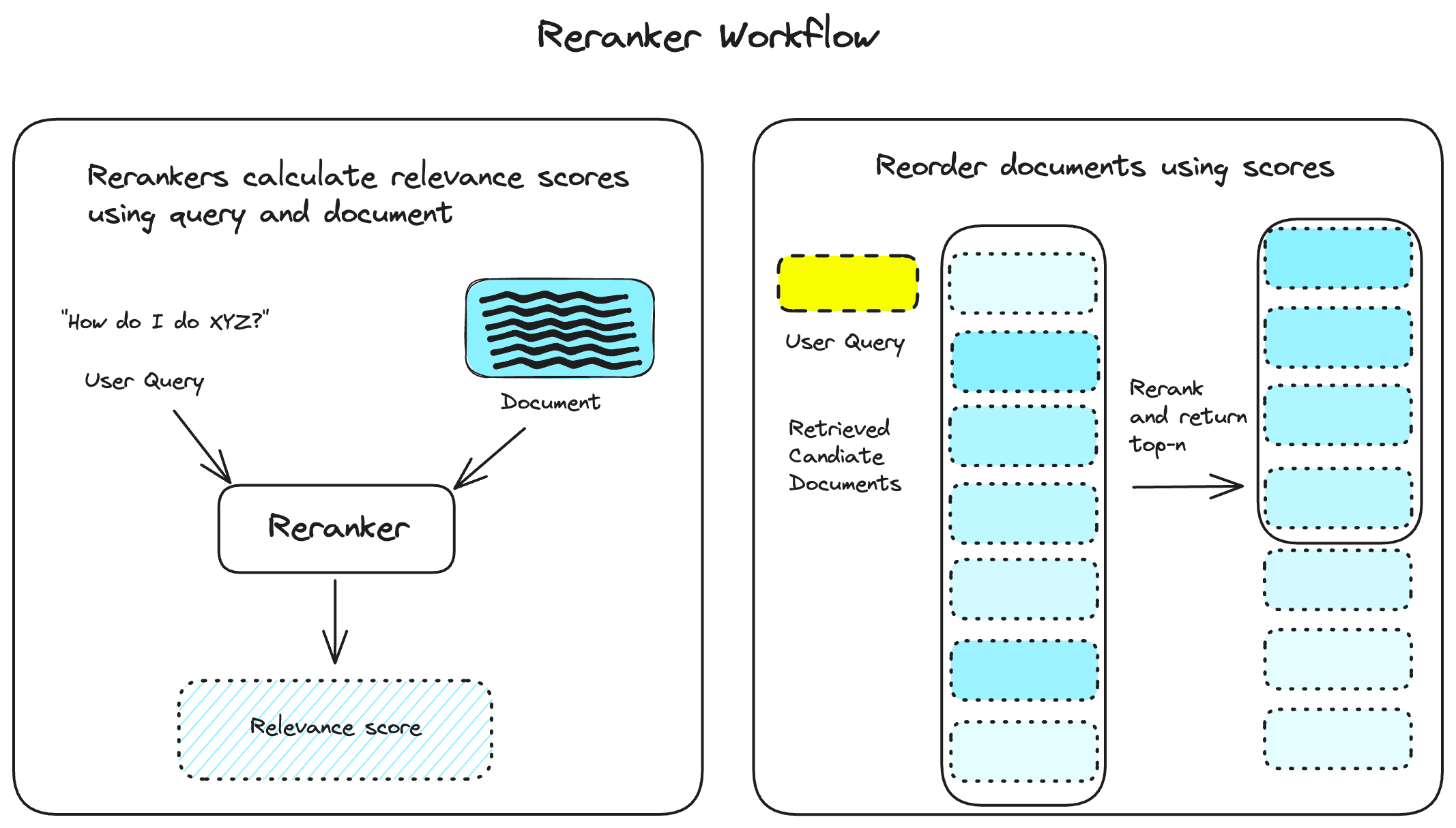
A diagram visualizing how rerankers calculate relevance scores on the left, and how documents are reordered from most to least relevant on the right

Rerankers calculate a relevance score using each query document pair. Then, documents are reordered from most to least relevant.

Rerankers refine the results you get from a vector database query. They do this by calculating relevance scores for each document based on how important it is to satisfy the user's query. That score is used to reorder the queried documents and return only the top-n results.

Usually, rerankers accept a larger than average number of documents and return the highly relevant subset of those.
Why use Rerankers at all?

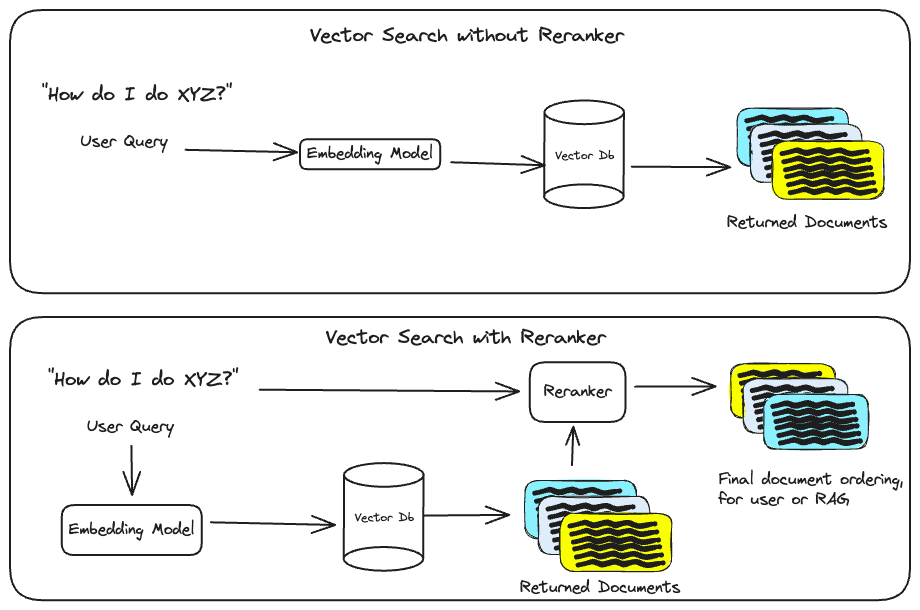
A before and after diagram of using rerankers in a vector search workflow

A simple architecture diagram of vector search with and without a reranker. Notice that the query is also passed to the reranker with the documents.

Adding a reranker to your vector search or RAG pipelines is an easy way to increase the quality of retrieved documents.

Using a reranker in your search pipeline has a few benefits:

  • Increases Recall: When using the same number of returned documents, reranked results often contain more relevant documents than when using semantic search alone.
  • Increases Precision: As relevance scoring happens during query time, it contextualizes the query and initial set of retrieved documents. This new ordering ensures the most relevant documents are prioritized.
  • Improves User Experience: Having a tractable number of highly relevant results reduces the time to benefit from the search for the user, impacting churn/conversion metrics.

Rerankers may also be particularly important in specific industries, datasets, and applications.

Consider the benefit of rerankers in the following situations:

  1. Complex Documents:
    • Datasets where relevant information is spread across multiple documents.
    • Example: Legal research involving cross-referencing case laws and statutes.
  2. Recommendation Systems:
    • Scenarios where the users are prompted to buy or click on things related and relevant to previous activity
    • Example: Presenting product reviews where users typically only read a few relevant results before buying.
  3. Premium on Relevant Results:
    • Essential for datasets where relevance is of utmost importance for search.
    • Example: Healthcare organizations that prioritize correct and important information during searches.

These points compound at scale: every second counts for quickly satisfying user queries in domains such as e-commerce, customer support, and finance.
Optimizing RAG Context Windows with Rerankers

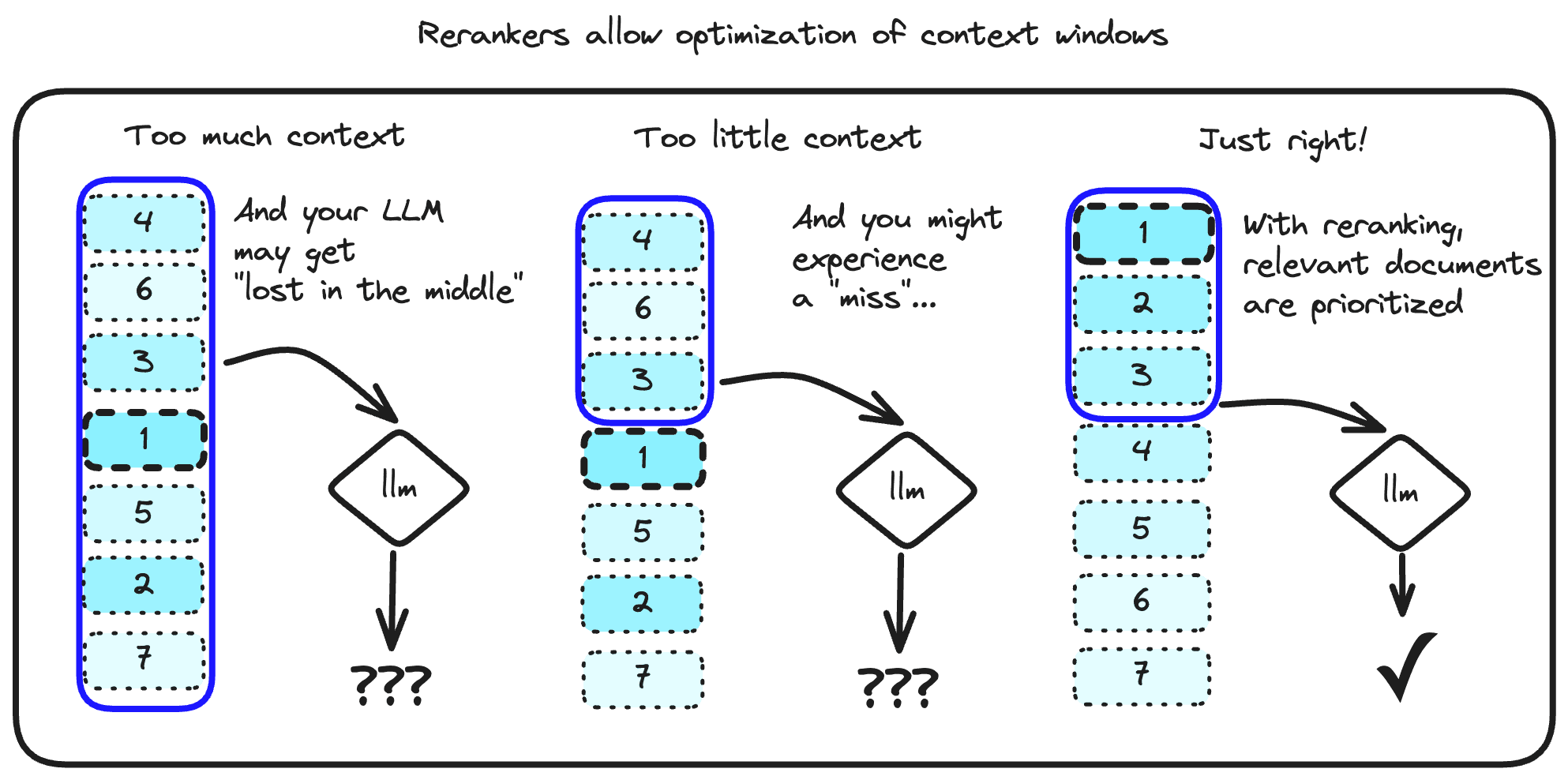
A side by side goldilocks style comparison of having too much, too little, and just the right amount of relevant context for LLMs in

A comparison of common issues with context windows and LLMs. Rerankers can help surface documents to optimize these windows.

One of the goals of a great RAG application is finding the sweet spot of contextual information to generate the correct info.

Context windows determine how much information a generating LLM can use to create a response. As models are released with larger and larger context windows, it can be tempting to use them with as many documents as possible for better generation.

However, there is some evidence that LLM performance degrades when provided with too much information in context windows, which may even depend on where the information is provided. This is colloquially known as the “lost in the middle” result, when documents near the middle of the context window of LLMs are missed, resulting in erroneous output or hallucinations.[1, 2].

Although long-context LLMs help mitigate this, performance is still capped by the quality and quantity of documents passed to them [3]. Not to mention the increased costs of processing more tokens at ingest!

RAG pipelines benefit from a reranking step during document retrieval, which ensures the context window has the smallest number of highly relevant documents for use. Learn more about this tradeoff and others when building RAG pipelines in our guide here.

Using Pinecone Inference Rerank API

Through the Pinecone Inference API , you can access a reranking model for your vector search workflows using one API call:

from pinecone import Pinecone

pc = Pinecone("API-KEY")

rerank_results = pc.inference.rerank(
    model="bge-reranker-v2-m3",
    query="Tell me about the tech company known as Apple",
    documents=[
      "Apple is a popular fruit known for its sweetness and crisp texture.",	
      "Apple is known for its innovative products like the iPhone.",
      "Many people enjoy eating apples as a healthy snack.",
      "Apple Inc. has revolutionized the tech industry with its sleek designs and user-friendly interfaces.",
      "An apple a day keeps the doctor away, as the saying goes.",
    ],
    top_n=3,
    return_documents=True,
)

Pinecone Rerank uses the bge-reranker-v2-m3 model, a lightweight open-source and multilingual reranker.

There's no need to set up tokenization, hosting, other preprocessing pipelines, or even language-specific information: the endpoint handles it for you, much like using our hosted embedding model, multilingual-e5-large!

Integrate the Rerank API in your search workflows after querying your documents, allowing the reranker to return a smaller set of relevant documents for your pipeline.

Here's an example of stringing together an Inference embed, Query, and Rerank call:

query = "Tell me about the tech company known as Apple"

x = pc.inference.embed(
    "multilingual-e5-large",
    inputs=[query],
    parameters={
        "input_type": "query"
    }
)

query_results = index.query(
    namespace="ns1",
    vector=x[0].values,
    top_k=3,
    include_values=False,
    include_metadata=True
)

# Keep in mind to transform data for reranking
documents = [
    {"id": x["id"], "text": x["metadata"]["text"]} 
    for x in query_results["matches"]
]


reranked_documents = pc.inference.rerank(
    model="bge-reranker-v2-m3",
    query=query,
    documents=documents,
    top_n=3,
    return_documents=True,
)

You can even query a larger-than-usual number of documents from your database and select a smaller top-n for the reranker to return.

What is BGE Reranker?

The BGE Reranker models are a multilingual reranker series of models from the Beijing Academy of Artificial Intelligence. The models were initialized from an XLM-RoBERTa model and further fine-tuned on multilingual retrieval data to optimize reranking performance within and across several languages.

For more details on how multilingual models are trained, check out our guide to multilingual e5 here. For preliminary information about model performance from the BAAI, refer to their GitHub here or on Hugging Face here.

We can understand how rerankers can refine retrieved documents through two distinct model development characteristics qualities: domain-specific training data and cross-encoding architecture.

Relevance Training Data for Rerankers

Much like any other large language model, rerankers require a large dataset to learn an internal representation of relevance.

Most datasets (like passage ranking for MS-MARCO) contain queries, relevant documents, and non-relevant documents. The labeling for these documents can be obtained from user behavior data or manually annotated by people [4].

Then, the reranking task can be seen as a binary classification task, where queries are aligned with relevant and non-relevant documents as positive and negative classes, respectively.

In fact, you can make a simple reranker using just the BERT embedding model and this framework, as demonstrated in this research paper [5].

For a deeper discussion on retrieval metrics involved in reranker training, refer to our blog posts covering various relevance metrics and information retrieval evaluation measures.

Reranker Architecture
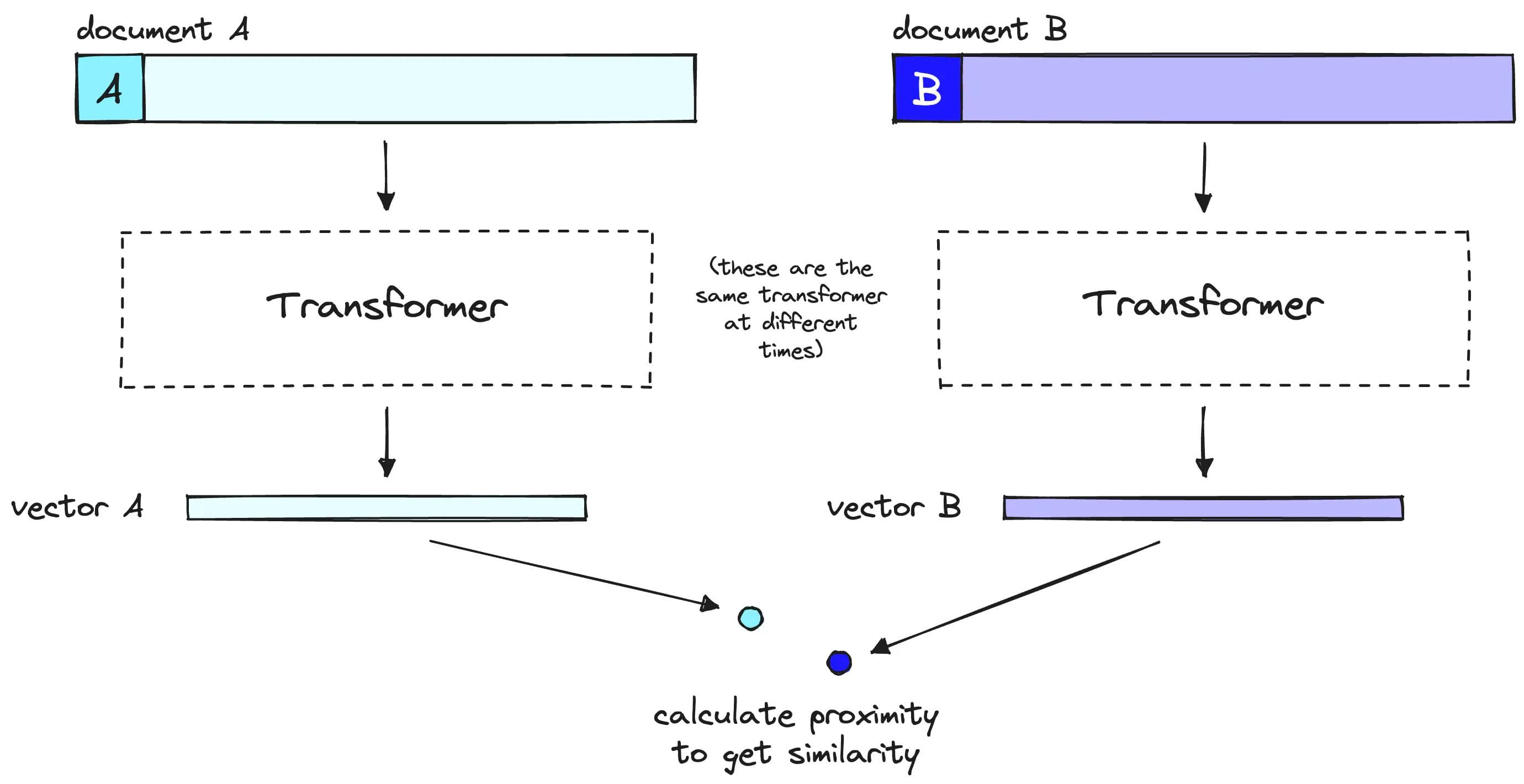
example of biencoder architecture for embedding

Also known as a "bi-encoder", this diagram shows how embedding models calculate semantic similarity.

While embedding models can accept queries and documents independently, rerankers must input both the query and the document at the same time. This is because most rerankers are cross-encoders, which differ from the embed-and-compare architecture commonly associated with vector search.

Embedding models create high-quality representations of their inputs, while cross-encoders output scores when given two inputs. While embedding models do a fantastic job at this, quality inevitably degrades when cramming vast amounts of information into a fixed-size vector.
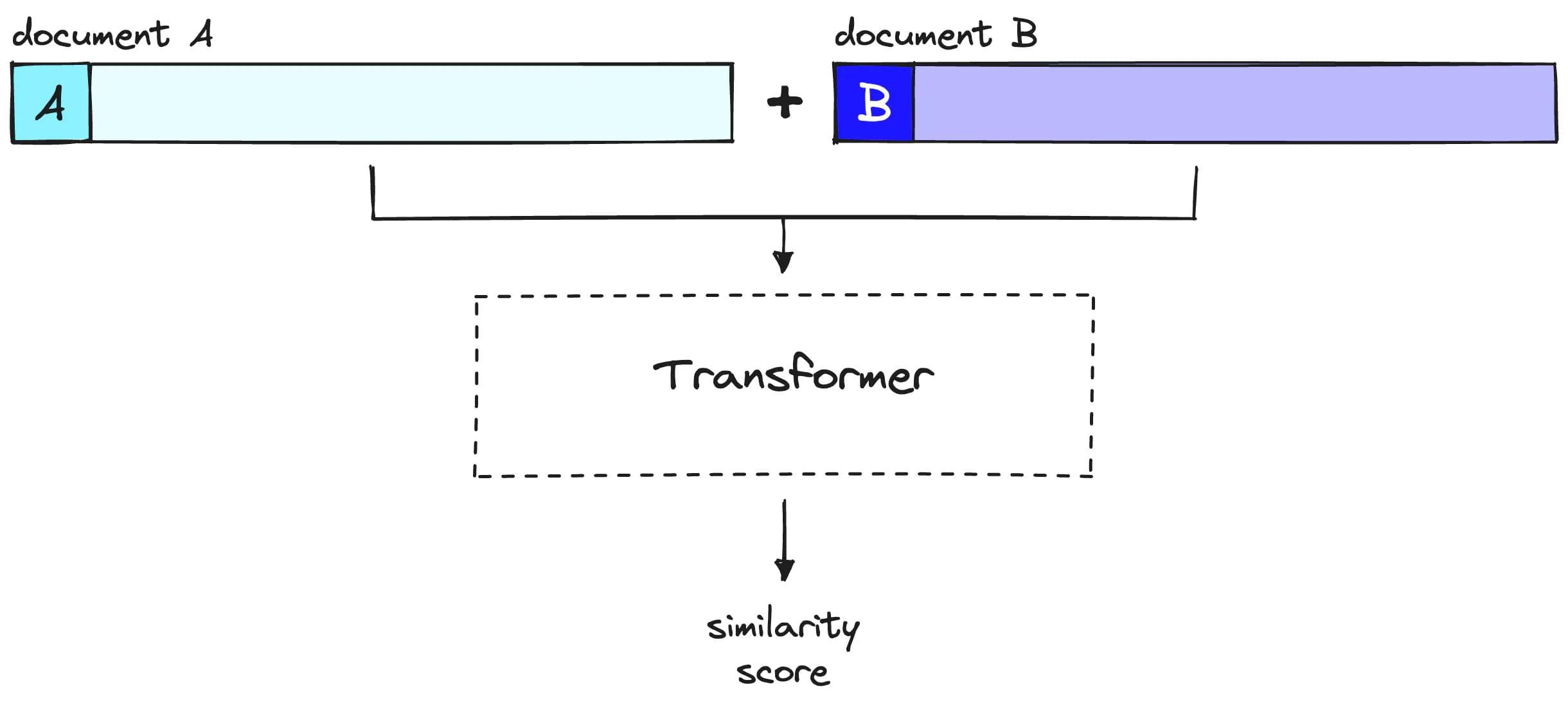
Cross encoder architecture example for rerankers

An example cross encoder reranker. Note that both query and document are ingested at the same time.

Cross encoding allows the model to make high-quality internal representations of the queries and documents and use those representations to quantify the metric in mind, in this case, relevance. By separating the task of finding relevance amongst queries and documents, the model can calculate a higher quality representation of this per query and document [1].

Rerank Best Practices

Keep Latency in Mind with Reranking

After learning about the refining benefits of rerankers for vector search, it may be tempting to assume that rerankers are a no-brainer to incorporate. However, rerankers come with a fundamental tradeoff: they can introduce significant latency.

Two main factors affect Rerank latency: document size in tokens and number of documents.

Recall that rerankers use a cross-encoder architecture. This means that every time documents are retrieved in response to a query, the reranker must calculate new relevance scores for each query-document pair. This computation cannot be easily saved as vector embeddings can in Pinecone.

Additionally, the latency will vary based on how large each document is. Because of this, we recommend experimenting with different values of top_n based on your latency and quality needs. Start with small values, such as top_k=10 and top_n=3, and iterate based on quality and latency for your application.

When using the Rerank endpoint, consider the following tips:

  • Remember the following critical parameters for using Rerank: max query tokens of 256, max doc tokens of 1024, and a max of 100 documents
  • Raise your retrieved top-k results from a standard of 3 to 5, to 10 or even 50, to allow for a deeper relevance search
  • Record the relevance of documents for downstream users and RAG pipelines. Use this information to tweak your Rerank and query calls and measure how well the endpoint works in production
  • Re-evaluate a set of in-domain search data at your organization with and without the reranker. Include measures that not only measure accuracy and relevance but also time for the user to act on the result to understand the overall effectiveness of the reranker

Using rerankers can be an easy way to increase the relevance of retrieved output from search queries with Pinecone. Incorporate the Pinecone Rerank into your pipelines today to refine your searches.

References

[1] J. Briggs, “Rerankers and two-stage retrieval” Pinecone, https://www.pinecone.io/learn/series/rag/rerankers/

[2] N. F. Liu et al., “Lost in the middle: How language models use long contexts | transactions of the Association for Computational Linguistics | MIT Press” MIT Press Direct, https://direct.mit.edu/tacl/article/doi/10.1162/tacl_a_00638/119630/Lost-in-the-Middle-How-Language-Models-Use-Long

[3] Q. Leng, J. Portes, S. Havens, and M. Carbin, Long Context RAG Performance of LLMs”, Databricks, https://www.databricks.com/blog/long-context-rag-performance-llms

[4] P. Bajaj et al., “MS-Marco: A human generated machine reading comprehension dataset” a"”iv.org, https://arxiv.org/abs/1611.09268

[5] R. Nogueira and K. Cho, “Passage Re-ranking with BERT” arxiv.org, https://arxiv.org/abs/1901.04085