




惯性聚合 高效追踪和阅读你感兴趣的博客、新闻、科技资讯
阅读原文 在惯性聚合中打开

推荐订阅源

A
Arctic Wolf
Recent Commits to openclaw:main
Google Online Security Blog
Help Net Security
Help Net Security
cs.AI updates on arXiv.org
T
The Exploit Database - CXSecurity.com
Application and Cybersecurity Blog
S
Security Affairs
N
News and Events Feed by Topic
Forbes - Security
Forbes - Security
月光博客
月光博客
博客园 - Franky
The GitHub Blog
The GitHub Blog
O
OpenAI News
The Cloudflare Blog
Google DeepMind News
P
Privacy & Cybersecurity Law Blog
WordPress大学
WordPress大学
H
Help Net Security
Apple Machine Learning Research
V
Visual Studio Blog
爱范儿
爱范儿
S
Secure Thoughts
T
The Blog of Author Tim Ferriss
SecWiki News
SecWiki News
Exploit-DB.com RSS Feed
J
Java Code Geeks
阮一峰的网络日志
阮一峰的网络日志
宝玉的分享
宝玉的分享
博客园_首页
Cisco Talos Blog
Cisco Talos Blog
C
CXSECURITY Database RSS Feed - CXSecurity.com
C
Cisco Blogs
博客园 - 三生石上(FineUI控件)
Hacker News: Ask HN
Hacker News: Ask HN
CTFtime.org: upcoming CTF events
人人都是产品经理
人人都是产品经理
腾讯CDC
Know Your Adversary
Know Your Adversary
P
Proofpoint News Feed
云风的 BLOG
云风的 BLOG
The Last Watchdog
The Last Watchdog
博客园 - 叶小钗
cs.CV updates on arXiv.org
Hugging Face - Blog
Hugging Face - Blog
PCI Perspectives
PCI Perspectives
罗磊的独立博客
有赞技术团队
有赞技术团队
B
Blog RSS Feed
L
LINUX DO - 最新话题

Pinecone

Pinecone Assistant: A Managed Knowledge Layer for Production AI Applications Multi-domain RAG in n8n: why one knowledge base is not enough Allspice Transforms the Culinary Experience with Semantic Search Powered by Pinecone | Pinecone Building RAG workflows in n8n: choosing the right Pinecone node Knowledge needs a meta-knowledge layer Garbage Day: How Pinecone Safely Deletes Billions of Objects at Scale When "Performance" Means Two Different Things Pinecone BYOC: Pinecone in your AWS, GCP, or Azure account, no vendor access True, Relevant, and Wrong: The Applicability Problem in RAG Use the Pinecone Plugin for Claude Code to develop AI Applications Faster Millions at Stake: How Melange's High-Recall Retrieval Prevents Litigation Collapse Powering High-stakes Patent Search at Scale: How Melange Built a Reliable AI System on Pinecone | Pinecone Pinecone Assistant Node in n8n: Turn Any Data Source Into Knowledge RAG with Access Control Pinecone Dedicated Read Nodes are now in Public Preview Inside Pinecone: Slab Architecture New Bulk Data Operations: Update, Delete, and Fetch by Metadata The Hidden Cost of Building: Lessons from Aquant Simplifying Vector Embeddings with Pinecone Integrated Inference Capabilities Pinecone joins Microsoft Marketplace as a Launch Partner GTM Engineering: Clay + Pinecone for AI-powered Sales Outbound Build an AI knowledge assistant with Google Docs and Pinecone Moving Pinecone forward with Ash Ashutosh as CEO and Edo spearheading our growing AI ambitions as Chief Scientist Pinecone Founder Edo Liberty to Spearhead Pinecone’s Growing AI Ambitions; Appoints Ash Ashutosh as CEO to Expand Vector Database Market Leadership Fast, Accurate Retrieval for Creators at Scale: Delphi’s Path Toward a Million Conversational Agents with Pinecone | Pinecone Announcing Pinecone Pioneers: A Program for Builders, Organizers, and Community Leaders What is Context Engineering? Chunking Strategies for LLM Applications Beyond the hype: Why RAG remains essential for modern AI Obviant Makes 30% More Accurate Defense Acquisition Recommendations Combining Sparse and Dense Retrieval with Pinecone | Pinecone Build more knowledgeable AI applications with new LLMs and greater control in Pinecone Assistant #NYTECHWEEK 2025 Retrieval-Augmented Generation (RAG) Accurate and Efficient Metadata Filtering in Pinecone’s Serverless Vector Database | Pinecone Terminal X AI Agents, Powered by Pinecone, Turn Complex Financial Data Into Production-grade Insights at Scale | Pinecone Aquant Delivers Scalable, Expert-level Service Intelligence with Pinecone | Pinecone Cascading retrieval with multi-vector representations: balancing efficiency and effectiveness Vector databases aren't just for large-scale enterprise AI Unveiling DIME: Reproducibility, Scalability, and Formal Analysis of Dimension Importance Estimation for Dense Retrieval | Pinecone Fast and Effective Early Termination for Simple Ranking Functions | Pinecone Domain-specific AI Agents at Scale: CustomGPT.ai Serves 10,000+ Customers with Pinecone | Pinecone Using Pinecone asynchronously with FastAPI A Flexible Resource for Top-Weighted Comparisons Between Sets and Rankings | Pinecone Build secure, scalable agentic AI workflows with Rubrik Annapurna and Pinecone Tool up: Pinecone’s first MCP servers are here Add context to your agent with Pinecone Assistant MCP remote server E2Rank: Efficient and Effective Layer-wise Reranking | Pinecone ColBERT-serve: Efficient Multi-Stage Memory-Mapped Scoring | Pinecone Efficient Constant-Space Multi-Vector Retrieval | Pinecone How Vanguard Worked with Pinecone to Boost Customer Support with Faster Calls and 12% More Accurate Responses | Pinecone Pinecone Named to Fast Company's Annual List of the World's Most Innovative Companies of 2025 Launch Week: Pinecone for agents, search, recommendations, and more Optimizing Pinecone for agents (and more) Retrieval Inference for scale and performance How 1up Turns Sales Reps Into Product Experts with Pinecone | Pinecone Don’t be dense: Launching sparse indexes in Pinecone Unlock High-Precision Keyword Search with pinecone-sparse-english-v0 Evolving Pinecone's architecture to meet the demands of Knowledgeable AI Pinpoint references faster with citation highlights in Pinecone Assistant Bringing the leading vector database to your cloud Getting started with llama-text-embed-v2 Natural Language Counterfactual Explanations for Graphs Using Large Language Models | Pinecone Easily build knowledgeable chat and agent-based applications in minutes with Pinecone Assistant, now generally available How to build an agentic, chat or RAG knowledge system using Pinecone Assistant Real-time RAG with Pinecone and Estuary Flow BigQuery to Pinecone in Real-Time with Estuary Flow Stravito Turns Market and Consumer Data Into Actionable Insights with Pinecone Inference | Pinecone Accelerate prototyping and development with Pinecone Local First-of-its-kind Pinecone Knowledge Platform to Power Best-in-class Retrieval for Customers Introducing integrated inference: Embed, rerank, and retrieve your data with a single API Strengthening security and increasing control with CMEK and API key roles Introducing Pinecone Rerank V0 Introducing cascading retrieval: Unifying dense and sparse with reranking From Idea to Action: How Pinecone Assistant Meaningfully Accelerates AI Business Building AI apps on Azure with Pinecone just got a lot easier Building a reliable, curated, and accurate RAG system with Cleanlab and Pinecone Four features of the Assistant API you aren't using - but should Deploying Pinecone with Infrastructure as Code (IaC) Streamlining CI/CD with Pinecone Local September 2024 Product Update Results of the Big ANN: NeurIPS'23 competition | Pinecone Introducing import from object storage for more efficient data transfer to Pinecone serverless Simplify, enhance, and evaluate RAG development with Pinecone Assistant, now in public preview Vectors and Graphs: Better Together August 2024 Product Update Pinecone Helps Deep Talk Deliver World-Class AI Assistants with Lower Engineering Overhead | Pinecone Assembled Delivers Better, Faster AI- Driven Support with Pinecone | Pinecone Llama 3.1 Agent using LangGraph and Ollama Build knowledgeable AI with Pinecone serverless, now generally available on Microsoft Azure Pinecone serverless is now generally available on Google Cloud, adding knowledge to AI assistants and other applications Accelerating Legal Discovery and Analysis with Pinecone and Voyage AI Bridging Dense and Sparse Maximum Inner Product Search | Pinecone Refine Retrieval Quality with Pinecone Rerank Introducing reranking to Pinecone Inference to simplify building accurate AI July 2024 Product Update Connect to Pinecone within your platform to enable a seamless AI development experience Introducing Pinecone API Versioning RAG Brag with Inkeep Co-Founder Nick Gomez LangGraph and Research Agents Introducing Pinecone Inference to streamline your AI workflow
ZoomInfo Delivers High-quality, Real-time Contact Recommendations for GTM Teams with Pinecone, Driving a 50% Increase in User Engagement | Pinecone
2026-04-15 · via Pinecone

ZoomInfo provides go-to-market intelligence software used by sales and marketing teams to identify the right people and companies to engage. Its platform includes hundreds of millions of professional contact records, enriched with firmographic data and advanced AI search tools.

To give its customers faster and more relevant results, ZoomInfo’s Applied AI team set out to build a real-time contact recommendation system at scale. The goal was to change how users discover the right people to reach out to inside a target account. Instead of manually searching and filtering, users would receive personalized suggestions the moment they viewed a company profile.

Building this capability required accurate and low-latency vector search over more than 390 million contact embeddings. The team needed a vector database that was simple to use, production-ready, and able to support the full customer base and more. After early experimentation, ZoomInfo chose Pinecone.

Challenge

Delivering real-time personalized recommendations at scale

ZoomInfo wanted to transform how its users discover the right people to contact inside a target account. The existing experience required users to manually search, filter, and navigate through large volumes of professional contact data. This slowed time-to-action and made it harder for sales teams to quickly identify the most relevant buyers. For many users, identifying the right contacts often required hours of manual searching and filtering across large datasets.

The Applied AI team began engineering a system that could generate personalized recommendations the moment a user viewed a company profile. This involved building and tuning vector embeddings from its proprietary contact data using a ~400M-parameter text embedding model, producing high-dimensional representations optimized for real-time relevance. It also required a new technical foundation: real-time semantic search over hundreds of millions of contact embeddings, with accuracy strong enough to meaningfully improve user engagement.

Several constraints made this challenging:

  • Real-time latency: Results needed to return in under a second to support an interactive UI
  • Massive scale: The system needed to serve vectors across more than 100,000 namespaces and support traffic growth across ZoomInfo’s large and increasing customer base
  • High recall and ranking quality: Recommendations had to outperform existing algorithms to justify rollout
  • Operational reliability: The team required predictable performance with no complex tuning or manual system management
  • Throughput growth: Full deployment required on the order of hundreds of queries per second, with headroom to continue scaling
  • Developer efficiency: The team needed a solution that allowed rapid iteration without adding infrastructure overhead

ZoomInfo considered vendors including Milvus, pgvector, and Spanner. Milvus and other open-source vector databases depended on deep expertise in ANN tuning and distributed cluster management, which would add ongoing operational overhead for ZoomInfo. pgvector and Spanner, as bolt-ons of traditional database systems, were constrained by architectures not designed for high-throughput vector search at scale, leading to performance and scalability limitations.

These challenges created a clear need for infrastructure that could support high-volume, low-latency vector search while remaining simple to integrate and operate across ZoomInfo’s platform.

Solution

Implementing real-time vector search with Pinecone

To build a real-time semantic search system that could support its recommendation workloads, ZoomInfo adopted Pinecone as the vector database powering the platform. Pinecone provided the reliability, accuracy, and operational efficiency the team needed to deliver fast, personalized results at scale. These capabilities allowed ZoomInfo customers to shift from a manual, multi-step discovery process to an instant, recommendation-driven workflow.

ZoomInfo began by building an end-to-end proof of concept using Pinecone’s Python SDK. Within three weeks, the team had loaded millions of embeddings, validated recall, and confirmed that Pinecone could meet sub-second latency requirements without manual index configuration or tuning. In parallel, the Applied AI team engineered data pipelines to generate and update these embeddings at scale, ensuring that Pinecone’s vector indexes remained fresh as new contact information was added to the platform. They also evaluated model outputs for relevancy and quality to verify that the system delivered meaningful recommendations for end users. This early phase proved that Pinecone could support the level of performance necessary for an interactive recommendation experience.

In Pinecone’s serverless environment, storage and compute scale independently, and the platform automatically manages indexing, capacity, and resource allocation. Because users never manage clusters, nodes, or machines directly, ZoomInfo could rely on Pinecone to handle sharding, data distribution, and performance optimization under the hood. This removed the operational overhead typically associated with vector infrastructure and allowed ZoomInfo’s engineers to focus on modeling, evaluation, and product integration instead of system maintenance.

ZoomInfo also benefited from Pinecone’s unique slab architecture, which stores vectors in large, contiguous units to avoid the fragmentation and unpredictable access patterns common in other vector databases. With slabs, all operations remain independent; data is available the moment it is written, and the system never pauses for background index optimization. Writes proceed at a constant speed without blocking queries, and reads fan out across slabs in parallel, allowing the system to consider all relevant data efficiently during search. Combined with Pinecone’s use of memory-mapped files for fast access, this design provides the predictable, low-latency performance needed to support ZoomInfo’s real-time recommendation workloads as they increase.

As the system grew to support more products and user cohorts, Pinecone’s Dedicated Read Nodes (DRN) became an important part of the deployment. DRN provides isolated read replicas with a warm data path—memory plus local SSD—that delivers predictable low-latency performance even under sustained, high-QPS workloads. Replicas scale throughput linearly, while shards scale storage, giving ZoomInfo a clear path to grow without re-architecting the system. The predictable, per-node pricing model also offered better cost efficiency than per-request pricing for ZoomInfo’s steady, always-on traffic patterns.

Pinecone’s slab architecture and Dedicated Read Nodes gave us the speed, consistency, and isolation we needed to run real-time recommendations at scale. Instead of managing infrastructure, we spend our time improving our recommendation model and the product itself. That has reduced the time our customers spend researching, filtering, and evaluating contacts—from hours to minutes—by giving them the right people to reach out to with a single click. — Carlos Nunez, Vice President of Engineering and Applied AI at ZoomInfo

result
Higher relevance, faster decisions, and scalable performance

With Pinecone powering its real-time recommendation system, ZoomInfo improved relevance, user engagement, and system performance across its platform.

Pinecone’s vector search accuracy made recommendations more actionable, helping users act faster and spend less time searching for the right contacts. These improvements strengthened customer interaction with the feature and supported a more efficient workflow for sales teams.

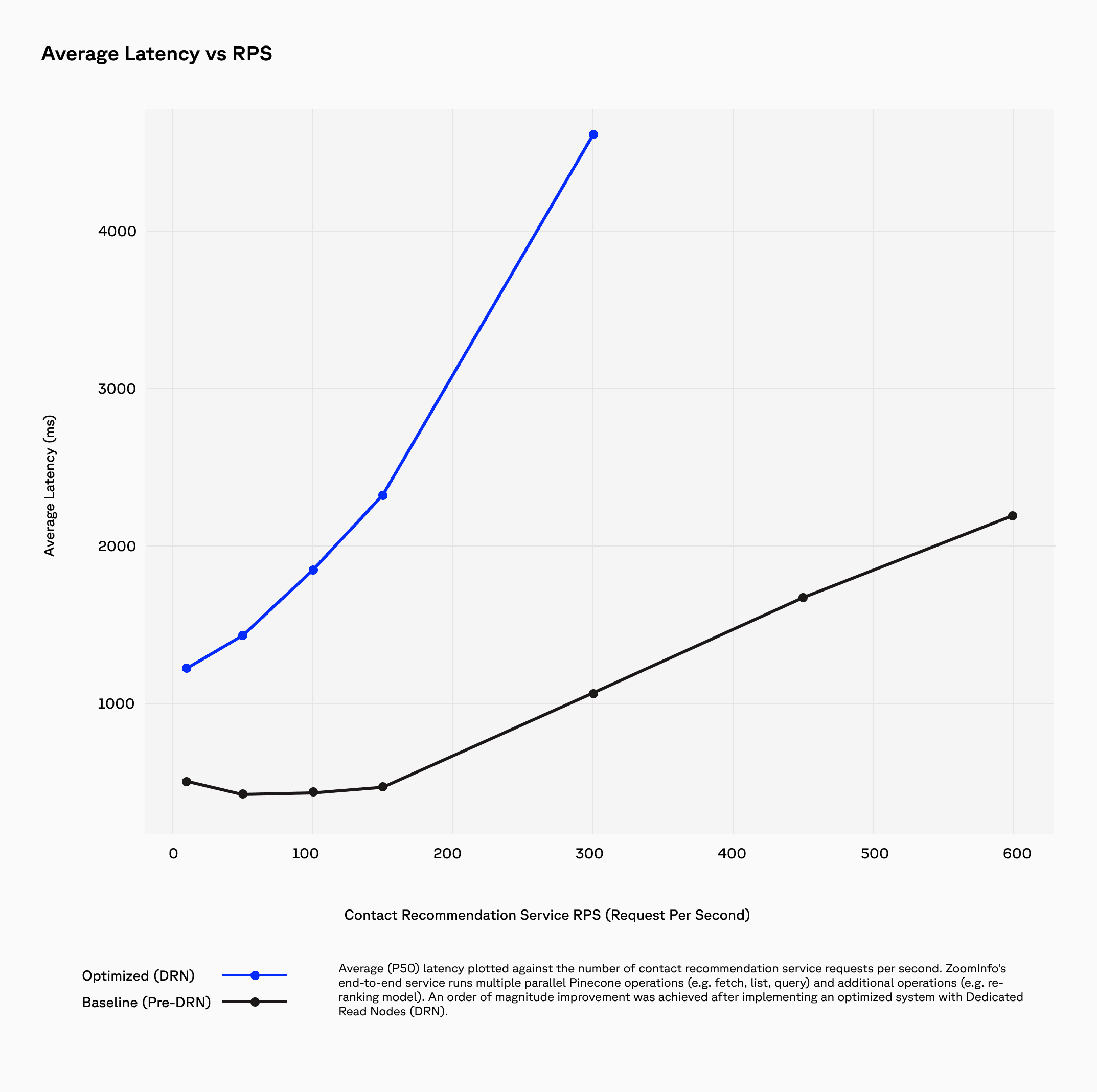
Pinecone’s asynchronous operations, serverless design, slab-based storage, and Dedicated Read Nodes also provided the throughput and latency stability required to expand recommendations across ZoomInfo’s product suite. The system maintained predictable performance under sustained traffic while reducing the operational burden associated with managing vector infrastructure. Pinecone sustained a P50 latency of ~60ms at ~40 QPS, which helped ZoomInfo’s goal of keeping the end-to-end latency of the entire recommendation service below 1 second for lighter loads (<100 RPS), and less than 5 seconds for heavier loads (>100 RPS). This was achieved even as ZoomInfo scaled to more than 390 million vectors.

Pinecone enabled us to build, scale, and optimize a real-time contact recommendation system that processes thousands of large-embedding-model vector search queries per second, which has driven a 2x improvement in relevancy and 50% boost to user engagement. — Tamiro Scholer, Senior Data Scientist at ZoomInfo

Key Outcomes

  • >50% increase in user engagement, driven by more relevant and timely recommendations
  • 2x improvement in relevancy and recall, resulting in higher-quality suggestions
  • 50x increase in peak customer requests served, enabling rollout across more products and cohorts
  • Consistent low-latency performance, supported by slab-based storage and Dedicated Read Nodes
  • Reduced operational overhead, freeing engineering time for model and product improvements
  • Faster time-to-action—from hours to minutes—for end users, with instant access to high-quality contact recommendations

ZoomInfo now delivers a faster, more accurate recommendation experience that helps users identify the right buyers quickly and take action sooner, strengthening the value of its platform.

Expanding real-time recommendations across the platform

With a scalable and reliable vector search foundation in place, ZoomInfo plans to expand its recommendation capabilities across more products, customer segments, and internal applications. The Applied AI team is exploring additional ways to use Pinecone to support new surfaces, new types of recommendations, and broader adoption throughout the platform.

ZoomInfo expects to extend the same real-time semantic search pipeline to power new workflows for go-to-market teams, as well as additional AI-driven insights built on the underlying dataset. Future enhancements will continue to focus on shortening time-to-action for customers by surfacing the most relevant insights immediately within their workflow. As usage grows, Pinecone’s combination of serverless scale, slab-based storage, and Dedicated Read Nodes will continue to provide the predictable performance and cost efficiency needed for sustained high-QPS and low-latency workloads.

Over time, ZoomInfo plans to increase traffic volumes even further and integrate recommendations into more touchpoints across its product suite. With Pinecone, the team is well positioned to support these growth targets while maintaining the responsiveness and accuracy that end users rely on. — Nilesh Mishra, Senior Manager of Applied AI at ZoomInfo