








Making sense of complex, interconnected information is a major challenge across many fields. This article introduces a new AI approach that tackles this problem head-on. Enhancing how machines understand and explore data opens up new possibilities for insight discovery in areas ranging from legal analysis to scientific research. This article introduces a novel method that uses metadata-driven ontologies for more consistent graph construction, demonstrated through an exploration of Supreme Court case data.
AI reasoning continues to evolve, but the main challenge remains: how do we create systems that can reason precisely and flexibly?
The latest advances in the field, including Retrieval-Augmented Generation (RAG), are beginning to bridge this gap by combining structured knowledge retrieval with the generative power of LLMs - but the journey is far from over.
We continuously evolve how we think about how machines can simulate human intelligence. In the early days, reasoning was seen as a puzzle of logic and rules. AI systems were expert systems, where knowledge was neatly organized into ontologies—structured representations of facts and relationships - and conditional rules. For example, MYCIN, an early AI designed for medical diagnosis, applied “if-then” rules to navigate a web of diseases and treatments, leading to precise, explainable decisions.
However, these symbolic systems faced a challenge: they were only as good as the rules they were given. Real-world knowledge, unlike ontologies, is messy, uncertain, and constantly changing. These rigid systems couldn’t adapt to new or unexpected information. As AI attempted to scale beyond narrow domains, it became clear that reasoning couldn't be confined to strict logic.
The 1990s introduced another paradigm shift—probabilistic models. These systems embraced uncertainty, using statistics to make educated guesses rather than following rigid rules. Bayesian networks, for example, allowed AI to reason probabilistically about the likelihood of different outcomes based on incomplete information. This was a significant step forward. AI systems could now handle more ambiguity and learn from data, making them far more flexible than their symbolic predecessors.
But this flexibility came at a cost. Probabilistic models, while powerful, lacked the transparency of symbolic systems. Decisions became more complicated to trace and explain. The interpretability that came with expert systems—where every step of the reasoning process was visible—was sacrificed for the ability to generalize and scale.
Today, AI reasoning has continued to evolve with the advent of large language models (LLMs) like GPT-4, Llama 3, etc. These models seem to behave as if they reason, driven by patterns learned from huge amounts of data rather than explicit rules or probabilities.
LLMs generate responses that can be both incredibly detailed and contextually relevant, mimicking the flow of human conversation. Researchers have been split on whether or not LLMs represent a “true” understanding of the world or whether it just seems that way. Whether LLMs are truly capable of reasoning or not, they can effectively perform various tasks that were previously impossible or very hard to automate.
But while LLMs are powerful, they, too, have their drawbacks. Unlike earlier systems, they lack a structured knowledge base, making their reasoning opaque. They can generate convincing text, but without a solid grounding in facts, they are prone to hallucinations—producing information that sounds right but is factually incorrect. This black-box nature of LLMs highlights a fundamental tension in AI: the balance between interpretability and flexibility.
By retrieving relevant information from a knowledge base and providing it as context to the LLM, RAG addresses several fundamental limitations:
Vector databases form the backbone of most RAG systems. They efficiently store and retrieve document embeddings and enable quick similarity searches to find relevant documents, crucial for providing accurate and up-to-date information to the LLM.
While RAG marked a significant advancement in AI systems' ability to access and utilize external knowledge, it's not without limitations. RAG is really good at finding relevant documents, but it often struggles to capture and leverage the intricate web of relationships between different pieces of information.
GraphRAG, a new concept that emerged in the industry following publications from researchers at companies such as Microsoft Research and Neo4j, aims to address these shortcomings by representing knowledge as a graph structure. The approaches to GraphRAG are evolving as well, and as this bleeding-edge field continues to progress, we are bound to see many types of implementations of the same concept.
In this post, we’ll juxtapose the LLM-centric approach (set forth by the Microsoft GraphRAG paper) and an approach that limits the reliance on the LLM during graph construction.
GraphRAG builds upon the foundation of RAG by introducing a graph-based knowledge representation. This approach allows the system to:
GraphRAG can be used for a variety of use cases, such as:
While GraphRAG can be incredibly useful, it introduced its own set of challenges:
These limitations require a more comprehensive, controlled knowledge representation and retrieval approach.
Reasoning over data may take various forms. While RAG and GraphRAG are more focused on retrieval, we wanted to explore how vector and graph databases can be used in conjunction to allow for structured - and eventually automated - data exploration. The basic premise is this: using semantic search, we can limit filter a sub-graph and then generate graph queries to ask and answer contextually relevant questions. This iterative exploration process could be done either manually or agentically.
This approach differs from GraphRAG in several key ways, which we'll explore in this post. One crucial distinction is that unlike GraphRAG—which relies on an LLM for graph construction—we use the metadata inherent in the dataset itself (as well as other more “stable” sources for entities and relations). This metadata essentially forms the underlying ontological structure of our data, which is then reflected in the graph.
As we’ll show, we were able to effectively generate queries on this graph that were both contextually relevant and likely to resolve a helpful answer. This was primarily due to the constrained way we constructed the graph.
When guided by a well-defined ontology, the number of effective queries an LLM can generate increases despite—and indeed because of—the constraints imposed on entity and relationship types. Here are the main advantages of this approach:
Not all datasets provide such rich metadata. In those cases, alternative methods for constructing and applying an ontology would be necessary. We'll explore these challenges in future posts, but for now, we're focusing on these metadata-driven methods (among others) to guide our graph construction.
At its core, our work brings together four key components:
Let’s take a look at the flow diagram of the system:
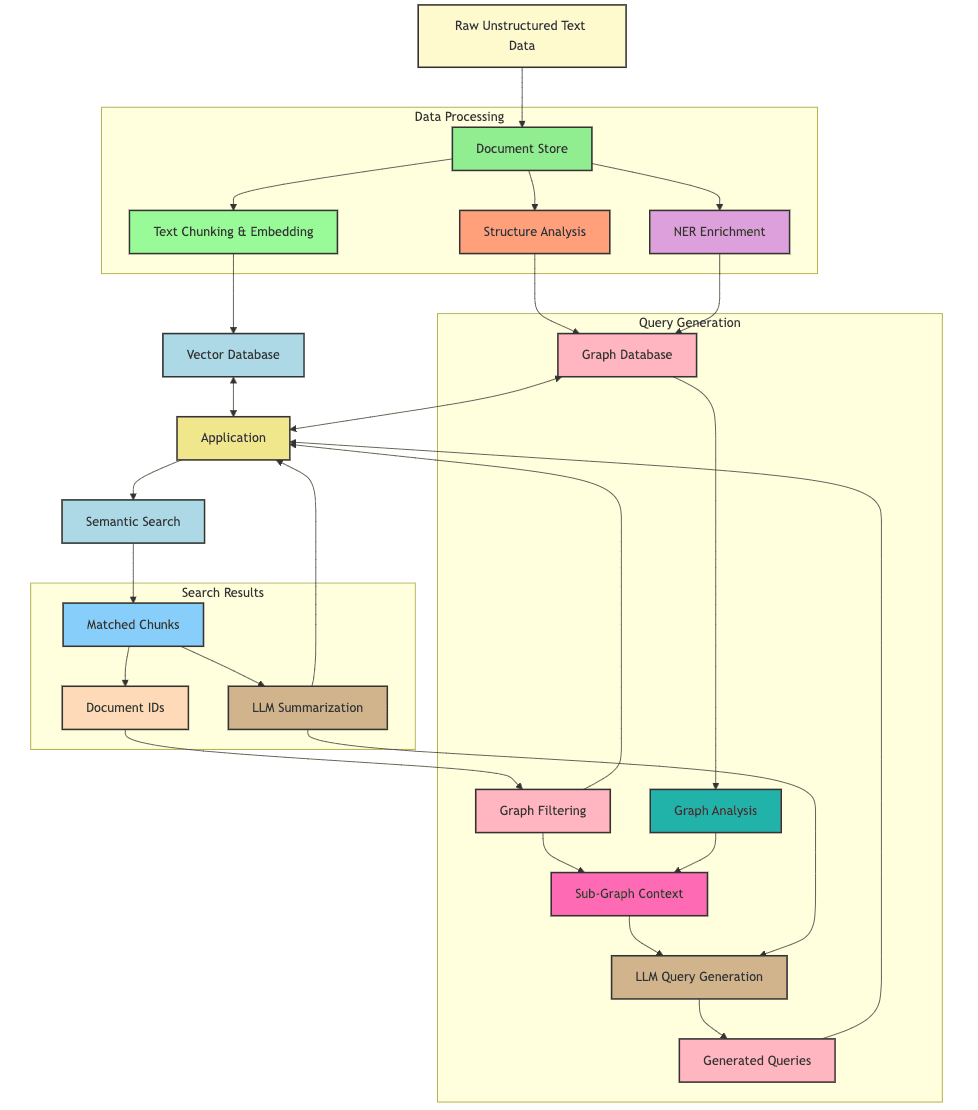
Our workflow begins in semantic space, where raw, unstructured text data—documents, sentences, or paragraphs—exist in their natural form. The challenge is to transform this data into something structured and actionable, guided by domain-specific knowledge.
Our data takes two parallel routes, one that goes to the vector database, and the other goes to the graph database. Both begin in the document store, which contains both the raw semantic data as well as the metadata used to construct the graph.
To demonstrate the practical application of our agentic graph exploration approach, we've developed an example centered around exploring Supreme Court cases. This demo showcases how our system can effectively navigate and extract insights from complex legal data, leveraging the power of semantic search, graph databases, and AI-driven query generation.
Our chosen domain of Supreme Court cases provides an ideal testing ground for several reasons:
In the following sections, we'll point out the specifics of how we processed this data and utilized our system to generate meaningful insights from it.
Our pipeline begins by ingesting and processing the raw case data across three key components:
Here’s a detailed breakdown of the pipeline:
case in the document DB:Case, Party, Justice, and Advocate are defined (processing pipeline - cell 8)advocated_by, decided_by , won_by are derived from the data. (processing pipeline - cell 14)opinion text with “good-old-fashioned” NER using flair (processing pipeline - cell 10).entities and relations are saved as nodes and edges in Neo4j.(Document DB → Vector DB + GraphDB pipeline)
With our knowledge graph and embeddings in place, we move to generating insightful queries from our data.
The process begins by gathering comprehensive context (see graphStatsQueries.ts) :
Our query generator then leverages this context to generate Cypher queries (see cypherQuestionsPromptBuilder.ts):
AI reasoning has undergone significant changes, each iteration grappling with the trade-offs between structure and flexibility. Our work on graph exploration represents a step towards reconciling these competing needs. By integrating semantic search, graph databases, and LLM-driven query generation, we've developed a system that can navigate complex datasets with both precision and contextual understanding.
Our Supreme Court case demonstration illustrates the potential of this approach in real-world applications, showing how metadata-driven ontologies can guide meaningful exploration of intricate domains. While challenges remain, this method opens up new avenues for AI-assisted knowledge discovery, potentially offering a bridge between the interpretability of structured systems and the adaptability of modern language models.
此内容由惯性聚合(RSS阅读器)自动聚合整理,仅供阅读参考。 原文来自 — 版权归原作者所有。