





As humans, we don’t learn tasks in isolation. As we move our knowledge path forward, we build on previously learned and related challenges, which accelerates the learning process.
If you already know a particular musical, cooking, or dance style, you will not forget that knowledge and start from scratch when learning a different style; you will reuse the knowledge you already have and finetune it to absorb the new features. This is an incredible human capability, which can also be applied to machines through the use of Transfer Learning (TL).
This way, what has been learned in one setting is built upon to improve generalization on a related setting, which is a huge advantage over traditional approaches that don’t capture this benefit. Traditional Machine Learning models require training from scratch, which is computationally expensive and requires a large amount of data to achieve high performance. They also involve isolated training, where each model is independently trained for a specific purpose without any dependency on past knowledge.
Transfer Learning (TL) is a Machine Learning method where a model developed for a task is reused as the starting point for a model in another task.
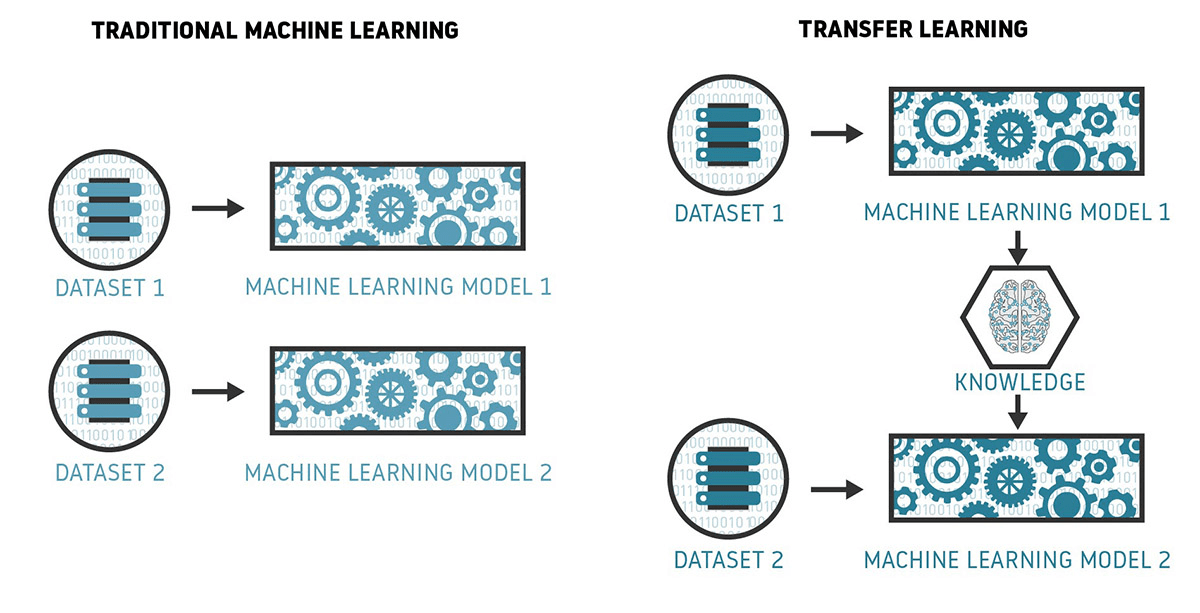
Traditional Machine Learning vs. Transfer Learning.
TL has become highly popular given the enormous resources required to train Deep Learning models, especially in the areas of:
How does the transfer learning process work? Although there are different approaches, two of the main ones are:
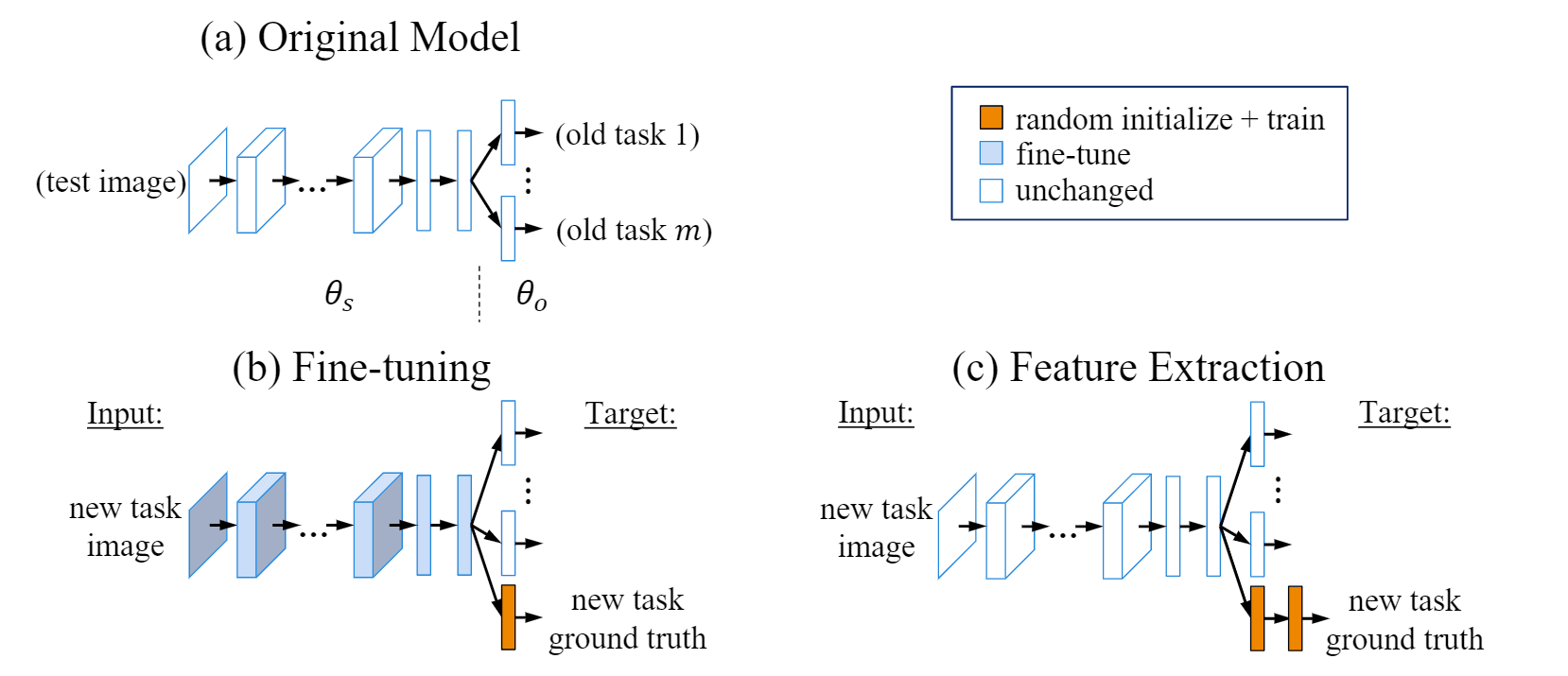
These approaches can be integrated in TL, producing the following workflow:
As a last step, one can perform a fine-tuning of the model: unfreezing the entire model obtained above (or part of it) and re-training it on the new data with a very low learning rate. This can potentially achieve meaningful improvements by incrementally adapting the pretrained features to the new data.
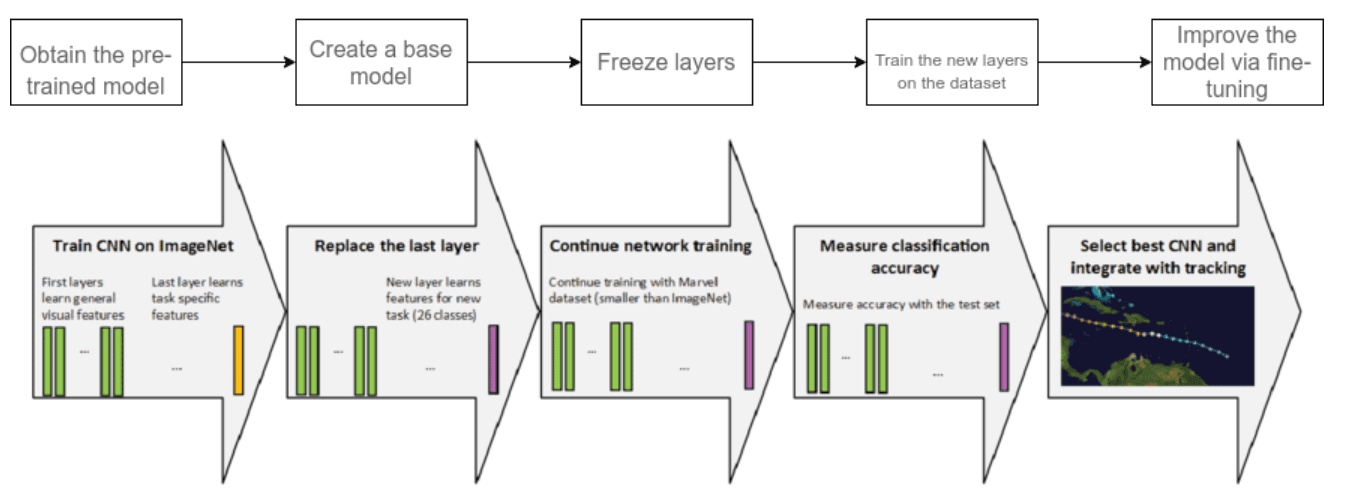
The Transfer Learning process.
Using this workflow as a generic approach to perform TL, let’s see how specific pretrained models can be used to solve different challenges.
In Computer Vision, the intuition is that if a model is trained on a large and general enough dataset, it will effectively serve as a generic model of the visual world. Some of the main pretrained models used in Computer Vision for TL are:
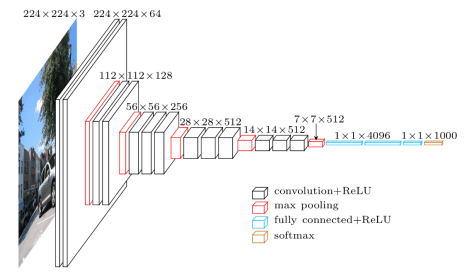
Macro Architecture of VGG16. Source: VGG in TensorFlow
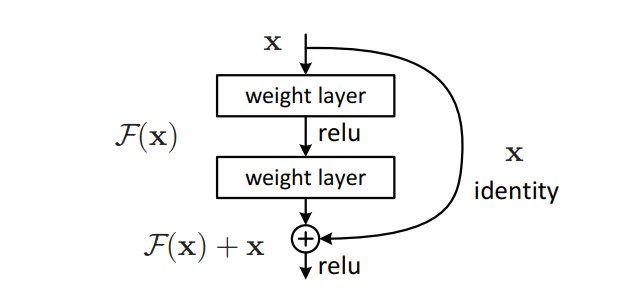
The advantage of adding the “identity shortcut connection” is that if any layer hurts the performance of the model, then it will be skipped.
Like in Computer Vision, you can take advantage of the learned features from NLP pretrained models without having to start from scratch by training a large model on a large dataset. Some of the main pretrained models used in NLP for TL are:
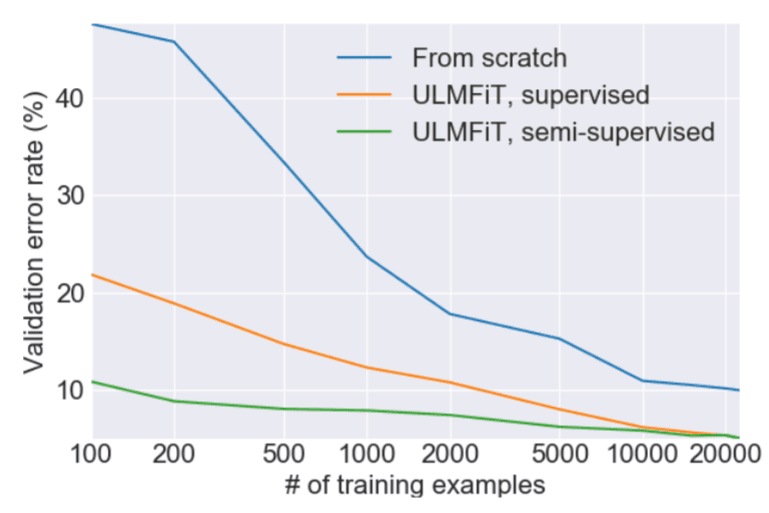
ULMFiT requires orders of magnitude less data than previous approaches.
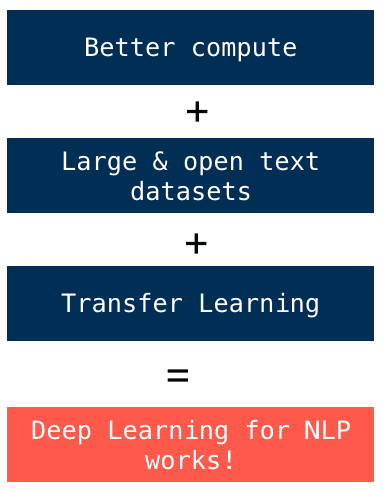
BERT proved to become the most popular of the modern NLP models. BERT was made possible by two major trends. Firstly, hardware has gotten exponentially better, especially GPUs. Second, the web, mostly composed of text, provided a large, open and diverse dataset.
Transfer learning is a shortcut to saving time, resources and getting better performance. Although it’s not obvious that there will be a benefit to using TL in the domain until after the model has been developed and evaluated, there are some possible advantages like:
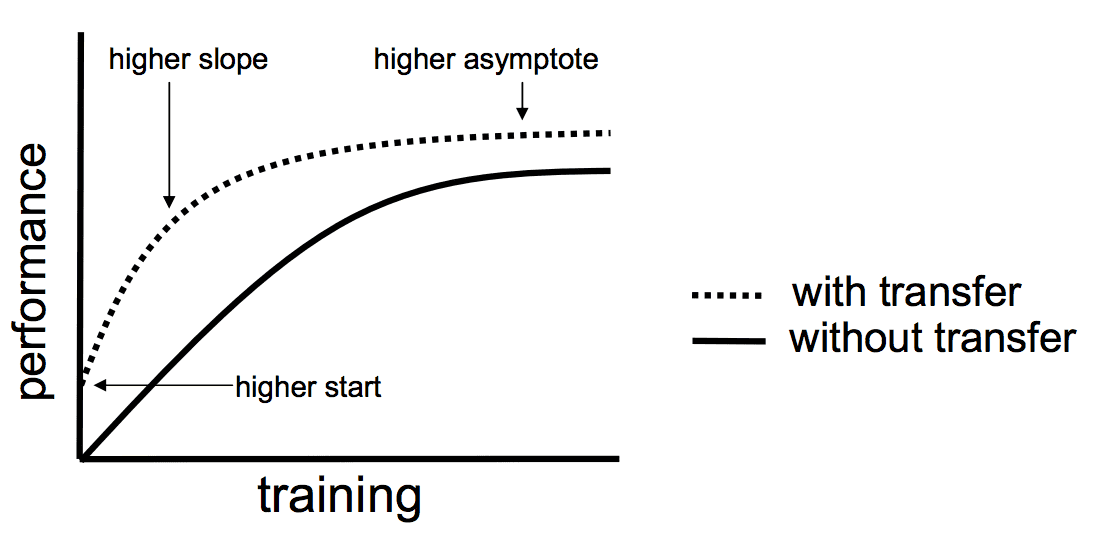
Three ways in which transfer might improve learning.
Ideally, you would see all three benefits from a successful application of TL, which in practical terms, you can try to seek if:
This all sounds great, but although the goal of TL is to improve a model’s performance, it can also degrade it. If the TL task ends up with a decrease in the performance or accuracy of the new model, then it produces an effect called negative transfer. Negative transfer can be caused by too high a dissimilarity of the problem domains or the inability of the model to train for the new domain’s data set (in addition to the new data set itself).
Transfer learning can also induce overfitting, which happens when the new model learns details and noises from the training data that negatively impact its outputs.
Transfer learning can come with a variety of serious problems, including distributional biases, social stereotypes, potentially revealing training samples, and other possible harms. In the case of NLP language pretrained models, one particular type of harm is the generation of toxic language, which includes hate speech, insults, profanities, and threats.
There’s no such thing as free lunch. Although transfer learning has several limitations, it allows for repurposing models for new problems with less data for training, gaining efficiencies in time and resources.
Besides the obvious economic benefits of using TL, some people believe it might also be the gateway to more impactful advancements in AI. As Demis Hassabis (CEO and co-founder of DeepMind) said:
I think Transfer Learning is the key to General Intelligence. And I think the key to doing Transfer Learning will be the acquisition of conceptual knowledge that is abstracted away from perceptual details of where you learned it from.
此内容由惯性聚合(RSS阅读器)自动聚合整理,仅供阅读参考。 原文来自 — 版权归原作者所有。