

惯性聚合 高效追踪和阅读你感兴趣的博客、新闻、科技资讯
阅读原文 在惯性聚合中打开

推荐订阅源

钛媒体:引领未来商业与生活新知
钛媒体:引领未来商业与生活新知
T
Troy Hunt's Blog
P
Proofpoint News Feed
V
Vulnerabilities – Threatpost
C
Cybersecurity and Infrastructure Security Agency CISA
K
Kaspersky official blog
Cyberwarzone
Cyberwarzone
T
Tor Project blog
Cisco Talos Blog
Cisco Talos Blog
S
Securelist
L
Lohrmann on Cybersecurity
Security Latest
Security Latest
T
Threatpost
H
Heimdal Security Blog
W
WeLiveSecurity
A
Arctic Wolf
Cyber Security Advisories - MS-ISAC
奇客Solidot–传递最新科技情报
奇客Solidot–传递最新科技情报
G
GRAHAM CLULEY
IT之家
IT之家
freeCodeCamp Programming Tutorials: Python, JavaScript, Git & More
TaoSecurity Blog
TaoSecurity Blog
A
About on SuperTechFans
cs.CL updates on arXiv.org
N
News and Events Feed by Topic
Hacker News - Newest:
Hacker News - Newest: "LLM"
Last Week in AI
Last Week in AI
T
The Blog of Author Tim Ferriss
Threat Intelligence Blog | Flashpoint
Microsoft Azure Blog
Hugging Face - Blog
Hugging Face - Blog
Google DeepMind News
量子位
Stack Overflow Blog
Stack Overflow Blog
Know Your Adversary
Know Your Adversary
B
Blog RSS Feed
阮一峰的网络日志
阮一峰的网络日志
WordPress大学
WordPress大学
cs.CV updates on arXiv.org
AI
AI
OSCHINA 社区最新新闻
OSCHINA 社区最新新闻
博客园 - 司徒正美
Apple Machine Learning Research
GbyAI
GbyAI
Vercel News
Vercel News
C
Cyber Attacks, Cyber Crime and Cyber Security
Latest news
Latest news
D
Darknet – Hacking Tools, Hacker News & Cyber Security
大猫的无限游戏
大猫的无限游戏
Forbes - Security
Forbes - Security

Pinecone

Pinecone Assistant: A Managed Knowledge Layer for Production AI Applications Multi-domain RAG in n8n: why one knowledge base is not enough Allspice Transforms the Culinary Experience with Semantic Search Powered by Pinecone | Pinecone Building RAG workflows in n8n: choosing the right Pinecone node Knowledge needs a meta-knowledge layer Garbage Day: How Pinecone Safely Deletes Billions of Objects at Scale When "Performance" Means Two Different Things Pinecone BYOC: Pinecone in your AWS, GCP, or Azure account, no vendor access True, Relevant, and Wrong: The Applicability Problem in RAG Use the Pinecone Plugin for Claude Code to develop AI Applications Faster Millions at Stake: How Melange's High-Recall Retrieval Prevents Litigation Collapse Powering High-stakes Patent Search at Scale: How Melange Built a Reliable AI System on Pinecone | Pinecone Pinecone Assistant Node in n8n: Turn Any Data Source Into Knowledge RAG with Access Control Pinecone Dedicated Read Nodes are now in Public Preview Inside Pinecone: Slab Architecture New Bulk Data Operations: Update, Delete, and Fetch by Metadata The Hidden Cost of Building: Lessons from Aquant Simplifying Vector Embeddings with Pinecone Integrated Inference Capabilities Pinecone joins Microsoft Marketplace as a Launch Partner GTM Engineering: Clay + Pinecone for AI-powered Sales Outbound Build an AI knowledge assistant with Google Docs and Pinecone Moving Pinecone forward with Ash Ashutosh as CEO and Edo spearheading our growing AI ambitions as Chief Scientist Pinecone Founder Edo Liberty to Spearhead Pinecone’s Growing AI Ambitions; Appoints Ash Ashutosh as CEO to Expand Vector Database Market Leadership Fast, Accurate Retrieval for Creators at Scale: Delphi’s Path Toward a Million Conversational Agents with Pinecone | Pinecone Announcing Pinecone Pioneers: A Program for Builders, Organizers, and Community Leaders Chunking Strategies for LLM Applications Beyond the hype: Why RAG remains essential for modern AI Obviant Makes 30% More Accurate Defense Acquisition Recommendations Combining Sparse and Dense Retrieval with Pinecone | Pinecone Build more knowledgeable AI applications with new LLMs and greater control in Pinecone Assistant #NYTECHWEEK 2025 Retrieval-Augmented Generation (RAG) Accurate and Efficient Metadata Filtering in Pinecone’s Serverless Vector Database | Pinecone Terminal X AI Agents, Powered by Pinecone, Turn Complex Financial Data Into Production-grade Insights at Scale | Pinecone Aquant Delivers Scalable, Expert-level Service Intelligence with Pinecone | Pinecone Cascading retrieval with multi-vector representations: balancing efficiency and effectiveness Vector databases aren't just for large-scale enterprise AI Unveiling DIME: Reproducibility, Scalability, and Formal Analysis of Dimension Importance Estimation for Dense Retrieval | Pinecone Fast and Effective Early Termination for Simple Ranking Functions | Pinecone Domain-specific AI Agents at Scale: CustomGPT.ai Serves 10,000+ Customers with Pinecone | Pinecone Using Pinecone asynchronously with FastAPI A Flexible Resource for Top-Weighted Comparisons Between Sets and Rankings | Pinecone Build secure, scalable agentic AI workflows with Rubrik Annapurna and Pinecone Tool up: Pinecone’s first MCP servers are here Add context to your agent with Pinecone Assistant MCP remote server E2Rank: Efficient and Effective Layer-wise Reranking | Pinecone ColBERT-serve: Efficient Multi-Stage Memory-Mapped Scoring | Pinecone Efficient Constant-Space Multi-Vector Retrieval | Pinecone How Vanguard Worked with Pinecone to Boost Customer Support with Faster Calls and 12% More Accurate Responses | Pinecone Pinecone Named to Fast Company's Annual List of the World's Most Innovative Companies of 2025 Launch Week: Pinecone for agents, search, recommendations, and more Optimizing Pinecone for agents (and more) Retrieval Inference for scale and performance How 1up Turns Sales Reps Into Product Experts with Pinecone | Pinecone Don’t be dense: Launching sparse indexes in Pinecone Unlock High-Precision Keyword Search with pinecone-sparse-english-v0 Evolving Pinecone's architecture to meet the demands of Knowledgeable AI Pinpoint references faster with citation highlights in Pinecone Assistant Bringing the leading vector database to your cloud Getting started with llama-text-embed-v2 Natural Language Counterfactual Explanations for Graphs Using Large Language Models | Pinecone Easily build knowledgeable chat and agent-based applications in minutes with Pinecone Assistant, now generally available How to build an agentic, chat or RAG knowledge system using Pinecone Assistant Real-time RAG with Pinecone and Estuary Flow BigQuery to Pinecone in Real-Time with Estuary Flow Stravito Turns Market and Consumer Data Into Actionable Insights with Pinecone Inference | Pinecone Accelerate prototyping and development with Pinecone Local First-of-its-kind Pinecone Knowledge Platform to Power Best-in-class Retrieval for Customers Introducing integrated inference: Embed, rerank, and retrieve your data with a single API Strengthening security and increasing control with CMEK and API key roles Introducing Pinecone Rerank V0 Introducing cascading retrieval: Unifying dense and sparse with reranking From Idea to Action: How Pinecone Assistant Meaningfully Accelerates AI Business Building AI apps on Azure with Pinecone just got a lot easier Building a reliable, curated, and accurate RAG system with Cleanlab and Pinecone Four features of the Assistant API you aren't using - but should Deploying Pinecone with Infrastructure as Code (IaC) Streamlining CI/CD with Pinecone Local September 2024 Product Update Results of the Big ANN: NeurIPS'23 competition | Pinecone Introducing import from object storage for more efficient data transfer to Pinecone serverless Simplify, enhance, and evaluate RAG development with Pinecone Assistant, now in public preview Vectors and Graphs: Better Together August 2024 Product Update Pinecone Helps Deep Talk Deliver World-Class AI Assistants with Lower Engineering Overhead | Pinecone Assembled Delivers Better, Faster AI- Driven Support with Pinecone | Pinecone Llama 3.1 Agent using LangGraph and Ollama Build knowledgeable AI with Pinecone serverless, now generally available on Microsoft Azure Pinecone serverless is now generally available on Google Cloud, adding knowledge to AI assistants and other applications Accelerating Legal Discovery and Analysis with Pinecone and Voyage AI Bridging Dense and Sparse Maximum Inner Product Search | Pinecone Refine Retrieval Quality with Pinecone Rerank Introducing reranking to Pinecone Inference to simplify building accurate AI July 2024 Product Update Connect to Pinecone within your platform to enable a seamless AI development experience Introducing Pinecone API Versioning RAG Brag with Inkeep Co-Founder Nick Gomez LangGraph and Research Agents Introducing Pinecone Inference to streamline your AI workflow Build Privacy-aware AI software using Pinecone
What is Context Engineering?
Arjun Patel · 2025-07-16 · via Pinecone

Putting the Pieces Together

LLMs are getting better, faster, and smarter, and as they do, we need new ways to use them.

Applications people build with them have transitioned from asking LLMs to write to letting LLMs drive actions. With that, comes new challenges in developing what are called agentic applications.

Context engineering is a term that attempts to describe the architecting necessary to support building accurate LLM applications. But what does context engineering involve?

Hallucinations Constrain AI Applications

Much has been made of the potential of agents to complete tasks and revolutionize industries. Still, if there’s one thing that has passed the test of time, it’s that LLM applications will always fail without the relevant information. And in those failures, come hallucinations.

Multiple tool calls, messages, and competing objectives blur instructions in agentic applications. Due to these diverse integrations all competing for a fixed (literal!) attention span for a model, a need arises for engineering their integration. Absent this, models default to their world knowledge and information to generate results, which can result in unintended consequences.

Context engineering is an umbrella term for a series of techniques to maintain the necessary information needed for an agent to complete tasks successfully. Harrison Chase from LangChain breaks down context engineering into a few parts:
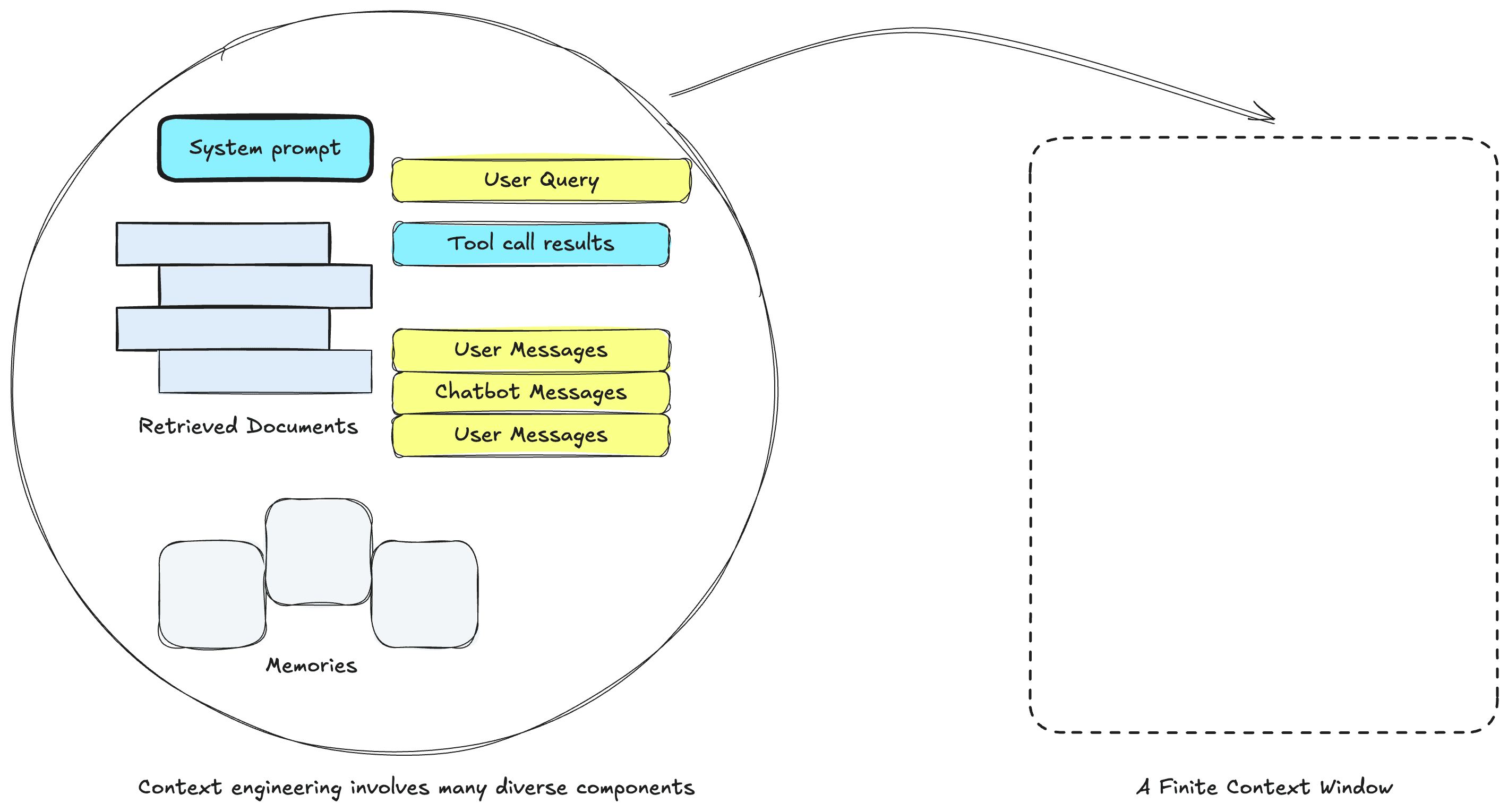
  • actions the LLM can take (tool use)
  • instructions from the user (prompt engineering)
  • data related to the task at hand, like code, documents, produced artifacts, etc (retrieval)
  • historical artifacts like conversation memory or user facts (long and short term memory)
  • data produced by subagents, or other intermediate task or tool outputs (agentic architectures)

The building blocks of context engineering visualized, such that pieces are fit into a rectangular window.

Context Engineering requires putting together many building blocks of context generated from various resources, into a finite context window

All of these must fit into a finite context window for applications to succeed.

Retrieval and vector databases are uniquely impactful for these applications, as they help retrieve the external information in various modalities and representations necessary to ground responses with context. But just having the context isn’t enough.

Organizing, filtering, deleting, and processing this information so that an LLM can continue to focus on the task at hand is context engineering.

Applying Lessons from Retrieval-augmented Generation to Context Engineering

Now if you’re reading this far, you might think, oh no!! Another technique for the aspiring AI engineer to learn, the horror! How will you ever catch up!?!

Not to fear. If you’ve built any search or retrieval-augmented generation application before, you already know a lot of the principles for context engineering! In fact, we can make the argument that context engineering is just a step-up abstraction of prompt engineering for RAG applications.

How, you ask?

Imagine you’ve built an application for helping answer incoming customer support tickets. It’s architected as follows:

  1. Take an incoming user query, and query your semantic search which indexes documents from your company
  2. pass the retrieved context to an LLM, like Claude or OpenAI
  3. Answer user queries using the context

Accordingly, the application has access to a knowledge base of information that might include previous support tickets, company documentation, and other information critical to respond to users.

You might use a prompt like this:

You are a customer support agent tasked with helping users solve their problems. 

You have access to a knowledge base containing documentation, FAQs, and previous support tickets.

Given the information below, please help the user with their query. 

If you don't know the answer, say so and offer to create a support ticket.

INSTRUCTIONS:

Always be polite and professional

Use the provided context to answer questions accurately

If the information needed is not in the context, acknowledge this and offer to create a support ticket

If creating a ticket, collect: user name, email, issue description, and priority level

For technical questions, provide step-by-step instructions when possible

CONTEXT: <retrieved docs>

USER QUERY: <user query>

Please respond in a helpful, conversational manner while remaining factual and concise.

In that prompt, you’d balance how to drive the LLM’s behavior, manage the documents retrieved from the user query, and provide any additional information necessary for the task at hand.

It’s a great proof-of-concept that quickly delivers answers to frustrated users. But, you have a new requirement now:

Build a chatbot that can manage support tickets given user queries

Specifically, the chatbot must be turned into an agent that can:

  • Maintain a conversation with users and extract key information from them for the tickets
  • Open, write to, update, and close support tickets
  • Answer tickets that are in-domain or available in a knowledge base or previous tickets
  • Route the tickets to an appropriate customer support personnel for follow-up

The LLM must reason and act instead of just responding. It must also maintain information about a given set of tickets over time to provide a personalized user experience.

So, how do we go about doing this?

We might need some of the following:

  • Tool Use, to enable writing and closing tickets
  • Memory, to understand user needs and maintain key information over time, as well as to summarize and manage information over time
  • Retrieval, to modify user queries to find documentation and information over time
  • Structured Generation, to properly extract information for tickets, or to classify and route tickets to employees
  • Compaction, Deletion, and Scratchpads to maintain, remove, and persist temporary information over time

All of these additional capabilities consume significant context over time, and warrant additional data structures, mechanisms, programming, and prompt engineering to smooth out capabilities.

Fortunately, prompt engineering for RAG incorporates many lessons you’d need to help tackle this problem.

We know that all embedding models and LLMs have limits to the amount of information they can process in their context window, and that the best way to budget this window is via chunking.

Furthermore, you may be familiar with reranking, which allows you to refine relevant documents sets down to more manageable sizes, to reduce cost, latency and hallucination rates.

Here, we can see how summarization and reranking can prune context down for future conversational turns.
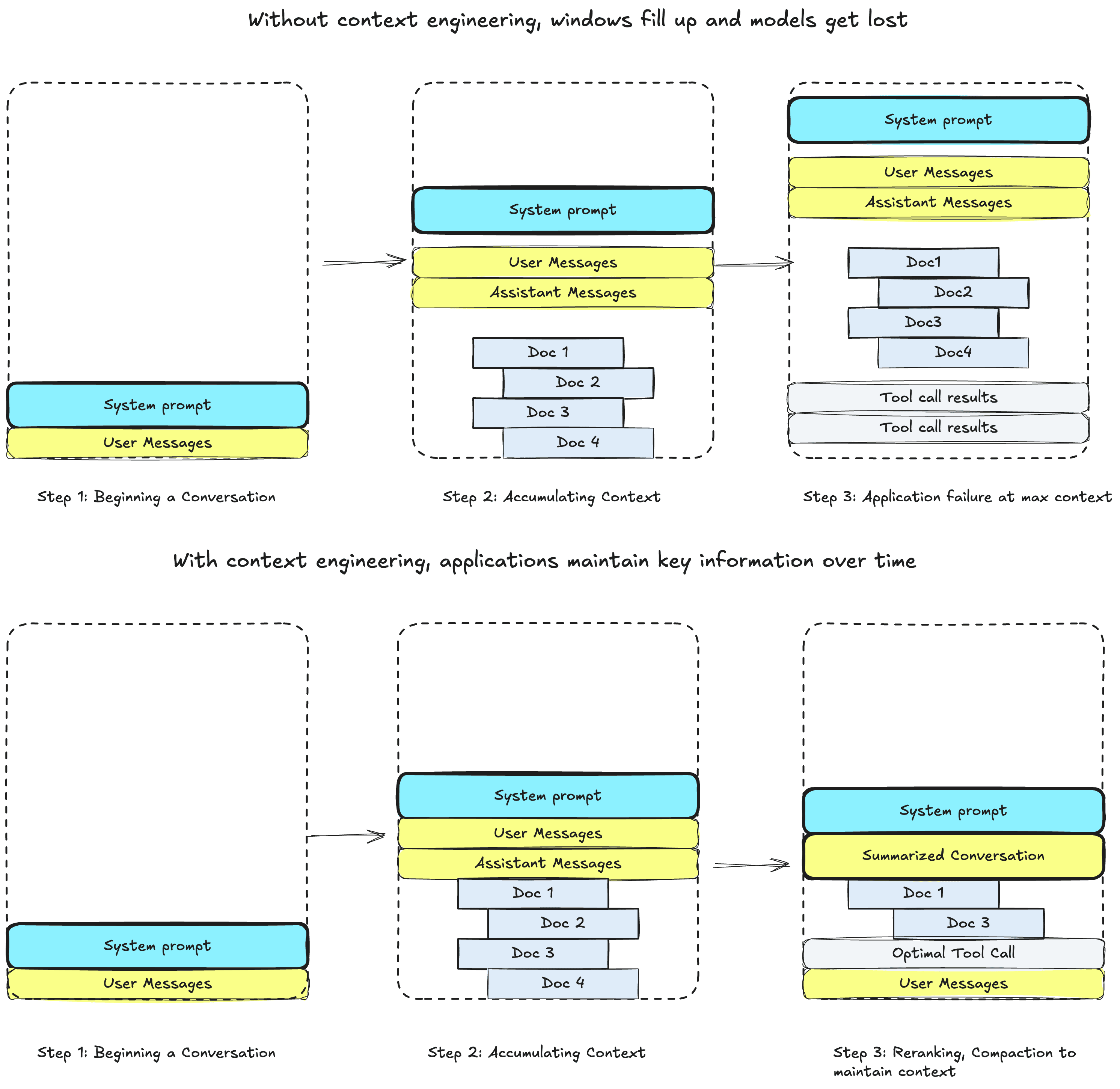
A visual of some time steps of maintaining context over time. The top row is without context engineering, where context builds up and is flushed. The bottom involves compaction and summarization

And, if you are building agents, you might even know about the importance of letting your agent control queries to an external vector database via a tool or MCP server, which lets it determine the appropriate questions to ask for the task at hand.

All of these techniques help you generate accurate responses given a user’s query. For more examples of how this is achieved in practice, read Dexter Horthy’s great writeup on context engineering in prompts, or Drew Breunig’s write up on fixing context issues here.

But, user’s might make multiple queries. They might ask for revisions on existing information, or for you to get new information for the current task. They want their problems solved, not just explained. This is where an agentic architecture becomes necessary, and context engineering starts to become a useful concept.

How Context Engineering informs Agentic Architectures

As you build this system, you get some feedback from your coworkers:

Your current implementation relies on a single agent interacting with the user. This creates a bottleneck where the agent must wait on tool calls or user input to do certain things. What if we implemented a subagent architecture instead?

In other words, instead of having a single LLM instance make tickets, route requests, and maintain a conversation with users, our LLM could delegate tasks to other agents to complete asynchronously.

This would free up our “driving” LLM instance to continue conversing with our frustrated customer, ensuring lower latencies in a domain where every second matters.

Great idea! But, context engineering gives us a framework to think about the benefits of these kinds of parallelized architectures versus sequential ones.

Anthropic and Cognition both wrote about the tradeoffs that come with these, concluding that for read-heavy applications (like research agents) or certain technical ones (code agents), a sequential agentic architecture may be easier to maintain context with than one that involves subagents. This mostly comes down to engineering the context gained and lost over the course of the agent’s work, as well as eschewing multi-agent architectures due to the difficulty of maintaining context over multiple agent runs.

Try your hand at context engineering with Pinecone

Only after perfecting the art of optimizing this information can you focus on architecting agentic applications.

Prompt engineering for RAG helps you answer a user’s initial query well. Context engineering ensures users have great experiences with subsequent queries and tasks.

Ready to practice your context engineering skills? Take a look at our example notebooks, such as our LangGraph retrieval agent located here to get started learning!

For the infrastructure category that makes context engineering operational at scale, see how a knowledge engine works.