

惯性聚合 高效追踪和阅读你感兴趣的博客、新闻、科技资讯
阅读原文 在惯性聚合中打开

推荐订阅源

月光博客
月光博客
V
Visual Studio Blog
C
Check Point Blog
Google DeepMind News
S
SegmentFault 最新的问题
博客园 - 聂微东
量子位
T
Tailwind CSS Blog
罗磊的独立博客
I
InfoQ
钛媒体:引领未来商业与生活新知
钛媒体:引领未来商业与生活新知
Y
Y Combinator Blog
L
LangChain Blog
小众软件
小众软件
Engineering at Meta
Engineering at Meta
freeCodeCamp Programming Tutorials: Python, JavaScript, Git & More
Security Latest
Security Latest
M
MIT News - Artificial intelligence
Know Your Adversary
Know Your Adversary
MongoDB | Blog
MongoDB | Blog
Google DeepMind News
大猫的无限游戏
大猫的无限游戏
H
Help Net Security
爱范儿
爱范儿
T
The Exploit Database - CXSecurity.com
有赞技术团队
有赞技术团队
V
Vulnerabilities – Threatpost
Martin Fowler
Martin Fowler
A
Arctic Wolf
酷 壳 – CoolShell
酷 壳 – CoolShell
博客园 - 司徒正美
Cyberwarzone
Cyberwarzone
阮一峰的网络日志
阮一峰的网络日志
The Hacker News
The Hacker News
Apple Machine Learning Research
宝玉的分享
宝玉的分享
GbyAI
GbyAI
Latest news
Latest news
云风的 BLOG
云风的 BLOG
Cyber Security Advisories - MS-ISAC
腾讯CDC
AWS News Blog
AWS News Blog
aimingoo的专栏
aimingoo的专栏
让小产品的独立变现更简单 - ezindie.com
L
Lohrmann on Cybersecurity
博客园 - Franky
S
Securelist
D
Darknet – Hacking Tools, Hacker News & Cyber Security
T
Threatpost
美团技术团队

Pinecone

Pinecone Assistant: A Managed Knowledge Layer for Production AI Applications Multi-domain RAG in n8n: why one knowledge base is not enough Allspice Transforms the Culinary Experience with Semantic Search Powered by Pinecone | Pinecone Building RAG workflows in n8n: choosing the right Pinecone node Knowledge needs a meta-knowledge layer Garbage Day: How Pinecone Safely Deletes Billions of Objects at Scale When "Performance" Means Two Different Things Pinecone BYOC: Pinecone in your AWS, GCP, or Azure account, no vendor access True, Relevant, and Wrong: The Applicability Problem in RAG Use the Pinecone Plugin for Claude Code to develop AI Applications Faster Millions at Stake: How Melange's High-Recall Retrieval Prevents Litigation Collapse Powering High-stakes Patent Search at Scale: How Melange Built a Reliable AI System on Pinecone | Pinecone Pinecone Assistant Node in n8n: Turn Any Data Source Into Knowledge RAG with Access Control Pinecone Dedicated Read Nodes are now in Public Preview Inside Pinecone: Slab Architecture New Bulk Data Operations: Update, Delete, and Fetch by Metadata The Hidden Cost of Building: Lessons from Aquant Simplifying Vector Embeddings with Pinecone Integrated Inference Capabilities Pinecone joins Microsoft Marketplace as a Launch Partner GTM Engineering: Clay + Pinecone for AI-powered Sales Outbound Build an AI knowledge assistant with Google Docs and Pinecone Moving Pinecone forward with Ash Ashutosh as CEO and Edo spearheading our growing AI ambitions as Chief Scientist Pinecone Founder Edo Liberty to Spearhead Pinecone’s Growing AI Ambitions; Appoints Ash Ashutosh as CEO to Expand Vector Database Market Leadership Fast, Accurate Retrieval for Creators at Scale: Delphi’s Path Toward a Million Conversational Agents with Pinecone | Pinecone Announcing Pinecone Pioneers: A Program for Builders, Organizers, and Community Leaders What is Context Engineering? Chunking Strategies for LLM Applications Beyond the hype: Why RAG remains essential for modern AI Obviant Makes 30% More Accurate Defense Acquisition Recommendations Combining Sparse and Dense Retrieval with Pinecone | Pinecone Build more knowledgeable AI applications with new LLMs and greater control in Pinecone Assistant #NYTECHWEEK 2025 Retrieval-Augmented Generation (RAG) Accurate and Efficient Metadata Filtering in Pinecone’s Serverless Vector Database | Pinecone Terminal X AI Agents, Powered by Pinecone, Turn Complex Financial Data Into Production-grade Insights at Scale | Pinecone Aquant Delivers Scalable, Expert-level Service Intelligence with Pinecone | Pinecone Cascading retrieval with multi-vector representations: balancing efficiency and effectiveness Vector databases aren't just for large-scale enterprise AI Unveiling DIME: Reproducibility, Scalability, and Formal Analysis of Dimension Importance Estimation for Dense Retrieval | Pinecone Fast and Effective Early Termination for Simple Ranking Functions | Pinecone Domain-specific AI Agents at Scale: CustomGPT.ai Serves 10,000+ Customers with Pinecone | Pinecone Using Pinecone asynchronously with FastAPI A Flexible Resource for Top-Weighted Comparisons Between Sets and Rankings | Pinecone Build secure, scalable agentic AI workflows with Rubrik Annapurna and Pinecone Tool up: Pinecone’s first MCP servers are here Add context to your agent with Pinecone Assistant MCP remote server E2Rank: Efficient and Effective Layer-wise Reranking | Pinecone ColBERT-serve: Efficient Multi-Stage Memory-Mapped Scoring | Pinecone Efficient Constant-Space Multi-Vector Retrieval | Pinecone How Vanguard Worked with Pinecone to Boost Customer Support with Faster Calls and 12% More Accurate Responses | Pinecone Pinecone Named to Fast Company's Annual List of the World's Most Innovative Companies of 2025 Launch Week: Pinecone for agents, search, recommendations, and more Optimizing Pinecone for agents (and more) Retrieval Inference for scale and performance How 1up Turns Sales Reps Into Product Experts with Pinecone | Pinecone Don’t be dense: Launching sparse indexes in Pinecone Unlock High-Precision Keyword Search with pinecone-sparse-english-v0 Evolving Pinecone's architecture to meet the demands of Knowledgeable AI Pinpoint references faster with citation highlights in Pinecone Assistant Bringing the leading vector database to your cloud Getting started with llama-text-embed-v2 Natural Language Counterfactual Explanations for Graphs Using Large Language Models | Pinecone Easily build knowledgeable chat and agent-based applications in minutes with Pinecone Assistant, now generally available How to build an agentic, chat or RAG knowledge system using Pinecone Assistant Real-time RAG with Pinecone and Estuary Flow BigQuery to Pinecone in Real-Time with Estuary Flow Stravito Turns Market and Consumer Data Into Actionable Insights with Pinecone Inference | Pinecone Accelerate prototyping and development with Pinecone Local First-of-its-kind Pinecone Knowledge Platform to Power Best-in-class Retrieval for Customers Introducing integrated inference: Embed, rerank, and retrieve your data with a single API Strengthening security and increasing control with CMEK and API key roles Introducing Pinecone Rerank V0 Introducing cascading retrieval: Unifying dense and sparse with reranking From Idea to Action: How Pinecone Assistant Meaningfully Accelerates AI Business Building AI apps on Azure with Pinecone just got a lot easier Building a reliable, curated, and accurate RAG system with Cleanlab and Pinecone Four features of the Assistant API you aren't using - but should Deploying Pinecone with Infrastructure as Code (IaC) Streamlining CI/CD with Pinecone Local September 2024 Product Update Results of the Big ANN: NeurIPS'23 competition | Pinecone Introducing import from object storage for more efficient data transfer to Pinecone serverless Simplify, enhance, and evaluate RAG development with Pinecone Assistant, now in public preview Vectors and Graphs: Better Together August 2024 Product Update Pinecone Helps Deep Talk Deliver World-Class AI Assistants with Lower Engineering Overhead | Pinecone Assembled Delivers Better, Faster AI- Driven Support with Pinecone | Pinecone Llama 3.1 Agent using LangGraph and Ollama Build knowledgeable AI with Pinecone serverless, now generally available on Microsoft Azure Pinecone serverless is now generally available on Google Cloud, adding knowledge to AI assistants and other applications Accelerating Legal Discovery and Analysis with Pinecone and Voyage AI Bridging Dense and Sparse Maximum Inner Product Search | Pinecone Refine Retrieval Quality with Pinecone Rerank Introducing reranking to Pinecone Inference to simplify building accurate AI July 2024 Product Update Connect to Pinecone within your platform to enable a seamless AI development experience Introducing Pinecone API Versioning RAG Brag with Inkeep Co-Founder Nick Gomez LangGraph and Research Agents Introducing Pinecone Inference to streamline your AI workflow
OpenAI Assistants API vs Canopy: A Quick Comparison
James Briggs, Amnon Catav, Ilai Giloh, Roy Miara · 2023-11-09 · via Pinecone

We recently announced the release of Canopy, an open-source framework for quickly building high-performance Retrieval Augmented Generation (RAG) for GenAI applications. OpenAI has also announced the release of Assistants API — an API with built-in vector-based retrieval.

Of course, we wondered: How good is the OpenAI Assistants API, and how does it compare to Canopy?

To find out, we ran several tests to compare the two frameworks using the ai-arxiv dataset — a realistic, real-world dataset containing 423 old and new ArXiv papers about LLMs and machine learning.

This is only a quick comparison to help you (and us) make sense of these brand-new frameworks. Over time, we will continue testing and sharing our findings, and we welcome contributions from the community.

And now, onto the findings...

TL;DR - OpenAI Assistants API vs Canopy (powered by Pinecone):

  • Assistants API is limited to storing only 20 documents from the dataset. Canopy could store all 423 documents, with room for another ~777 before reaching the limit of Pinecone's free plan.
  • Assistants API couldn't answer a question that required retrieving context from multiple documents. Canopy could search across the entire dataset and therefore was able to answer the question.
  • Assistants API hallucinated on a question related to one of the stored documents. Canopy answered the same question correctly.
  • The response latency of Canopy was 21% lower (ie, faster) than that of Assistants API.

Storage Capacity

We began with the full dataset of 423 documents. By most standards, this is a small dataset. For reference, with Canopy — which uses Pinecone as its vector database — you can store up to 100,000 vector embeddings on the free plan. That's around 1,200+ similarly sized documents.

OpenAI's Assistants API has an official limit of 20 documents. That didn't stop us from trying to fit the entire dataset: We concatenated many of the papers until we had compressed them into 20 separate documents.

Unfortunately, we hit a snag on document upload — our dataset contains GPT's special tokens <|endoftext|> and <|endofprompt|>. The API doesn't provide an option to process these — so we replaced these tokens before continuing with the upload.

After uploading, we tried querying the Assistants API via the OpenAI Playground and the API. Unfortunately, we hit another problem.
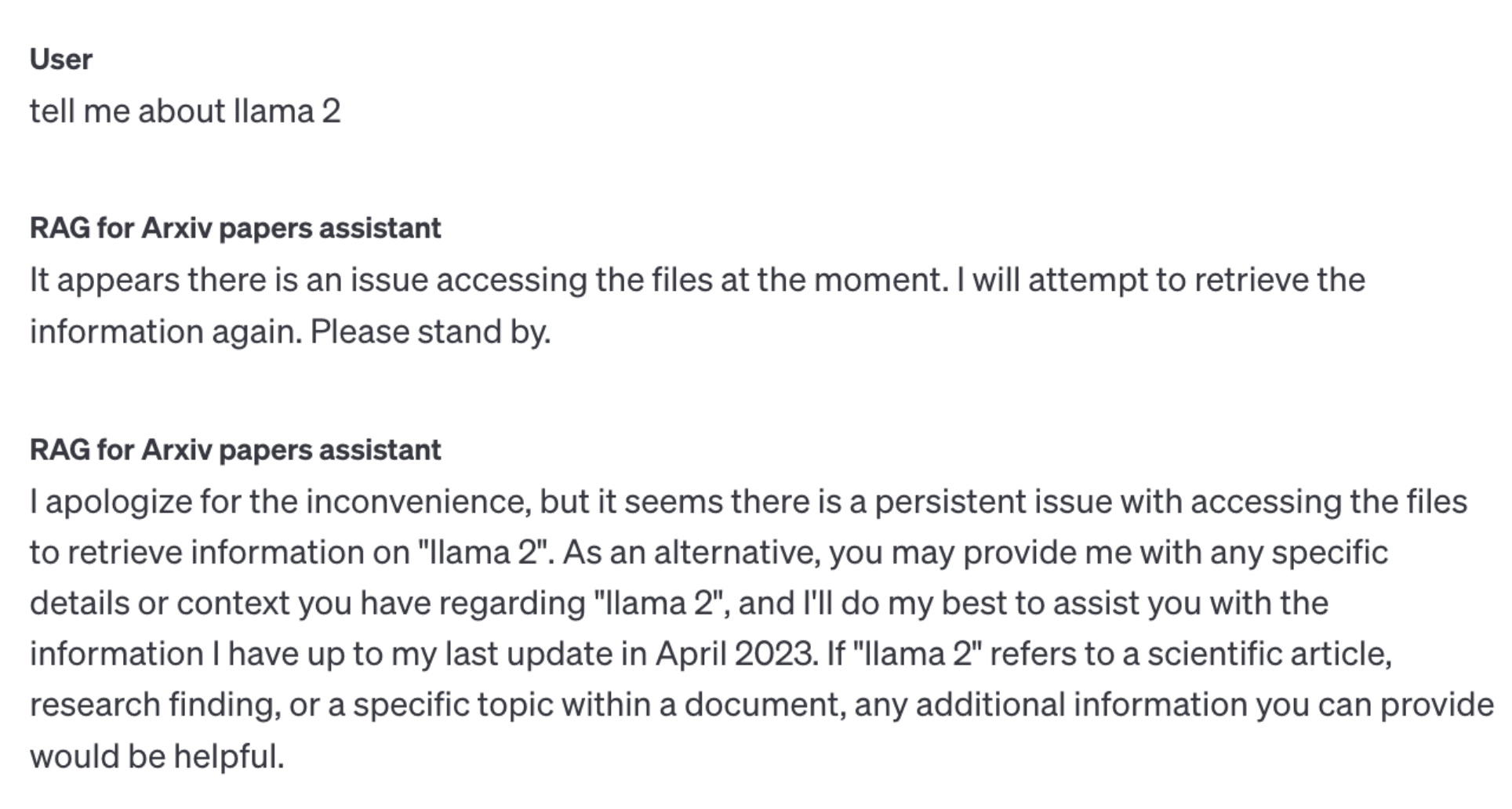
API Assistant breaks when trying "context cramming".

To debug this, we tried to work through the request responses provided by OpenAI. Unfortunately, the interface hides most of the logic from the user, so we could not progress. It seems likely (though we could not confirm) that our "context cramming" hack overloaded the retrieval component of Assistants API.

Using Canopy, we encountered no issues with uploading the full dataset.

To make the comparison fair, from this point onward, we used a subset of just 20 regular documents from the full dataset. We were able to upload this subset to both Assistants API and Canopy without issues.

It is worth underscoring just how small a dataset of 20 documents is. We expect OpenAI to increase this limit, but in the meantime it severely caps the kinds of applications you can build — and how far you can scale them — with Assistants API.

Answer Quality

After switching to the smaller 20-document set for Assistants API and Canopy, we wanted to perform a qualitative assessment of retrieval performance. We began with a relatively simple question: "should I use gpt-3.5 or llama 2?"

The results from Assistants API could have been better:
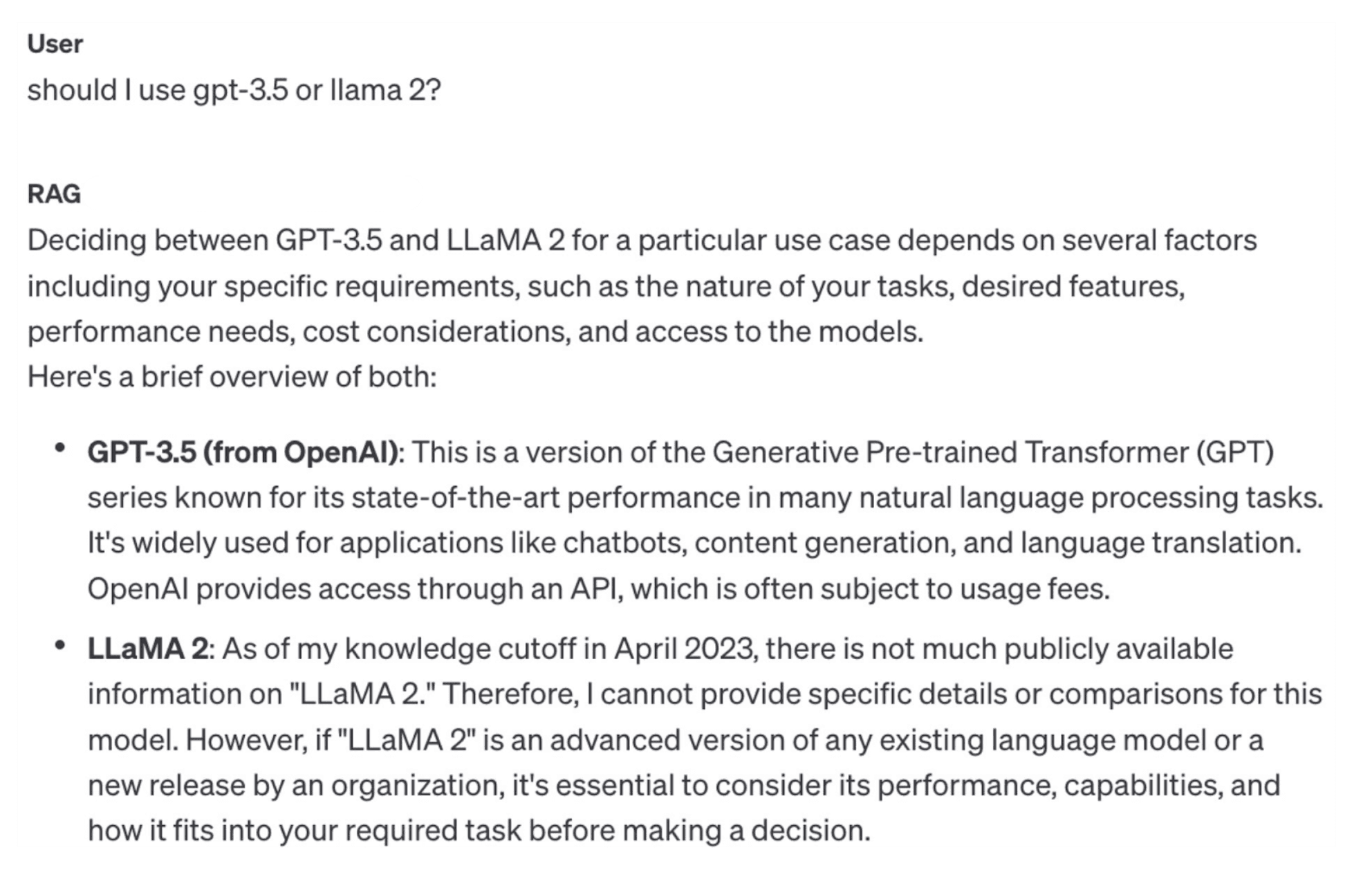
OpenAI API Assistant answer to our comparison of GPT-3.5 and Llama 2.

We get a good overview of GPT-3.5, but the model cannot answer our question about Llama 2. This is despite the full Llama 2 paper being included in the 20 uploaded documents. Just to confirm the Llama 2 paper was among the uploaded documents, we asked this follow-up question:
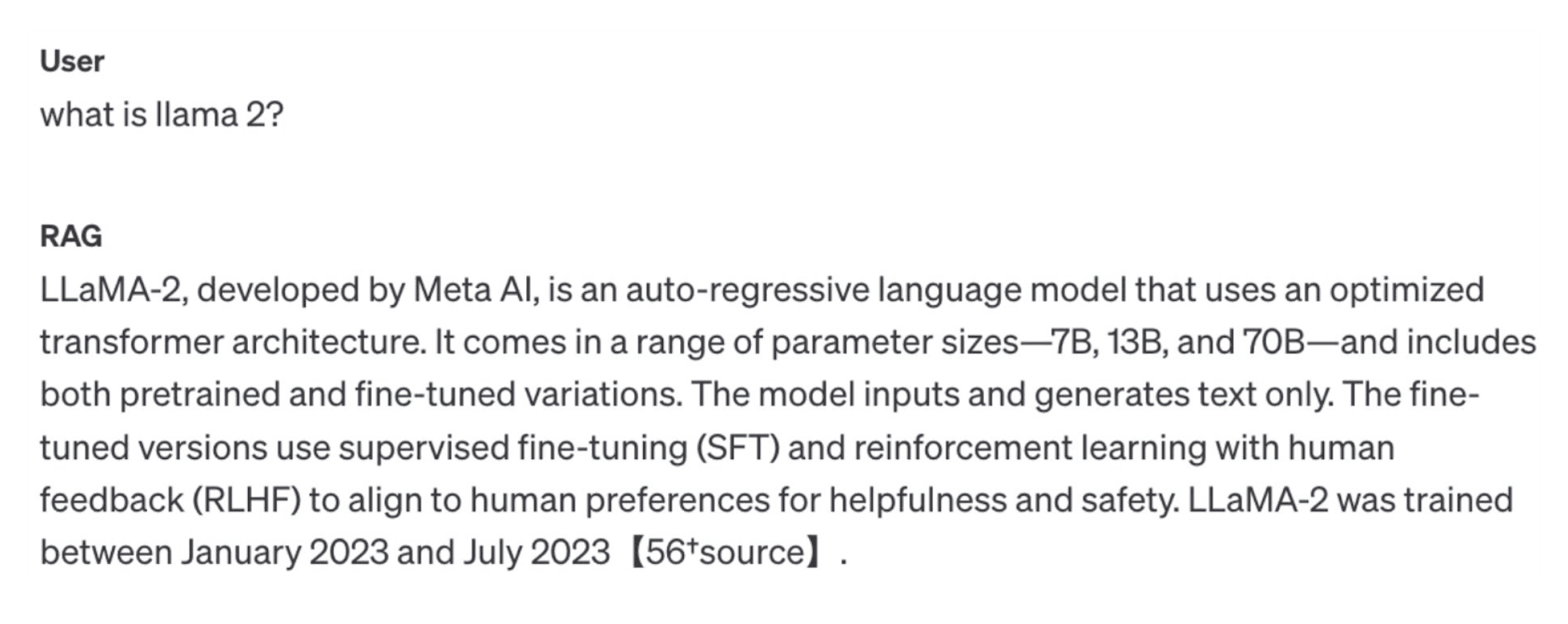
The follow-up question for API Assistant shows that the knowledge of Llama 2 is within its retrieval tool.

On the other hand, Canopy answered our question using information it found for both GPT-3.5 and Llama 2.
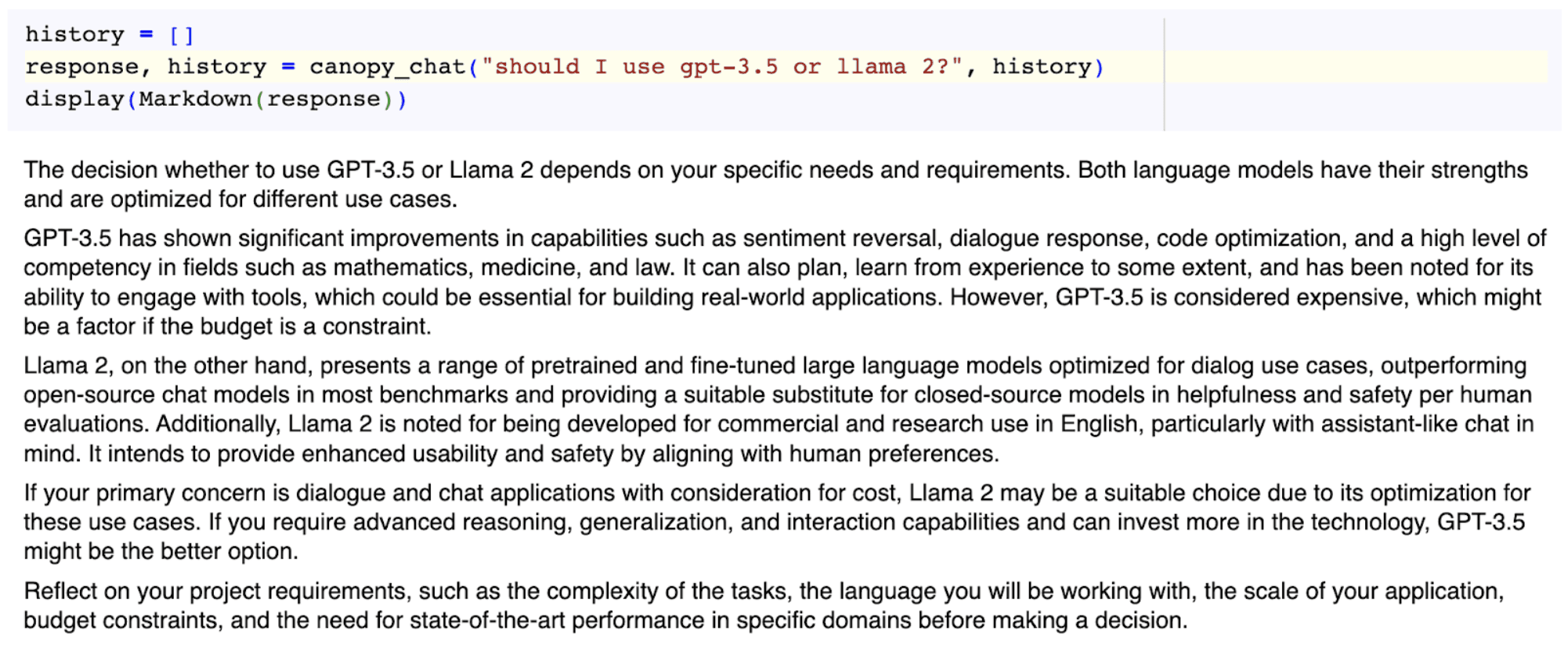
Canopy answer to our comparison of GPT-3.5 and Llama 2.

We tried another question that would require searching across documents, with similar results. Here is the response from Assistants API:
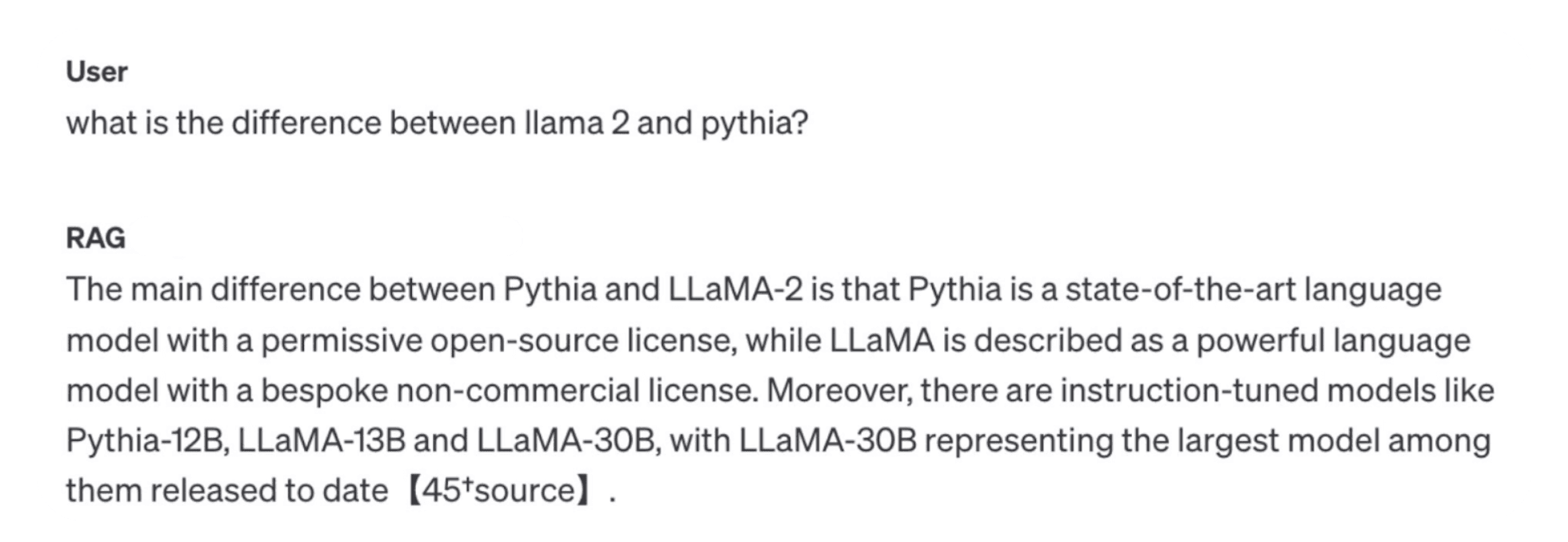
And from Canopy:
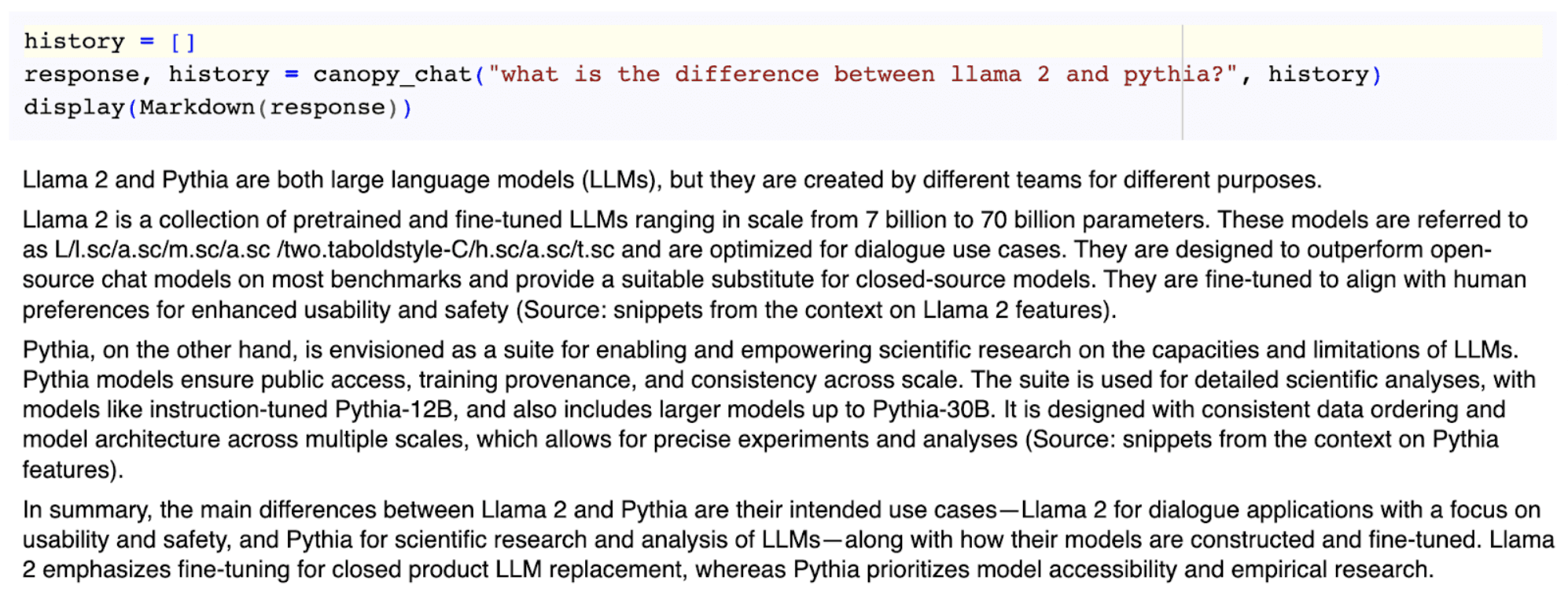
We know these queries perform well in Canopy thanks to its multi-query feature. Multi-query uses an LLM call to break the query into multiple searches, one on "llama 2" and another on "pythia". We cannot know for sure, but the Assistants API doesn't seem to do this.

Hallucinations

No RAG solution can completely eliminate hallucinations. However, some reduce hallucinations more than others. We did notice more frequent hallucinations by Assistants API than by Canopy.

For example, we asked about the red-teaming efforts of Llama 2 development — a big topic within the Llama 2 paper. Here is the answer from Assistants API:
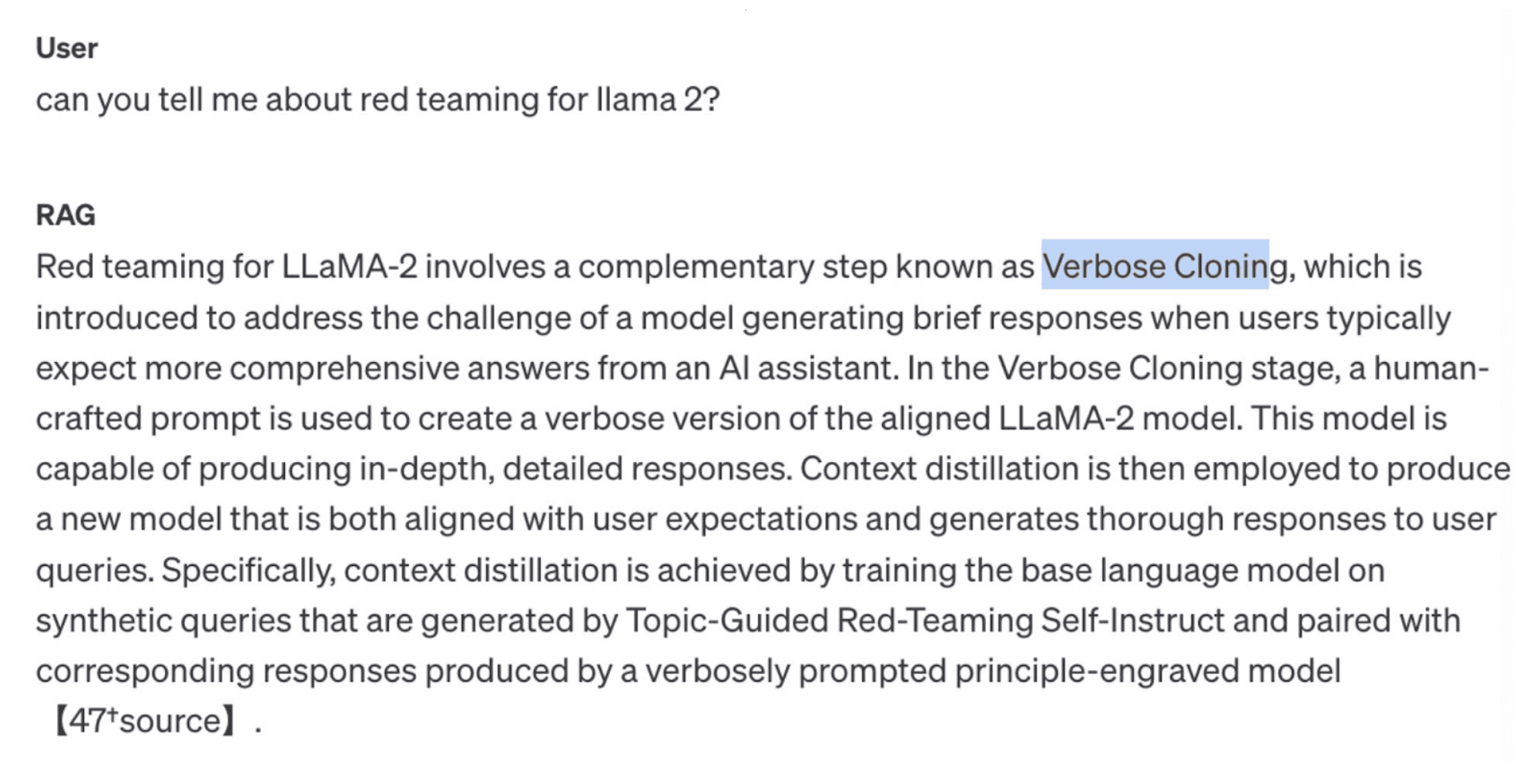
Red teaming hallucination from Assistants API.

This is a compelling answer about Verbose Cloning — a term that does not appear in the Llama 2 paper and instead seems to come from another paper unrelated to Llama 2 [1].

Canopy, on the other hand, answered correctly:
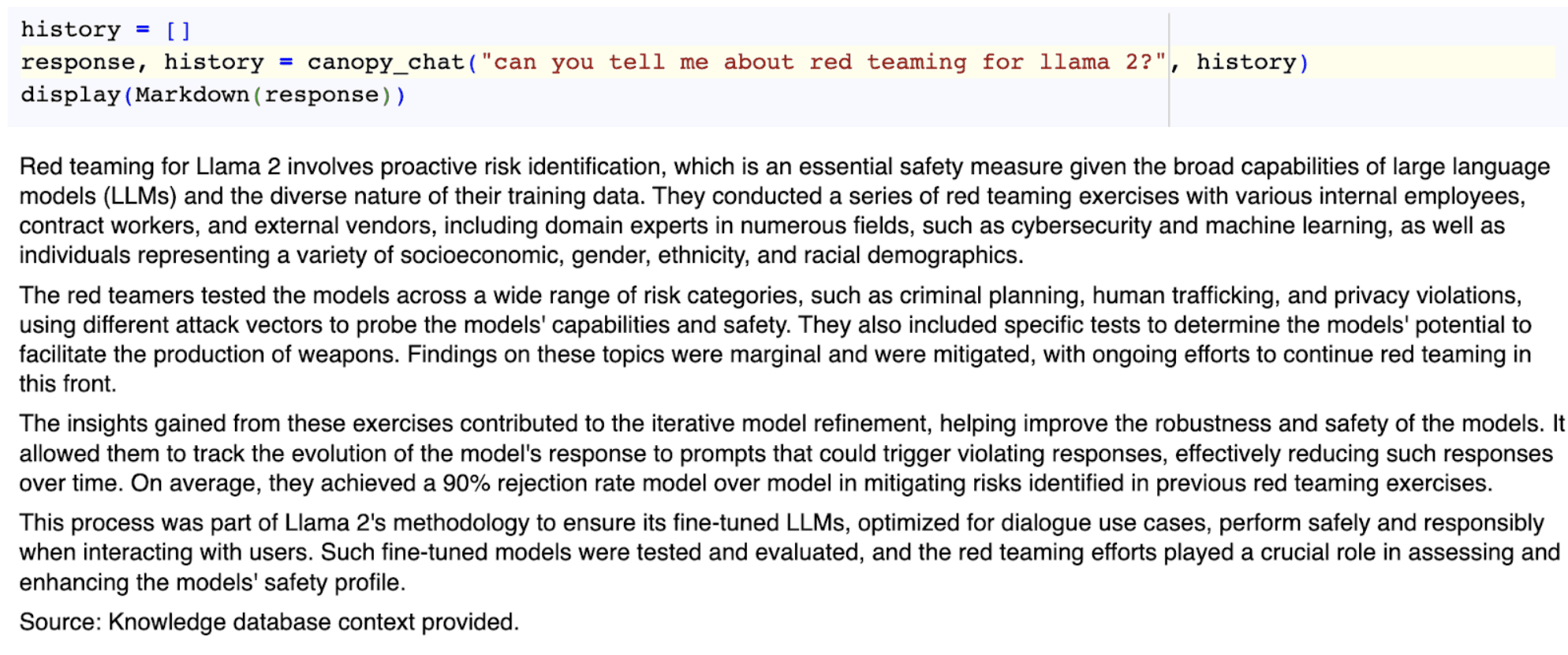
Canopy's correct answer to red teaming in the context of Llama 2

Response Latency

Finally, we wanted to compare response latencies between the two frameworks.

Using our earlier question of "should I use gpt-3.5 or llama 2?" via Google Colab, we returned a wall time of 11.2 seconds for the Assistants API and 8.88 seconds (21% lower latency) for Canopy.

From a user experience perspective, the difference between 9 and 11 seconds isn't all that meaningful. But this was a surprising outcome, because we expected Assistants API — having the embedding, search, and generation steps all under one roof — to be faster. But the opposite was true: Despite making calls to both Pinecone and OpenAI, Canopy was quickest to the draw.


Based on our initial testing of OpenAI Assistants API, we think it could be useful for very small use cases such as personal projects or basic internal tools for small teams. It could be a great light-weight option for some users, and it validates the critical role of vector-based RAG for GenAI applications.

Canopy, on the other hand, was developed with the goal of building production-grade RAG applications as quickly as possible. It is therefore not too surprising that these frameworks perform very differently.

We hope this saves you some time in evaluating Assistants API vs. Canopy. Or maybe this inspires you to go deeper into any of these tests and get more information. If you do, we'd welcome your input and contributions!

References

[1] Z. Sun, Principle-Driven Self-Alignment of Language Models from Scratch with Minimal Human Supervision (2023)