



惯性聚合 高效追踪和阅读你感兴趣的博客、新闻、科技资讯
阅读原文 在惯性聚合中打开

推荐订阅源

博客园 - 三生石上(FineUI控件)
Martin Fowler
Martin Fowler
月光博客
月光博客
AI
AI
B
Blog
钛媒体:引领未来商业与生活新知
钛媒体:引领未来商业与生活新知
C
CXSECURITY Database RSS Feed - CXSecurity.com
WordPress大学
WordPress大学
GbyAI
GbyAI
L
Lohrmann on Cybersecurity
O
OpenAI News
Schneier on Security
P
Palo Alto Networks Blog
Cyber Security Advisories - MS-ISAC
T
Troy Hunt's Blog
V2EX - 技术
V2EX - 技术
W
WeLiveSecurity
L
LINUX DO - 最新话题
人人都是产品经理
人人都是产品经理
S
Security Affairs
OSCHINA 社区最新新闻
OSCHINA 社区最新新闻
A
Arctic Wolf
Recorded Future
Recorded Future
Microsoft Security Blog
Threat Intelligence Blog | Flashpoint
G
GRAHAM CLULEY
N
Netflix TechBlog - Medium
TaoSecurity Blog
TaoSecurity Blog
C
Check Point Blog
Scott Helme
Scott Helme
cs.CV updates on arXiv.org
Apple Machine Learning Research
PCI Perspectives
PCI Perspectives
www.infosecurity-magazine.com
Vercel News
Vercel News
The Hacker News
The Hacker News
Y
Y Combinator Blog
Latest news
Latest news
SecWiki News
SecWiki News
Hugging Face - Blog
Hugging Face - Blog
cs.AI updates on arXiv.org
Google Online Security Blog
Webroot Blog
Webroot Blog
Google DeepMind News
Recent Commits to openclaw:main
C
Cisco Blogs
博客园_首页
H
Hackread – Cybersecurity News, Data Breaches, AI and More
宝玉的分享
宝玉的分享
L
LINUX DO - 热门话题

Pinecone

Pinecone Assistant: A Managed Knowledge Layer for Production AI Applications Multi-domain RAG in n8n: why one knowledge base is not enough Allspice Transforms the Culinary Experience with Semantic Search Powered by Pinecone | Pinecone Building RAG workflows in n8n: choosing the right Pinecone node Knowledge needs a meta-knowledge layer Garbage Day: How Pinecone Safely Deletes Billions of Objects at Scale When "Performance" Means Two Different Things Pinecone BYOC: Pinecone in your AWS, GCP, or Azure account, no vendor access True, Relevant, and Wrong: The Applicability Problem in RAG Use the Pinecone Plugin for Claude Code to develop AI Applications Faster Millions at Stake: How Melange's High-Recall Retrieval Prevents Litigation Collapse Powering High-stakes Patent Search at Scale: How Melange Built a Reliable AI System on Pinecone | Pinecone Pinecone Assistant Node in n8n: Turn Any Data Source Into Knowledge RAG with Access Control Pinecone Dedicated Read Nodes are now in Public Preview Inside Pinecone: Slab Architecture New Bulk Data Operations: Update, Delete, and Fetch by Metadata The Hidden Cost of Building: Lessons from Aquant Simplifying Vector Embeddings with Pinecone Integrated Inference Capabilities Pinecone joins Microsoft Marketplace as a Launch Partner GTM Engineering: Clay + Pinecone for AI-powered Sales Outbound Build an AI knowledge assistant with Google Docs and Pinecone Moving Pinecone forward with Ash Ashutosh as CEO and Edo spearheading our growing AI ambitions as Chief Scientist Pinecone Founder Edo Liberty to Spearhead Pinecone’s Growing AI Ambitions; Appoints Ash Ashutosh as CEO to Expand Vector Database Market Leadership Fast, Accurate Retrieval for Creators at Scale: Delphi’s Path Toward a Million Conversational Agents with Pinecone | Pinecone Announcing Pinecone Pioneers: A Program for Builders, Organizers, and Community Leaders What is Context Engineering? Chunking Strategies for LLM Applications Beyond the hype: Why RAG remains essential for modern AI Obviant Makes 30% More Accurate Defense Acquisition Recommendations Combining Sparse and Dense Retrieval with Pinecone | Pinecone Build more knowledgeable AI applications with new LLMs and greater control in Pinecone Assistant #NYTECHWEEK 2025 Retrieval-Augmented Generation (RAG) Accurate and Efficient Metadata Filtering in Pinecone’s Serverless Vector Database | Pinecone Terminal X AI Agents, Powered by Pinecone, Turn Complex Financial Data Into Production-grade Insights at Scale | Pinecone Aquant Delivers Scalable, Expert-level Service Intelligence with Pinecone | Pinecone Cascading retrieval with multi-vector representations: balancing efficiency and effectiveness Vector databases aren't just for large-scale enterprise AI Unveiling DIME: Reproducibility, Scalability, and Formal Analysis of Dimension Importance Estimation for Dense Retrieval | Pinecone Fast and Effective Early Termination for Simple Ranking Functions | Pinecone Domain-specific AI Agents at Scale: CustomGPT.ai Serves 10,000+ Customers with Pinecone | Pinecone Using Pinecone asynchronously with FastAPI A Flexible Resource for Top-Weighted Comparisons Between Sets and Rankings | Pinecone Build secure, scalable agentic AI workflows with Rubrik Annapurna and Pinecone Tool up: Pinecone’s first MCP servers are here Add context to your agent with Pinecone Assistant MCP remote server E2Rank: Efficient and Effective Layer-wise Reranking | Pinecone ColBERT-serve: Efficient Multi-Stage Memory-Mapped Scoring | Pinecone Efficient Constant-Space Multi-Vector Retrieval | Pinecone How Vanguard Worked with Pinecone to Boost Customer Support with Faster Calls and 12% More Accurate Responses | Pinecone Pinecone Named to Fast Company's Annual List of the World's Most Innovative Companies of 2025 Launch Week: Pinecone for agents, search, recommendations, and more Optimizing Pinecone for agents (and more) Retrieval Inference for scale and performance How 1up Turns Sales Reps Into Product Experts with Pinecone | Pinecone Don’t be dense: Launching sparse indexes in Pinecone Unlock High-Precision Keyword Search with pinecone-sparse-english-v0 Evolving Pinecone's architecture to meet the demands of Knowledgeable AI Pinpoint references faster with citation highlights in Pinecone Assistant Bringing the leading vector database to your cloud Getting started with llama-text-embed-v2 Natural Language Counterfactual Explanations for Graphs Using Large Language Models | Pinecone Easily build knowledgeable chat and agent-based applications in minutes with Pinecone Assistant, now generally available How to build an agentic, chat or RAG knowledge system using Pinecone Assistant Real-time RAG with Pinecone and Estuary Flow BigQuery to Pinecone in Real-Time with Estuary Flow Stravito Turns Market and Consumer Data Into Actionable Insights with Pinecone Inference | Pinecone Accelerate prototyping and development with Pinecone Local First-of-its-kind Pinecone Knowledge Platform to Power Best-in-class Retrieval for Customers Introducing integrated inference: Embed, rerank, and retrieve your data with a single API Strengthening security and increasing control with CMEK and API key roles Introducing Pinecone Rerank V0 Introducing cascading retrieval: Unifying dense and sparse with reranking From Idea to Action: How Pinecone Assistant Meaningfully Accelerates AI Business Building AI apps on Azure with Pinecone just got a lot easier Building a reliable, curated, and accurate RAG system with Cleanlab and Pinecone Four features of the Assistant API you aren't using - but should Deploying Pinecone with Infrastructure as Code (IaC) Streamlining CI/CD with Pinecone Local September 2024 Product Update Results of the Big ANN: NeurIPS'23 competition | Pinecone Introducing import from object storage for more efficient data transfer to Pinecone serverless Simplify, enhance, and evaluate RAG development with Pinecone Assistant, now in public preview Vectors and Graphs: Better Together August 2024 Product Update Pinecone Helps Deep Talk Deliver World-Class AI Assistants with Lower Engineering Overhead | Pinecone Assembled Delivers Better, Faster AI- Driven Support with Pinecone | Pinecone Llama 3.1 Agent using LangGraph and Ollama Build knowledgeable AI with Pinecone serverless, now generally available on Microsoft Azure Pinecone serverless is now generally available on Google Cloud, adding knowledge to AI assistants and other applications Accelerating Legal Discovery and Analysis with Pinecone and Voyage AI Bridging Dense and Sparse Maximum Inner Product Search | Pinecone Refine Retrieval Quality with Pinecone Rerank Introducing reranking to Pinecone Inference to simplify building accurate AI July 2024 Product Update Connect to Pinecone within your platform to enable a seamless AI development experience Introducing Pinecone API Versioning RAG Brag with Inkeep Co-Founder Nick Gomez LangGraph and Research Agents Introducing Pinecone Inference to streamline your AI workflow
Options for Solving Hallucinations in Generative AI
Xian Huang · 2023-08-21 · via Pinecone

Gen AI Can Deliver Trillions - Are You Ready to Capture it?

If you’re under pressure to start a Generative AI product strategy for your company, you are not alone. A recent survey of 400 senior AI professionals at organizations with annual revenue above $3 billion shows that more than 60% of them are likely to adopt Generative AI in the next 12 months, while 45% of the respondents have already started their Generative AI experiment.

At Pinecone, we’re seeing an explosion of interest from engineering leaders at large enterprises. They come to us with similar questions: We have an ambitious AI plan; where should we get started, and how can we get it right?

This enthusiasm and sense of urgency come from the significant business impact Generative AI could bring. Mckinsey estimates that Generative AI has the potential to contribute approximately $2.6 trillion to $4.4 trillion yearly across 63 different use cases. In the banking sector alone, its full implementation across use cases could generate an extra $200 billion to $340 billion annually.

We are developing a series guiding you to navigate this exciting but noisy space and help your company capture the full potential of AI. Today we’ll be focused on addressing hallucination in Gen AI applications.

Retrieval Augmented Generation(RAG) stands out as a widely-adopted approach to address Gen AI hallucination. In this article, we’ll explain what AI hallucination is, the main solutions for this problem, and why RAG is the preferred approach in terms of scalability, cost-efficacy, and performance.

Hallucination - A Major Challenge in Building Generative AI Applications

The excitement around Generative has propelled the wide adoption of Large Language Models (LLMs). While LLMs like Meta’s Llama2 have made building AI applications easier than ever, they also come with many issues. And one of the most discussed concerns is AI hallucination. Hallucination is when LLMs make up answers but make them sound factual. Let’s take a look at the example below.

Let’s say a user comes to your AI Chatbot and wants to figure out how to turn off the automatic reverse braking on the Volvo XC60. Your chatbot generates the answer below:
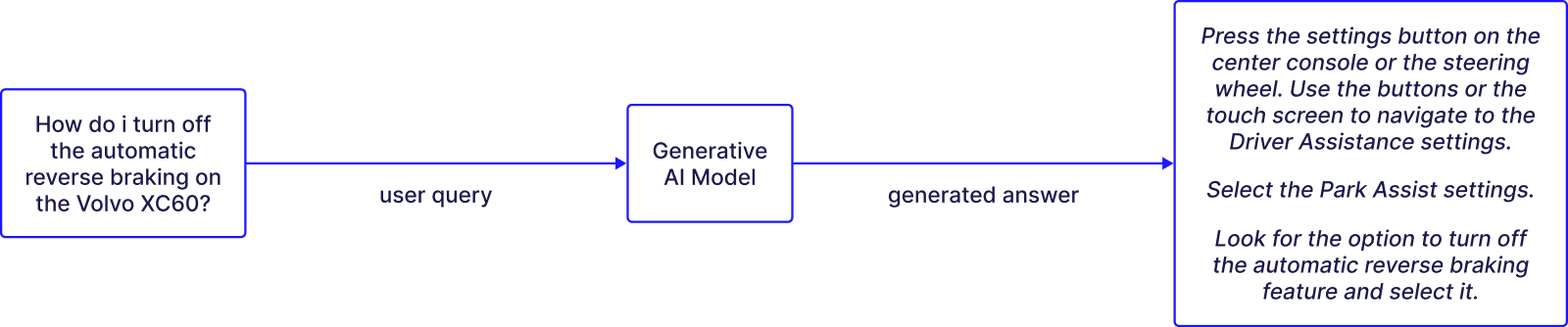
Hallucinated Generative Chat

Hallucinated Generative Chat

It may sound plausible with accurate grammar and seemingly reasonable steps, but it’s a total hallucination. What causes AI applications to hallucinate?

Reasons for AI Hallucination

There are two main reasons for hallucination:

LLMs are trained largely from information scraped from the Internet

They don’t have access to a much larger corpus of information that is proprietary and stored in corporate data warehouses. Because they are trained largely from information scraped from the Internet, which unfortunately also encodes all kinds of dangerous misinformation, they can produce wrong and even harmful outputs. Even though the teams behind those LLMs like Claude highlight their effort in red teaming, this remains a huge problem for most, if not all, LLMs today.

LLMs suffer from knowledge cutoff

Training LLMs is time-consuming and extremely expensive. OpenAI’s Sam Altman estimated it cost around $100 million to train the foundation model behind ChatGPT. But they become quickly out-of-date with respect to any recent information. This is called knowledge cutoff, meaning that LLMs are unaware of any post-training event.

For example, ChatGPT/GPT-4 is unable to provide answers after September 2021. If the answer you're looking for requires up-to-date information, proprietary company data, or even the current weather in New York, you're likely to get a hallucination without additional and timely context.

Hallucination is concerning because the LLMs generating them don't know they're hallucinating. They are designed to respond with convincing-sounding text output, so it requires a human expert to pay attention to notice hallucinations at the moment. If your model is talking directly to your customers and hallucinating, it can lead to lost customer trust and a damaged brand.

The factually wrong answers could be very dangerous in certain cases, like giving incorrect instructions about how to turn off a certain braking mode in your car.

Main Approaches to Reduce Hallucination

There are a few main approaches to building better AI products, including 1) training your own model, 2) fine tuning, 3) prompt engineering, and 4) Retrieval Augmented Generation. Let’s take a look at those options and see why RAG is the most popular option among companies. We’ll evaluate each option on their scalability (cost and complexity) and performance.

Train your own foundational model

Many large enterprises are investigating training their own foundation models on their own proprietary, domain-specific data.

To train a foundational model, you need to jump through several hoops, including acquiring a diverse dataset for training the foundation model on various tasks, preparing the dataset, configuring training parameters, algorithm architecture, computational resources, and more before you can deploy the model for user access.
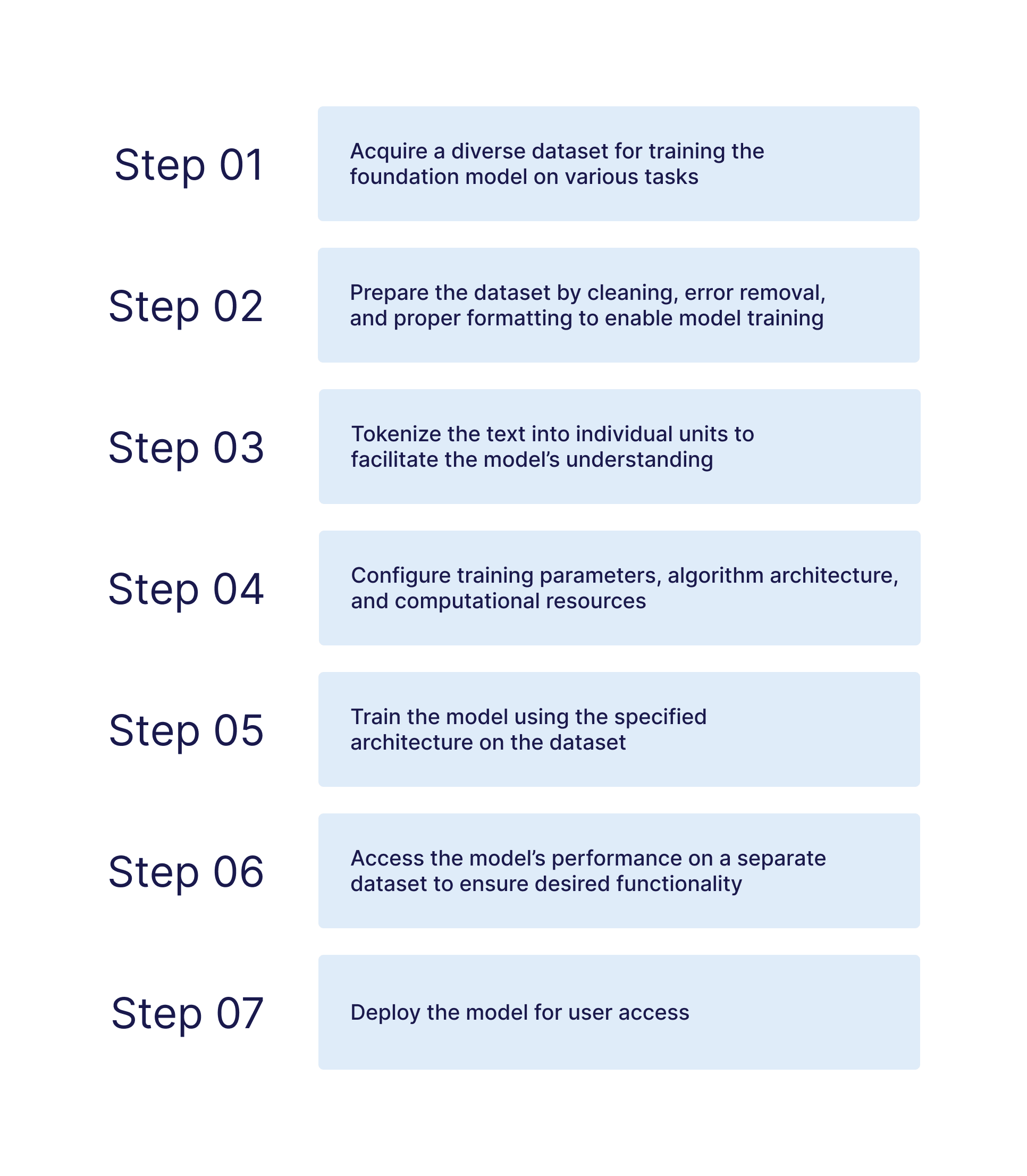
Steps to train your own foundation model

Steps to train your own foundation model

This is the most complex, costly, and time-consuming approach of all. You’ll need 1) expertise - a top-notch team including machine learning experts and system engineers, 2) a significant amount of computing resources, and 3) massive labeled data sets. While it can improve accuracy with training in domain-specific data, it doesn’t solve the problem that a model won’t have access to recent or real-time data.

Fine Tuning

Fine-tuning is the process of providing additional training to a model with a smaller task-specific dataset.

For example, if you’d like to build a sentiment analysis product using fine tuning, you’ll need to choose a pre-trained LLM and fine tune it on an additional dataset with financial news and market reports etc.
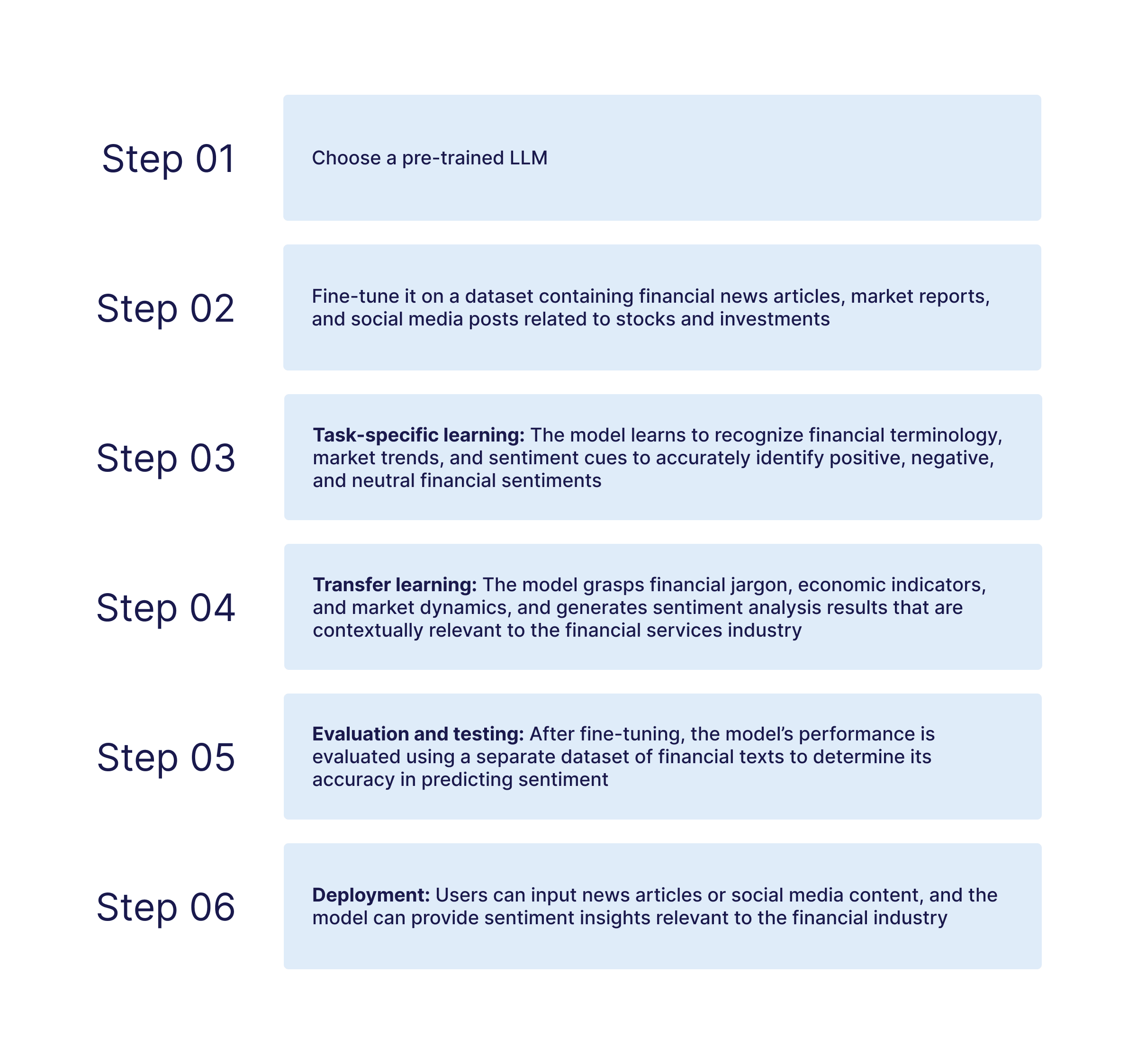
Steps to fine tune a foundation model

Steps to fine tune a foundation model

Although it’s less resource-intensive than training your own model, it’s still complex and costly. You need to repeatedly invest significant time, money, and effort in labeling tasks, while also continuously overseeing quality changes, accuracy fluctuations, and shifts in data distribution. If your data evolves, even a fine-tuned model can’t guarantee accuracy. It doesn’t give your products long-term memory; you have to update your model constantly.

Prompt Engineering

Prompt engineering refers to experimenting with your instructions to the AI model so it can generate optimal results.

This is the easiest and least costly approach, as you can update your prompts easily with just a few lines of code, but it delivers the least improvement in terms of addressing hallucinations. LLMs accept not just prompts but also context, which is additional relevant information provided to the model for consideration when generating the answer. Prompt engineering doesn’t provide any meaningful new context.

Why RAG is the Preferred Approach to Deliver Enterprise-Grade Gen AI Products

Retrieval Augmented Generation refers to the process when your Gen AI application fetches specific and relevant context and provides it to the LLM at generation time. The image below shows how RAG solves hallucination in the Volvo case.
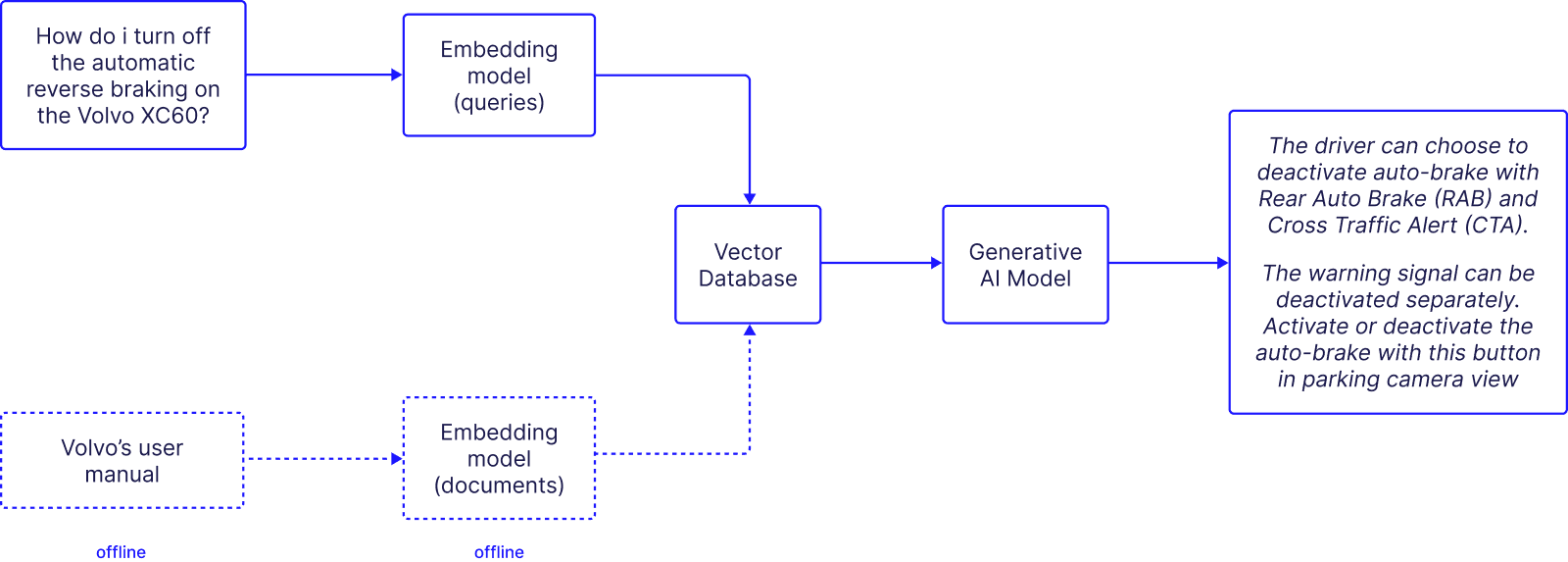
Retrieval Augmented Generation

Retrieval Augmented Generation

  1. Query: A user sends a query to the chatbot.
  2. Contextual search: This is the step where the query gets additional context with your Gen AI application searching and retrieving contextual information from external data sources.
  3. Inference: The LLM receives the original query sent by the user with the additional context. This significantly increases the model’s accuracy because it can access factual data.
  4. Response: The LLM sends the response back to the chatbot with factually correct information.

With the RAG model, our user can finally get the right answer to turn off the automatic reverse braking on the Volvo xc60.

Understanding Embeddings and Vector Database in RAG

The above flow shows the high-level framework of RAG. To fully understand its implementation details, you need to know semantic search. Semantic search, unlike keyword-based search, focuses on the meaning of the search query. It finds relevant results with similar meanings even if the exact words don’t match.

To do a semantic search, you need to convert the user’s query into embeddings, a type of numeric data representation that carries within it semantic information that’s critical for the AI to gain understanding and maintain a long-term memory they can draw upon when executing complex tasks. These embeddings are then sent to the vector database that stores the embeddings of your proprietary data. The database conducts a "nearest neighbor" search, identifying vectors that most closely match the user's intent. Once the vector database retrieves the nearest vectors, your application supplies them to the LLM through its context window, guiding it to execute its generative response.

Achieve Performance, Cost Efficiency, and Scalability with RAG

Semantic Search and RAG provide dramatically more relevant search results than a keyword search. As a result, most companies are moving to this approach when they build their GenAI applications. Together with LLMs, they are one of the two key technologies for building great generative AI applications today.
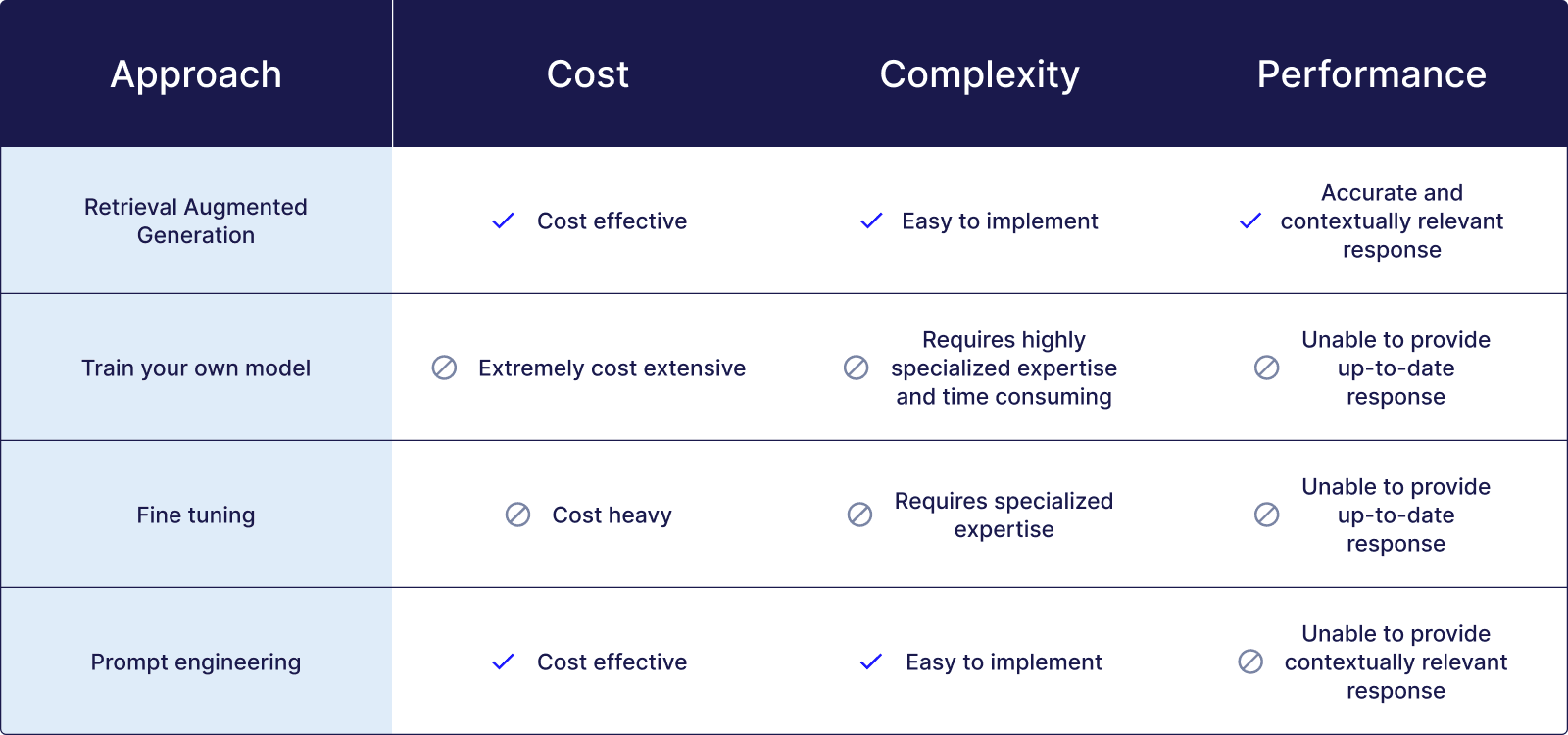
Pros and cons for main solutions

Pros and cons for main solutions

Compared to other approaches, RAG is much easier to implement because it doesn't require machine learning experts. Your application developers can figure it out relatively quickly and implement it in your GenAI apps. If you’re using Pinecone, you can get started in seconds.

RAG allows you to generate more contextually relevant responses with improved accuracy, especially for intricate queries demanding a profound knowledge of the subject. Additionally, RAG can be customized for particular sectors, making it a versatile instrument for a range of uses in finance, e-commerce, software development, and more. Unlike pre-trained models, RAG can leverage inherent knowledge that can be readily adjusted or even augmented on the go. This empowers researchers and engineers to manage recent knowledge without the need to retrain the entire model, saving time and computational resources.

What’s Next?

Understanding that RAG is the most cost-effective approach to improving your Generative AI performance is only the start. We’ll dive into more topics as you start your Generative AI journey. Stay tuned.

If you want to catch up in the Generative AI competition, don’t wait around. Contact our experts now and learn how Pinecone can help you deliver better results.