

惯性聚合 高效追踪和阅读你感兴趣的博客、新闻、科技资讯
阅读原文 在惯性聚合中打开

推荐订阅源

cs.AI updates on arXiv.org
C
CERT Recently Published Vulnerability Notes
GbyAI
GbyAI
Google DeepMind News
C
CXSECURITY Database RSS Feed - CXSecurity.com
AWS News Blog
AWS News Blog
V
Vulnerabilities – Threatpost
T
Tenable Blog
P
Proofpoint News Feed
C
Check Point Blog
T
The Exploit Database - CXSecurity.com
F
Full Disclosure
P
Privacy & Cybersecurity Law Blog
美团技术团队
U
Unit 42
C
Cyber Attacks, Cyber Crime and Cyber Security
阮一峰的网络日志
阮一峰的网络日志
Simon Willison's Weblog
量子位
AI
AI
Spread Privacy
Spread Privacy
Help Net Security
Help Net Security
Know Your Adversary
Know Your Adversary
IT之家
IT之家
K
KPMG report finds enterprise disconnect between AI and its ROI | CIO
P
Proofpoint News Feed
Recent Commits to openclaw:main
L
LangChain Blog
I
Intezer
T
The Blog of Author Tim Ferriss
爱范儿
爱范儿
月光博客
月光博客
Recorded Future
Recorded Future
O
OpenAI News
WordPress大学
WordPress大学
Microsoft Security Blog
J
Java Code Geeks
Y
Y Combinator Blog
Engineering at Meta
Engineering at Meta
S
Security @ Cisco Blogs
Recent Announcements
P
Privacy International News Feed
NISL@THU
NISL@THU
MongoDB | Blog
MongoDB | Blog
W
WeLiveSecurity
B
Blog RSS Feed
Blog — PlanetScale
Blog — PlanetScale
博客园 - Franky
Cyberwarzone
Cyberwarzone
H
Hacker News: Front Page

Pinecone

Pinecone Assistant: A Managed Knowledge Layer for Production AI Applications Multi-domain RAG in n8n: why one knowledge base is not enough Allspice Transforms the Culinary Experience with Semantic Search Powered by Pinecone | Pinecone Building RAG workflows in n8n: choosing the right Pinecone node Knowledge needs a meta-knowledge layer Garbage Day: How Pinecone Safely Deletes Billions of Objects at Scale When "Performance" Means Two Different Things Pinecone BYOC: Pinecone in your AWS, GCP, or Azure account, no vendor access True, Relevant, and Wrong: The Applicability Problem in RAG Use the Pinecone Plugin for Claude Code to develop AI Applications Faster Millions at Stake: How Melange's High-Recall Retrieval Prevents Litigation Collapse Powering High-stakes Patent Search at Scale: How Melange Built a Reliable AI System on Pinecone | Pinecone Pinecone Assistant Node in n8n: Turn Any Data Source Into Knowledge RAG with Access Control Pinecone Dedicated Read Nodes are now in Public Preview Inside Pinecone: Slab Architecture New Bulk Data Operations: Update, Delete, and Fetch by Metadata The Hidden Cost of Building: Lessons from Aquant Simplifying Vector Embeddings with Pinecone Integrated Inference Capabilities Pinecone joins Microsoft Marketplace as a Launch Partner GTM Engineering: Clay + Pinecone for AI-powered Sales Outbound Build an AI knowledge assistant with Google Docs and Pinecone Moving Pinecone forward with Ash Ashutosh as CEO and Edo spearheading our growing AI ambitions as Chief Scientist Pinecone Founder Edo Liberty to Spearhead Pinecone’s Growing AI Ambitions; Appoints Ash Ashutosh as CEO to Expand Vector Database Market Leadership Fast, Accurate Retrieval for Creators at Scale: Delphi’s Path Toward a Million Conversational Agents with Pinecone | Pinecone Announcing Pinecone Pioneers: A Program for Builders, Organizers, and Community Leaders What is Context Engineering? Chunking Strategies for LLM Applications Beyond the hype: Why RAG remains essential for modern AI Obviant Makes 30% More Accurate Defense Acquisition Recommendations Combining Sparse and Dense Retrieval with Pinecone | Pinecone Build more knowledgeable AI applications with new LLMs and greater control in Pinecone Assistant #NYTECHWEEK 2025 Retrieval-Augmented Generation (RAG) Accurate and Efficient Metadata Filtering in Pinecone’s Serverless Vector Database | Pinecone Terminal X AI Agents, Powered by Pinecone, Turn Complex Financial Data Into Production-grade Insights at Scale | Pinecone Aquant Delivers Scalable, Expert-level Service Intelligence with Pinecone | Pinecone Cascading retrieval with multi-vector representations: balancing efficiency and effectiveness Vector databases aren't just for large-scale enterprise AI Unveiling DIME: Reproducibility, Scalability, and Formal Analysis of Dimension Importance Estimation for Dense Retrieval | Pinecone Fast and Effective Early Termination for Simple Ranking Functions | Pinecone Domain-specific AI Agents at Scale: CustomGPT.ai Serves 10,000+ Customers with Pinecone | Pinecone Using Pinecone asynchronously with FastAPI A Flexible Resource for Top-Weighted Comparisons Between Sets and Rankings | Pinecone Build secure, scalable agentic AI workflows with Rubrik Annapurna and Pinecone Tool up: Pinecone’s first MCP servers are here Add context to your agent with Pinecone Assistant MCP remote server E2Rank: Efficient and Effective Layer-wise Reranking | Pinecone ColBERT-serve: Efficient Multi-Stage Memory-Mapped Scoring | Pinecone Efficient Constant-Space Multi-Vector Retrieval | Pinecone How Vanguard Worked with Pinecone to Boost Customer Support with Faster Calls and 12% More Accurate Responses | Pinecone Pinecone Named to Fast Company's Annual List of the World's Most Innovative Companies of 2025 Launch Week: Pinecone for agents, search, recommendations, and more Optimizing Pinecone for agents (and more) Retrieval Inference for scale and performance How 1up Turns Sales Reps Into Product Experts with Pinecone | Pinecone Don’t be dense: Launching sparse indexes in Pinecone Unlock High-Precision Keyword Search with pinecone-sparse-english-v0 Evolving Pinecone's architecture to meet the demands of Knowledgeable AI Pinpoint references faster with citation highlights in Pinecone Assistant Bringing the leading vector database to your cloud Getting started with llama-text-embed-v2 Natural Language Counterfactual Explanations for Graphs Using Large Language Models | Pinecone Easily build knowledgeable chat and agent-based applications in minutes with Pinecone Assistant, now generally available How to build an agentic, chat or RAG knowledge system using Pinecone Assistant Real-time RAG with Pinecone and Estuary Flow BigQuery to Pinecone in Real-Time with Estuary Flow Stravito Turns Market and Consumer Data Into Actionable Insights with Pinecone Inference | Pinecone Accelerate prototyping and development with Pinecone Local First-of-its-kind Pinecone Knowledge Platform to Power Best-in-class Retrieval for Customers Introducing integrated inference: Embed, rerank, and retrieve your data with a single API Strengthening security and increasing control with CMEK and API key roles Introducing Pinecone Rerank V0 Introducing cascading retrieval: Unifying dense and sparse with reranking From Idea to Action: How Pinecone Assistant Meaningfully Accelerates AI Business Building AI apps on Azure with Pinecone just got a lot easier Building a reliable, curated, and accurate RAG system with Cleanlab and Pinecone Four features of the Assistant API you aren't using - but should Deploying Pinecone with Infrastructure as Code (IaC) Streamlining CI/CD with Pinecone Local September 2024 Product Update Results of the Big ANN: NeurIPS'23 competition | Pinecone Introducing import from object storage for more efficient data transfer to Pinecone serverless Simplify, enhance, and evaluate RAG development with Pinecone Assistant, now in public preview Vectors and Graphs: Better Together August 2024 Product Update Pinecone Helps Deep Talk Deliver World-Class AI Assistants with Lower Engineering Overhead | Pinecone Assembled Delivers Better, Faster AI- Driven Support with Pinecone | Pinecone Llama 3.1 Agent using LangGraph and Ollama Build knowledgeable AI with Pinecone serverless, now generally available on Microsoft Azure Pinecone serverless is now generally available on Google Cloud, adding knowledge to AI assistants and other applications Accelerating Legal Discovery and Analysis with Pinecone and Voyage AI Bridging Dense and Sparse Maximum Inner Product Search | Pinecone Refine Retrieval Quality with Pinecone Rerank Introducing reranking to Pinecone Inference to simplify building accurate AI July 2024 Product Update Connect to Pinecone within your platform to enable a seamless AI development experience Introducing Pinecone API Versioning RAG Brag with Inkeep Co-Founder Nick Gomez LangGraph and Research Agents Introducing Pinecone Inference to streamline your AI workflow
Vector Embeddings for Developers: The Basics
Roie Schwaber-Cohen · 2023-06-30 · via Pinecone

You might not know it yet, but vector embeddings are everywhere. They are the building blocks of many machine learning and deep learning algorithms used by applications ranging from search to AI assistants. If you’re considering building your own application in this space, you will likely run into vector embeddings at some point. In this post, we’ll try to get a basic intuition for what vector embeddings are and how they can be used.

What problem are we trying to solve?

When you build a traditional application, your data structures are represented as objects that probably come from a database. These objects have properties (or columns in a database) that are relevant to the application you’re building.

Over time, the number of properties of these objects grows — to the point where you may need to be more intentional about which properties you need to complete a given task. You may even end up creating specialized representations of these objects to solve particular tasks without paying the overhead of having to process very “fat” objects. This process is known as feature engineering — you optimize your application by picking only the essential features relevant to the task at hand.

When you deal with unstructured data, you will have to go through this same feature engineering process. However, unstructured data is likely to have many more pertinent features, and performing manual feature engineering is bound to be untenable.

In those cases, we can use vector embeddings as a form of automatic feature engineering. Instead of manually picking the required features from our data, we apply a pre-trained machine learning model that will produce a representation of this data that is more compact while preserving what’s meaningful about the data.

What are vector embeddings?

Before we delve into what vector embeddings are, let’s talk about vectors. A vector is a mathematical structure with a size and a direction. For example, we can think of the vector as a point in space, with the “direction” being an arrow from (0,0,0) to that point in the vector space.

Vector diagram

As developers, it might be easier to think of a vector as an array containing numerical values. For example:

When we look at a bunch of vectors in one space, we can say that some are closer to one another, while others are far apart. Some vectors can seem to cluster together, while others could be sparsely distributed in the space.
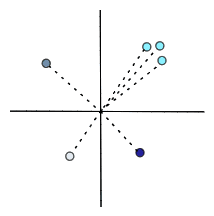
Vector distance diagram

We’ll soon explore how these relationships between vectors can be useful.

Vectors are an ideal data structure for machine learning algorithms — modern CPUs and GPUs are optimized to perform the mathematical operations needed to process them. But our data is rarely represented as vectors. This is where vector embedding comes into play. It’s a technique that allows us to take virtually any data type and represent it as vectors.

But it isn’t as simple as just turning data into vectors. We want to ensure that we can perform tasks on this transformed data without losing the data’s original meaning. For example, if we want to compare two sentences — we don’t want just to compare the words they contain but rather whether or not they mean the same thing. To preserve the data’s meaning, we need to understand how to produce vectors where relationships between the vectors make sense.

To do this, we need what’s known as an embedding model. Many modern embedding models are built by passing a large amount of labeled data to a neural network. You might have heard of neural networks before — they are also a popular tool used to solve all sorts of complex problems. In very simple terms, neural networks are made of layers of nodes connected by functions. We then train these neural networks to perform all sorts of tasks.

We train neural networks by applying supervised learning — feeding the network a large set of training data made of pairs of inputs and labeled outputs. Alternatively, we can apply self-supervised or unsupervised learning either of which doesn’t require labeled outputs. These values are transformed with each layer of network activations and operations. With every iteration of training, the neural network modifies the activations in each layer. Eventually, it can predict what an output label should be for a given input — even if it hasn’t seen that particular input before.

The embedding model is basically this neural network with the last layer removed. Instead of getting a specific labeled value for an input, we get a vector embedding.

A great example of an embedding model is the popular word2vec, which is regularly used for a wide variety of text-based tasks. Let’s take a look at a visualization produced by TensorFlow’s projector tool, which makes it easy to visualize embeddings.
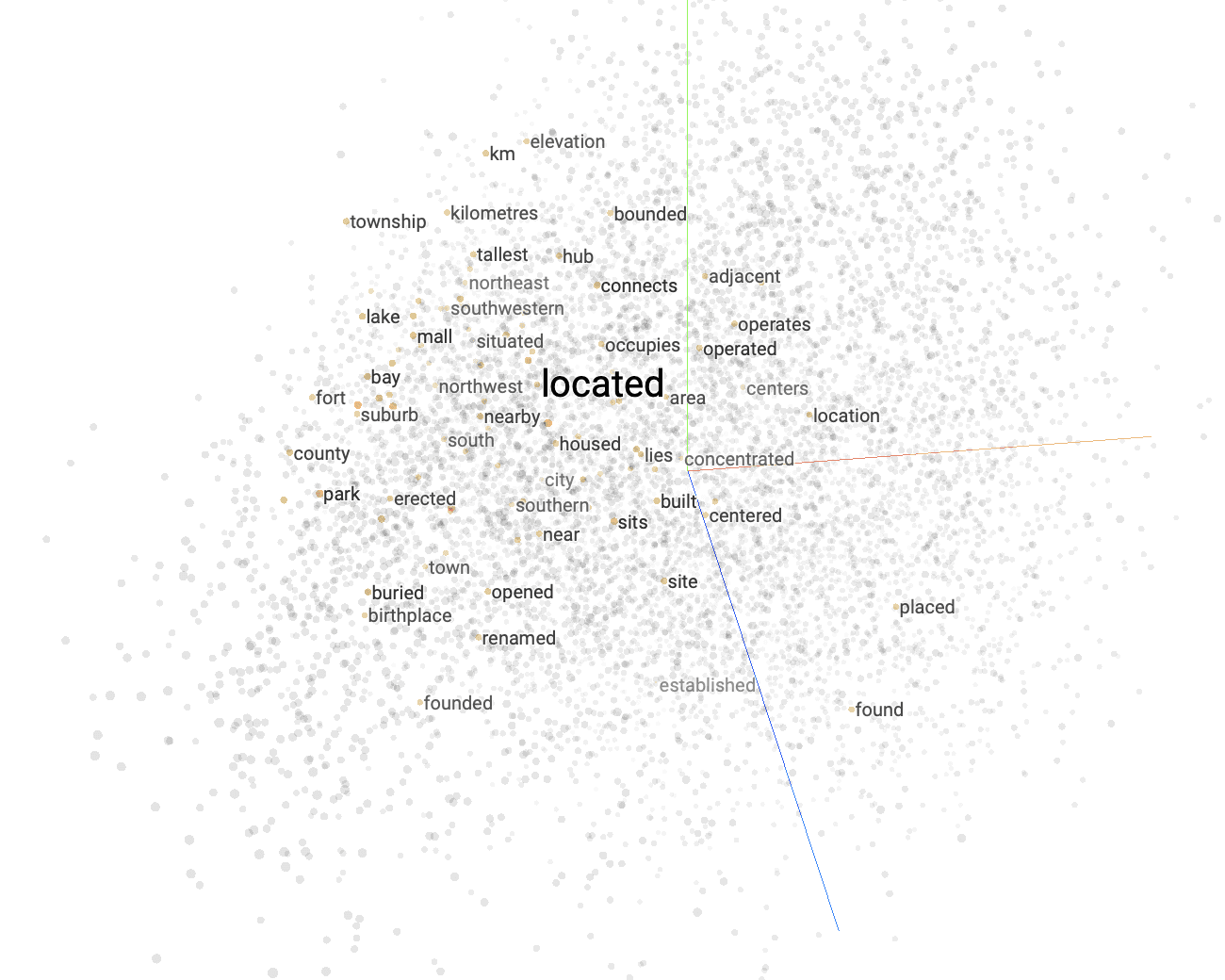
Embedding Visualization

While this visualization represents only three dimensions of the embeddings, it can help us understand how the embedding model works. There are multiple data points highlighted in the visualization, each representing a vector embedding for a word. As the name suggests, word2vec embeds words. Words that appear close to one another are semantically similar, while far-apart words have different semantic meanings.

Once trained, an embedding model can transform our raw data into vector embeddings. That means it knows where to place new data points in the vector space.
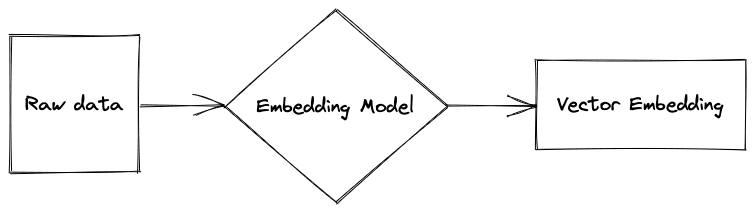
Embedding Process

As we saw with word2vec, within the context of the model, vectors that are close together have a contextual similarity, whereas far-apart vectors are different from one another. That’s what gives our vector meaning — its relationship with other vectors in the vector space depends on how the embedding model “understands” the domain it was trained on.

What can I do with vector embeddings?

Vector embeddings are an incredibly versatile tool and can be applied in many domains. Generally speaking, an application would use a vector embedding as its query and produce other vector embeddings which are similar to it, with their corresponding values. The difference between applications of each domain is the significance of this similarity.

Here are some examples:

  • Semantic Search - search engines traditionally work by searching for overlaps of keywords. By leveraging vector embeddings, semantic search can go beyond keyword matching and deliver based on the query’s semantic meaning.
  • Question-answering applications - by training an embedding model with pairs of questions and corresponding answers, we can create an application that would answer questions that have not been seen before.
  • Image search - vector embeddings are perfectly suited to serve as the basis for image retrieval tasks. There are multiple off-the-shelf models, such as CLIP, ResNet, and more. Different models handle different types of tasks like image similarity, object detection, and many more.
  • Audio search - by converting the audio into a set of activations (an audio spectrogram), we produce vector embeddings that can be used for audio similarity search.
  • Recommender Systems - we can create embeddings out of structured data that correlate to different entities such as products, articles, etc. In most cases, you’d have to create your own embedding model since it would be specific to your particular application. Sometimes this can be combined with unstructured embedding methods when images or text descriptions are found.
  • Anomaly detection - We can create embeddings for anomaly detection using large data sets of labeled sensor information that identify anomalous occurrences.

Vector embeddings are incredibly powerful, and this is by no means an exhaustive list — head to our example apps section to go deeper. You can also read more about the basics of vector search to see how Pinecone can help you wrangle vector embeddings.