


惯性聚合 高效追踪和阅读你感兴趣的博客、新闻、科技资讯
阅读原文 在惯性聚合中打开

推荐订阅源

Hugging Face - Blog
Hugging Face - Blog
Microsoft Azure Blog
月光博客
月光博客
S
Securelist
J
Java Code Geeks
Recorded Future
Recorded Future
Exploit-DB.com RSS Feed
K
KPMG report finds enterprise disconnect between AI and its ROI | CIO
M
MIT News - Artificial intelligence
S
Secure Thoughts
Y
Y Combinator Blog
H
Hackread – Cybersecurity News, Data Breaches, AI and More
D
Docker
Martin Fowler
Martin Fowler
The Last Watchdog
The Last Watchdog
WordPress大学
WordPress大学
The GitHub Blog
The GitHub Blog
Vercel News
Vercel News
O
OpenAI News
www.infosecurity-magazine.com
博客园_首页
OSCHINA 社区最新新闻
OSCHINA 社区最新新闻
PCI Perspectives
PCI Perspectives
N
News and Events Feed by Topic
H
Heimdal Security Blog
SecWiki News
SecWiki News
奇客Solidot–传递最新科技情报
奇客Solidot–传递最新科技情报
Cyber Security Advisories - MS-ISAC
cs.AI updates on arXiv.org
博客园 - 【当耐特】
T
Troy Hunt's Blog
L
LINUX DO - 最新话题
Hacker News: Ask HN
Hacker News: Ask HN
Hacker News - Newest:
Hacker News - Newest: "LLM"
N
Netflix TechBlog - Medium
A
Arctic Wolf
The Hacker News
The Hacker News
I
Intezer
S
Schneier on Security
CTFtime.org: upcoming CTF events
Apple Machine Learning Research
L
Lohrmann on Cybersecurity
宝玉的分享
宝玉的分享
P
Privacy & Cybersecurity Law Blog
Stack Overflow Blog
Stack Overflow Blog
T
Tor Project blog
小众软件
小众软件
Simon Willison's Weblog
The Cloudflare Blog
Jina AI
Jina AI

AWS News Blog

Amazon SQS turns 20: Two decades of reliable messaging at scale | Amazon Web Services AWS Weekly Roundup: AWS Builder Center at 1 year, Network Scanning in Security Hub, Loom for AWS, and more (July 13, 2026) | Amazon Web Services AWS Weekly Roundup: Claude Sonnet 5 on AWS, Amazon WorkSpaces for AI agents, AWS service availability updates, and more (July 6, 2026) | Amazon Web Services Upgrade Amazon EKS clusters with confidence using Kubernetes version rollbacks | Amazon Web Services Accelerate your infrastructure deployments by up to 4x with AWS CloudFormation Express mode | Amazon Web Services Amazon EC2 C9g and C9gd instances powered by AWS Graviton5 processors are now available | Amazon Web Services Automate public TLS certificate issuance with ACME support in AWS Certificate Manager | Amazon Web Services AWS Weekly Roundup, Agentic CX designer for Amazon Connect Customer, EC2 AMI Watermarks, Open Governance for MySQL, and more (June 29, 2026) | Amazon Web Services Run isolated sandboxes with full lifecycle control: AWS Lambda introduces MicroVMs | Amazon Web Services AWS Weekly Roundup: NY Summit recap, Local Zone in Hanoi, Grok 4.3 in Bedrock, price reductions, and more (June 22, 2026) | Amazon Web Services Announcing Amazon EC2 G7 instances accelerated by NVIDIA RTX PRO 4500 Blackwell Server Edition GPUs | Amazon Web Services Amazon ECS introduces new high-resolution metrics for faster service auto scaling | Amazon Web Services Top announcements of the AWS Summit in New York, 2026 | Amazon Web Services Introducing Amazon Bedrock Managed Knowledge Base for faster, more accurate enterprise AI applications | Amazon Web Services Announcing Web Search on Amazon Bedrock AgentCore: Ground your AI agents in current, accurate web knowledge | Amazon Web Services Proactively reduce tech debt autonomously with AWS Transform – continuous modernization (preview) | Amazon Web Services AWS DevOps Agent adds release management capabilities to assess code changes before production (preview) | Amazon Web Services AWS Security Agent adds threat modeling, Kiro power and Claude Code plugin, and more | Amazon Web Services Amazon S3 annotations: attach rich, queryable context directly to your objects | Amazon Web Services AWS WAF adds AI traffic monetization capability to help content owners charge AI bots for content access | Amazon Web Services AWS Weekly Roundup: AWS FinOps Agent in preview, Gemma 4 on Bedrock, Kiro Pro Max, and more (June 15, 2026) | Amazon Web Services Now available: Amazon EC2 M9g and M9gd instances powered by new AWS Graviton5 processors | Amazon Web Services Anthropic Claude Fable 5 on AWS: Mythos-class capabilities with built-in safeguards now available | Amazon Web Services AWS Weekly Roundup: BYOM for Amazon RDS for SQL Server, AWS IoT Device SDK for Swift, and more (June 8, 2026) | Amazon Web Services Try the new console experience in Amazon Bedrock, optimized for Anthropic- and OpenAI-compatible APIs | Amazon Web Services Improve your application resilience with Amazon Cognito multi-Region replication | Amazon Web Services Get started with OpenAI GPT-5.5, GPT-5.4 models, and Codex on Amazon Bedrock | Amazon Web Services AWS Weekly Roundup: Claude Opus 4.8 on AWS, Aurora MySQL with Kiro Powers, and more (June 1, 2026) | Amazon Web Services Introducing the next generation of AWS Resilience Hub for generative AI-based SRE resilience journey | Amazon Web Services Introducing the next generation of Amazon OpenSearch Serverless for building your agentic AI applications | Amazon Web Services Meet Our Newest AWS Heroes – May 2026 | Amazon Web Services AWS Weekly Roundup: AWS Local Zones in Istanbul, open-source ExtendDB, Kiro Web, and more (May 25, 2026) | Amazon Web Services AWS Weekly Roundup: AWS Transform at 1 year, Claude Platform on AWS, EC2 M3 Ultra Mac instances, and more (May 18, 2026) | Amazon Web Services Amazon Bedrock introduces new advanced prompt optimization and migration tool | Amazon Web Services Amazon Redshift introduces AWS Graviton-based RG instances with an integrated data lake query engine | Amazon Web Services AWS Weekly Roundup: Amazon Bedrock AgentCore payments, Agent Toolkit for AWS, and more (May 11, 2026) | Amazon Web Services The AWS MCP Server is now generally available | Amazon Web Services Modernize your workflows: Amazon WorkSpaces now gives AI agents their own desktop (preview) | Amazon Web Services AWS Weekly Roundup: What’s Next with AWS 2026, Amazon Quick, OpenAI partnership, and more (May 4, 2026) | Amazon Web Services Top announcements of the What’s Next with AWS, 2026 | Amazon Web Services AWS Weekly Roundup: Anthropic & Meta partnership, AWS Lambda S3 Files, Amazon Bedrock AgentCore CLI, and more (April 27, 2026) | Amazon Web Services AWS Weekly Roundup: Claude Opus 4.7 in Amazon Bedrock, AWS Interconnect GA, and more (April 20, 2026) | Amazon Web Services Introducing Anthropic’s Claude Opus 4.7 model in Amazon Bedrock | Amazon Web Services AWS Interconnect is now generally available, with a new option to simplify last-mile connectivity | Amazon Web Services AWS Weekly Roundup: Claude Mythos Preview in Amazon Bedrock, AWS Agent Registry, and more (April 13, 2026) | Amazon Web Services Launching S3 Files, making S3 buckets accessible as file systems | Amazon Web Services AWS Weekly Roundup: AWS DevOps Agent & Security Agent GA, Product Lifecycle updates, and more (April 6, 2026) | Amazon Web Services Amazon Bedrock Guardrails supports cross-account safeguards with centralized control and management | Amazon Web Services Announcing managed daemon support for Amazon ECS Managed Instances | Amazon Web Services Announcing the AWS Sustainability console: Programmatic access, configurable CSV reports, and Scope 1–3 reporting in one place | Amazon Web Services AWS Weekly Roundup: AWS AI/ML Scholars program, Agent Plugin for AWS Serverless, and more (March 30, 2026) | Amazon Web Services Customize your AWS Management Console experience with visual settings including account color, region and service visibility | Amazon Web Services AWS Weekly Roundup: NVIDIA Nemotron 3 Super on Amazon Bedrock, Nova Forge SDK, Amazon Corretto 26, and more (March 23, 2026) | Amazon Web Services 20 years in the AWS Cloud – how time flies! | Amazon Web Services Our First 2026 AWS Heroes Cohort Is Here! | Amazon Web Services AWS Weekly Roundup: Amazon S3 turns 20, Amazon Route 53 Global Resolver general availability, and more (March 16, 2026) | Amazon Web Services Twenty years of Amazon S3 and building what’s next | Amazon Web Services Introducing account regional namespaces for Amazon S3 general purpose buckets | Amazon Web Services AWS Weekly Roundup: Amazon Connect Health, Bedrock AgentCore Policy, GameDay Europe, and more (March 9, 2026) | Amazon Web Services Introducing OpenClaw on Amazon Lightsail to run your autonomous private AI agents | Amazon Web Services AWS Weekly Roundup: OpenAI partnership, AWS Elemental Inference, Strands Labs, and more (March 2, 2026) | Amazon Web Services AWS Security Hub Extended offers full-stack enterprise security with curated partner solutions | Amazon Web Services Transform live video for mobile audiences with AWS Elemental Inference | Amazon Web Services AWS Weekly Roundup: Claude Sonnet 4.6 in Amazon Bedrock, Kiro in GovCloud Regions, new Agent Plugins, and more (February 23, 2026) | Amazon Web Services
Announcing Amazon Aurora PostgreSQL serverless database creation in seconds | Amazon Web Services
2026-03-25 · via AWS News Blog

Voiced by Polly

At re:Invent 2025, Colin Lazier, vice president of databases at AWS, emphasized the importance of building at the speed of an idea—enabling rapid progress from concept to running application. Customers can already create production-ready Amazon DynamoDB tables and Amazon Aurora DSQL databases in seconds. He previewed creating an Amazon Aurora serverless database with the same speed, and customers have since requested quick access and speed to this capability.
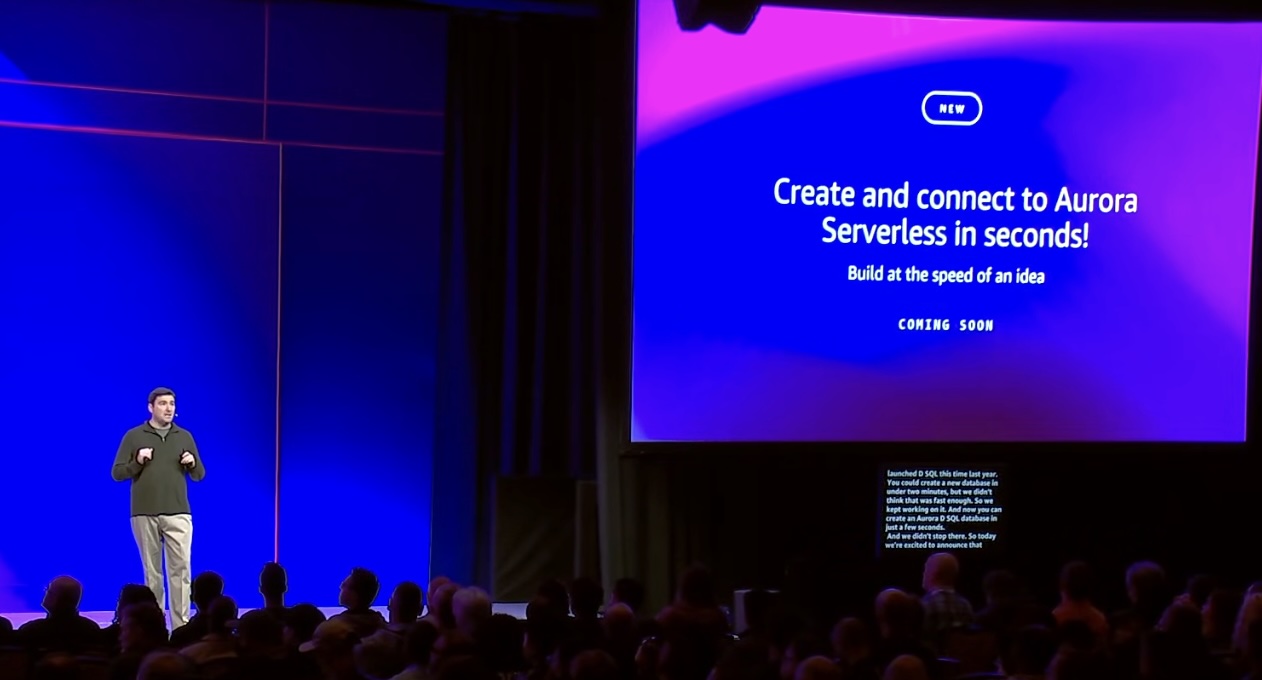
Today, we’re announcing the general availability of a new express configuration for Amazon Aurora PostgreSQL, a streamlined database creation experience with preconfigured defaults designed to help you get started in seconds.

With only two clicks, you can have an Aurora PostgreSQL serverless database ready to use in seconds. You have the flexibility to modify certain settings during and after database creation in the new configuration. For example, you can change the capacity range for the serverless instance at the time of create or add read replicas, modify parameter groups after the database is created. Aurora clusters with express configuration are created without an Amazon Virtual Private Cloud (Amazon VPC) network and include an internet access gateway for secure connections from your favorite development tools – no VPN, or AWS Direct Connect required. Express configuration also sets up AWS Identity and Access Management (IAM) authentication for your administrator user by default, enabling passwordless database authentication from the beginning without additional configuration.

After it’s created, you have access to features available for Aurora PostgreSQL serverless, such as deploying additional read replicas for high availability and automated failover capabilities. This launch also introduces a new internet access gateway routing layer for Aurora. Your new serverless instance comes enabled by default with this feature, which allows your applications to connect securely from anywhere in the world through the internet using the PostgreSQL wire protocol from a wide range of developer tools. This gateway is distributed across multiple Availability Zones, offering the same level of high availability as your Aurora cluster.

Creating and connecting to Aurora in seconds means fundamentally rethinking how you get started. We launched multiple capabilities that work together to help you onboard and run your application with Aurora. Aurora is now available on AWS Free Tier, which you gain hands-on experience with Aurora at no upfront cost. After it’s created, you can directly query an Aurora database in AWS CloudShell or using programming languages and developer tools through a new internet accessible routing component for Aurora. With integrations such as v0 by Vercel, you can use natural language to start building your application with the features and benefits of Aurora.

Create an Aurora PostgreSQL serverless database in seconds
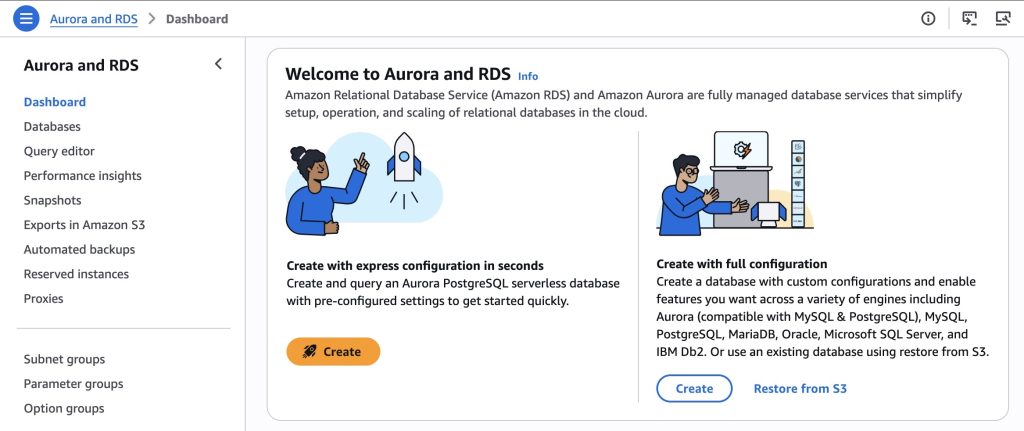
To get started, go to the Aurora and RDS console and in the navigation pane, choose Dashboard. Then, choose Create with a rocket icon.
Review pre-configured settings in the Create with express configuration dialog box. You can modify the DB cluster identifier or the capacity range as needed. Choose Create database.
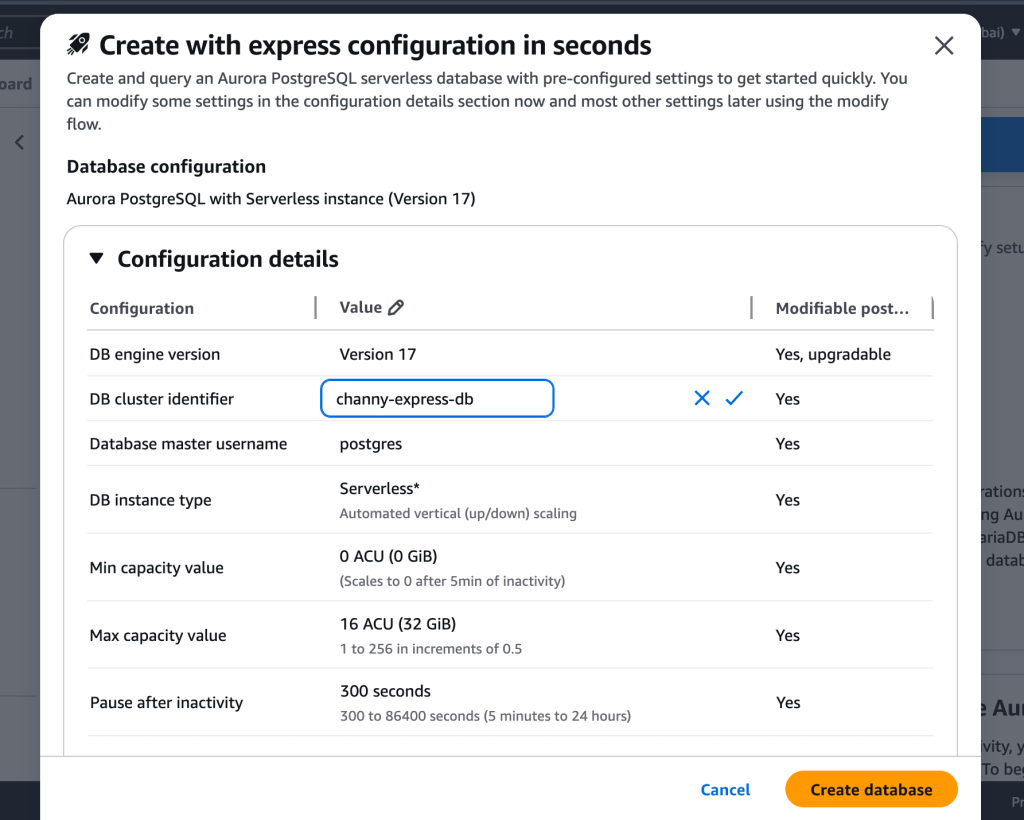
You can also use the AWS Command Line Interface (AWS CLI) or AWS SDKs with the parameter --with-express-configuration to create both a cluster and an instance within the cluster with a single API call which makes it ready for running queries in seconds.To learn more, visit Creating an Aurora PostgreSQL DB cluster with express configuration.

Here is a CLI command to create the cluster:

$ aws rds create-db-cluster --db-cluster-identifier channy-express-db \
    --engine aurora-postgresql \
    –-with-express-configuration

Your Aurora PostgreSQL serverless database should be ready in seconds. A success banner confirms the creation, and the database status changes to Available.
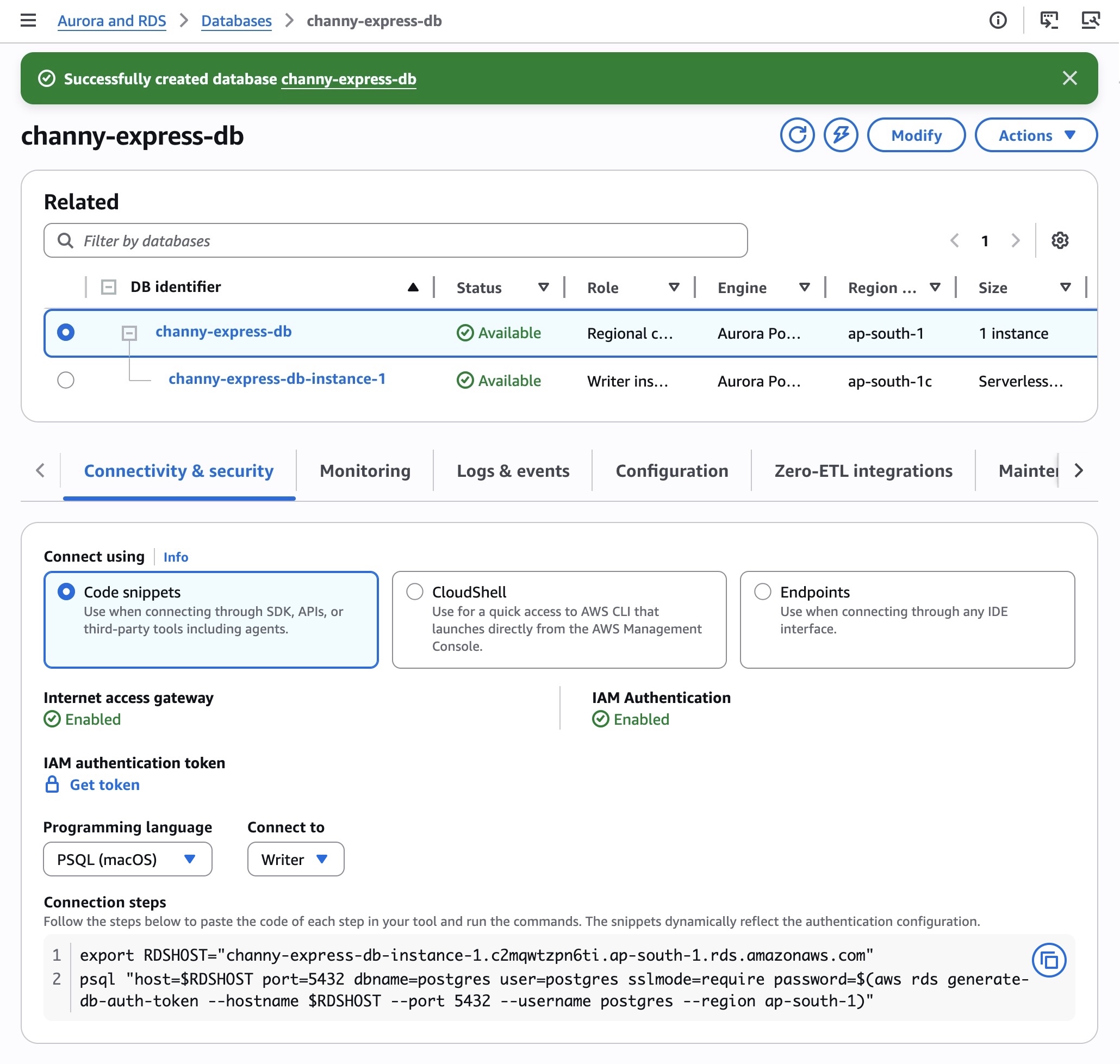
After your database is ready, go to the Connectivity & security tab to access three connection options. When connecting through SDKs, APIs, or third-party tools including agents, choose Code snippets. You can choose various programming languages such as .NET, Golang, JDBC, Node.js, PHP, PSQL, Python, and TypeScript. You can paste the code from each step into your tool and run the commands.

For example, the following Python code is dynamically generated to reflect the authentication configuration:

import psycopg2
import boto3

auth_token = boto3.client('rds', region_name='ap-south-1').generate_db_auth_token(DBHostname='channy-express-db-instance-1.abcdef.ap-south-1.rds.amazonaws.com', Port=5432, DBUsername='postgres', Region='ap-south-1')

conn = None
try:
    conn = psycopg2.connect(
        host='channy-express-db-instance-1.abcdef.ap-south-1.rds.amazonaws.com',
        port=5432,
        database='postgres',
        user='postgres',
        password=auth_token,
        sslmode='require'
    )
    cur = conn.cursor()
    cur.execute('SELECT version();')
    print(cur.fetchone()[0])
    cur.close()
except Exception as e:
    print(f"Database error: {e}")
    raise
finally:
    if conn:
        conn.close()

Choose CloudShell for quick access to the AWS CLI which launches directly from the console. When you choose Launch CloudShell, you can see the command is pre-populated with relevant information to connect to your specific cluster. After connecting to the shell, you should see the psql login and the postgres => prompt to run SQL commands.
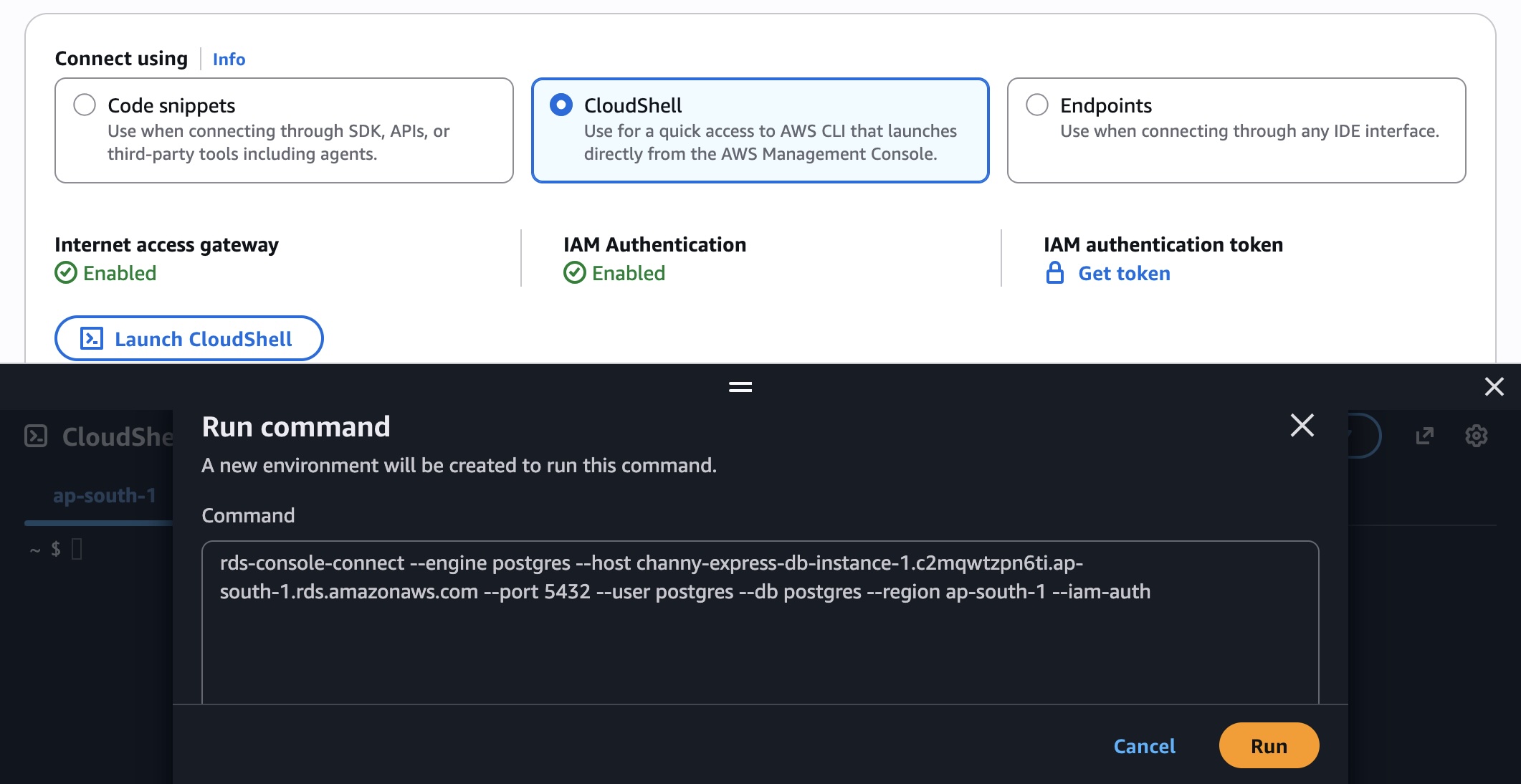
You can also choose Endpoints to use tools that only support username and password credentials, such as pgAdmin. When you choose Get token, you use an AWS Identity and Access Management (IAM) authentication token generated by the utility in the password field. The token is generated for the master username that you set up at the time of creating the database. The token is valid for 15 minutes at a time. If the tool you’re using terminates the connection, you will need to generate the token again.

Building your application faster with Aurora databases
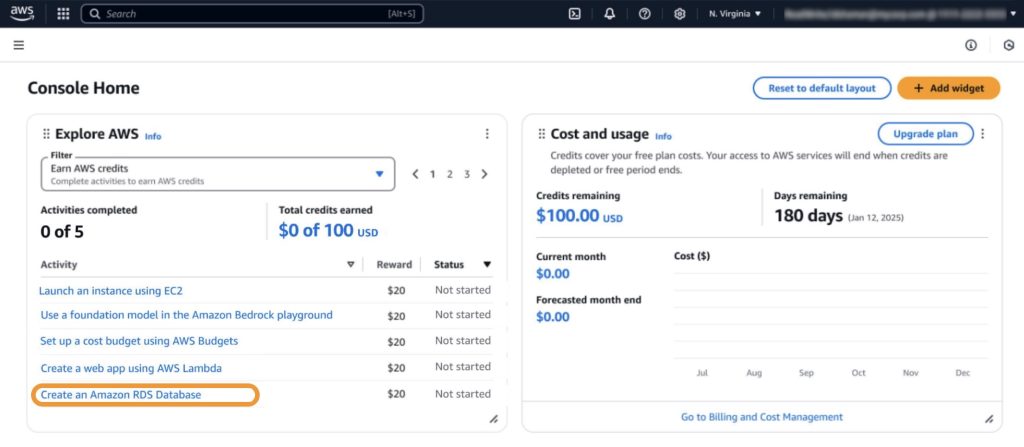
At re:Invent 2025, we announced enhancements to the AWS Free Tier program, offering up to $200 in AWS credits that can be used across AWS services. You’ll receive $100 in AWS credits upon sign-up and can earn an additional $100 in credits by using services such as Amazon Relational Database Service (Amazon RDS), AWS Lambda, and Amazon Bedrock. In addition, Amazon Aurora is now available across a broad set of eligible Free Tier database services.
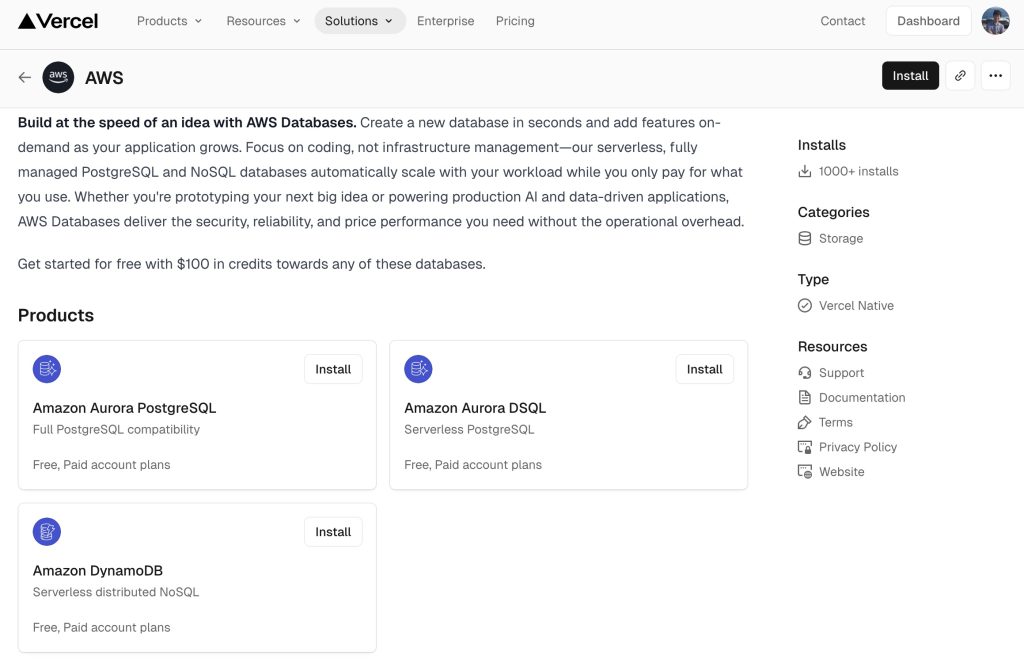
Developers are embracing platforms such as Vercel, where natural language is all it takes to build production-ready applications. We announced integrations with Vercel Marketplace to create and connect to an AWS database directly from Vercel in seconds and v0 by Vercel, an AI-powered tool that transforms your ideas into production-ready, full-stack web applications in minutes. It includes Aurora PostgreSQL, Aurora DSQL, and DynamoDB databases. You can also connect your existing databases created through express configuration with Vercel. To learn more, visit AWS for Vercel.
Like Vercel, we’re bringing our databases seamlessly into their experiences and are integrating directly with widely adopted frameworks, AI assistant coding tools, environments, and developer tools, all to unlock your ability to build at the speed of an idea.

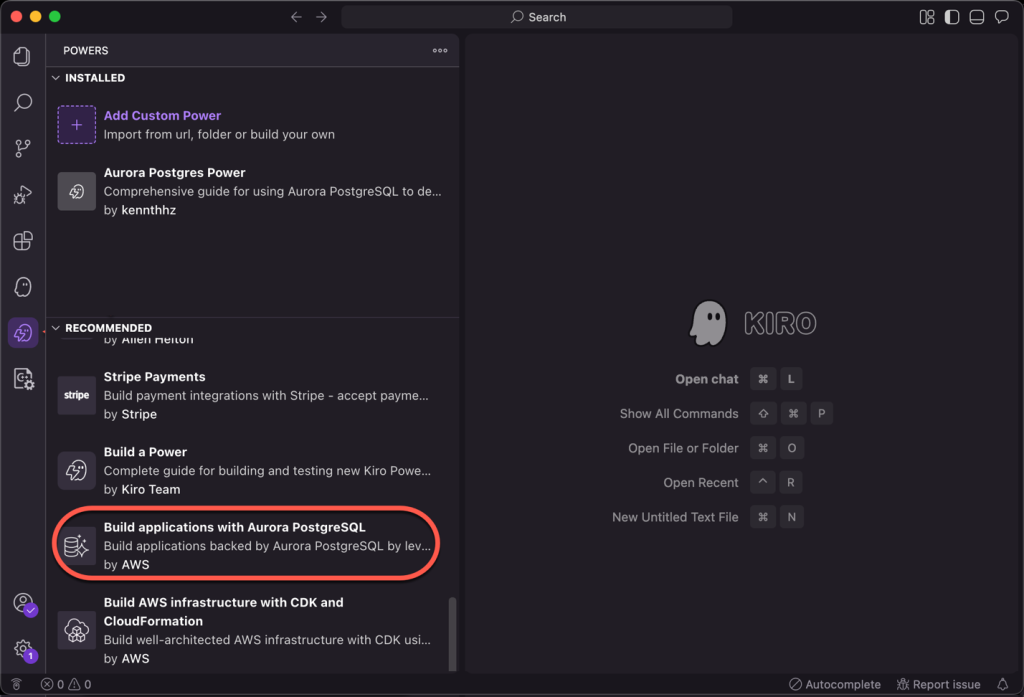
We introduced Aurora PostgreSQL integration with Kiro powers, which developers can use to build Aurora PostgreSQL backed applications faster with AI agent-assisted development through Kiro. You can use Kiro power for Aurora PostgreSQL within Kiro IDE and from the Kiro powers webpage for one-click installation. To learn more about this Kiro Power, read Introducing Amazon Aurora powers for Kiro and Amazon Aurora Postgres MCP Server.
Now available
You can create an Aurora PostgreSQL serverless database in seconds today in all AWS commercial Regions. For Regional availability and a future roadmap, visit the AWS Capabilities by Region.

You pay only for capacity consumed based on Aurora Capacity Units (ACUs) billed per second from zero capacity, which automatically starts up, shuts down, and scales capacity up or down based on your application’s needs. To learn more, visit the Amazon Aurora Pricing page.

Give it a try in the Aurora and RDS console and send feedback to AWS re:Post for Aurora PostgreSQL or through your usual AWS Support contacts.

Channy