





惯性聚合 高效追踪和阅读你感兴趣的博客、新闻、科技资讯
阅读原文 在惯性聚合中打开

推荐订阅源

P
Privacy & Cybersecurity Law Blog
aimingoo的专栏
aimingoo的专栏
Microsoft Azure Blog
T
Tailwind CSS Blog
P
Proofpoint News Feed
T
The Blog of Author Tim Ferriss
WordPress大学
WordPress大学
GbyAI
GbyAI
Engineering at Meta
Engineering at Meta
I
InfoQ
U
Unit 42
小众软件
小众软件
阮一峰的网络日志
阮一峰的网络日志
Martin Fowler
Martin Fowler
博客园 - Franky
钛媒体:引领未来商业与生活新知
钛媒体:引领未来商业与生活新知
G
Google Developers Blog
Security Archives - TechRepublic
S
Security Affairs
Jina AI
Jina AI
Google DeepMind News
M
MIT News - Artificial intelligence
cs.CV updates on arXiv.org
The Last Watchdog
The Last Watchdog
H
Hacker News: Front Page
MongoDB | Blog
MongoDB | Blog
A
About on SuperTechFans
Y
Y Combinator Blog
The GitHub Blog
The GitHub Blog
N
News and Events Feed by Topic
cs.AI updates on arXiv.org
SecWiki News
SecWiki News
V
V2EX
MyScale Blog
MyScale Blog
V2EX - 技术
V2EX - 技术
www.infosecurity-magazine.com
G
GRAHAM CLULEY
博客园 - 司徒正美
L
LangChain Blog
F
Fortinet All Blogs
Scott Helme
Scott Helme
量子位
Recent Announcements
Cyberwarzone
Cyberwarzone
C
CERT Recently Published Vulnerability Notes
Cloudbric
Cloudbric
W
WeLiveSecurity
The Register - Security
NISL@THU
NISL@THU
博客园_首页

AWS News Blog

AWS Weekly Roundup: One-click Lambda setup prompt, OpenAI GPT-5.6 models on Bedrock, and more (July 20, 2026) | Amazon Web Services Amazon SQS turns 20: Two decades of reliable messaging at scale | Amazon Web Services AWS Weekly Roundup: AWS Builder Center at 1 year, Network Scanning in Security Hub, Loom for AWS, and more (July 13, 2026) | Amazon Web Services AWS Weekly Roundup: Claude Sonnet 5 on AWS, Amazon WorkSpaces for AI agents, AWS service availability updates, and more (July 6, 2026) | Amazon Web Services Upgrade Amazon EKS clusters with confidence using Kubernetes version rollbacks | Amazon Web Services Accelerate your infrastructure deployments by up to 4x with AWS CloudFormation Express mode | Amazon Web Services Amazon EC2 C9g and C9gd instances powered by AWS Graviton5 processors are now available | Amazon Web Services Automate public TLS certificate issuance with ACME support in AWS Certificate Manager | Amazon Web Services AWS Weekly Roundup, Agentic CX designer for Amazon Connect Customer, EC2 AMI Watermarks, Open Governance for MySQL, and more (June 29, 2026) | Amazon Web Services Run isolated sandboxes with full lifecycle control: AWS Lambda introduces MicroVMs | Amazon Web Services AWS Weekly Roundup: NY Summit recap, Local Zone in Hanoi, Grok 4.3 in Bedrock, price reductions, and more (June 22, 2026) | Amazon Web Services Announcing Amazon EC2 G7 instances accelerated by NVIDIA RTX PRO 4500 Blackwell Server Edition GPUs | Amazon Web Services Amazon ECS introduces new high-resolution metrics for faster service auto scaling | Amazon Web Services Top announcements of the AWS Summit in New York, 2026 | Amazon Web Services Introducing Amazon Bedrock Managed Knowledge Base for faster, more accurate enterprise AI applications | Amazon Web Services Announcing Web Search on Amazon Bedrock AgentCore: Ground your AI agents in current, accurate web knowledge | Amazon Web Services AWS DevOps Agent adds release management capabilities to assess code changes before production (preview) | Amazon Web Services AWS Security Agent adds threat modeling, Kiro power and Claude Code plugin, and more | Amazon Web Services Amazon S3 annotations: attach rich, queryable context directly to your objects | Amazon Web Services AWS WAF adds AI traffic monetization capability to help content owners charge AI bots for content access | Amazon Web Services AWS Weekly Roundup: AWS FinOps Agent in preview, Gemma 4 on Bedrock, Kiro Pro Max, and more (June 15, 2026) | Amazon Web Services Now available: Amazon EC2 M9g and M9gd instances powered by new AWS Graviton5 processors | Amazon Web Services Anthropic Claude Fable 5 on AWS: Mythos-class capabilities with built-in safeguards now available | Amazon Web Services AWS Weekly Roundup: BYOM for Amazon RDS for SQL Server, AWS IoT Device SDK for Swift, and more (June 8, 2026) | Amazon Web Services Try the new console experience in Amazon Bedrock, optimized for Anthropic- and OpenAI-compatible APIs | Amazon Web Services Improve your application resilience with Amazon Cognito multi-Region replication | Amazon Web Services Get started with OpenAI GPT-5.5, GPT-5.4 models, and Codex on Amazon Bedrock | Amazon Web Services AWS Weekly Roundup: Claude Opus 4.8 on AWS, Aurora MySQL with Kiro Powers, and more (June 1, 2026) | Amazon Web Services Introducing the next generation of AWS Resilience Hub for generative AI-based SRE resilience journey | Amazon Web Services Introducing the next generation of Amazon OpenSearch Serverless for building your agentic AI applications | Amazon Web Services Meet Our Newest AWS Heroes – May 2026 | Amazon Web Services AWS Weekly Roundup: AWS Local Zones in Istanbul, open-source ExtendDB, Kiro Web, and more (May 25, 2026) | Amazon Web Services AWS Weekly Roundup: AWS Transform at 1 year, Claude Platform on AWS, EC2 M3 Ultra Mac instances, and more (May 18, 2026) | Amazon Web Services Amazon Bedrock introduces new advanced prompt optimization and migration tool | Amazon Web Services Amazon Redshift introduces AWS Graviton-based RG instances with an integrated data lake query engine | Amazon Web Services AWS Weekly Roundup: Amazon Bedrock AgentCore payments, Agent Toolkit for AWS, and more (May 11, 2026) | Amazon Web Services The AWS MCP Server is now generally available | Amazon Web Services Modernize your workflows: Amazon WorkSpaces now gives AI agents their own desktop (preview) | Amazon Web Services AWS Weekly Roundup: What’s Next with AWS 2026, Amazon Quick, OpenAI partnership, and more (May 4, 2026) | Amazon Web Services Top announcements of the What’s Next with AWS, 2026 | Amazon Web Services AWS Weekly Roundup: Anthropic & Meta partnership, AWS Lambda S3 Files, Amazon Bedrock AgentCore CLI, and more (April 27, 2026) | Amazon Web Services AWS Weekly Roundup: Claude Opus 4.7 in Amazon Bedrock, AWS Interconnect GA, and more (April 20, 2026) | Amazon Web Services Introducing Anthropic’s Claude Opus 4.7 model in Amazon Bedrock | Amazon Web Services AWS Interconnect is now generally available, with a new option to simplify last-mile connectivity | Amazon Web Services AWS Weekly Roundup: Claude Mythos Preview in Amazon Bedrock, AWS Agent Registry, and more (April 13, 2026) | Amazon Web Services Launching S3 Files, making S3 buckets accessible as file systems | Amazon Web Services AWS Weekly Roundup: AWS DevOps Agent & Security Agent GA, Product Lifecycle updates, and more (April 6, 2026) | Amazon Web Services Amazon Bedrock Guardrails supports cross-account safeguards with centralized control and management | Amazon Web Services Announcing managed daemon support for Amazon ECS Managed Instances | Amazon Web Services Announcing the AWS Sustainability console: Programmatic access, configurable CSV reports, and Scope 1–3 reporting in one place | Amazon Web Services AWS Weekly Roundup: AWS AI/ML Scholars program, Agent Plugin for AWS Serverless, and more (March 30, 2026) | Amazon Web Services Customize your AWS Management Console experience with visual settings including account color, region and service visibility | Amazon Web Services Announcing Amazon Aurora PostgreSQL serverless database creation in seconds | Amazon Web Services AWS Weekly Roundup: NVIDIA Nemotron 3 Super on Amazon Bedrock, Nova Forge SDK, Amazon Corretto 26, and more (March 23, 2026) | Amazon Web Services 20 years in the AWS Cloud – how time flies! | Amazon Web Services Our First 2026 AWS Heroes Cohort Is Here! | Amazon Web Services AWS Weekly Roundup: Amazon S3 turns 20, Amazon Route 53 Global Resolver general availability, and more (March 16, 2026) | Amazon Web Services Twenty years of Amazon S3 and building what’s next | Amazon Web Services Introducing account regional namespaces for Amazon S3 general purpose buckets | Amazon Web Services AWS Weekly Roundup: Amazon Connect Health, Bedrock AgentCore Policy, GameDay Europe, and more (March 9, 2026) | Amazon Web Services Introducing OpenClaw on Amazon Lightsail to run your autonomous private AI agents | Amazon Web Services AWS Weekly Roundup: OpenAI partnership, AWS Elemental Inference, Strands Labs, and more (March 2, 2026) | Amazon Web Services AWS Security Hub Extended offers full-stack enterprise security with curated partner solutions | Amazon Web Services Transform live video for mobile audiences with AWS Elemental Inference | Amazon Web Services AWS Weekly Roundup: Claude Sonnet 4.6 in Amazon Bedrock, Kiro in GovCloud Regions, new Agent Plugins, and more (February 23, 2026) | Amazon Web Services
Proactively reduce tech debt autonomously with AWS Transform – continuous modernization (preview) | Amazon Web Services
Micah Walter · 2026-06-17 · via AWS News Blog

AWS News Blog

Voiced by Polly

Today, we’re announcing AWS Transform – continuous modernization (preview), a new capability of AWS Transform for continuous, autonomous tech debt analysis and remediation at scale. AWS Transform already helps enterprises migrate out of data centers, modernize mainframe and Windows applications, and handle the undifferentiated work of software maintenance: upgrading Java versions, swapping deprecated frameworks, and updating AWS Lambda runtimes before they reach end of life. This new experience builds on this. Customers get full visibility into the state of their codebase across thousands of repositories, prioritized findings, and the pull requests that make the fixes.

Engineering organizations typically consume up to 30% of IT budgets. Customers stitch together point tools: one to detect dependency issues, another to flag vulnerabilities, another for code quality. But no existing tool detects, prioritizes, and remediates tech debt continuously and at scale. The result is a manual, app-by-app cycle that drains engineering capacity. Leaders fall back on self-reported team status that lags reality and hides regressions. AI-assisted development makes this worse: as coding agents accelerate the pace of change, tech debt accumulates faster than developers can keep up. Customers need a capability that detects, prioritizes, and remediates tech debt continuously, autonomously, and at scale.

Continuous analysis
To address the visibility challenge, this new capability within AWS Transform automatically scans your code repositories against configurable baselines and generates findings in hours, not weeks. Out of the box, AWS Transform – continuous modernization includes policies for detecting end of life dependencies, deprecated frameworks, and other common sources of technical debt. You can also extend these with your own remediation patterns specific to your organization, including approved libraries, internal coding standards, or tech debt policies your platform team already enforces. For example, if your team has deprecated an internal library or prefers a particular logging pattern, you can codify that as a policy and run it across all your repositories continuously.

Unlike periodic manual efforts, continuous analysis provides ground truth directly from your code. When a repository falls behind your baseline, you know immediately, showing which components are behind and by how much, regardless of how the team chooses to address it. This eliminates the need for status check-ins and manual compliance tracking, giving platform teams an always current view of their technical debt landscape.

Autonomous remediation at scale
Once you’ve identified and prioritized findings, you can configure autonomous remediations that generate pull requests for affected repositories automatically. This new AWS Transform capability provides out-of-the-box remediation transformations for common scenarios such as Java version upgrades, SDK migrations, and library updates. You can also create custom transformations for organization-specific patterns.

When you launch a remediation, the continuous modernization capability creates pull requests for each affected repository, notifying the owning team with a message like: “This repository is behind on your organization’s baseline for this dependency. Here’s a PR that resolves it.” Teams can review and merge the PR, or choose to remediate using their own approach. Either way, continuous analysis detects when the fix is in place, providing ground truth without requiring manual confirmation.

AWS Transform – continuous modernization integrates with AWS Security Agent to detect and remediate security vulnerabilities at the source-code level, so security findings flow into the same prioritized list and pull-request workflow as other tech debt.

Let’s try it out
To get started with, I navigated to the AWS Transform web application. From the dashboard, I can see an overview of my organization’s repositories and their current status against my configured baselines.

First, I connected my source control system and initiated an analysis against my specified policies. Within hours, the analysis returned findings across my repositories, showing which ones were behind the baseline and by how much. I could see the severity, the number of affected files, and the specific tech debt patterns detected.

From here, I selected a group of high-priority findings and launched a remediation campaign. AWS Transform – continuous modernization generated pull requests for each affected repository. I could monitor the campaign’s progress in real time, seeing which PRs were created, which were merged, and which repositories returned to compliance.
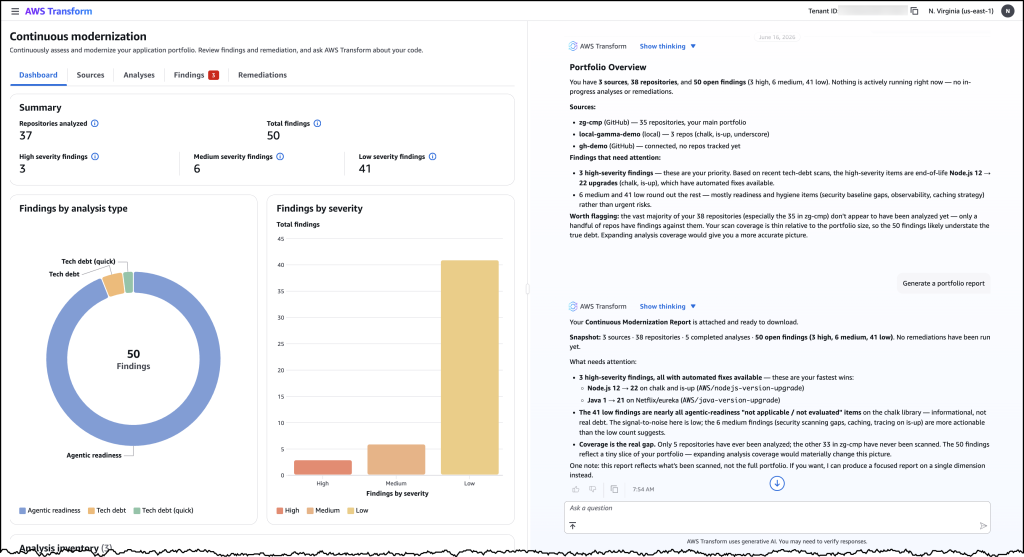
Image 1: AWS Transform – continuous modernization dashboard showing a portfolio overview of your technical debt findings across all connected repositories.
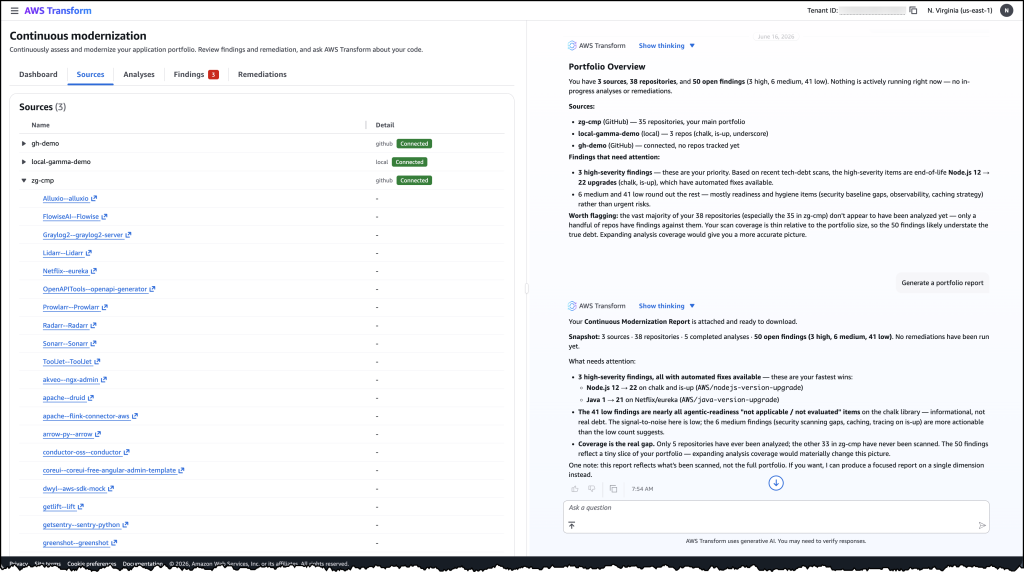
Image 2: The detailed findings view listing individual tech debt items by severity, category, and repository with their available remediation options.
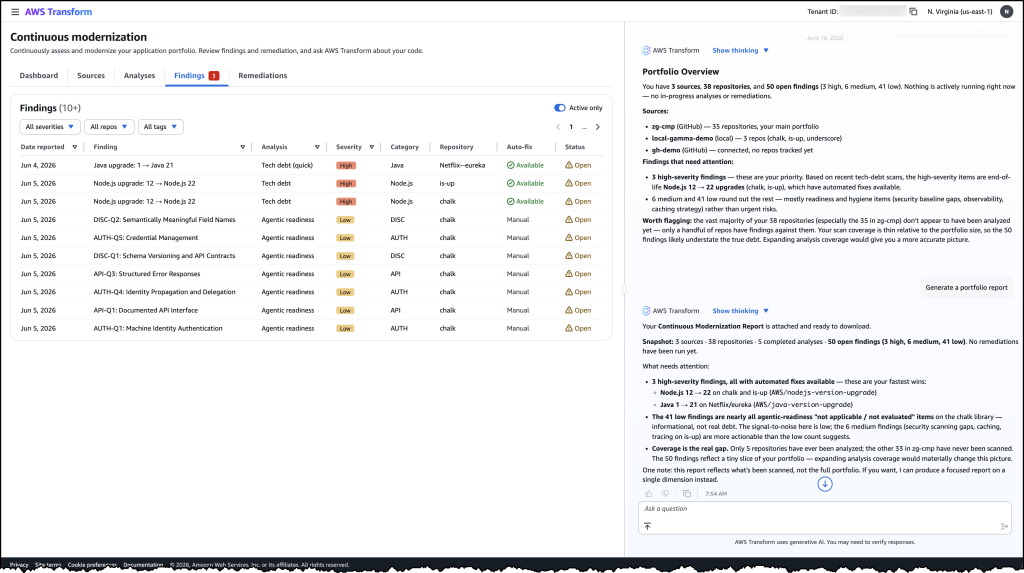
Image 3: The sources view showing connected repositories from GitHub and local environments that continuous modernization is tracking for analysis.

Faster ways to modernize
These capabilities support two distinct approaches to code modernization. In continuous mode, you can use continuous modernization to keep your codebases current as baselines evolve. Think of this as the day-to-day work of upgrading libraries, applying security patches, and enforcing coding standards across your organization.

For larger modernization projects, such as migrating from one framework to another or upgrading a major runtime version across hundreds of applications, you can use campaign mode for targeted, project-based modernization. AWS Transform custom continues to provide the flexible primitive for these larger efforts. AWS Transform – continuous modernization is purpose-built for the recurring, high-volume work that platform teams manage every day.

Now available
AWS Transform – continuous modernization (preview) is available today. You can get started through the AWS Transform web application, via the AWS Transform Kiro Power, or through MCP and skills for integration with your existing coding agents. To learn more, visit the AWS Transform documentation.