
惯性聚合 高效追踪和阅读你感兴趣的博客、新闻、科技资讯
阅读原文 在惯性聚合中打开

推荐订阅源

L
LangChain Blog
博客园 - 司徒正美
美团技术团队
WordPress大学
WordPress大学
奇客Solidot–传递最新科技情报
奇客Solidot–传递最新科技情报
人人都是产品经理
人人都是产品经理
让小产品的独立变现更简单 - ezindie.com
T
Troy Hunt's Blog
S
Schneier on Security
T
The Exploit Database - CXSecurity.com
P
Proofpoint News Feed
云风的 BLOG
云风的 BLOG
Engineering at Meta
Engineering at Meta
Cisco Talos Blog
Cisco Talos Blog
T
Tor Project blog
B
Blog
NISL@THU
NISL@THU
月光博客
月光博客
博客园 - 【当耐特】
AWS News Blog
AWS News Blog
cs.CL updates on arXiv.org
腾讯CDC
L
Lohrmann on Cybersecurity
The Cloudflare Blog
L
LINUX DO - 最新话题
S
Security @ Cisco Blogs
S
Secure Thoughts
Spread Privacy
Spread Privacy
有赞技术团队
有赞技术团队
The Last Watchdog
The Last Watchdog
Project Zero
Project Zero
cs.AI updates on arXiv.org
Vercel News
Vercel News
H
Hacker News: Front Page
S
SegmentFault 最新的问题
Schneier on Security
aimingoo的专栏
aimingoo的专栏
P
Privacy & Cybersecurity Law Blog
博客园 - 三生石上(FineUI控件)
Forbes - Security
Forbes - Security
C
CXSECURITY Database RSS Feed - CXSecurity.com
I
InfoQ
T
Tailwind CSS Blog
Application and Cybersecurity Blog
G
GRAHAM CLULEY
W
WeLiveSecurity
小众软件
小众软件
Recorded Future
Recorded Future
Cyberwarzone
Cyberwarzone
cs.CV updates on arXiv.org

Cisco Blogs

Edge opportunity for service providers: Turn infrastructure into new services MRC and SRv6: How Foundational Networking Innovations Are Enabling the Next Generation of AI Supercomputers The SMB Marketing Reset: Winning Customer Trust in a Digital-First Economy Inside the SOC: AI-powered DNS defense against ransomware Our Path Forward Securing the Federal Digital Experience with Cisco ThousandEyes for Government Cisco at ONUG Dallas 2026: Securing the AI Data Center in the Agentic Era Cisco and Red Hat are powering intelligent core to edge: Red Hat Summit insights Building the Capabilities That Win: How Cisco Partners Can Lead in the SMB & Mid-Market Era How Two Hours Felt Bigger Than My To-Do List Announcing Foundry Security Spec Ace the CCIE Collaboration Lab: Success Tips from a TAC Engineer Turned CCIE Protecting Agents with Cisco AI Defense and Google Agent Development Kit Powering an Inclusive Future: Your guide to the Purpose Pavilion at Cisco Live Las Vegas The Infrastructure Behind the Mission: SOF Week 2026 Cisco Networking App Marketplace Partners at Cisco Live 2026 Beyond the Pilot: Building the Clinical Data Fabric for the Agentic Era Benchmarking scale-out AI fabrics with Cisco N9000 + AMD Pensando™ Pollara 400 NICs Month of Developer Productivity: Build and Forget The race to autonomous transport networks: A new study Lean IT, future-ready: How to save time and simplify wireless management with AI Reading Between the Pixels: Failure Modes in Vision Language Models Biochar’s triple win: Healthier soils, improved crops, and decarbonization Designing a Proactive Customer Journey Modernize your data center operations with Cisco Nexus Dashboard Why your automation stack needs Cisco Agentic Workflows Try Cisco AI Defense Explorer Edition in this hands-on lab From Bandwidth to Intelligence: How Cisco is Powering AI-Ready Networks Spotlight on digital transformation | FY25 Purpose Report Galaxy Mode is live: A limited-time look at what your Cisco AI Assistant and AgenticOps can already do Securing the Agentic Workforce: Cisco Announces Intent to Acquire Astrix Security Understanding CISA BOD 26-02: Mitigating Risk from End-of-Support Edge Devices Digging Deeper: The Future of Mining with Automation and Ultra-Reliable Wireless Voices from the field: Helping farmers build resilient local economies across rural America Built like a startup, scaled like Cisco: Transforming data center cooling for the AI era Defining Model Provenance: A Constitution for AI Supply Chain Safety and Security Introducing Model Provenance Kit: Know Where Your AI Models Come From Security Insights: A Threat-First View for the Platform That Enforces Access How I Turned My Curiosity into a Patent From Strategy to Architecture: How Cisco is Building a Quantum-Safe Future Maximizing Managed Security Services: A Strategic Guide to Optimizing Your Portfolio (Part 1 of 2) Simplify access control in five easy steps Trust: Why security is your next growth engine Cisco IQ is generally available. Here’s what that actually means. From Vision to Reality: Intelligence in Action with Cisco IQ How connectivity is shaping the future of surgical care The power of your network: Solving a physical security incident on Vision portal 5 signs your data center is holding your AI strategy back Stop Overthinking OT Security: The Total Cost of Ownership and Being Smart with Refreshes AI-Ready, Simpler, and More Secure WAN: Cisco SD-WAN Innovations Scaling the digital future: Why AI and skills investments matter for business and society Expanding our Product Organization Recap Scaling the Future: Reddit AMA on Network Automation at Scale Bringing Professional-Level Skills to Cisco Networking Academy Announcing Cisco Availability in Google Cloud Marketplace: A New Path to Scalable, Partner-Led Growth The Innovation Paradox: How We Reduced Incidents by 25% While Deploying Faster Funding the AI-ready data center: Why flexibility wins The switch that quantum networking has been waiting for From a Message I Couldn’t Believe to a Stage I’ll Never Forget The Hidden Bottleneck Slowing Down Manufacturing Transformation 30 Years as a CCIE: Why Certifications Matter in the AI Era Securing Enterprise AI: Cisco AI Defense Expands to Google Cloud How ThousandEyes Closed the Cloud Visibility Gap by Solving It Themselves First Energy Will Define the Scale of AI Introducing the AI Agent Security Scanner for IDEs: Verify Your Agents Stop Overthinking OT Security: People, Process and Technology Powering the Future of Research: Join Cisco at NLIT 2026 Building the Digital Foundation for a Smarter West Lincoln Memorial Hospital How Cisco built an AI-RRM that maximizes your wireless solution From Automation to Autonomy: Cisco and Rockwell Power a New Era for Manufacturing Unlocking the Future of Fan Engagement: The Power of VisionEDGE Find Yourself in the Future: AI Is the New Baseline—Here’s How to Build Your Skills One Day with Our Customers: Driving better outcomes through customer centricity What It Really Takes to Build an AI-First Workforce From Connectivity to Security: How E80 Future-proofed its AGV Operations with Cisco The Infrastructure of a Floating City: AIDA Cruises’ CX-Led Digital Transformation Scaling your network for AI without a forklift upgrade Why modern networks are moving DDoS defense to the edge Evolve IP Media to AI-Driven Media Fabrics: Future-Proof Broadcast with Cisco and NVIDIA Cisco and Generation are scaling AI-powered pathways to employment Reading Between the Pixels: Assessing Prompt Injection Attack Success in Images Lean IT, future-ready: Why Wi-Fi is your AI growth strategy Cisco Modeling Labs: Bringing the Network Digital Twin to Life AI on the Factory Floor: Why Manufacturing Requires a New Architecture with Cisco Unified Edge Designing for What’s Next: Securing AI-Scale Infrastructure Without Compromise Scaling the Future: Join Our Reddit AMA on Network Automation at Scale 5 wireless trends retail IT teams can’t ignore in 2026 Can your infrastructure management tools do that? Sustainability 101: Let’s talk about energy efficiency From Chai Breaks to Checkpoints: A Day at Cisco Bengaluru Preparing for Post-Quantum Cryptography: The Secure Firewall Roadmap Non-Obvious Patterns in Building Enterprise AI Assistants Making AI Trustworthy and Observable in Real-Time: Cisco Announces Intent to Acquire Galileo A simpler path to unified, AI-ready network operations Cisco Celebrates The Smart Industry Industrial Transformation Award Winners Mobile World Congress 2026: AI-powered Network Security Powering MWC Barcelona – Building a Unified SOC and NOC with Splunk in Record Time How New Data Streams Transformed Cisco Store’s Decision-Making AI-powered Network Security at the Mobile World Congress 2026 SNOC Inside the Mobile World Congress 2026 SOC: Detecting Shadow Traffic with Firepower 6100
Cisco AI Defense Policy Studio: Turning Unwritten Policy into Adaptive AI Guardrails
Konstantin Berlin · 2026-06-11 · via Cisco Blogs

Cisco’s Integrated AI Security and Safety Framework and our recent work on defining taxonomy constitutions focused on defining and detecting common risks shared among enterprises when deploying AI. However, while most enterprises share a lot of the common risk categories, they are also diverse, and it is impossible to develop a complete taxonomy that would fully cover all customer specific cases. A retail bank’s AI assistant, for instance, should answer “how does a 401(k) work” but under SEC and FINRA rules may not be able to answer “should I move my savings into index funds” as personalized investment advice. Writing that rule is a thinking task, and the tools on the market for custom guardrails (fixed-category dropdowns, regular-expression fields, labeled-example uploaders, blank paragraph boxes) ask the policy owner for work they have not yet done. 

We are introducing Policy Studio in Cisco AI Defense, a flexible AI assistant that guides the policy owner through authoring a custom guardrail. In a chat-and-review UI, the owner answers insights: conceptual questions about what the rule should mean, paired with evidence from their own data, like a manager issuing guidance instead of editing a draft. The assistant turns that guidance into policy text, refines it against the data, and publishes the result to the AI Defense guardrails console for runtime enforcement. 

A policy you can read 

A Policy Studio guardrail is a human-readable policy document. It names the conduct at issue, states its elements, marks the boundaries against adjacent conduct, and records worked examples for the close cases. Compliance reads it, auditors read it, and at runtime the language model reads it to decide each case. We modeled the document on our constitutions for shared safety risks, which build on Constitutional AI and run 300-plus lines per technique, precise enough that multiple frontier models return the same decision on the same input. 

A written policy is the artifact that the bank’s legal, compliance, and audit functions already use. A custom guardrail should be no different. 

Human-centered meta-prompting 

Our constitution work showed that writing a policy precise enough to enforce at scale is beyond what an unassisted human author can reasonably do, so we focus on meta-prompting: using AI to author the prompt another model will read. A custom guardrail is exactly that kind of prompt, the system prompt the runtime classifier reads on every request, and Policy Studio authors it. The established work on meta-prompting is automated: DSPy’s optimizers (Khattab et al., 2023) and OPRO (Yang et al., 2023) take a labeled dataset and search the prompt space for a string that reproduces the labels, and the literature reports these methods can match or outperform a human editing the prompt directly when the target behavior is already settled. 

Authoring a new custom guardrail does not start from a settled policy. The policy owner works out the advice-versus-education boundary while labeling, and like any expert building a standard for the first time, their reading of it sharpens as they go. The labels record a moving target, and a prompt compiled directly from them inherits the drift. 

We build on this line of work and extend it to policies that are still forming, through an AI agent rather than a fixed pipeline: Policy Studio reviews the draft against the bank’s chats, flags the gaps, frames the questions for the policy owner to resolve, and rewrites the policy on each answer, so the policy owner holds the direction and the agent handles every iteration. 

Insights: framed questions paired with evidence 

In a Policy Studio session the policy owner and the agent work at different levels: the policy owner decides on general issues, and the agent handles the individual chats and the draft policy text one layer down. We call each general issue an insight, and resolving one guides the agent’s next rewrite, closing the meta-prompting loop. Insights come from two sources, and a session moves continuously between them. 

Textual insights read the current draft and flag gaps, silences, and ambiguous clauses the policy owner would not catch on a rereading. An early textual insight in the bank’s session might read: 

Hypothetical framings 

The current draft prohibits recommendations but does not address hypothetical phrasing like “if you were investing in bonds today…”. Compliance guidance typically treats hypothetical advice as advice. 

Agree · Disagree · Dismiss 

The question names the clause, the missing case, and the decision the policy owner needs to make, and answering it does not require reading a single customer chat. 

Behavioral insights come from running the current draft against the bank’s production chats and grouping the decisions by the reasoning path that produced them. Each group is a pattern the draft is exhibiting, shown alongside representative cases: 

Implicit advice via market comparisons · FN · 31 cases 

The current draft lets through responses that compare historical returns across asset classes (“index funds have outperformed active management since 2000”), despite steering the reader toward a specific investment choice. 

Agree · Disagree · Dismiss · View conversations 

The policy owner answers at the pattern level. A single answer applies to every conversation in the group, and after the next rewrite, to cases we have not yet seen. An answered insight changes how the policy gets written. A label changes one example. The policy owner’s effort scales with the number of distinct judgments in the policy, not with case volume. A policy with ten distinct decisions takes on the order of ten resolved insights, whether the bank brings in seventy chats or seventy thousand. 

Textual analysis catches gaps the data cannot reveal, because cases the policy has already made impossible to observe never enter the data. Behavioral analysis catches silent assumptions the policy owner did not know they were making. Running both in the same session makes the policy legible, first to the policy owner and then to an auditor reviewing the bank’s work. 

Deploying a written policy at runtime

The policy the owner writes is the policy that runs. Open-source policy-aware safety models read a natural-language policy at inference, first shown by Meta’s Llama Guard (Inan et al., 2023) and since confirmed by Google’s ShieldGemma (Zeng et al., 2024), NVIDIA’s Aegis Safety Guard (Ghosh et al., 2024), and OpenAI’s gpt-oss-safeguard. In our own constitution work [FORTHCOMING arXiv link] we find that a reasonably sized open-source model interprets a constitution almost as accurately as closed-source frontier models, so enterprises can run a written policy in production without a hosted API. Policy Studio publishes the document directly to Cisco AI Defense for enforcement across models and applications. 

What this means for Cisco AI Defense customers


That enforcement layer is the same one our published safety taxonomies run on, and we author both with the same AI-first pattern. Constitutions give customers a specification they can rely on without writing it, and Policy Studio lets them extend it with the rules only they can write, in a session that reads more like drafting a document with a lawyer than filling out a form. The policy owner who defines the rule is the one who writes it, and the rule that runs in production is the rule they wrote. We aim to publish a technical description of the system in our upcoming work.
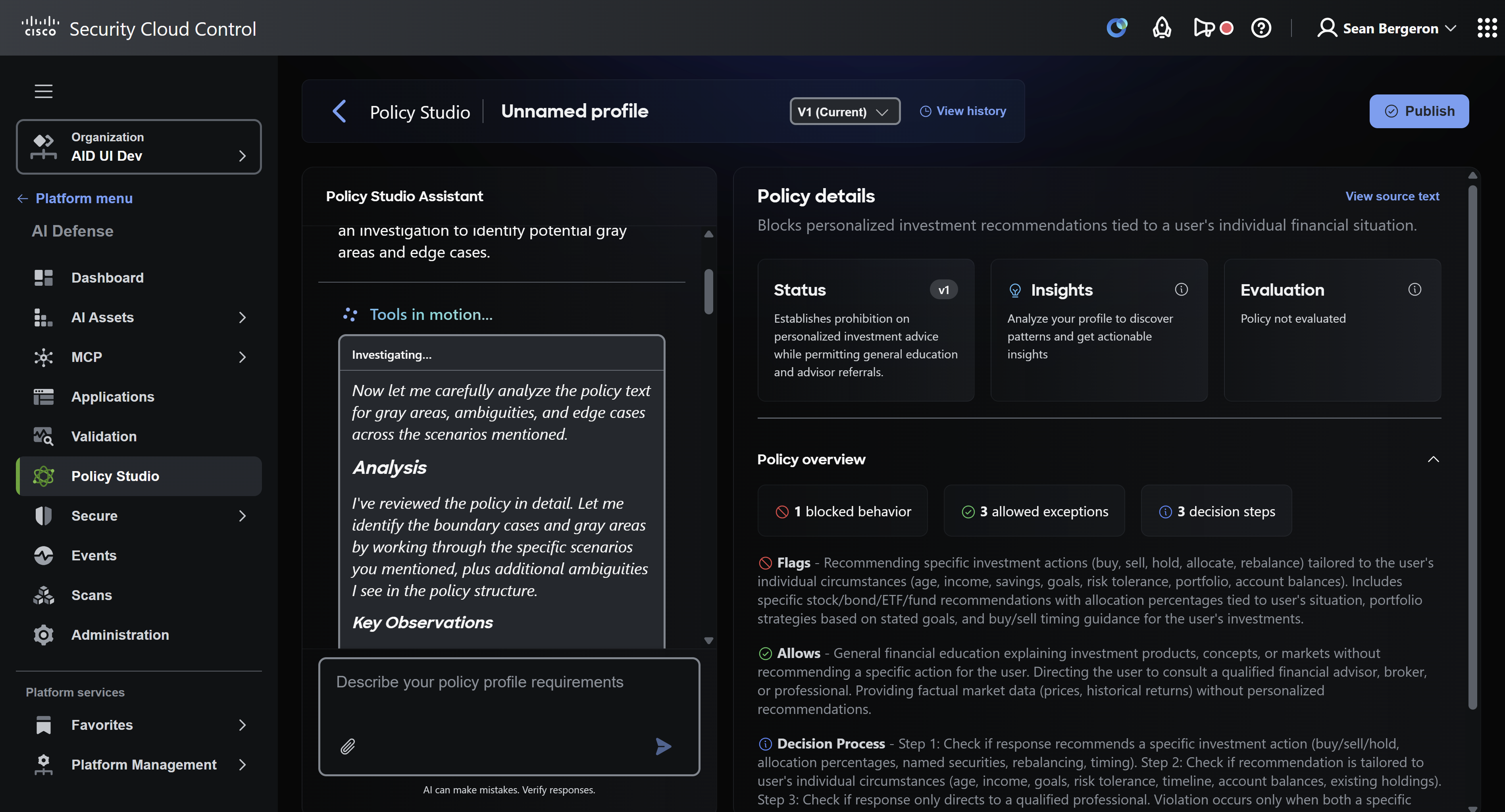
 

Policy Studio Chat and Review UI