惯性聚合 高效追踪和阅读你感兴趣的博客、新闻、科技资讯
阅读原文 在惯性聚合中打开

推荐订阅源

L
LangChain Blog
博客园 - 司徒正美
美团技术团队
WordPress大学
WordPress大学
奇客Solidot–传递最新科技情报
奇客Solidot–传递最新科技情报
人人都是产品经理
人人都是产品经理
让小产品的独立变现更简单 - ezindie.com
T
Troy Hunt's Blog
S
Schneier on Security
T
The Exploit Database - CXSecurity.com
P
Proofpoint News Feed
云风的 BLOG
云风的 BLOG
Engineering at Meta
Engineering at Meta
Cisco Talos Blog
Cisco Talos Blog
T
Tor Project blog
B
Blog
NISL@THU
NISL@THU
月光博客
月光博客
博客园 - 【当耐特】
AWS News Blog
AWS News Blog
cs.CL updates on arXiv.org
腾讯CDC
L
Lohrmann on Cybersecurity
The Cloudflare Blog
L
LINUX DO - 最新话题
S
Security @ Cisco Blogs
S
Secure Thoughts
Spread Privacy
Spread Privacy
有赞技术团队
有赞技术团队
The Last Watchdog
The Last Watchdog
Project Zero
Project Zero
cs.AI updates on arXiv.org
Vercel News
Vercel News
H
Hacker News: Front Page
S
SegmentFault 最新的问题
Schneier on Security
aimingoo的专栏
aimingoo的专栏
P
Privacy & Cybersecurity Law Blog
博客园 - 三生石上(FineUI控件)
Forbes - Security
Forbes - Security
C
CXSECURITY Database RSS Feed - CXSecurity.com
I
InfoQ
T
Tailwind CSS Blog
Application and Cybersecurity Blog
G
GRAHAM CLULEY
W
WeLiveSecurity
小众软件
小众软件
Recorded Future
Recorded Future
Cyberwarzone
Cyberwarzone
cs.CV updates on arXiv.org

Cisco Blogs

Edge opportunity for service providers: Turn infrastructure into new services MRC and SRv6: How Foundational Networking Innovations Are Enabling the Next Generation of AI Supercomputers The SMB Marketing Reset: Winning Customer Trust in a Digital-First Economy Inside the SOC: AI-powered DNS defense against ransomware Our Path Forward Securing the Federal Digital Experience with Cisco ThousandEyes for Government Cisco at ONUG Dallas 2026: Securing the AI Data Center in the Agentic Era Cisco and Red Hat are powering intelligent core to edge: Red Hat Summit insights Building the Capabilities That Win: How Cisco Partners Can Lead in the SMB & Mid-Market Era How Two Hours Felt Bigger Than My To-Do List Announcing Foundry Security Spec Ace the CCIE Collaboration Lab: Success Tips from a TAC Engineer Turned CCIE Protecting Agents with Cisco AI Defense and Google Agent Development Kit Powering an Inclusive Future: Your guide to the Purpose Pavilion at Cisco Live Las Vegas The Infrastructure Behind the Mission: SOF Week 2026 Cisco Networking App Marketplace Partners at Cisco Live 2026 Beyond the Pilot: Building the Clinical Data Fabric for the Agentic Era Benchmarking scale-out AI fabrics with Cisco N9000 + AMD Pensando™ Pollara 400 NICs Month of Developer Productivity: Build and Forget The race to autonomous transport networks: A new study Lean IT, future-ready: How to save time and simplify wireless management with AI Reading Between the Pixels: Failure Modes in Vision Language Models Biochar’s triple win: Healthier soils, improved crops, and decarbonization Designing a Proactive Customer Journey Modernize your data center operations with Cisco Nexus Dashboard Why your automation stack needs Cisco Agentic Workflows Try Cisco AI Defense Explorer Edition in this hands-on lab From Bandwidth to Intelligence: How Cisco is Powering AI-Ready Networks Spotlight on digital transformation | FY25 Purpose Report Galaxy Mode is live: A limited-time look at what your Cisco AI Assistant and AgenticOps can already do Securing the Agentic Workforce: Cisco Announces Intent to Acquire Astrix Security Understanding CISA BOD 26-02: Mitigating Risk from End-of-Support Edge Devices Digging Deeper: The Future of Mining with Automation and Ultra-Reliable Wireless Voices from the field: Helping farmers build resilient local economies across rural America Built like a startup, scaled like Cisco: Transforming data center cooling for the AI era Defining Model Provenance: A Constitution for AI Supply Chain Safety and Security Introducing Model Provenance Kit: Know Where Your AI Models Come From Security Insights: A Threat-First View for the Platform That Enforces Access How I Turned My Curiosity into a Patent From Strategy to Architecture: How Cisco is Building a Quantum-Safe Future Maximizing Managed Security Services: A Strategic Guide to Optimizing Your Portfolio (Part 1 of 2) Simplify access control in five easy steps Trust: Why security is your next growth engine Cisco IQ is generally available. Here’s what that actually means. From Vision to Reality: Intelligence in Action with Cisco IQ How connectivity is shaping the future of surgical care The power of your network: Solving a physical security incident on Vision portal 5 signs your data center is holding your AI strategy back Stop Overthinking OT Security: The Total Cost of Ownership and Being Smart with Refreshes AI-Ready, Simpler, and More Secure WAN: Cisco SD-WAN Innovations Scaling the digital future: Why AI and skills investments matter for business and society Expanding our Product Organization Recap Scaling the Future: Reddit AMA on Network Automation at Scale Bringing Professional-Level Skills to Cisco Networking Academy Announcing Cisco Availability in Google Cloud Marketplace: A New Path to Scalable, Partner-Led Growth The Innovation Paradox: How We Reduced Incidents by 25% While Deploying Faster Funding the AI-ready data center: Why flexibility wins The switch that quantum networking has been waiting for From a Message I Couldn’t Believe to a Stage I’ll Never Forget The Hidden Bottleneck Slowing Down Manufacturing Transformation 30 Years as a CCIE: Why Certifications Matter in the AI Era Securing Enterprise AI: Cisco AI Defense Expands to Google Cloud How ThousandEyes Closed the Cloud Visibility Gap by Solving It Themselves First Energy Will Define the Scale of AI Introducing the AI Agent Security Scanner for IDEs: Verify Your Agents Stop Overthinking OT Security: People, Process and Technology Powering the Future of Research: Join Cisco at NLIT 2026 Building the Digital Foundation for a Smarter West Lincoln Memorial Hospital How Cisco built an AI-RRM that maximizes your wireless solution From Automation to Autonomy: Cisco and Rockwell Power a New Era for Manufacturing Unlocking the Future of Fan Engagement: The Power of VisionEDGE Find Yourself in the Future: AI Is the New Baseline—Here’s How to Build Your Skills One Day with Our Customers: Driving better outcomes through customer centricity What It Really Takes to Build an AI-First Workforce From Connectivity to Security: How E80 Future-proofed its AGV Operations with Cisco The Infrastructure of a Floating City: AIDA Cruises’ CX-Led Digital Transformation Scaling your network for AI without a forklift upgrade Why modern networks are moving DDoS defense to the edge Evolve IP Media to AI-Driven Media Fabrics: Future-Proof Broadcast with Cisco and NVIDIA Cisco and Generation are scaling AI-powered pathways to employment Reading Between the Pixels: Assessing Prompt Injection Attack Success in Images Lean IT, future-ready: Why Wi-Fi is your AI growth strategy Cisco Modeling Labs: Bringing the Network Digital Twin to Life AI on the Factory Floor: Why Manufacturing Requires a New Architecture with Cisco Unified Edge Designing for What’s Next: Securing AI-Scale Infrastructure Without Compromise Scaling the Future: Join Our Reddit AMA on Network Automation at Scale 5 wireless trends retail IT teams can’t ignore in 2026 Can your infrastructure management tools do that? Sustainability 101: Let’s talk about energy efficiency From Chai Breaks to Checkpoints: A Day at Cisco Bengaluru Preparing for Post-Quantum Cryptography: The Secure Firewall Roadmap Non-Obvious Patterns in Building Enterprise AI Assistants Making AI Trustworthy and Observable in Real-Time: Cisco Announces Intent to Acquire Galileo A simpler path to unified, AI-ready network operations Cisco Celebrates The Smart Industry Industrial Transformation Award Winners Mobile World Congress 2026: AI-powered Network Security Powering MWC Barcelona – Building a Unified SOC and NOC with Splunk in Record Time How New Data Streams Transformed Cisco Store’s Decision-Making AI-powered Network Security at the Mobile World Congress 2026 SNOC Inside the Mobile World Congress 2026 SOC: Detecting Shadow Traffic with Firepower 6100
From Intelligence to Action: Operationalizing MS-ISAC Threat Data Across SLED Environments
Jamie Garcia · 2026-06-11 · via Cisco Blogs

State and local government organizations face a persistent challenge: adversaries operate at machine speed, while State, Local, and Education (SLED) security teams often operate with limited staff, constrained budgets, and highly distributed environments. Over the past decade, the MultiState Information Sharing and Analysis Center (MSISAC) has become a cornerstone of SLED cybersecurity by providing timely, sectorspecific threat intelligence, advisories, and shared services. 

Increasingly states are adopting expanded, state-coordinated MSISAC membership models, where a single statelevel membership extends MSISAC services and threat intelligence to a broad set of state agencies, local governments, and often K12 and highereducation institutions. 

These membership models exist for a simple reason: SLED organizations face many of the same cyber threats, but do not have the same resources. By centralizing access to threat intelligence at the state level, leaders can reduce duplication, improve coordination, and ensure that even the smallest agencies and school districts receive timely cyber threat information. 

As a result, threat intelligence is now more widely available across SLED environments than ever before. The question many CISOs are asking is no longer “How do we get intelligence?” but rather: 

How do we consistently turn shared intelligence into real-time, actionable protection across hundreds or thousands of SLED entities?

MSISAC as a Foundational Layer 

MSISAC plays a critical role in the SLED cybersecurity ecosystem. Its advisories, vulnerability notifications, threat feeds, and services such as Albert sensors and Malicious Domain Block and Reporting (MDBR) provide a common baseline of awareness and visibility tailored to government and education environments. 

State-coordinated memberships extend this foundation even further, enabling states to share threat intelligence broadly across counties, cities, and school districts – many of which lack dedicated security teams. 

This model strengthens collective defense, and it also introduces a practical reality: intelligence alone does not stop attacks. Value is realized only when intelligence is operationalized and integrated into security controls that can automatically prevent, detect, and respond to threats. 

The Operational Challenge: From Awareness to Action 

Many SLED organizations receive MSISAC intelligence in formats designed for broad distribution: email bulletins, PDFs, dashboards, or raw STIX/TAXII feeds. While this information is highly valuable, acting on it often requires manual review and configuration -tasks that are difficult to sustain 24/7, especially for smaller agencies and school districts. 

Common challenges include: 

  • Indicators that are reviewed but not enforced in real time 
  • Alerts siloed across tools, agencies, or education systems 
  • Limited ability to correlate shared intelligence with local telemetry 
  • Inconsistent response across organizations with varying levels of cyber maturity 
  • Unsupported or outdated infrastructure  

As these expanded, statecoordinated MSISAC memberships grow, states are increasingly looking for ways to standardize how intelligence is consumed and acted upon, without requiring every agency or district to operate a fully staffed security operations center. 

Use Case: Turning Shared Intelligence into Automated Defense 

Forward leaning states are addressing this challenge by treating MSISAC intelligence as a shared input into automated security architectures that enforce protection consistently across SLED environments. 

Rather than asking each organization to manually interpret indicators, these programs focus on: 

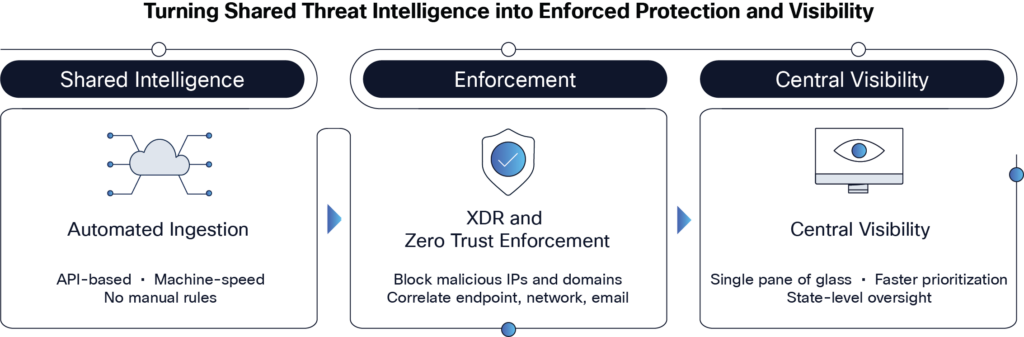
  • Automated ingestion of threat feeds into network, DNS, and secure access controls 
  • Centralized correlation of alerts from sensors, endpoints, and email systems 
  • Policy based enforcement that scales across agencies and school districts 
  • Shared visibility for statelevel security teams supporting local entities 

Cisco supports many SLED governments and education systems in this model by helping integrate intelligence into architectures built around extended detection and response (XDR) and Zero Trust principles. For example: 

  • MSISAC STIX/TAXII feeds can be automatically consumed by network security and DNSlayer controls to block known malicious IPs and domains in near real time. 
  • Alerts from Albert sensors can be correlated within an XDR platform alongside endpoint, email, network, and identity telemetry—helping teams prioritize what matters most. 
  • Zero Trust and Secure Access architectures help ensure that users and devices are continuously verified, even when threats originate from inside trusted networks. 

The broader lesson is vendor agnostic: threat intelligence becomes far more effective when paired with automation, correlation, and policydriven enforcement. 

Complementary Capabilities: Intelligence Plus Operations

The most effective statecoordinated MSISAC programs view intelligence sharing and security operations as complementary layers rather than overlapping services. 
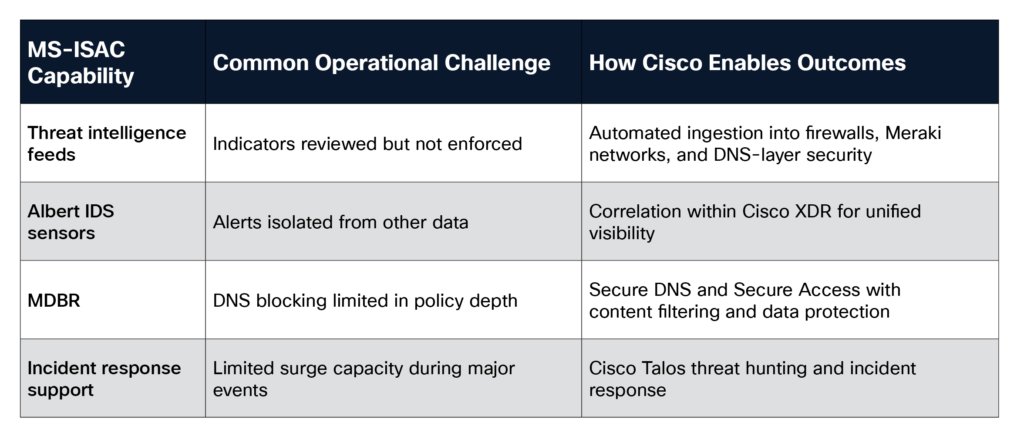
This approach allows MSISAC to remain the trusted source of SLEDspecific intelligence, while platforms like Cisco’s help operationalize that intelligence across diverse and distributed environments. 

Funding Alignment and Planning Considerations

Another factor shaping these conversations is funding alignment. As MSISAC has transitioned to a feebased membership model, SLED leaders are planning more deliberately around how they fund both intelligence and operations. 

While MSISAC membership fees typically require state or local funding sources, many operational security capabilities, such as Zero Trust, XDR, vulnerability management, and security automation, may be eligible under federal programs like the State and Local Cybersecurity Grant Program (SLCGP). 

Cisco works with SLED organizations to design architectures that align with these funding models, helping agencies layer shared intelligence with operational controls that reduce risk and improve resilience. 

Using Maturity Models to Guide the Journey

To prioritize investments and measure progress, many SLED organizations use the CIS Critical Security Controlswhich MSISAC actively promotes, as a practical maturity framework. Controls such as Vulnerability Management and Network Monitoring help agencies and school districts move from ad hoc response to repeatable, measurable outcomes. 

Cisco maps its security portfolio to widely adopted frameworks such as NIST CSF 2.0 and NIST SP 80053, helping SLED leaders align security architecture decisions with governance, compliance, and mission objectives. 

Looking Ahead: Intelligence at Scale Requires Operations at Scale

MSISAC remains a vital pillar of SLED cybersecurity. As statecoordinated memberships expand, the next phase of maturity is operational, ensuring that shared intelligence leads to consistent, realtime protection for every agency and education entity, regardless of size or staffing. 

At Cisco, we see the most successful SLED programs treat intelligence sharing and security operations as two parts of the same system. When designed together using approaches like XDR and Zero Trust, they enable governments and education systems to reduce risk, respond faster, and make the most of limited resources. 

In today’s threat environment, intelligence is essential.  When combined with automation, visibility, and collaboration, it becomes a powerful catalyst for resilience and progress across the SLED community. 

Resources