







These include:
Here are five additional, high-impact ways to reduce congestion, improve mobility, and enhance quality of life.
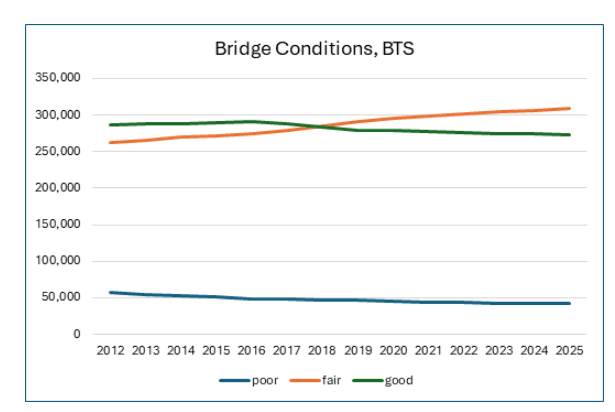
1. Prioritize Maintenance and Preservation of Existing Infrastructure – A well-maintained transportation network is the foundation of efficient mobility. Roads, rails, and highways naturally degrade over time. According to the Bureau of Transportation Statistics, the number of bridges in poor condition has dropped by 27%, while the number of bridges in fair condition has grown by 18%. Bridges in good condition have dropped by 5%. Avoiding bridge closures and weight restrictions allows traffic and commerce to continue flowing across the transportation network.
Additionally, proper maintenance saves money in the long run to be spent on other congestion-relief projects to keep traffic moving.
See INRIX data on recent construction work on the I-5 Ship Canal Bridge for more information on how closing or restricting bridge access impacts traffic in Seattle.
2. Maximizing Throughput on Existing Infrastructure – Maximizing traffic throughput given a fixed supply of infrastructure is cost-effective and improves roadway performance. In Seattle, the I-5 Express Lanes switch directions depending on the time of day to accommodate peak demand flows. In New York, the Lincoln Tunnel Express Bus Lane (XBL) runs contraflow during the morning peak period. This simple switch carries more than 70,000 bus riders a day while only operating during the morning commute, far surpassing many light rail and commuter rail lines without the need for rails. For example, Los Angeles’ Metro A-Line stretches nearly 60 miles and currently carries 69,000 riders per weekday.
The creative use of existing highway capacity for bus rapid transit can pay dividends to bus riders and travelers heading into the city, easing the commute for everyone.
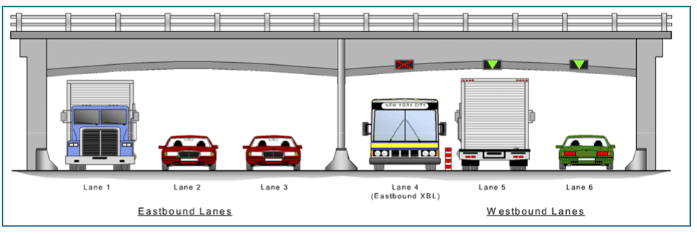
Cross section of XBL on Route 495
3. Align Transit with Real-World Travel Patterns – Vanpools are often the most direct origin to destination (O&D) public transit option for suburban residents to commute to employment hubs. These services utilize origin and destination matchmaking to provide a direct trip with passengers willing to pay nearly the full cost of the trip.
For example, Washington state has the largest public vanpool fleet in the country. Its vanpool program links riders together who share a common destination, typically downtown. This has made Seattle well-suited for suburban to urban and point-to-point transit, namely vanpools. But since commuting habits to downtowns have changed, services need to be aligned with the latest data.
Transit operators can use INRIX O&D data and matrices to better align bus and transit services to capture a larger portion of the commuter market. While public transit is often a trade-off between commuter and public services, analyzing demand can maximize passenger utilization per platform hour of service.
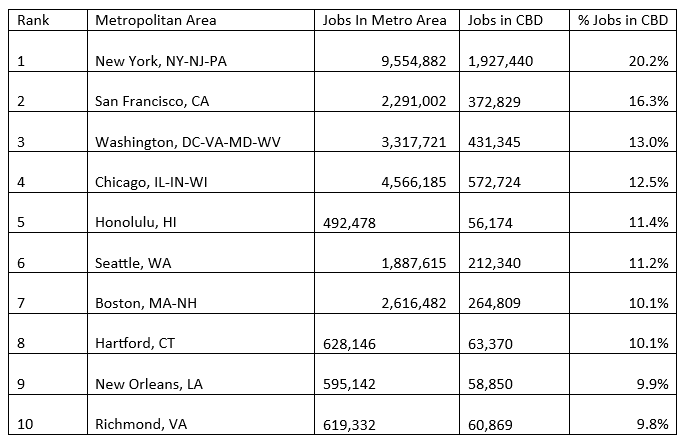
This is especially useful when central business districts hold a large percentage of the region’s jobs, like the Metro regions outlined below:
4. Enable Smarter Freight Movement in Urban Cores –
Freight and delivery vehicles often contribute to congestion due to double-parking, short and frequent stops, and occupying travel lanes due to inadequate loading zone capacity, increasing congestion in dense urban areas with limited road networks.
That’s why INRIX partnered with the Portland Bureau of Transportation on their zero-emission delivery zone. By providing real-time parking availability and digital curb infrastructure, city officials can help move freight within the zone with minimal impact on traffic congestion within the zone, leading to fewer carbon emissions and cleaner air quality.
Portland officials hailed the pilot program as a success, citing seven indicators as proof, including more companies contracting with freight companies and more electric vehicles being used.
5. Deliver Real-Time Alerts to Drivers and Freight Operators – INRIX partners directly with commercial truck safety and efficiency companies like Drivewyze to reduce collisions and improve safety on roadways. These alerts infrom truck drivers of dangerous or congested conditions ahead, allowing drivers to reduce hard braking and collisions.
Recent studies on the efficacy of in-cab alerts to dangerous conditions have been conducted by the Ohio Department of Transportation (ODOT) and Cleveland State University, ODOT and Purdue, and the Indiana Department of Transportation and Purdue.
Their conclusions found that secondary crashes involving a commercial motor vehicle decreased by 29% in Ohio with in-cab alerts, with “reduced delays by an average of 20.5 hours per mile in the after period (2022-2023) compared to the before period (2018-2019). (Cleveland State Study)” They further calculated that, conservatively, two fatal crashes and four severe crashes were prevented as a result of in-cab results.
In addition, 84% of trucks avoided hard braking as a result of in-cab alerts, allowing smoother speed transitions and fewer rear-end collisions.
Moving Forward: Smarter, More Connected Mobility
Reducing congestion isn’t about a single solution; it’s about combining infrastructure, data, and innovation to create a more responsive transportation ecosystem.
From preserving what we already have to leveraging real-time intelligence, these strategies demonstrate that meaningful improvements are within reach; without requiring massive new construction.
As cities continue to evolve, embracing these forward-thinking approaches will be key to building safer, more efficient, and more sustainable mobility systems for everyone.
Watch the “Traffic Slowdown Alerts” webinar for more information on in-cab alerts and their effectiveness.
此内容由惯性聚合(RSS阅读器)自动聚合整理,仅供阅读参考。 原文来自 — 版权归原作者所有。