

惯性聚合 高效追踪和阅读你感兴趣的博客、新闻、科技资讯
阅读原文 在惯性聚合中打开

推荐订阅源

Schneier on Security
N
Netflix TechBlog - Medium
IT之家
IT之家
MongoDB | Blog
MongoDB | Blog
博客园_首页
S
SegmentFault 最新的问题
H
Help Net Security
P
Proofpoint News Feed
云风的 BLOG
云风的 BLOG
T
The Blog of Author Tim Ferriss
量子位
GbyAI
GbyAI
M
MIT News - Artificial intelligence
Recorded Future
Recorded Future
P
Privacy & Cybersecurity Law Blog
B
Blog
月光博客
月光博客
博客园 - 聂微东
Vercel News
Vercel News
罗磊的独立博客
腾讯CDC
Threat Intelligence Blog | Flashpoint
A
Arctic Wolf
D
Darknet – Hacking Tools, Hacker News & Cyber Security
Stack Overflow Blog
Stack Overflow Blog
T
Threat Research - Cisco Blogs
Blog — PlanetScale
Blog — PlanetScale
L
Lohrmann on Cybersecurity
I
Intezer
小众软件
小众软件
T
The Exploit Database - CXSecurity.com
Jina AI
Jina AI
C
Check Point Blog
AWS News Blog
AWS News Blog
C
Cisco Blogs
Martin Fowler
Martin Fowler
The Last Watchdog
The Last Watchdog
www.infosecurity-magazine.com
宝玉的分享
宝玉的分享
S
Security Affairs
大猫的无限游戏
大猫的无限游戏
N
News and Events Feed by Topic
雷峰网
雷峰网
freeCodeCamp Programming Tutorials: Python, JavaScript, Git & More
H
Hacker News: Front Page
cs.AI updates on arXiv.org
F
Full Disclosure
P
Proofpoint News Feed
Cyber Security Advisories - MS-ISAC
Microsoft Security Blog

Security & Identity

Now in preview: Find and fix software vulnerabilities with CodeMender | Google Cloud Blog Cloud CISO Perspectives: How AI leverages deep context as the defender’s advantage | Google Cloud Blog Introducing k8s-aibom on GKE for automated AI bills of materials | Google Cloud Blog Contributing to U.K. financial sector resilience as a critical third party | Google Cloud Blog Meet the 33 cybersecurity startups joining the Gemini Startup Forum | Google Cloud Blog Drive proactive security, prioritize risks with Google Threat Intelligence and Wiz ASM | Google Cloud Blog Shift into high gear with agents: Securing the software-defined vehicle | Google Cloud Blog New IDC study: How Mandiant transforms security into a competitive advantage | Google Cloud Blog Google Cloud confirmed to offer a safer choice for EU public sector organizations with Dutch DPIA approval | Google Cloud Blog Securing agentic AI: What's new in VPC Service Controls | Google Cloud Blog Verifiable trust in the AI era: What’s new in Confidential Computing | Google Cloud Blog Choice, compliance, and collaboration: Europe’s path to open digital sovereignty | Google Cloud Blog Driving the UK’s next chapter: From AI potential to agentic reality | Google Cloud Blog Google named a Leader in IDC MarketScape SIEM 2026 Vendor Assessment | Google Cloud Blog Cloud CISO Perspectives: The 4 lessons that guided AI Threat Defense | Google Cloud Blog Powering the next era of Confidential AI Detecting and containing AI-powered threats with Google Security Operations agents Cloud CISO Perspectives: How to build an AI-ready security program for the public sector Introducing Google AI Threat Defense to help you outpace the adversary Cloud CISO Perspectives: How Google + Wiz changes multicloud strategy for CISOs Why cloud infrastructure is the foundation for digital health in 2026 Beyond source code: The files AI coding agents trust — and attackers exploit What's new in IAM: Security, governance, and runtime defense Google named a Leader in the 2026 Gartner Magic Quadrant for Cyberthreat Intelligence Technologies Introducing Agent Gateway ISV ecosystem for security and governance Cloud CISO Perspectives: At Next ‘26, why we’re multicloud and multi-AI Next ‘26: Redefining security for the AI era with Google Cloud and Wiz | Google Cloud Blog Introducing Google Cloud Fraud Defense, the next evolution of reCAPTCHA | Google Cloud Blog Next ‘26: Announcing new partner-supported workflows for Google Security Operations | Google Cloud Blog Cloud CISO Perspectives: How CISOs can pursue technical and cultural resilience (Q&A) | Google Cloud Blog Essential AI and cloud security now on by default Securing AI inference on GKE with Model Armor A Leader in Forrester Wave Sovereign Cloud Platform 2026 See beyond the IP and secure URLs with Google Cloud NGFW Cloud CISO Perspectives: RSAC: AI, security, and the workforce of the future How to build AI agents with Google-managed MCP servers Bringing dark web intelligence into the AI era RSAC ’26: Supercharging agentic AI defense with frontline threat intelligence IAP integration with Cloud Run Why context is the missing link in AI data security Welcoming Wiz to Google Cloud: Redefining security for the AI era Cloud CISO Perspectives: New Threat Horizons report highlights current cloud threats Google named a Leader in IDC MarketScape: U.S. SLG Professional Security Services Introducing the Google Cloud recommended security checklist Cloud CISO Perspectives: How Google approaches critical security topics, from fundamentals to AI Sovereignty and European competitiveness: A partnership-led approach to AI growth Cloud CISO Perspectives: New AI threats report: Distillation, experimentation, and integration Delivering a secure, open, and sovereign digital world Introducing Single-tenant Cloud HSM for more data encryption control Cloud CISO Perspectives: 5 top CISO priorities in 2026
Cloud CISO Perspectives: How Google Cloud Security uses AI internally | Google Cloud Blog
Chris Betz · 2026-06-30 · via Security & Identity

Welcome to the second Cloud CISO Perspectives for June 2026. Today, we’re discussing how we use AI to chart a path to autonomous software development lifecycle security.

As with all Cloud CISO Perspectives, the contents of this newsletter are posted to the Google Cloud blog. If you’re reading this on the website and you’d like to receive the email version, you can subscribe here.

Cloud CISO Perspectives: Our path to autonomous SDLC security

By Chris Betz, CISO, and Ruchi Shah, senior director, Security Engineering, Google Cloud

https://storage.googleapis.com/gweb-cloudblog-publish/images/Chris_Betz.max-2200x2200.png

AI has upended the economics of exploiting vulnerabilities, effectively erasing the traditional patching window. To survive this new reality, security requires an autonomous defense.

To counter machine-speed, AI-driven threats, we’ve worked hard to transition Google Cloud’s security posture to an autonomous, proactive model. By embedding specialized AI agents directly into our software development lifecycle (SDLC), we’ve created automated guardrails that protect code at a scale and speed unreachable by human teams — and we’re taking steps to make those same guardrails widely available.

https://storage.googleapis.com/gweb-cloudblog-publish/images/Ruchi_Shah.max-2200x2200.jpg

How we designed agentic, secure SDLC architecture

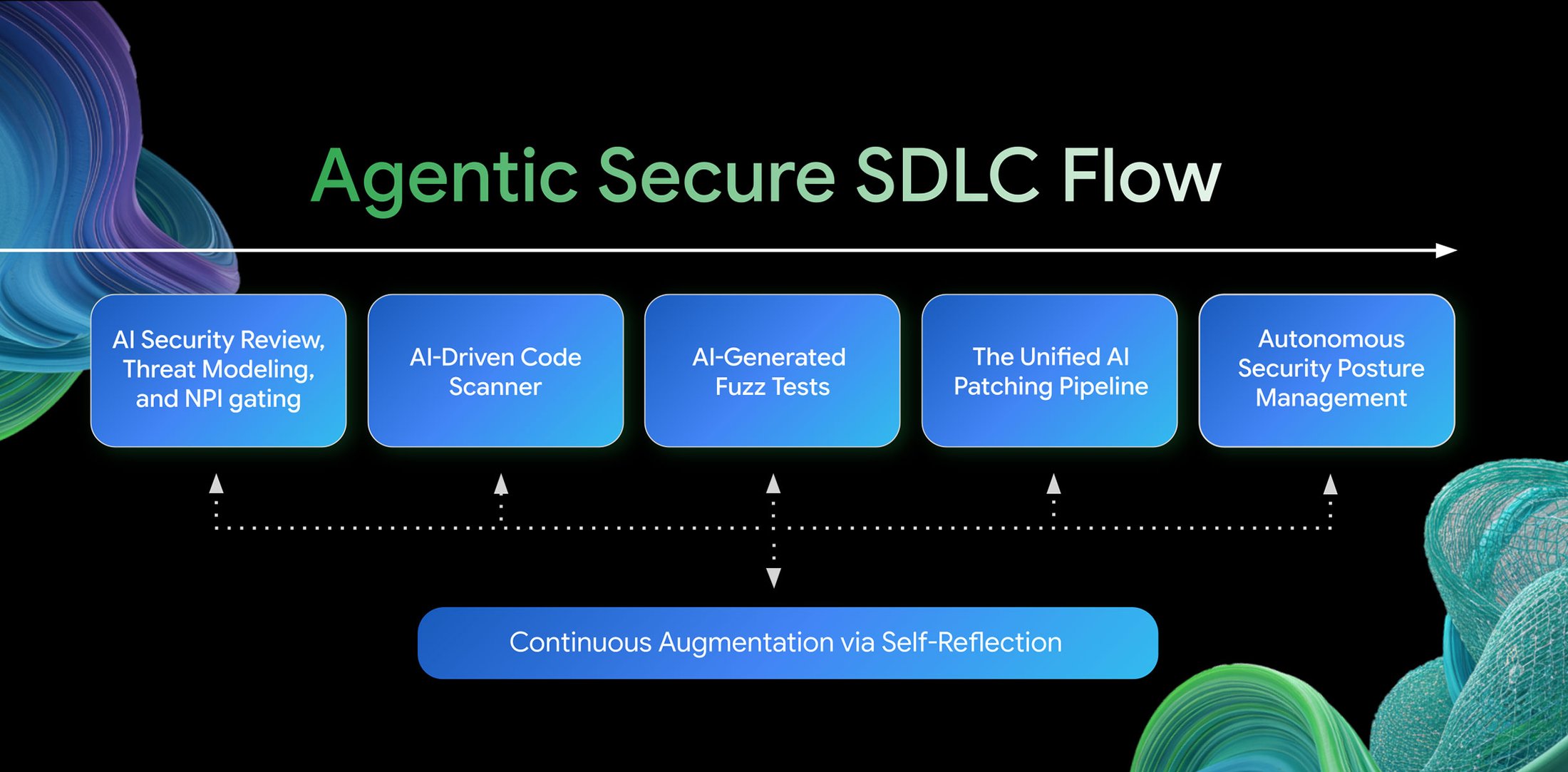
Google Cloud deploys modular, interconnected AI agents across every stage of the software lifecycle to continuously harden products from code ingestion to production.

1. Design, review, and gate

Historically, launch intakes and threat modeling were manual bottlenecks. Today, Google Cloud engineering teams route product launches through an agent-based security review pipeline.

Agents cross-reference designs against a continuous control catalog of more than 200 rigorous security requirements. High-risk indicators are automatically triaged and flagged for human engineering intervention, while a dynamic product dossier updates in real-time to replace static threat models.
https://storage.googleapis.com/gweb-cloudblog-publish/images/AgenticSecureSDLC_Flow_HeroBanner_R2.max-2200x2200.jpg

Google Cloud has embedded agentic capabilities across the entire SDLC flow to continuously harden products end-to-end.

2. Centralized AI code scanning and the Mantis framework

Naive, decentralized AI code scanning suffers from sloppiness, frequently hallucinating bugs and yielding true-positive rates under 7%. To solve this, we built Mantis, our core multi-agent orchestration framework designed specifically for scalable, context-aware repository analysis. 

The core skills at the heart of Mantis are now open source to demonstrate the fundamental concept. We have a more full-fledged version running internally and securing our customers.

Mantis eliminates brute-force code ingestion by constructing a hierarchical security summary tree. By condensing individual files into directory and root-level summaries, Mantis reduces token overhead by over 85% while preserving critical structural context across massive repositories.

The architecture relies on a highly-coordinated workflow across new agents and existing technologies:

  • Strategist agent: Evaluates the high-level code structure, threat models, and dependency graphs to isolate risky architectural patterns, establishing a prioritized global plan of targeted investigation tasks.

  • Research agents: Acting as specialized domain investigators, these agents use internal code searches to drill into raw source files, examining data tracking, control flows, and sanitization logic.

  • Deduplicator, reviewer, and critic agents: Sanitize findings to filter out noise and eliminate false positives.

  • Reproduction sandbox: Automatically runs AI-generated proof-of-concept exploits in an isolated, emulated environment to verify real-world exploitability before alerting developers.

3. Self-healing fuzz testing

While code scanning provides breadth, dynamic fuzz testing uncovers deep runtime vulnerabilities. However, writing and maintaining fuzz harnesses are often a significant engineering bottleneck.

Stateless AI systems repeatedly fall into the same logical traps, such as attempting to fix bugs inefficiently and hallucinating about non-existent code. Our framework solves this by introducing a post-hoc self-reflection loop.

Our autonomous, multi-agent engine eliminates manual intervention:

  • Context and Drafting agents synthesize product logic and existing unit tests to author initial fuzzing harnesses.

  • Building and Testing agents execute the code and feed real-time compiler and linker errors into a Hallucination Cleaner agent, which acts as an automated mechanic to repair broken dependencies and build configurations.

  • Quality Analyzer agents monitor runtime execution, actively adjusting inputs to bypass code blockers and penetrate deeper into complex, stateful APIs.

4. The unified AI patching pipeline

Finding thousands of vulnerabilities at scale can create a dangerous remediation backlog without proper planning. To close the exposure window, our discovery tools route findings directly into an autonomous remediation pipeline:

  • The Reproduce agent replicates the crash in the sandbox.

  • The Bug Context agent maps the failure execution path.

  • The Patch agent generates a targeted code fix.

  • The Evaluation agent runs a rigorous regression loop (that re-compiles code and executes tests) to ensure the patch is safe. Only fully-validated fixes are submitted to a human reviewer.

5. Autonomous and secure posture management

Post-launch, we maintain security integrity with an autonomous security posture management (ASPM) system. By converting our security standard catalog into programmable skills files, the ASPM system continuously checks production systems for configuration drift, automatically triggering agentic remediation when a violation occurs.

Continuous augmentation via self-reflection

Stateless AI systems repeatedly fall into the same logical traps, such as attempting to fix bugs inefficiently and hallucinating about non-existent code. Our framework solves this by introducing a post-hoc self-reflection loop. After a workflow concludes, a dedicated reflection agent analyzes execution logs, tool histories, and human feedback.

Successful trajectories and design patterns are permanented into a global knowledge store. When future agents spin up, this intelligence is injected directly into their context window, creating a compounding-interest effect on our security engineering. This approach has helped us to improve both the vulnerability fix success rate and efficiency. 

Moving toward immune software

Google Cloud's internal journey demonstrates that protecting software at AI-scale requires a fundamental paradigm shift from human-dependent checklists to proactive multi-agent orchestration. By pairing open-source tooling like Mantis with autonomous, self-healing execution loops, we are pioneering a future of "immune" software development — where applications continuously discover, validate, and patch their own weaknesses in real-time.

You can learn more about how we use Mantis and other tools to find and fix vulnerabilities at machine-speed here.

In case you missed it

Here are the latest updates, products, services, and resources from our security teams so far this month:

  • Verifiable trust in the AI era: What’s new in Confidential Computing: To help further strengthen verifiable privacy in cloud AI deployments, here’s our latest Confidential Computing innovations. Read more.
  • Choice, compliance, and collaboration: Europe’s path to open digital sovereignty: Our Sovereign Cloud solutions are designed to meet Europe's tiered compliance requirements at every level. Read more.
  • How AI Is rewriting the SecOps playbook: With adversaries operating at machine speed, defenders must prioritize speed, automation, and continuous decision-making. Read more.
  • Google named a Leader in IDC MarketScape SIEM 2026 Vendor Assessment: We are proud to announce that Google has been named a Leader in the 2026 IDC MarketScape for worldwide SIEM platforms. Read more.
  • Announcing the Wiz Runtime Sensor for Windows: Wiz pairs real-time threat detection with a memory-safe architecture that scales efficiently to protect your essential cloud infrastructure. Read more.
  • New VPC Service Controls updates can help secure agents: Designed for agentic workloads, new capabilities in VPC Service Controls can help establish a network-level, destination-based perimeter. Read more.
  • Bug hunting on Gemini Spark: Gemini Spark brings a persistent agent to the Gemini App. Learn how to approach security testing for this new paradigm and focus on high-impact bugs. Read more.

Please visit the Google Cloud blog for more security stories published this month.

Threat Intelligence news

  • China-nexus threat actor targets medical community for cross-sector research: Google Threat Intelligence Group (GTIG) has identified a sophisticated campaign attributed to UNC6508, a People's Republic of China (PRC)-nexus threat actor, targeting the North American academic, medical, and military research community, that went undetected for more than a year. Read more.
  • ShinyHunters targets education sector with Oracle PeopleSoft exploit: Mandiant and GTIG have identified an active compromise and extortion campaign attributed to UNC6240 (ShinyHunters) targeting Oracle PeopleSoft application infrastructure. Read more.
  • Zero-day exploitation in Cisco Catalyst SD-WAN Manager: Mandiant has identified a threat actor targeting a vulnerability in Cisco Catalyst SD-WAN to escalate privileges from a compromised administrative account to root-level access. Read more.

Please visit the Google Cloud blog for more threat intelligence stories published this month.

Now hear this: Podcasts from Google Cloud

  • Cloud Security Podcast: How Google Cloud uses LLMs to defend billions of users: Google Cloud CISO Chris Betz discusses AI Threat Defense, and emphasizes shifting security practices earlier in the development lifecycle through human-AI collaboration. Listen here.
  • Cloud Security Podcast: To couple or decouple SIEM: Alex Hurtado, director, Detection Engineering, Scanner, and Christopher Witter, DNR lead, Dropbox, debate the merits of centralized versus decentralized SIEM architectures. Listen here.

To have our Cloud CISO Perspectives post delivered twice a month to your inbox, sign up for our newsletter. We’ll be back in a few weeks with more security-related updates from Google Cloud.

Posted in