





At Google, we see firsthand how the speed, scale, and sophistication of cyber threats continue to challenge traditional enterprise defenses. Today’s defenders can’t rely on reactive triage or fragmented data feeds; you require high-fidelity intelligence, deep underground visibility, and actionable context to anticipate adversary moves before an attack unfolds.

We are proud to announce that Forrester has named Google a Leader in The Forrester Wave™: External Threat Intelligence Service Providers, Q3 2026. In this evaluation, Google received the highest possible score of 5.0 across nine distinct criteria spanning both Current Offering and Strategy.
Organizations trust our decades of threat intelligence expertise to help them understand today’s attacks and to protect against tomorrow’s threats. Google Threat Intelligence operationalizes protection with specialized threat intelligence agents that autonomously conduct multi-step investigations and malware analysis at machine speed. Underpinning these capabilities is the unified visibility provided by Mandiant’s frontline incident response, VirusTotal’s crowdsourced visibility, and Google-scale infrastructure with industry-leading deep and dark web monitoring, illuminating adversary operations where they begin.
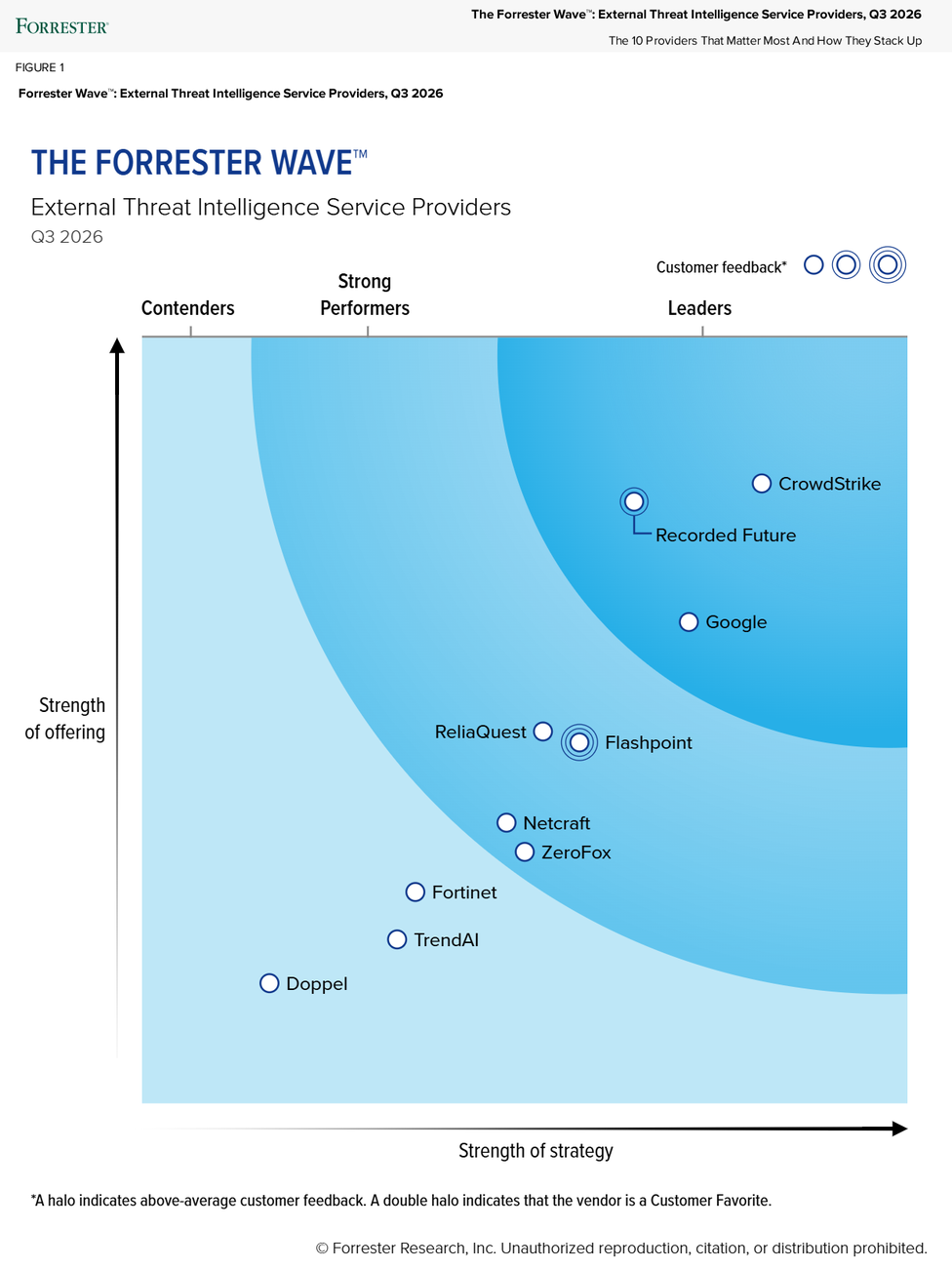
Google is a Leader in the Forrester Wave™: External Threat Intelligence Service Providers, Q3 2026
Accurate and relevant deep and dark web monitoring enables proactive security, spotting exposed credentials, threat actor reconnaissance, and illicit forum chatter before they escalate into active attacks.
We received the highest possible score in the Deep and Dark Web Monitoring and Intelligence Collection Sources criteria.
As Forrester wrote in the report, “Google is the only vendor in this evaluation that is also a frontier AI model developer and a significant player in quantum computing.”
Because Google Threat Intelligence has direct access to a leading frontier model rather than an off-the-shelf wrapper, our AI agents don’t just summarize data — they can actively evolve. We fine-tune and stress-test our agents continuously using proprietary Gemini best practices, removing the usage limits and latency typical of third-party layers.
For security teams, this translates directly to immediate threat context, faster detection updates, and drastically reduced time to resolution. The Forrester report stated, "Google's recent Gemini advancements accelerated the success of many of its Al-enabled functionalities." In addition to our finished intelligence reports, defenders can now use our agent to create custom analysis derived from frontline observations, tailored to their local threat profile and environment.
Google Threat Intelligence agents autonomously conduct campaign attribution and pioneer complex agentic malware analysis. Backed by codified Mandiant tradecraft, dynamic visual workflows, and real-time telemetry that programmatically hardens tool routing and execution, our agentic platform transforms complex threat landscapes into a decisive defender advantage.
Google received the highest scores possible in the Analyst Tradecraft and Services, Attribution and Frameworks Used, and Analyst Experience criteria in the report. This foundation is built by hundreds of dedicated researchers across the Google Threat Intelligence Group (GTIG) in over 30 countries speaking 30 languages. Our rigorous, evidence-based attribution maps directly to MITRE ATT&CK, empowering practitioners through interactive graphs and Gemini-enabled agentic threat intelligence.
By feeding the newest threat discoveries into detection workflows, these capabilities raise alert quality and take the guesswork out of rule creation across the security stack. Security operations center (SOC) teams and threat hunters can rapidly author resilient rules against novel variants, link suspicious events directly to known actor playbooks, and triage critical alerts with certainty.
While Google also received a 5/5 score in the partner ecosystem criterion, customers using Google Security Operations can directly leverage Google Threat Intelligence enrichments with agents:
The Triage and Investigation agent autonomously investigates alerts and prioritizes threats.
The Detection Engineering agent automatically finds and fills coverage gaps as they emerge.
The Threat Hunting agent proactively searches your environment for novel attack patterns.
Within the strategy category, Google Threat Intelligence received the highest possible scores in the Roadmap, Partner Ecosystem, and Community criteria, as well as the Intelligence Dissemination criterion in the Current Offering category.
The Forrester report stated, “Google maintains an open, partner-centric approach that avoids lock-in to the Google SecOps ecosystem and benefits from a strong community presence across the broader Google Cloud Security ecosystem.”
Google Threat Intelligence delivers a measurable impact on the speed and scale of modern defense. Our customers report identifying 139% more threats proactively and make their CTI teams 46% more efficient. These gains are accelerated by AI-driven summarization and context, and can help you eliminate manual guesswork, act on validated frontline intelligence, and focus on high-value investigations.
By accelerating detection engineering and proactive exposure management, Google Threat Intelligence identifies malicious infrastructure before adversaries can use it in campaigns. This faster defense helps you anticipate their maneuvers and disrupt their attack chains earlier, reducing threat dwell time and risk to your organization.
We are very pleased that Forrester recognized us as a Leader in Forrester Wave™: External Threat Intelligence Service Providers, Q3 2026. We continue to push the boundaries of what is possible in threat research, as an early, leading innovator enhancing malware analysis and dark web monitoring with AI. We continue to deliver the autonomous decision advantage to preemptively neutralize the right threats with the right action and the right context.
To learn more about Google’s position as a Leader, you can access the full Forrester Wave™: External Threat Intelligence Service Providers, Q3 2026 here.
Forrester does not endorse any company, product, brand, or service included in its research publications and does not advise any person to select the products or services of any company or brand based on the ratings included in such publications. Information is based on the best available resources. Opinions reflect judgment at the time and are subject to change. This report is part of a broader collection of Forrester resources, including interactive models, frameworks, tools, data, and access to analyst guidance. For more information, read about Forrester’s objectivity here .
此内容由惯性聚合(RSS阅读器)自动聚合整理,仅供阅读参考。 原文来自 — 版权归原作者所有。