








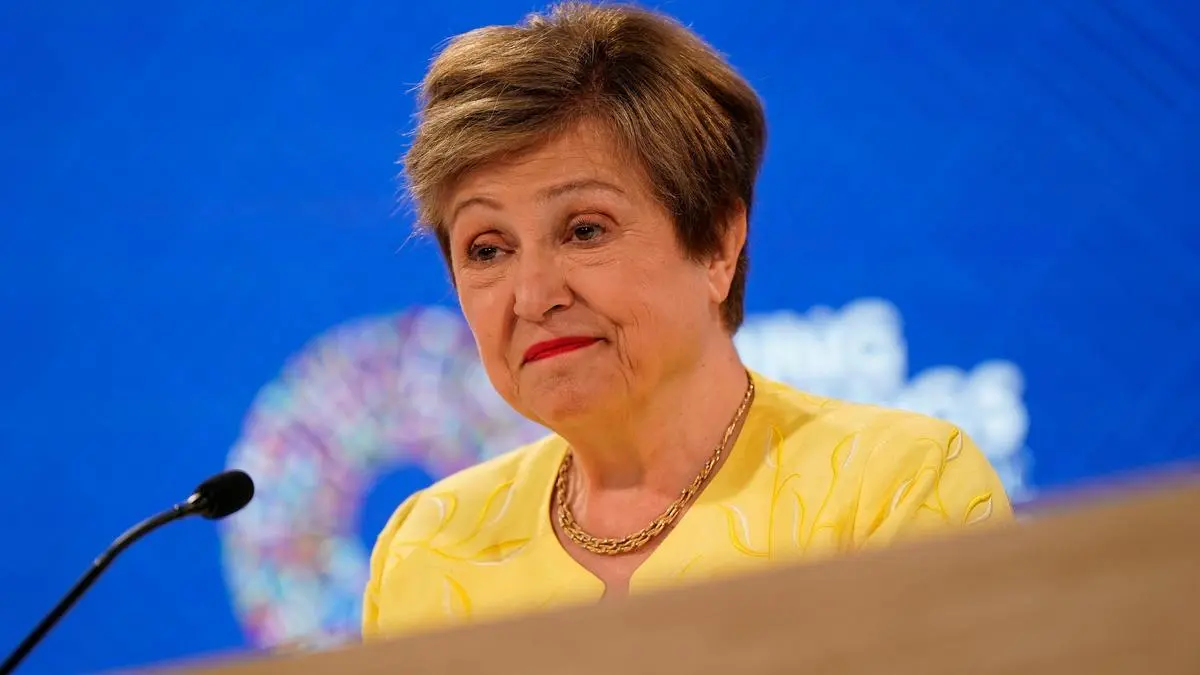
IMF Managing Director Kristalina Georgieva participates in a press briefing at the IMF/World Bank 2026 Spring Meetings in Washington, D.C., U.S (file photo) | Photo Credit: ELIZABETH FRANTZ
The IMF’s triad of global reports released a few days ago — on growth, fiscal stability and financial stability — do not paint a happy picture of the world’s economy and finances ‘in the shadow of war’. This, of course, is no surprise. Surely, pre-war estimates of global growth and inflation cannot hold; but what is noteworthy was the IMF’s take on US debt, and on US securities losing some of their sheen. Its view on India’s growth and fiscal position is rather positive, and sends a good signal to foreign investors at a time of fickle capital flows.
The three reports deal with the supply induced growth and inflation shocks in the wake of the war, and ways to cope with them. The burden of their message is that governments have run up too much debt and have exhausted fiscal space to provide a growth stimulus or energy subsidies; likewise, central banks must stick to inflation targeting above all else. Global gross government debt was at 94 per cent of GDP in 2025 and is expected to touch World War II levels of 100 per cent in 2029. Meanwhile, borrowing costs are expected to remain elevated. It is, however, noteworthy that the US’ public debt is at 126 per cent of its GDP, with China’s at 107 per cent and India at 83.4 per cent. US’ finances are edgy, with its government deficit at 7-8 per cent of GDP. This matters for the world, since it is the supplier of the world’s primary currency.
The strain is showing in a hugely significant way. The US runs a budget deficit of $2 trillion a year (public debt of $39 trillion), with interest cost at $1 trillion annually. Fresh debt issues are finding fewer takers at rising levels of debt and inflation, as a result of which safety and liquidity premium of US Treasuries, according to the IMF, has taken a hit. This raises borrowing costs for all. The profile of US creditors is changing, with foreign private entities and short-term debt dominating, replacing foreign central banks and the Federal Reserve. Seen along with the turbulence in equities over AI hype and the use of cryptocurrencies — which, strangely, does not find much mention in the IMF’s reports — and it seems that the US impact on the global financial scene is changing.
As for growth, there are straws in the wind that the conflict could wind down -- in which case the IMF’s ‘reference scenario’ of global growth at 3.1 per cent and inflation at 4.4 per cent in 2026 (average oil prices at $82.22 a barrel) may hold. India’s growth at 6.5 per cent for this year and the next places it above the rest of the world; more than China’s 4.4 per cent and 4 per cent, respectively, for 2026 and 2027. The IMF’s typically stern prescription against any subsidies seems a bit of a stretch, if growth is hit. In India’s case, a combination of price pass-through and subsidies may be needed, if the war persists. Finally, the Fund-Bank do not appear to acknowledge that new paradigms are replacing the old — such as industrial policy over earlier supply chains, or the prospect of huge shifts in trade, investment and finance.
Published on April 22, 2026
此内容由惯性聚合(RSS阅读器)自动聚合整理,仅供阅读参考。 原文来自 — 版权归原作者所有。