








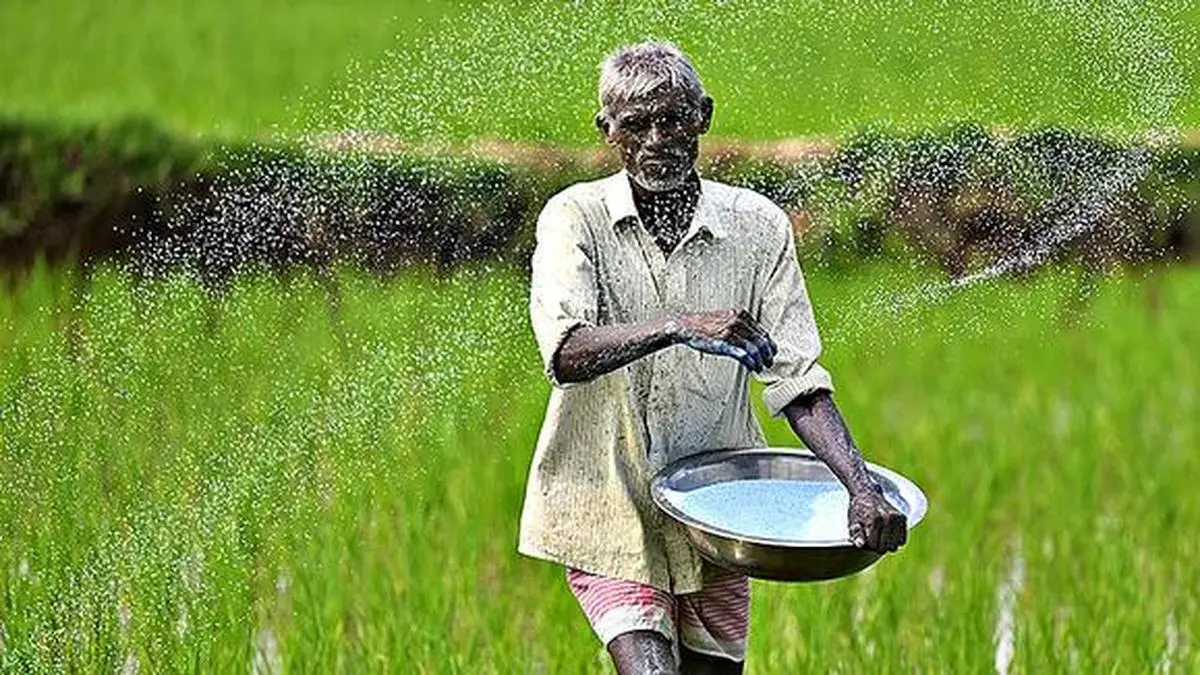
Natural gas is the basic input required for production of urea | Photo Credit: NAGARA GOPAL
India is heavily dependent on the Gulf region for import of inputs for production of fertilizers — namely, LNG, ammonia and sulphur and finished products urea and DAP. There should be a strategy beyond fire fighting for self-sufficiency.
Let us focus on supply and demand of nitrogen. More than 80 per cent of nitrogen application in India is through urea. Other nitrogen products are hardly used. Abnormal growth in demand for urea and decline in production widened the deficit from 4.4 million tonnes (mt) in 2023-24 to almost 10 mt in 2025-26. Import of urea is estimated to be nearly 10 mt in 2025-26 compared with 5.6 mt in 2024-25, an increase of almost 80 per cent.
Natural gas is the basic input required for production of urea. Domestic production is dependent on imported LNG to the extent of 85 per cent of total gas requirement.
In case of gas shortage, urea units should be encouraged to use mixed feed, or a mix of gas and naphtha. In early 2000s, a number of units had created facilities to use mixed feed before these were bypassed when imported gas became available in 2005.
Second, urea units using coal for utilities should be allowed to continue to use coal. This also works out to be cheaper than gas used for steam and power generation in spite higher energy consumption.
However, these units should be reimbursed adequately based on realistic energy consumption norms. Third, old units should be incentivised to modernise, to improve efficiency and increase production.
Fourth, it is time feasibility of producing green urea is explored, which will do away with the use of LNG. According to a recent PIB release, contracts for 7.24 lakh tonnes of green ammonia have been signed between green ammonia and fertilizer producers. This will reduce dependence on imported ammonia for production of non-urea fertilizers. There are techno-economic issues in production of urea with green ammonia.
The best way forward will be to construct a demonstration plant at the site of green ammonia production to find the gaps in technology and logistics and their solution before construction of full-scale plant.
Also, to what extent grey ammonia can be replaced with green ammonia in existing urea plants must be explored. It will be a realistic target to produce 20-25 per cent nitrogenous fertilizers using green ammonia in the next five years.
There are alternative products to urea for supply of nitrogen. Enhanced share of NP/NPK complex fertilizers in nitrogen use from the present 18 per cent can reduce dependence on urea. These fertilizers not only offer an opportunity for balanced fertilization but also the promise to be produced entirely with green ammonia.
Ammonium sulphate (AS) is another promising product. It has 20.5 per cent nitrogen and 23 per cent sulphur. It is especially suitable for sulphur deficient soils and oilseed crops.
It can also be produced using green ammonia and indigenous sulphur. Its present consumption is less than one million tonnes. But the real bottleneck in expanding use of AS is its treatment under subsidy policies.
In addition to very low subsidy both for nitrogen and sulphur under nutrient based subsidy (NBS) scheme, AS does not attract full subsidy as per NBS because it has been artificially capped at ₹9,479 per tonne.
Subsidy on AS works out to about a third of its cost in normal times compared to 85-90 per cent subsidy on urea without any cap. With the present subsidy structure, the selling price of AS has to be more than four times that of urea on per kg basis.
Amongst other factors, increase in nitrogen use efficiency (NUE) can hardly be over emphasised. Site specific integrated nutrient management with inclusion of organic fertilizers and soil amendment agents like bio-char can easily increase NUE by 10 percentage points.
Thus, action is required on correction in relative subsidy rates of fertilizer products, helping hand to urea units to realise their full potential for production of more and more green fertilizers.
The writer is Visiting Professor at ICRIER. Views are personal
Published on April 17, 2026
此内容由惯性聚合(RSS阅读器)自动聚合整理,仅供阅读参考。 原文来自 — 版权归原作者所有。