


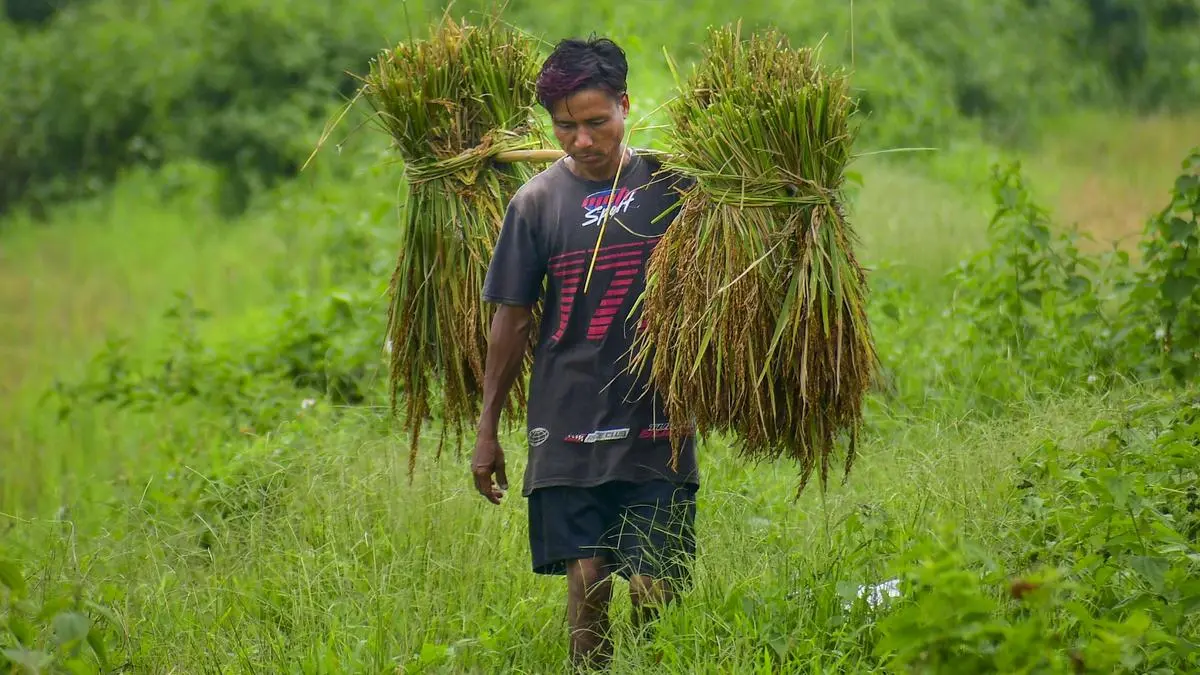
Agriculture: Monsoon worries | Photo Credit: -
The India Meteorological Department’s (IMD) June forecast for South-West monsoon carries more bad news than the April one. IMD now believes that monsoon rainfall for the country will likely be at 90 per cent of the Long Period Average (LPA), compared to the April forecast of 92 per cent. IMD’s June forecast for the monsoon is usually more accurate than the early April one. It suggests a deficient monsoon year, instead of merely a sub-normal one, and calls for greater preparation. The forecast also casts a damper on the spatial distribution of rain. Only North-East India, not very critical for the agri-economy, is now expected to receive normal rain.
Central and South Peninsular India and the North-West are likely to experience below normal rains. The monsoon core zone, which is rainfed and critical for agricultural output, is expected to receive less than 94 per cent of LPA. The forecast also raises the possibility of the looming El Nino coinciding exactly with the monsoon months. In April, the IMD had talked of weak La Nina conditions persisting until June, pushing back the advent of El Nino. It also held out the hope that a positive Indian Ocean Dipole (a weather phenomenon that counteracts the impact of El Nino) could emerge towards the end of the Southwest monsoon season. A positive IOD has in some years negated the El Nino effect. However, the latest forecast says that neutral IOD conditions are expected to continue, suggesting that this hope is receding. The World Meteorological Organisation has just predicted that there is an 80 per cent probability of a moderate to strong El Nino emerging between June and August. June has already seen a patchy start to the Southwest monsoon, accompanied by a countrywide heat wave. Should these conditions last through July, the critical sowing month, kharif output could be seriously hit.
In its latest estimates this week, the Agriculture Ministry has marginally lowered its kharif output target to 151 million tonnes for rice (from 154 million tonnes last year), 52.5 million tonnes for maize (55.1 MT last year) and 40 million tonnes for oilseeds (43.1 MT last year). Estimates for other kharif crops such as sugarcane, jowar, bajra, tur, urad and moong have either been hiked or left unchanged from the previous year. No estimates have been provided for horticulture crops. It is unclear if this is because the Ministry expects no impact from a deficient monsoon, or plans to course-correct as sowing progresses.
Pulses and vegetables have been key contributors to spells of runaway inflation in the past. Therefore, a sensible approach is to start with realistic estimates — and avoid knee-jerk actions such as export bans or import duty cuts which hurt farm incomes and impact India’s reputation as a reliable supplier of agri-products. Lower paddy and maize output also call for recalibration of the ambitious ethanol blending programme. Overall, the Centre and States should be prepared with policy options to deal with eventualities.
Published on June 3, 2026
此内容由惯性聚合(RSS阅读器)自动聚合整理,仅供阅读参考。 原文来自 — 版权归原作者所有。