



惯性聚合 高效追踪和阅读你感兴趣的博客、新闻、科技资讯
阅读原文 在惯性聚合中打开

推荐订阅源

J
Java Code Geeks
月光博客
月光博客
aimingoo的专栏
aimingoo的专栏
Google DeepMind News
Recent Announcements
MyScale Blog
MyScale Blog
钛媒体:引领未来商业与生活新知
钛媒体:引领未来商业与生活新知
S
SegmentFault 最新的问题
Hugging Face - Blog
Hugging Face - Blog
Martin Fowler
Martin Fowler
WordPress大学
WordPress大学
F
Fortinet All Blogs
小众软件
小众软件
D
Docker
U
Unit 42
博客园 - 聂微东
freeCodeCamp Programming Tutorials: Python, JavaScript, Git & More
爱范儿
爱范儿
OSCHINA 社区最新新闻
OSCHINA 社区最新新闻
IT之家
IT之家
云风的 BLOG
云风的 BLOG
博客园 - 司徒正美
有赞技术团队
有赞技术团队
腾讯CDC

Databricks

How lakebase architecture delivers 5x faster Postgres writes Why Talent Transformation Is the Missing Focus of Enterprise AI Public Health Intelligence Shouldn't Require a Data Scientist Mean Time to Detect Is a Data Access Problem First-party audience data is the ad sales relationship now Rethinking Distributed Systems for Serverless Performance and Reliability The AI Scaling Gap Hiding in Digital Native Companies 10 trillion samples a day: Scaling beyond traditional monitoring infra at Databricks AI success starts with clean data, not just better models How nOps Rebuilt Their Cloud Optimization Platform on Databricks Lakebase, and Why Other ISVs Should Too Peril Predicts: Precision Payouts for a Volatile World The foundation of AI scalability: one team, one platform, one operating model The Federal Data Paradox: Rich in Data, Poor in Access Driving Budapest Forward: How BKK Uses Databricks to Transform City Mobility LLM Vs AI: A Practical Guide to Differences, Use Cases, and Tools Model Risk Governance Is Not the Same as Risk Intelligence Generative AI for Business: A Complete Strategy and Implementation Guide Data Science vs Data Engineering: Choosing Analysis or Infrastructure AI Applications: Tools, Use Cases, and Platforms MLOps vs DevOps: A Practical Guide for Data Scientists and IT Teams Top Data Warehouse Tools For Modern Data Analytics Unlocking SAP Business Context in Databricks with Semantic Metadata Delta Sharing The marketing activation gap has a fix: Databricks and Stitch partner to turn data infrastructure into marketing performance Alert Fatigue Is a Business Risk Backstage with Lakebase Shipping Faster isn’t Learning Faster Why Your OEE Dashboard Is Lying to You The Turbine That Tried to Tell You It Was Failing Predicting Readmissions Isn't Enough. Acting in Time Is. Clinical Trials Run Longer Than They Have To. That's a Patient Problem
How MakeMyTrip achieved millisecond personalization at sc...
Sitesh Sharma, Aditya Kumar, Navneeth Nair · 2026-04-08 · via Databricks

Delivering Real-Time Personalization at Scale

Every millisecond counts when travelers search for hotels, flights, or experiences. As India's largest online travel agency, MakeMyTrip competes on real-time speed and relevance. One of its  most important features is "last-searched" hotels: as users tap the search bar, they expect a real-time, personalized list of their recent interests, based on their interaction with the system. 

At MakeMyTrip's scale, delivering that experience requires sub-second latency on a production pipeline serving millions of daily users — across both consumer and corporate travel lines of business.  By implementing Databricks' Real-Time Mode (RTM)—the next-generation execution engine in Apache Spark™ Structured Streaming, MakeMyTrip successfully achieved millisecond-level  latencies, while maintaining a cost-effective infrastructure and reducing engineering complexity.

The Challenge: Ultra-Low Latency Without Architectural Fragmentation

MakeMyTrip's data team needed sub-second latency for the "last-searched" hotels workflow across all lines of business. At their scale, even a few hundred milliseconds of delay creates friction in the user journey, directly impacting click-through rates.

Apache Spark's micro-batch mode introduced inherent latency limits that the team could not break despite extensive tuning — consistently delivering latency of one to two seconds, far too slow for their requirements.

Next, they evaluated Apache Flink across roughly 10 streaming pipelines which solved their latency requirements. However, adopting Apache Flink as a second engine would have introduced significant long-term challenges:

  • Architectural fragmentation: Maintaining separate engines for real-time and batch processing
  • Duplicated business logic: Business rules would need to be implemented and maintained across two codebases
  • Higher operational overhead: Doubling monitoring, debugging, and governance effort across multiple pipelines
  • Consistency risks: Results risk divergence between batch and real-time processing
  • Infrastructure costs: Running and tuning two engines increases compute spend and maintenance burden

Why Real-Time Mode: Millisecond Latency on a Single Spark Stack

Because MakeMyTrip never wanted a dual-engine architecture, Apache Flink was not a viable long-term option. The team made a deliberate architectural decision: to wait for Apache Spark to become faster, rather than fragment the stack.
Therefore, when Apache Spark Structured Streaming introduced RTM, MakeMyTrip became the first customer to adopt it. RTM allowed them to achieve millisecond-level latency on Apache Spark — meeting real-time requirements without introducing another engine or splitting the platform.

Maintaining two engines means doubling the complexity and the risk of logic drift between batch and real-time calculations. We wanted one source of truth -- one Spark-based pipeline -- rather than two engines to maintain. Real-Time Mode gave us the performance we needed with the simplicity we wanted." — Aditya Kumar, Associate Director of Engineering, MakeMyTrip

RTM delivers continuous, low-latency processing through three key technical innovations that work together to eliminate the latency sources inherent in micro-batch execution:

  • Continuous data flow: Data is processed as it arrives instead of being discretized into periodic chunks.
  • Pipeline scheduling: Stages run simultaneously without blocking, allowing downstream tasks to process data immediately without waiting for upstream stages to finish.
  • Streaming shuffle: Data is passed between tasks immediately, bypassing the latency bottlenecks of traditional disk-based shuffles.

Together, these innovations allow Apache Spark to achieve millisecond-scale pipelines that were previously only possible with specialized engines. To learn more about the technical foundation of RTM, read this blog, “Breaking the Microbatch Barrier: The Architecture of Apache Spark Real-Time Mode."
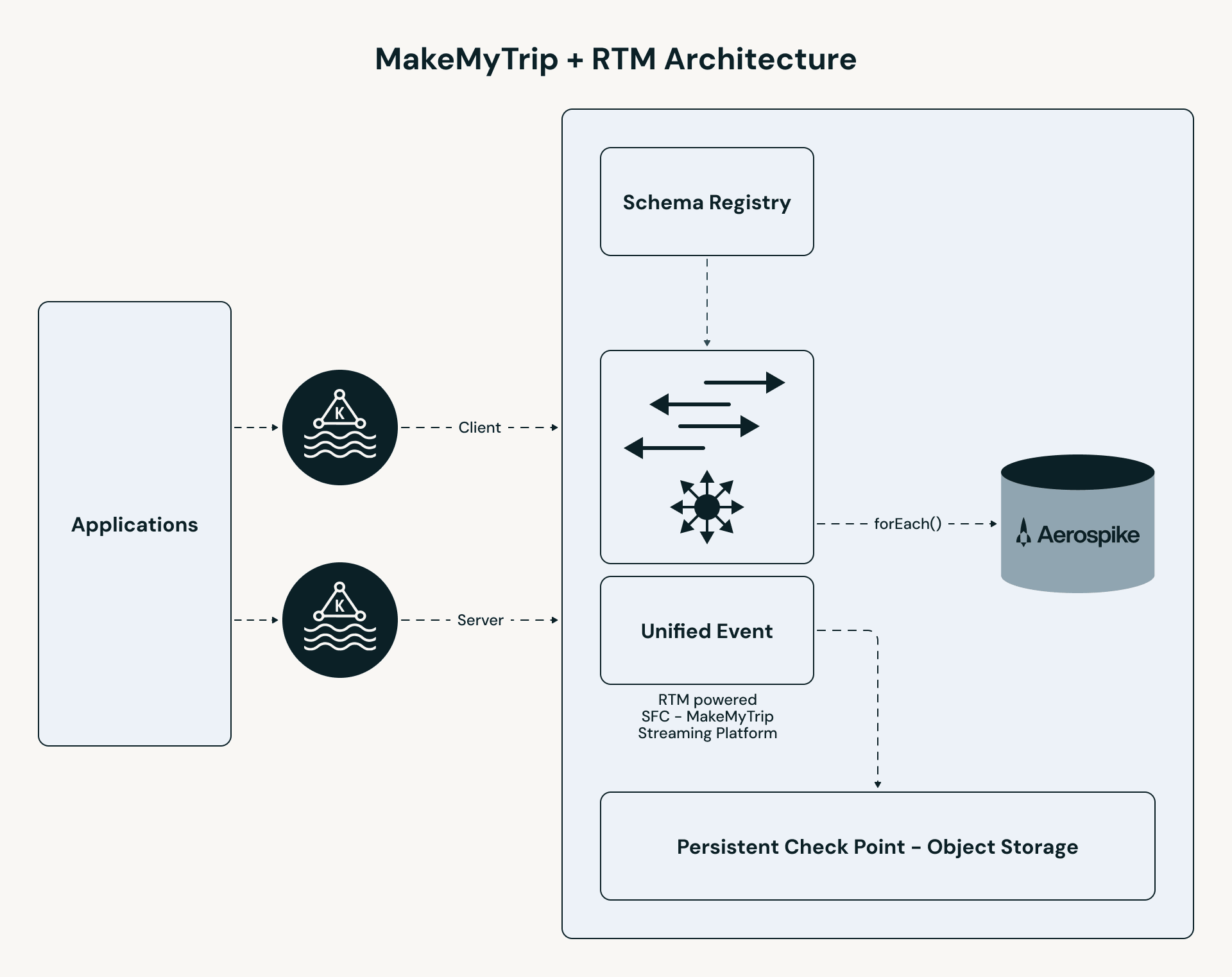
The Architecture: A Unified Real-Time Pipeline

Architecture: MakeMyTrip using Real-Time Mode

MakeMyTrip's pipeline follows a high-performance path:

  • Unified ingestion: B2C and B2B clickstream topics are merged into a single stream. All personalization logic — enrichment, stateful lookup, and event processing — is applied consistently across both user segments.
  • RTM processing: The Apache Spark engine uses concurrent scheduling and streaming shuffle to process events in milliseconds.
  • Stateful enrichment: The pipeline performs a low-latency lookup in Aerospike to retrieve the "Last N" hotels for each user.
  • Instant serving: Results are pushed to a UI cache (Redis), enabling the app to serve personalized results in under 50ms.

Configuring RTM: a single-line code change

Using RTM in your streaming query does not require rewriting business logic or restructuring pipelines. The only code change needed is setting the trigger type to RealTimeTrigger, as shown in the following code snippet:

The one infrastructure consideration: cluster task slots must be greater than or equal to the total number of active tasks across source and shuffle stages. MakeMyTrip's team analyzed their Kafka partitions, shuffle partitions, and pipeline complexity upfront to ensure sufficient concurrency before going to production.

Co-Developing RTM for Production

As RTM's first adopter, MakeMyTrip worked directly with Databricks engineering to bring the pipeline to production readiness. Several capabilities required active collaboration between the two teams to build, tune, and validate.

  1. Stream Union: Merging B2C and B2B into a Single Pipeline
    MakeMyTrip needed to unify two separate Kafka topic streams — B2C consumer clickstream and B2B corporate travel — into a single RTM pipeline so that the same personalization logic could be applied consistently across both user segments. After a month of close collaboration with Databricks engineering, the feature was built and shipped. The result was a single pipeline where all business logic lives in one place, with no divergence risk between user segments.
  2. Task Multiplexing: More Partitions, Fewer Cores
    RTM's default model assigns one slot/core per Kafka partition. With 64 partitions in MakeMyTrip's production setup, that translates to 64 slots/cores — cost-prohibitive at their scale. To address this, the Databricks team introduced the MaxPartitions option for Kafka, which allows multiple partitions to be handled by a single core. This gave MakeMyTrip the lever they needed to reduce infra costs without compromising throughput.
  3. Pipeline Hardening: Checkpointing, Backpressure, and Fault Tolerance
    The team worked through a set of operational challenges specific to high-throughput, low-latency workloads: tuning checkpoint frequency and retention, handling timeouts, and managing backpressure during surges in clickstream volume. By scaling to 64 Kafka partitions, enabling backpressure, and capping the MaxRatePerPartition at 500 events, the team optimized throughput and stability. Through this iterative tuning of batch configurations, partitioning, and retry behavior, they arrived at a stable, production-grade pipeline serving millions of users daily.

Results

RTM enabled instant personalization and improved responsiveness, higher engagement measured via click-through rates and operational simplicity of a single unified engine. Key metrics are shown below.

Metrics

Before RTM

After RTM

P50 latency

~1.23 seconds

44 ms

P99 latency

>1 minute

~500 ms

CTR uplift

baseline

+7%

Apache Spark as a Real-Time Engine

MakeMyTrip’s deployment proves that RTM on Spark delivers the extremely low latency that your real-time applications require. Because RTM is built on the same familiar Spark APIs, you can use the same business logic across batch and real time pipelines. You no longer need the overhead of maintaining a second platform or separate codebase for real time processing, and can simply enable RTM on Spark with a single line of code.

Real-Time Mode allowed us to compress our infrastructure and deliver real-time experiences without managing multiple streaming engines. As we move into the era of AI agents, steering them effectively requires building real-time context from data streams. We are experimenting with Spark RTM to supply our agents with the richest, most recent context necessary to take the best possible decisions.” — Aditya Kumar, Associate Director of Engineering, MakeMyTrip


Getting started with Real-Time Mode

To learn more about Real-Time Mode, watch this on-demand video on how to get started or review the documentation.