


惯性聚合 高效追踪和阅读你感兴趣的博客、新闻、科技资讯
阅读原文 在惯性聚合中打开

推荐订阅源

J
Java Code Geeks
GbyAI
GbyAI
阮一峰的网络日志
阮一峰的网络日志
Cloudbric
Cloudbric
奇客Solidot–传递最新科技情报
奇客Solidot–传递最新科技情报
宝玉的分享
宝玉的分享
I
Intezer
Simon Willison's Weblog
博客园_首页
The Cloudflare Blog
C
Cisco Blogs
AWS News Blog
AWS News Blog
IT之家
IT之家
Cyberwarzone
Cyberwarzone
罗磊的独立博客
美团技术团队
V
V2EX
Project Zero
Project Zero
A
Arctic Wolf
C
Cyber Attacks, Cyber Crime and Cyber Security
大猫的无限游戏
大猫的无限游戏
博客园 - 叶小钗
月光博客
月光博客
freeCodeCamp Programming Tutorials: Python, JavaScript, Git & More
酷 壳 – CoolShell
酷 壳 – CoolShell
博客园 - 聂微东
有赞技术团队
有赞技术团队
钛媒体:引领未来商业与生活新知
钛媒体:引领未来商业与生活新知
雷峰网
雷峰网
S
Schneier on Security
P
Privacy International News Feed
V
Visual Studio Blog
量子位
T
Tor Project blog
S
Securelist
腾讯CDC
A
About on SuperTechFans
T
Threat Research - Cisco Blogs
G
GRAHAM CLULEY
B
Blog RSS Feed
D
DataBreaches.Net
博客园 - 三生石上(FineUI控件)
B
Blog
NISL@THU
NISL@THU
L
Lohrmann on Cybersecurity
V
Vulnerabilities – Threatpost
人人都是产品经理
人人都是产品经理
博客园 - 【当耐特】
L
LINUX DO - 热门话题
Recorded Future
Recorded Future

Databricks

How lakebase architecture delivers 5x faster Postgres writes Why Talent Transformation Is the Missing Focus of Enterprise AI Public Health Intelligence Shouldn't Require a Data Scientist Mean Time to Detect Is a Data Access Problem First-party audience data is the ad sales relationship now Rethinking Distributed Systems for Serverless Performance and Reliability The AI Scaling Gap Hiding in Digital Native Companies 10 trillion samples a day: Scaling beyond traditional monitoring infra at Databricks AI success starts with clean data, not just better models How nOps Rebuilt Their Cloud Optimization Platform on Databricks Lakebase, and Why Other ISVs Should Too The foundation of AI scalability: one team, one platform, one operating model The Federal Data Paradox: Rich in Data, Poor in Access Driving Budapest Forward: How BKK Uses Databricks to Transform City Mobility LLM Vs AI: A Practical Guide to Differences, Use Cases, and Tools Model Risk Governance Is Not the Same as Risk Intelligence Generative AI for Business: A Complete Strategy and Implementation Guide Data Science vs Data Engineering: Choosing Analysis or Infrastructure AI Applications: Tools, Use Cases, and Platforms MLOps vs DevOps: A Practical Guide for Data Scientists and IT Teams Top Data Warehouse Tools For Modern Data Analytics Unlocking SAP Business Context in Databricks with Semantic Metadata Delta Sharing The marketing activation gap has a fix: Databricks and Stitch partner to turn data infrastructure into marketing performance Alert Fatigue Is a Business Risk Backstage with Lakebase Shipping Faster isn’t Learning Faster Why Your OEE Dashboard Is Lying to You The Turbine That Tried to Tell You It Was Failing Predicting Readmissions Isn't Enough. Acting in Time Is. Clinical Trials Run Longer Than They Have To. That's a Patient Problem Network Quality Is a Revenue Problem, Not a Technical One Shelf Availability Starts with Better Demand Visibility When Predicting the Next Hit Requires More Than Intuition Approximate Answers, Exact Decisions: New Sketch Functions for Analytics Companies Winning with AI Built the Data Layer First Rethinking SQL ETL for modern data platforms Stripe data now available on Databricks via Databricks Marketplace Databricks and Stripe Projects: Infrastructure Built for Agents Agents are ready but your architecture probably isn't Interoperability Between Unity Catalog and Google BigQuery via Catalog Federation Built In, Not Bolted On: What AI-Native Actually Means in Cybersecurity Operationalizing AI for public sector fraud prevention From months to minutes: Building real-time clinical data pipelines with natural language Agentic Data Engineering with Genie Code and Lakeflow Securely send first-party conversion signals with Snapchat Conversions API on Databricks Marketplace How leading tech companies are killing the builder’s tax with Lakebase Inside one of the first production deployments of Lakebase: LangGuard's agentic workflow governance engine The next generation of Databricks Genie Model Risk Management in 2026: A Banker’s Guide to the Revised Interagency Guidance OpenAI GPT-5.5 now available on Databricks, fully-governed through Unity AI Gateway Operational databases: How they work and when to use them Databricks partners with OpenAI on GPT-5.5 Announcing the Public Preview of Lakeflow Designer Are LLM agents good at join order optimization? How conversational analytics removes the BI bottleneck How to transform document activation workflows with Genie and Agent Bricks Beyond the spreadsheet: how Databricks is delivering the modern CFO in Financial Services AI App Development: Guide To Building AI-Powered Apps IoT in Manufacturing: Strategy, Components, Use Cases, and Challenges Stop Hand-Coding Change Data Capture Pipelines Multimodal Data Integration: Production Architectures for Healthcare AI Personalization Strategies for Media Companies A Modern AI Risk Management Framework Introducing the Databricks Excel Add-in for Business Users Real-Time Decisioning for AI Agents: Why you Need a Customer Context Layer First A Practical Guide to LLM Fine Tuning AI Data Transformation Guide for Data Engineers and Data Scientists Concurrency Control in DBMS: How Locking, MVCC and Optimistic Strategies Keep Data Consistent Bridging data science and marketing: Databricks unveils Delta Sharing integration for Adobe Experience Platform and agentic marketing workflows Take Control: Customer-Managed Keys for Lakebase Postgres Get hands on with agents, vibe coding and more at Data+ AI Summit Mercedes-Benz Builds a Cross-Cloud Data Mesh with Delta Sharing and Intelligent Replication, Cutting Costs by 66% What Is a Transactional Database? Introducing Genie Agent Mode Governing coding agent sprawl with Unity AI Gateway Governing Coding Agent Sprawl with Unity AI Gateway What is pgvector? Banks Don’t Have an AI Problem – They Have a Data Platform Problem Open Platform, Unified Pipelines: Why dbt on Databricks is Accelerating Why Your Agents Can’t Read Enterprise Documents — and How to Fix It Building with Databricks Document Intelligence and Lakeflow Databricks on Google Cloud: Innovate Faster. Smarter. Together. Introducing the Databricks Connector for Google Sheets: Real-Time, Governed Lakehouse Data in the Sheets Users Love Unity AI Gateway: How to connect agents to external MCPs securely Expanding agent governance with Unity AI Gateway Agentic reasoning in practice: Making sense of structured and unstructured data Agent Bricks: The Governed Enterprise Agent Platform 8 AI and data trends shaping financial services in 2026 Building real-time product search on Databricks Lovable + Databricks: Build Data-Driven Apps at the Speed of Thought Memory scaling for AI agents Powering clinical research innovation: How TriNetX uses Databricks to accelerate drug development Database Branching in Postgres: Git-Style Workflows with Databricks Lakebase How Zalando built a unified data foundation for AI and analytics on Databricks The next era of the open lakehouse: Apache Iceberg™ v3 in Public Preview on Databricks How FSIs eliminate silos between clients, operations, and finance How MakeMyTrip achieved millisecond personalization at scale with Databricks A multi-agent approach to audience intelligence AiChemy: Next-generation agent with MCP, skills and custom data for drug discovery Accelerate business insights with Lakeflow Connect, now with a Free Tier Unlocking Next-Gen Customer Experiences with Data Intelligence for Marketing
Peril Predicts: Precision Payouts for a Volatile World
2026-05-05 · via Databricks

A Category 4 hurricane makes landfall on Florida's Gulf Coast. Within hours — not weeks — insurers identify every affected property in the storm's path, match them against policy triggers, and begin issuing payouts. No adjusters dispatched. No claims forms filed. The data speaks for itself.

This is parametric insurance in action. Unlike traditional indemnity models, which reimburse verified losses through lengthy claims assessments, parametric policies pay out automatically when predefined conditions are met — wind speeds crossing a threshold, rainfall exceeding a set level, or an earthquake reaching a specific magnitude. Payouts are tied to objective event data from trusted third-party sources like NOAA and USGS, which means faster funds, clearer terms, and far less administrative overhead.

The shift is made possible by advances in catastrophe modeling. Modern cat models fuse geospatial data, weather observations, engineering insights, and historical loss records to estimate the probability and impact of extreme events — hurricanes, floods, wildfires, earthquakes. These models power a growing range of use cases: flood risk scoring, climate scenario analysis, elevation modeling, rooftop analytics, and land parcel assessment. For parametric programs specifically, they provide the foundation for defining triggers that are both reliable and fair.

But modeling alone isn't enough. Operationalizing parametric insurance means processing massive volumes of geospatial and environmental data in near real time. Satellite imagery, weather feeds, exposure datasets, and cat model outputs all need to converge so that when a triggering event occurs, the right policies pay the right amounts immediately. This is where the Databricks Geospatial Lakehouse comes in — unifying these data sources on a single platform so insurers can scale catastrophe analytics from insight to payout.

Business Insights by Persona

The Databricks Lakehouse delivers catastrophe insights to every function across the insurance value chain. Each team starts from the same unified data but asks different questions:

PersonaKey Question
UnderwriterWhich properties fall within the hurricane impact zone, what’s our total exposure, and how should we price this region going forward?

Risk Manager

How concentrated is our exposure in high-risk regions, and are we within risk tolerance thresholds?

Claims

Which policies should trigger immediate payout, and can we validate damage quickly?

Finance

What is the estimated loss vs reinsurance coverage, and what’s the hit to portfolio profitability?

Underwriter
Geospatial portfolio filtering lets underwriters view policies within a storm footprint, overlaid with hurricane tracks, wind zones, or flood extents. Exposure heatmaps surface high-value clusters at a glance, and property-level drill-downs show insured value, coverage limits, and location risk. Genie enables natural-language exploration of the same data.
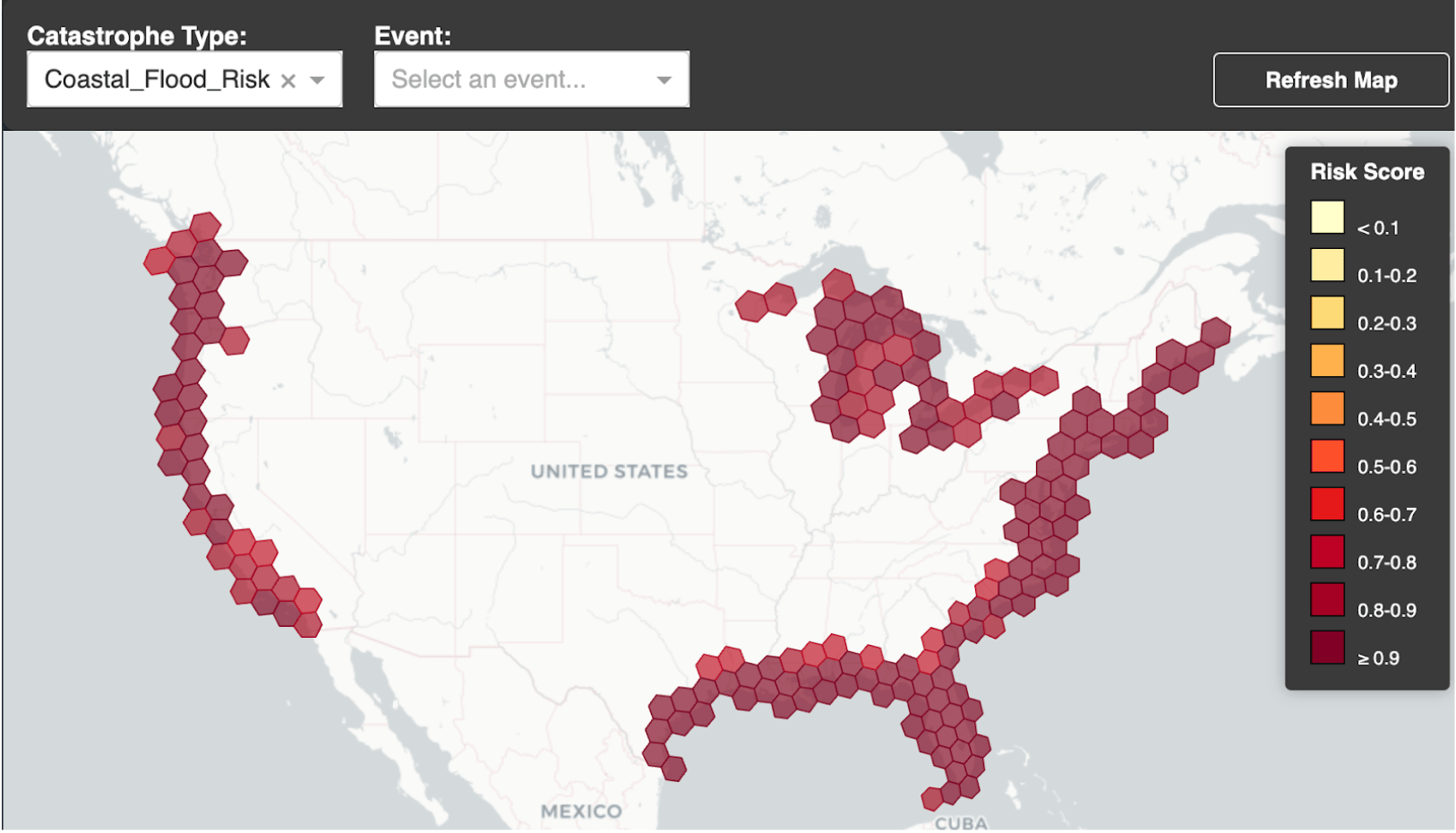
Underwriter

Risk Manager
Risk managers monitor geographic concentration and catastrophe accumulation across the portfolio. Filtering by catastrophe type or specific event renders affected properties on a map — color-coded by severity — with portfolio details accessible per property.
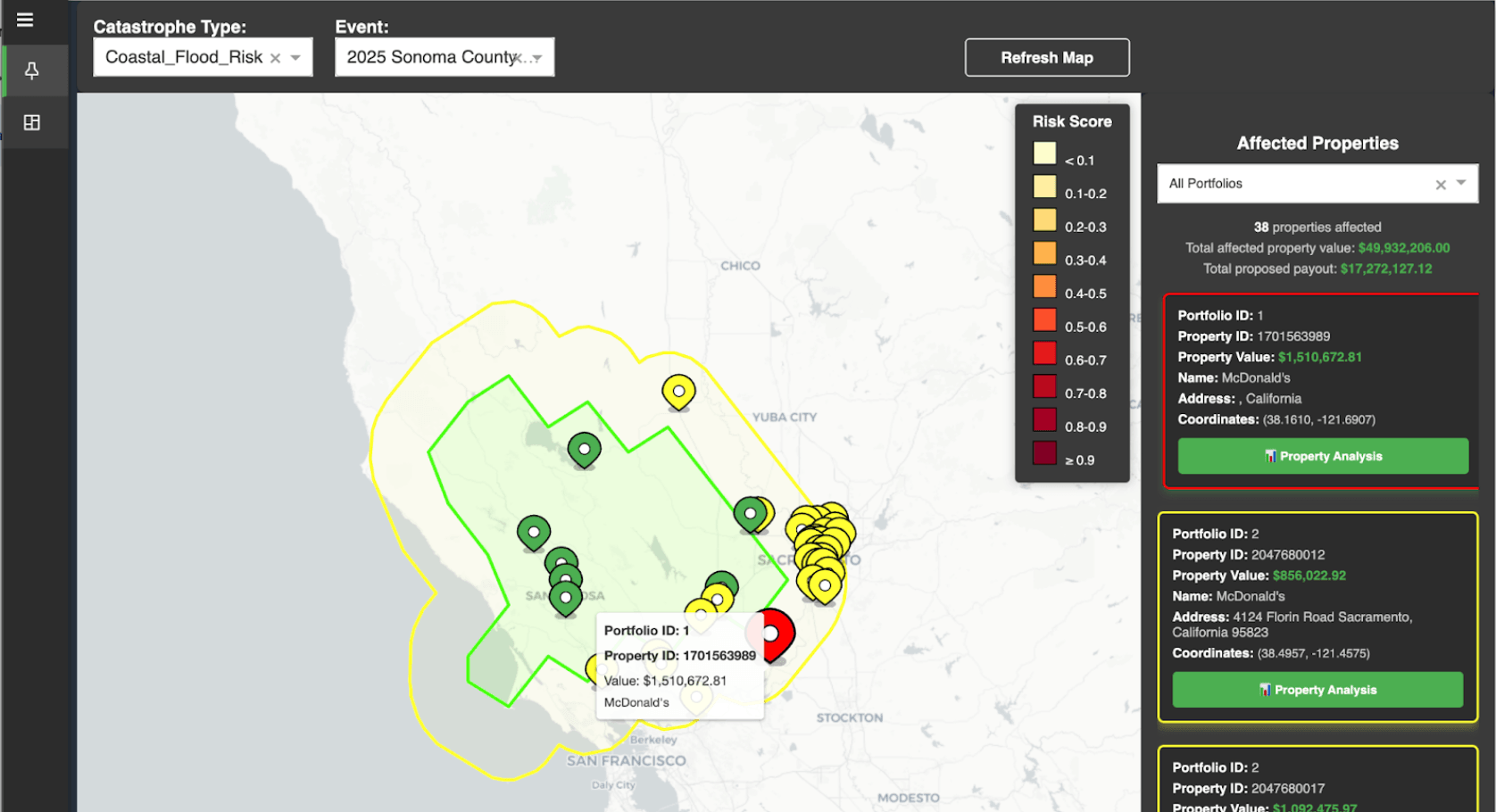
Risk Manager

Claims Investigator
Parametric triggers are detected automatically when event thresholds are crossed, surfacing eligible policies and geospatial payout zones. For validation, clicking into any property brings up before-and-after aerial imagery. Multimodal AI models on Databricks can analyze this imagery to confirm damage patterns, flag potential fraud, and accelerate payouts — all governed through the AI Gateway.
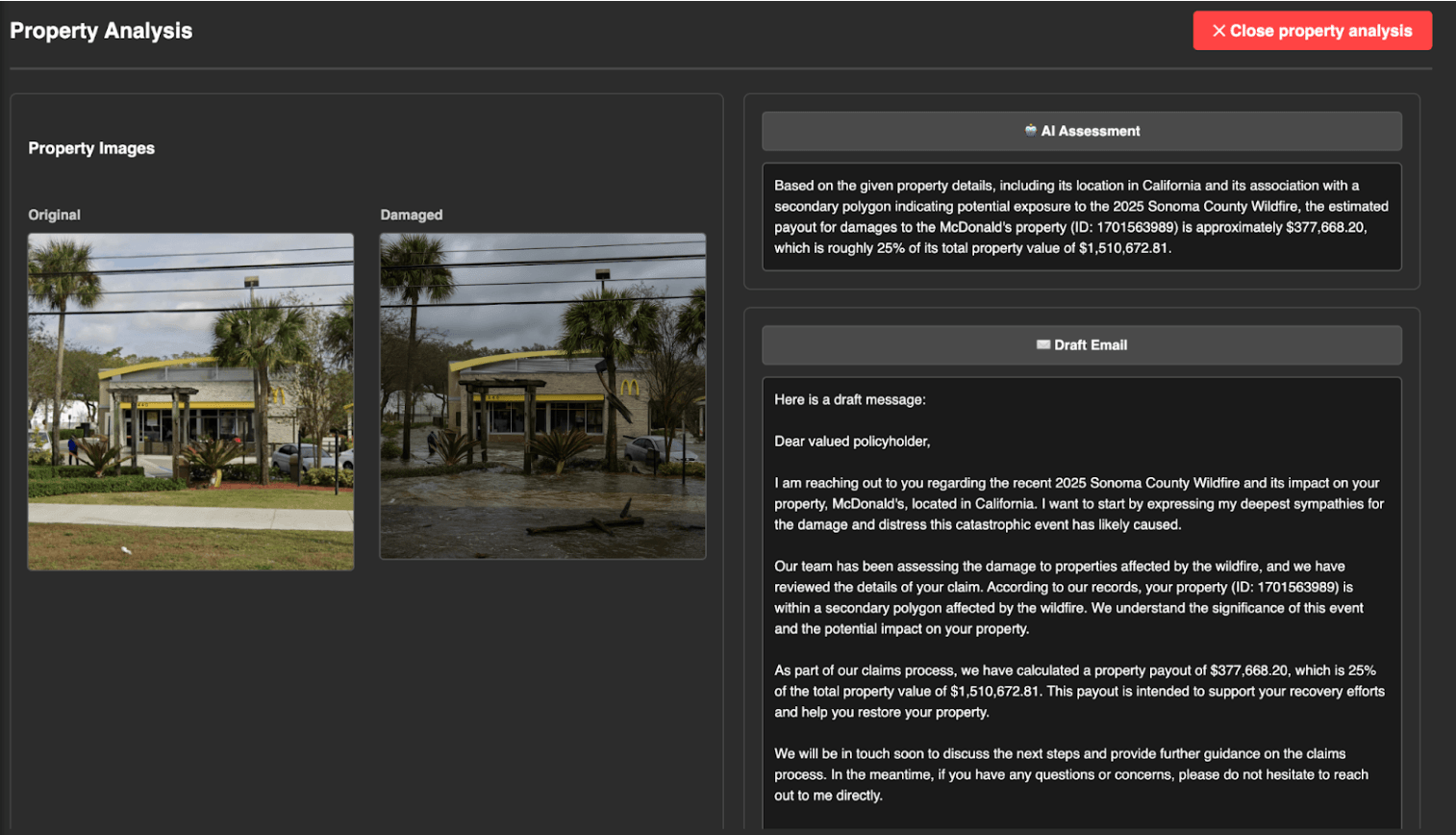
Claim Investigator

Finance
Event loss estimation dashboards give finance teams a real-time view of capital exposure and portfolio performance as catastrophe events unfold.
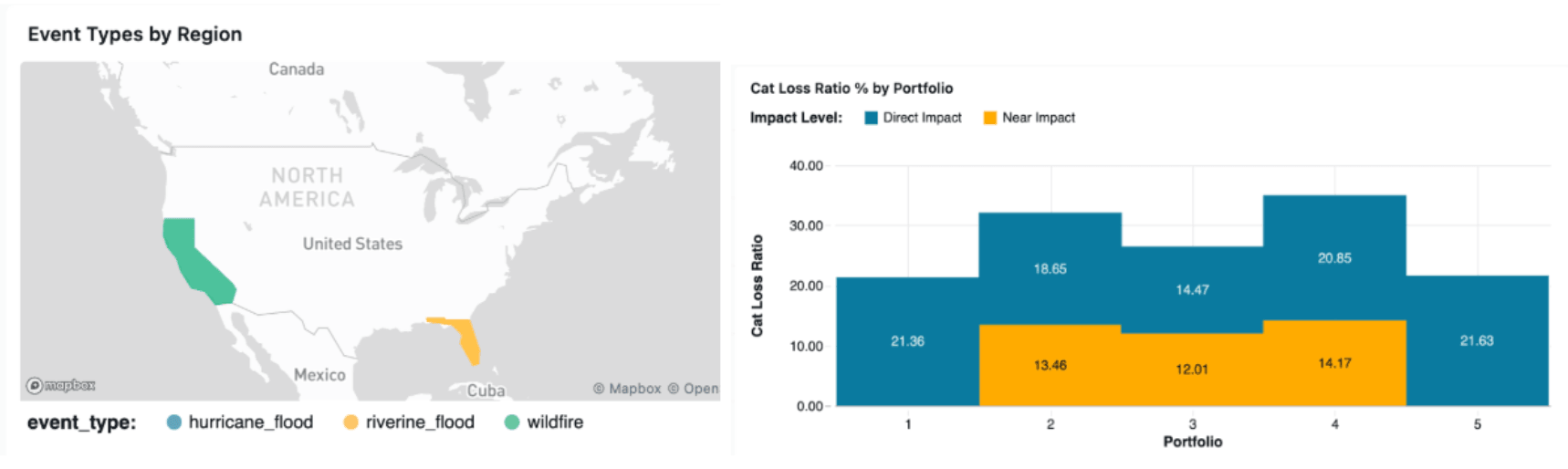
Finance

Lakehouse Architecture for Parametric Insurance

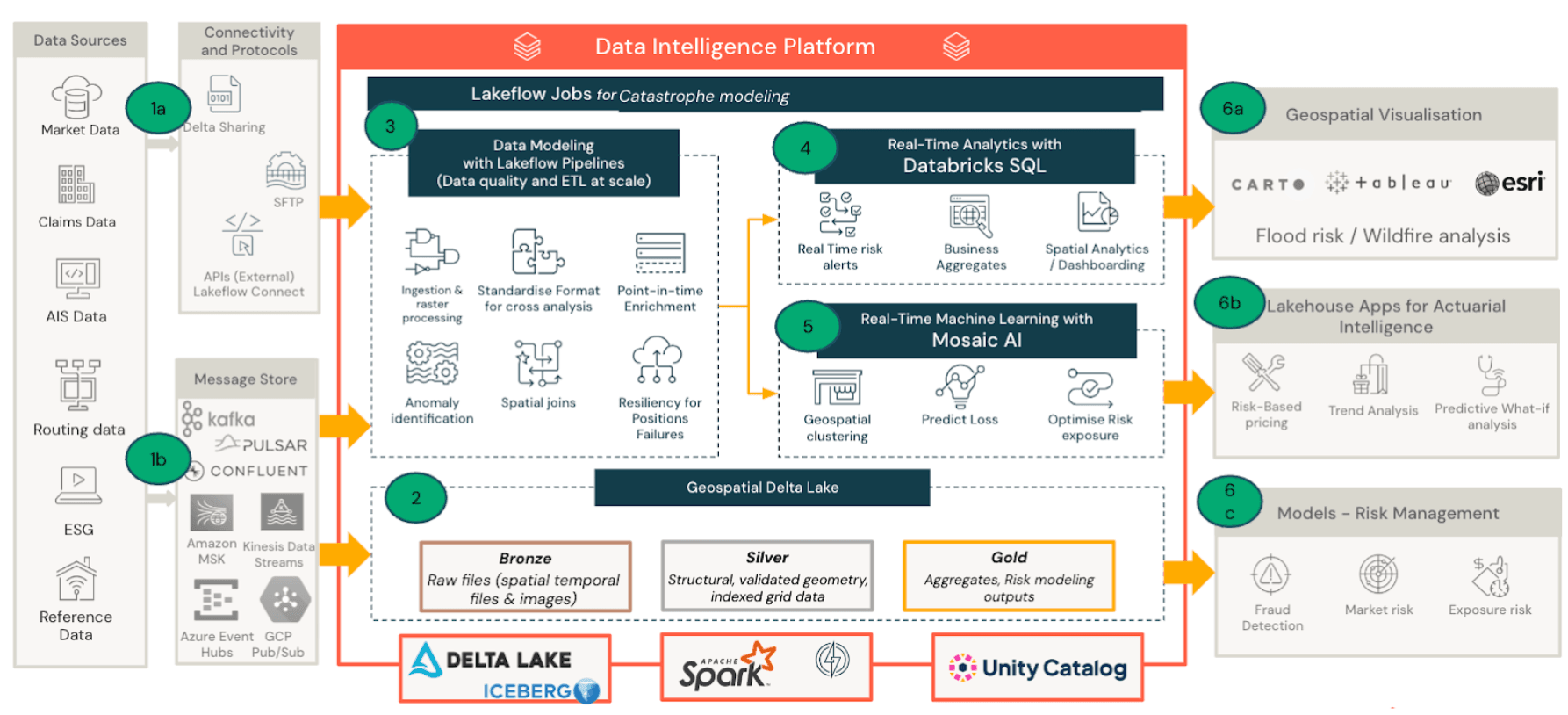
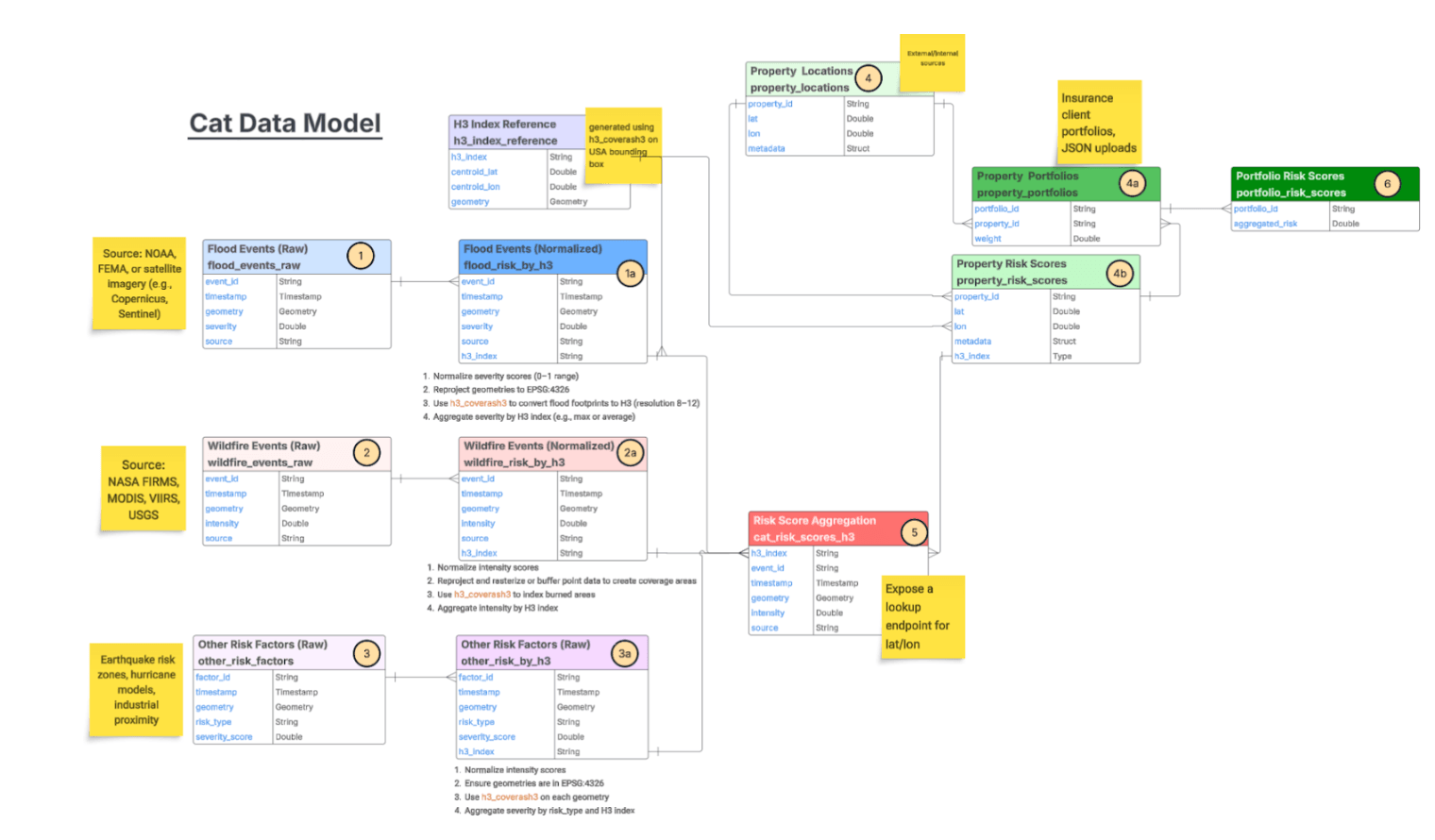
The Lakehouse architecture unifies hard-to-attain geospatial data sets for analytics and ML. Databricks’ Geospatial Lakehouse helps insurers, reinsurers, and risk modelers manage, analyze, and act on location-based data at scale, a crucial enabler for parametric insurance, catastrophe modeling, and risk engineering.
Lakehouse Architecture

  • Data ingestion: Satellite data, hazard feeds, and exposure datasets land in Delta Lake.
  • Geospatial processing and modeling: Spatial joins, proximity analysis, and catastrophe modeling pipelines run on Spark.
  • Business consumption: Dashboards, Lakehouse Apps, and Genie enable analysts and executives to explore catastrophe exposure and trigger payouts.

Geospatial processing and modeling

Here is a summary of the key benefits:

Data lands in the Lake

When a hurricane forms, satellite imagery, NOAA wind observations, flood model outputs, and seismic feeds begin streaming into Delta Lake alongside the insurer's own exposure and policy data. Delta Live Tables and Structured Streaming keep these layers continuously updated, so by the time the storm makes landfall, the platform already has a near-real-time picture of conditions on the ground. Typical data sources include:

Hazard Event Data

(Trigger Sources)

  • Satellite & Remote Sensing Data e.g., rainfall, temperature, wildfire spread (NASA, ESA, NOAA).
  • Seismic Data earthquake magnitude, depth, epicenter (USGS, IRIS).
  • Wind & Cyclone Tracksmaximum sustained wind speeds, storm paths (IBTrACS, NOAA HURDAT2).
  • Flood Modeling Outputs river gauge data, inundation depth (Copernicus Emergency Management, GFMS).
  • Drought Indices NDVI, soil moisture anomalies, rainfall deficits (FEWS NET, CHIRPS, SMAP).

Exposure & Asset Data

  • Insured Asset Locations – lat/lon coordinates of covered properties, farms, infrastructure.
  • Portfolio Metadata – value at risk, asset class/type, coverage limits, policyholder ID.
  • Population or Crop Distribution – gridded census data, agricultural yield maps (WorldPop, FAO, GEOGLAM)

Validation and Market Data

  • Historical Payout Logs – past parametric payouts and ground-truth event data.
  • Event Footprint Archives – modeled impact areas for cyclones, floods, etc.
  • Claims Correlation Studies – traditional vs. parametric claims for model calibration.
  • Climate Risk Projections – IPCC scenarios, downscaled CMIP6 data.

Geospatial processing matches events to policies

As hazard data flows in, the medallion architecture normalizes it into H3 indices and risk scores. Spark SQL's 100+ native spatial functions such as ST_Intersects, ST_Within, ST_Buffer, ST_Distance enable distributed spatial joins to match every insured asset against storm footprints, flood zones, and concentric payout tiers. Operations that would choke a traditional GIS tool scale to billions of geotagged rows.

Triggers fire and payouts go out

When event measurements cross policy thresholds, the platform identifies eligible policies, calculates tiered payouts based on proximity to the epicenter, and surfaces results to claims teams through dashboards, Lakehouse Apps, and Genie. AI models validate damage against aerial imagery before payouts are released.

Governance holds it together

Unity Catalog provides fine-grained access control, lineage tracking, and metadata management across every spatial dataset in the pipeline. When brokers, reinsurers, or regulators need access, Delta Sharing delivers it without duplicating data.

Key Takeaways

  • Parametric insurance is transforming catastrophe response, enabling faster payouts triggered by objective event data.
  • Geospatial analytics and catastrophe modeling are critical for defining accurate triggers and reducing basis risk.
  • The Databricks Geospatial Lakehouse unifies satellite data, exposure data, and catastrophe models, enabling insurers to analyze risk at global scale.
  • AI and machine learning further enhance parametric programs, supporting damage validation, fraud detection, and improved risk modeling.

As climate-driven catastrophes increase in frequency and severity, insurers must move toward faster, more data-driven approaches to risk transfer. By combining large-scale geospatial analytics with unified data and AI capabilities, the Databricks Lakehouse enables insurers to transform catastrophe insights into rapid, transparent payouts.