

惯性聚合 高效追踪和阅读你感兴趣的博客、新闻、科技资讯
阅读原文 在惯性聚合中打开

推荐订阅源

量子位
C
CXSECURITY Database RSS Feed - CXSecurity.com
S
Schneier on Security
博客园 - 叶小钗
博客园 - 三生石上(FineUI控件)
C
Cybersecurity and Infrastructure Security Agency CISA
Engineering at Meta
Engineering at Meta
Google DeepMind News
酷 壳 – CoolShell
酷 壳 – CoolShell
让小产品的独立变现更简单 - ezindie.com
H
Hackread – Cybersecurity News, Data Breaches, AI and More
Cyber Security Advisories - MS-ISAC
博客园_首页
T
Threat Research - Cisco Blogs
C
Cisco Blogs
Recent Announcements
S
Securelist
N
Netflix TechBlog - Medium
The Register - Security
P
Privacy & Cybersecurity Law Blog
宝玉的分享
宝玉的分享
D
Darknet – Hacking Tools, Hacker News & Cyber Security
L
LINUX DO - 热门话题
T
Tor Project blog
Threat Intelligence Blog | Flashpoint
月光博客
月光博客
AWS News Blog
AWS News Blog
P
Proofpoint News Feed
博客园 - 司徒正美
L
LINUX DO - 最新话题
Stack Overflow Blog
Stack Overflow Blog
博客园 - 聂微东
H
Help Net Security
Spread Privacy
Spread Privacy
PCI Perspectives
PCI Perspectives
Project Zero
Project Zero
I
Intezer
T
The Blog of Author Tim Ferriss
有赞技术团队
有赞技术团队
The Last Watchdog
The Last Watchdog
C
Check Point Blog
Blog — PlanetScale
Blog — PlanetScale
B
Blog RSS Feed
MyScale Blog
MyScale Blog
V
Vulnerabilities – Threatpost
Recorded Future
Recorded Future
T
Tenable Blog
Jina AI
Jina AI
D
DataBreaches.Net
阮一峰的网络日志
阮一峰的网络日志

Databricks

Why Talent Transformation Is the Missing Focus of Enterprise AI Public Health Intelligence Shouldn't Require a Data Scientist Mean Time to Detect Is a Data Access Problem First-party audience data is the ad sales relationship now Rethinking Distributed Systems for Serverless Performance and Reliability The AI Scaling Gap Hiding in Digital Native Companies 10 trillion samples a day: Scaling beyond traditional monitoring infra at Databricks AI success starts with clean data, not just better models How nOps Rebuilt Their Cloud Optimization Platform on Databricks Lakebase, and Why Other ISVs Should Too Peril Predicts: Precision Payouts for a Volatile World The foundation of AI scalability: one team, one platform, one operating model The Federal Data Paradox: Rich in Data, Poor in Access Driving Budapest Forward: How BKK Uses Databricks to Transform City Mobility LLM Vs AI: A Practical Guide to Differences, Use Cases, and Tools Model Risk Governance Is Not the Same as Risk Intelligence Generative AI for Business: A Complete Strategy and Implementation Guide Data Science vs Data Engineering: Choosing Analysis or Infrastructure AI Applications: Tools, Use Cases, and Platforms MLOps vs DevOps: A Practical Guide for Data Scientists and IT Teams Top Data Warehouse Tools For Modern Data Analytics Unlocking SAP Business Context in Databricks with Semantic Metadata Delta Sharing The marketing activation gap has a fix: Databricks and Stitch partner to turn data infrastructure into marketing performance Alert Fatigue Is a Business Risk Backstage with Lakebase Shipping Faster isn’t Learning Faster Why Your OEE Dashboard Is Lying to You The Turbine That Tried to Tell You It Was Failing Predicting Readmissions Isn't Enough. Acting in Time Is. Clinical Trials Run Longer Than They Have To. That's a Patient Problem Network Quality Is a Revenue Problem, Not a Technical One Shelf Availability Starts with Better Demand Visibility When Predicting the Next Hit Requires More Than Intuition Approximate Answers, Exact Decisions: New Sketch Functions for Analytics Companies Winning with AI Built the Data Layer First Rethinking SQL ETL for modern data platforms Stripe data now available on Databricks via Databricks Marketplace Databricks and Stripe Projects: Infrastructure Built for Agents Agents are ready but your architecture probably isn't Interoperability Between Unity Catalog and Google BigQuery via Catalog Federation Built In, Not Bolted On: What AI-Native Actually Means in Cybersecurity Operationalizing AI for public sector fraud prevention From months to minutes: Building real-time clinical data pipelines with natural language Agentic Data Engineering with Genie Code and Lakeflow Securely send first-party conversion signals with Snapchat Conversions API on Databricks Marketplace How leading tech companies are killing the builder’s tax with Lakebase Inside one of the first production deployments of Lakebase: LangGuard's agentic workflow governance engine The next generation of Databricks Genie Model Risk Management in 2026: A Banker’s Guide to the Revised Interagency Guidance OpenAI GPT-5.5 now available on Databricks, fully-governed through Unity AI Gateway Operational databases: How they work and when to use them Databricks partners with OpenAI on GPT-5.5 Announcing the Public Preview of Lakeflow Designer Are LLM agents good at join order optimization? How conversational analytics removes the BI bottleneck How to transform document activation workflows with Genie and Agent Bricks Beyond the spreadsheet: how Databricks is delivering the modern CFO in Financial Services AI App Development: Guide To Building AI-Powered Apps IoT in Manufacturing: Strategy, Components, Use Cases, and Challenges Stop Hand-Coding Change Data Capture Pipelines Multimodal Data Integration: Production Architectures for Healthcare AI Personalization Strategies for Media Companies A Modern AI Risk Management Framework Introducing the Databricks Excel Add-in for Business Users Real-Time Decisioning for AI Agents: Why you Need a Customer Context Layer First A Practical Guide to LLM Fine Tuning AI Data Transformation Guide for Data Engineers and Data Scientists Concurrency Control in DBMS: How Locking, MVCC and Optimistic Strategies Keep Data Consistent Bridging data science and marketing: Databricks unveils Delta Sharing integration for Adobe Experience Platform and agentic marketing workflows Take Control: Customer-Managed Keys for Lakebase Postgres Get hands on with agents, vibe coding and more at Data+ AI Summit Mercedes-Benz Builds a Cross-Cloud Data Mesh with Delta Sharing and Intelligent Replication, Cutting Costs by 66% What Is a Transactional Database? Introducing Genie Agent Mode Governing coding agent sprawl with Unity AI Gateway Governing Coding Agent Sprawl with Unity AI Gateway What is pgvector? Banks Don’t Have an AI Problem – They Have a Data Platform Problem Open Platform, Unified Pipelines: Why dbt on Databricks is Accelerating Why Your Agents Can’t Read Enterprise Documents — and How to Fix It Building with Databricks Document Intelligence and Lakeflow Databricks on Google Cloud: Innovate Faster. Smarter. Together. Introducing the Databricks Connector for Google Sheets: Real-Time, Governed Lakehouse Data in the Sheets Users Love Unity AI Gateway: How to connect agents to external MCPs securely Expanding agent governance with Unity AI Gateway Agentic reasoning in practice: Making sense of structured and unstructured data Agent Bricks: The Governed Enterprise Agent Platform 8 AI and data trends shaping financial services in 2026 Building real-time product search on Databricks Lovable + Databricks: Build Data-Driven Apps at the Speed of Thought Memory scaling for AI agents Powering clinical research innovation: How TriNetX uses Databricks to accelerate drug development Database Branching in Postgres: Git-Style Workflows with Databricks Lakebase How Zalando built a unified data foundation for AI and analytics on Databricks The next era of the open lakehouse: Apache Iceberg™ v3 in Public Preview on Databricks How FSIs eliminate silos between clients, operations, and finance How MakeMyTrip achieved millisecond personalization at scale with Databricks A multi-agent approach to audience intelligence AiChemy: Next-generation agent with MCP, skills and custom data for drug discovery Accelerate business insights with Lakeflow Connect, now with a Free Tier Unlocking Next-Gen Customer Experiences with Data Intelligence for Marketing
How Deutsche Börse built a generative AI tool to tackle the large-scale migration of Zeppelin notebooks to Databricks
2026-05-19 · via Databricks

At Deutsche Börse Group, our StatistiX platform provides approximately 95% of all Clearing and Trading data across the group, powering self-service analytics for hundreds of business users. Keeping that data accessible and actionable is central to everything we do.

For years, that meant Zeppelin notebooks running on Cloudera, with access to HDFS and Oracle data systems. The platform served us well, but the landscape shifted. Cloudera is fully decommissioning Zeppelin in 2027, our analytics workloads are moving to the cloud, and Databricks has been selected as our new unified analytics platform. That combination created a migration challenge that most organizations underestimate: 2,000+ users and a high volume of notebooks, many of them deeply embedded in day-to-day business workflows, all needing to move.

Rewriting everything manually would take years. So we decided to build a better path on Databricks.

The notebook migration problem

Infrastructure migrations get a lot of attention. Notebook migrations tend not to, which is a big reason why they slow teams down.

Our Zeppelin notebooks weren't simple scripts. They contained complex SQL and Python logic, custom interpreters, Oracle and HDFS references, visualizations, widgets and scheduling logic built up over years. Each one reflected institutional knowledge from the business teams who relied on it. The diversity across the entire notebook landscape made a rule-based rewriting engine impractical, since the logic was simply too heterogeneous and too business-specific for automated rules to handle reliably.

That constraint led us to a cleaner design insight: separate structure from logic, and apply the right tool to each. Structural conversion (mapping Zeppelin's paragraph format to Databricks cells, translating interpreter syntax, reformatting metadata) is deterministic and automatable, while logic reconstruction is not. Thankfully, LLMs are great at this structural conversion part..
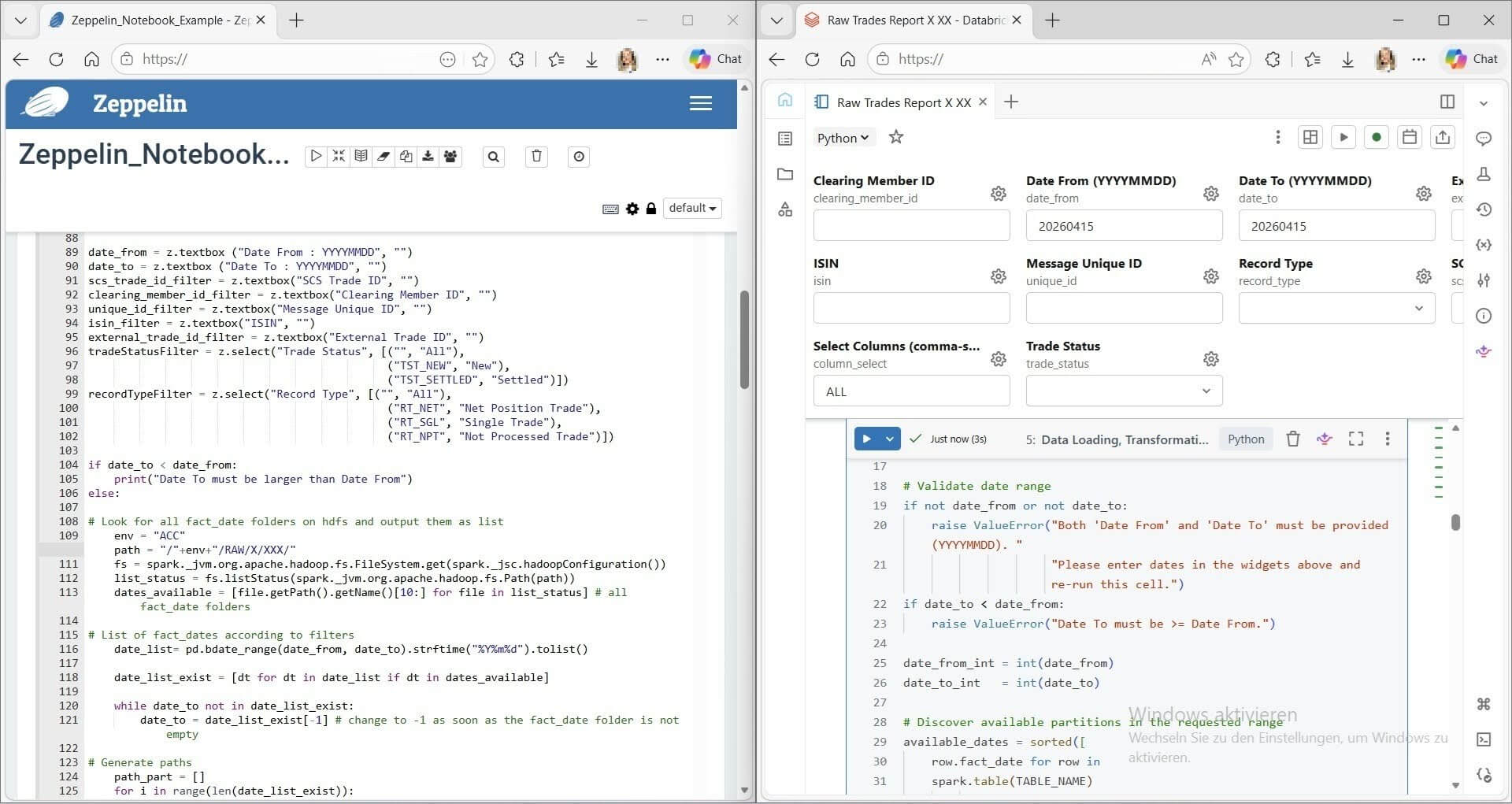
Notebook Migration

Building the converter on Databricks Apps

With that design principle in hand, we built the Zeppelin to Databricks Notebook Converter, a Databricks App designed specifically for our migration workflow.

The app handles the structural side of the conversion: Zeppelin paragraphs become Databricks cells, interpreter mappings are applied (%python, %sql, %pyspark and others are translated to their Databricks equivalents), and notebook metadata is reformatted into valid .ipynb JSON. Original content is preserved exactly. We're not rewriting logic at this stage, just preparing it for the next step.

That next step is Genie. For every uploaded notebook, the app automatically generates a context-aware prompt that includes specific details about our Zeppelin environment. Think our custom interpreters, data sources and configuration patterns. The prompt gives Genie the context it needs to reconstruct logic accurately in a Databricks-native way.

The workflow for a business user is straightforward:

  1. Export a Zeppelin notebook as JSON
  2. Upload it into the Databricks App
  3. Click Convert
  4. Download the converted .ipynb
  5. Open Databricks, upload the notebook, launch Genie and paste the generated prompt
  6. Genie asks clarifying questions and rebuilds the notebook

The app itself was built with a shadcn UI frontend. Originally, we built a Streamlit prototype, but we felt that shadcn gave us a more professional and scalable interface. The Databricks Apps development experience made it straightforward to ship quickly without standing up separate infrastructure.

What we chose not to automate

One of the most important design decisions was determining what the tool should intentionally leave alone.

The converter does not rewrite SQL logic, Python logic, visualizations, widgets, Oracle and HDFS references, scheduling logic or business-specific custom code. All of that content is preserved in the converted notebook, untouched, because rewriting it automatically would introduce errors and undermine trust in the output. These are exactly the elements that vary most across notebooks and that carry the most business-critical logic. They belong to Genie, which can interpret context, ask clarifying questions and make judgment calls that rules cannot.

This hybrid approach of automating the deterministic part and delegating the variable part allows us to avoid the brittleness of rule-based systems and leverage AI where it actually performs well.

The result: hours to minutes

By combining structural conversion with AI-assisted logic reconstruction, we've reduced notebook redevelopment from hours of manual effort to 15–20 minutes per notebook, depending on complexity. For a large-scale migration of this nature, spanning multiple business domains, this approach transforms what would have been a resource-intensive, time-consuming undertaking into a scalable, repeatable workflow that will take much less time. 

The speed gain also changes the nature of the work. Business users don't need deep Databricks expertise to migrate their own notebooks. They follow a short sequence of steps, get a prompt, and let Genie do the reconstruction. The tool is accessible enough that migration doesn't require a dedicated engineering team.

What we learned

A few principles emerged from this project that we'd carry into any similar effort.

  • Avoid overengineering. Our first attempt used a more complex agentic architecture that added overhead without solving the core problem. A simple UI and a clean backend turned out to be exactly sufficient.
  • Rule-based rewriting doesn't scale for heterogeneous content. The diversity of logic across our notebooks made rules impractical. LLMs are essential for handling that variability and the key is designing the handoff between automation and AI thoughtfully.
  • Context is the difference between a good prompt and a great one. Generic Genie prompts produce generic results. Investing in a prompt that encodes knowledge of our specific environment–interpreters, data sources, configuration patterns–is what made the output actually usable.
  • Engage your platform team early. Our collaboration with the Databricks team throughout the build helped us stay aligned and avoid rework.

What's next

While the initial development of our converter tool is complete, we are now proceeding with large-scale, real-world testing. Our immediate priorities include finalising prompt definitions to improve accuracy, validating the tool with notebooks across several business entities and IT, and preparing to onboard the users.

The broader implication is what excites us most. This project demonstrated that AI-assisted migration isn't a future capability, it's available now! By combining Databricks Apps with generative AI, we've built a repeatable workflow that turns one of cloud transformation's hardest problems into a fast, scalable process.