

惯性聚合 高效追踪和阅读你感兴趣的博客、新闻、科技资讯
阅读原文 在惯性聚合中打开

推荐订阅源

aimingoo的专栏
aimingoo的专栏
Microsoft Security Blog
S
SegmentFault 最新的问题
Forbes - Security
Forbes - Security
爱范儿
爱范儿
Stack Overflow Blog
Stack Overflow Blog
cs.AI updates on arXiv.org
C
CERT Recently Published Vulnerability Notes
S
Schneier on Security
Scott Helme
Scott Helme
C
Check Point Blog
T
Tenable Blog
博客园 - 三生石上(FineUI控件)
Threat Intelligence Blog | Flashpoint
L
Lohrmann on Cybersecurity
Google DeepMind News
人人都是产品经理
人人都是产品经理
N
News and Events Feed by Topic
B
Blog
P
Privacy International News Feed
I
Intezer
T
Threatpost
Google DeepMind News
L
LangChain Blog
Last Week in AI
Last Week in AI
Cyber Security Advisories - MS-ISAC
L
LINUX DO - 最新话题
博客园_首页
H
Hackread – Cybersecurity News, Data Breaches, AI and More
Hacker News - Newest:
Hacker News - Newest: "LLM"
C
Cybersecurity and Infrastructure Security Agency CISA
N
News and Events Feed by Topic
钛媒体:引领未来商业与生活新知
钛媒体:引领未来商业与生活新知
N
News | PayPal Newsroom
The Hacker News
The Hacker News
S
Security @ Cisco Blogs
罗磊的独立博客
PCI Perspectives
PCI Perspectives
Y
Y Combinator Blog
Exploit-DB.com RSS Feed
大猫的无限游戏
大猫的无限游戏
U
Unit 42
Hacker News: Ask HN
Hacker News: Ask HN
D
Docker
AI
AI
小众软件
小众软件
博客园 - 叶小钗
H
Help Net Security
TaoSecurity Blog
TaoSecurity Blog
P
Privacy & Cybersecurity Law Blog

CyberScoop

Security researchers find stalkers abusing Chrome's sync feature SonicWall customers under threat as attackers exploit 2 zero-days Dems press DNI nominee Jay Clayton on election security questions, but leave dismayed White House details ‘Gold Eagle’ clearinghouse for AI cyber threats Microsoft discloses ‘the mother of all’ vulnerability loads, tripling June’s previous record Treasury sanctions First VPN Service, others for abetting ransomware gangs States are building their own election defense networks as federal support evaporates Europe strikes out against Russia’s Turla over espionage, ‘destructive attacks’ Officials once again warn defenders that Russian hackers are targeting network devices AI-generated code has made security debt a governance problem Armenian national pleads guilty to Ryuk ransomware attacks CISA looks to remedy ailments from big May credential leak Former DigitalMint ransomware negotiator who duped clients sentenced to 70 months in jail Interpol cybercrime crackdown nets 5,800 arrests across 97 countries 764 splinter group leader sentenced to 40 years in jail French nonprofit starts global intelligence and research hub for AI cyber threats Found fast, fixed slow: The gap the AI clearinghouse must close Spain arrests suspected hacker linked to Russian hacktivist campaign Deepfake CSAM lawsuit against xAI, Grok expands Suspected Chinese espionage group used a Roundcube exploit chain to burrow into universities US Army websites defaced with pro-Kurdish sentiments, insults to Trump Sysdig clocks first documented case of agentic ransomware Finding vulnerabilities was never the hard part Someone infected a spyware probe overseer with spyware Alleged longstanding member of Scattered Spider extradited to US Researchers spot exploitation of another critical Oracle defect U.S. lifting export control restrictions on Anthropic’s Mythos, Fable This phishing kit looks more like BEC-as-a-service Citrix patches a new NetScaler flaw with echoes of CitrixBleed Trump budget boss Russell Vought open to re-staffing CISA DHS to unveil replacement council for critical infrastructure cybersecurity How ransomware syndicates weaponize corporate-style organization Warner bill would create federally vetted list for secure, trustworthy AI agents Supreme Court approves mail-in ballots that arrive after Election Day Supreme Court delivers ‘major win’ for tech privacy in Chatrie ruling What the post-quantum executive order really demands of CISOs ATF cancels controversial commercial geolocation contract FCC passes new cybersecurity rules for emergency systems, undersea cables Federal court rules Trump election-focused executive order illegal Russia uses Cellebrite to break into human rights activist’s phone, even after cancellation of contract Minnesota man known as ‘Snoopy’ sentenced in DraftKings hack Why patch directives only go so far Malicious hackers exploit Cisco zero-day for highest access level at communications service provider In a first, a court takedown goes after two cybercrime tools at once Open-source security is posing challenges governments can't easily solve Justice Department seizes infrastructure used by cyber scam and criminal marketplace Algerian man charged with running two cybercrime marketplaces Court rules SAVE database illegal, orders it dismantled Trump executive orders speed up post-quantum migration, boost industry Intel agencies: Frontier AI models will reshape cybersecurity faster than expected Authorities disrupt Evil Corp’s SocGholish botnet Congress tees up No FAKES Act, aiming at AI-generated deepfakes How software development's speed obsession enabled TeamPCP’s chaos crusade Accenture shells out $4.18B on three companies in big industrial cybersecurity push Attackers hit pair of critical Fortinet vulnerabilities the vendor disclosed in April Lawmakers leary about Trump administration’s Anthropic order AI’s constant patching treadmill can be a security problem A case for how to shape ‘ingredient lists’ for AI models Google exposes China espionage group that’s been lurking in networks undetected since 2023 Cybersecurity experts don’t think Anthropic’s Fable 5 presents a unique threat Anthropic disables new models after government calls them a national security concern FBI takes down massive China-based cybercrime network that caused $1.9B in losses US, France, and Italian authorities shut down massive deepfake porn site Conti ransomware group member pleads guilty, faces up to 20 years in prison ShinyHunters is actively extorting universities after exploiting an unpatched Oracle flaw CyberCorps is adapting to AI. The budget isn’t keeping up. Russian national charged in connection with Void Blizzard espionage campaign OpenAI: ‘Likely’ Chinese influence operation tried to use ChatGPT to stir debate on data centers CISA directive orders agencies to prioritize vulnerability patching in a new way Microsoft breaks Patch Tuesday record with 206 vulnerabilities Anthropic’s new model is Mythos on a leash CISA is rethinking how it prioritizes risks and vulnerabilities for feds, private sector Cisco customers encounter another SD-WAN zero-day under attack Meta accuses NSO Group of defying spyware injunction, files contempt of court complaint The AI security race needs accountability, not overregulation Nightmare Eclipse incident shows the researcher-vendor fights may never fully go away Hill Dems hammer GOP for $250M CISA budget cut Your AI agent could become your biggest insider threat Inside the race to adapt to an AI-powered security world European authorities crack down on illegal streaming networks DHS Secretary Markwayne Mullin pinpoints optimal CISA staffing levels DOD wants to integrate cyber in all operations, and integrate security into AI Trump administration releases scaled-back AI executive order Anthropic expanding access to Project Glasswing Attackers are exploiting Palo Alto Networks defect that initially flew under the radar Tina Peters, convicted in election-security breach, emerges defiant and vows legal fight USPS moving forward with mail-in ballot changes as courts weigh Trump’s election order Election threats are focused on campaign systems, not voting machines Tennessee man linked to 764 accused of series of crimes against children dating back to 2022 Federal audit reveals NIST’s NVD is plagued by poor planning and duplication House panel poised to hold hearing centered on AI impact on cyber Google security engineer accused of turning confidential search trends into $1.2M win on Polymarket Zapier fixes bug chain that researchers say risked widespread account takeover OpenAI heralds cybersecurity, election interference safeguard plans for 2026 midterms FBI warns US-based law firms to be on the lookout for cybercrime group that steals data in person UK spy chief labels AI ‘unstoppable force’ with offensive, defensive ramifications for cyberspace CrowdStrike disrupts Glassworm botnet that preyed on open-source supply chain Apple open-sources quantum-resistant encryption code White House charts new course for federal agencies and cybersecurity logging Anthropic: Mythos finds more than 10,000 software flaws in first month
Forget the model. When it comes to cybersecurity, it’s all about the harness
djohnson · 2026-07-15 · via CyberScoop

As AI-enabled hacking becomes a bigger threat for cybersecurity and national security, public attention has focused on mainly a few leading frontier AI companies developing more powerful large language models.

These models, and the billions of dollars behind them matter, but they’re only part of a larger shift. Enterprises are now building their own technology platforms that take these general-purpose LLMs and turn them into bespoke cybersecurity tools.

Industry professionals refer to these tools as a “harness.” They control the model’s behavior, limit its risks, and connect it to internal IT systems and networks so it can work reliably at scale.

New research from Cato Networks shared exclusively with CyberScoop shows how much power can come from a harness. It paired OpenAI’s ChatGPT 5.5 and GPT 5.5-Cyber models with its own tool and tested the abilities of the agent to hack into a victim network with as little human direction as possible.

Across six different scenarios, the pairing achieved complete end-to-end attack chains, including domain administrator privileges and Active Directory access, sometimes in as little as 40 minutes.

“What was most surprising is that first we saw that it was capable of doing accelerated reasoning and attack, and interacting and doing all this by itself, like doing all of the stages of the attacks,” said Guy Weisel, a tech evangelist at Cato Networks and one of the authors behind the research.

Critically, the most successful scenarios happened when the model was given appropriate operational context from the technical harness developed by Cato Networks.

“It does support that it’s not just about the frontier model,” said Weisel. “We found that [our harness] really helps the reasoning” of the LLM.
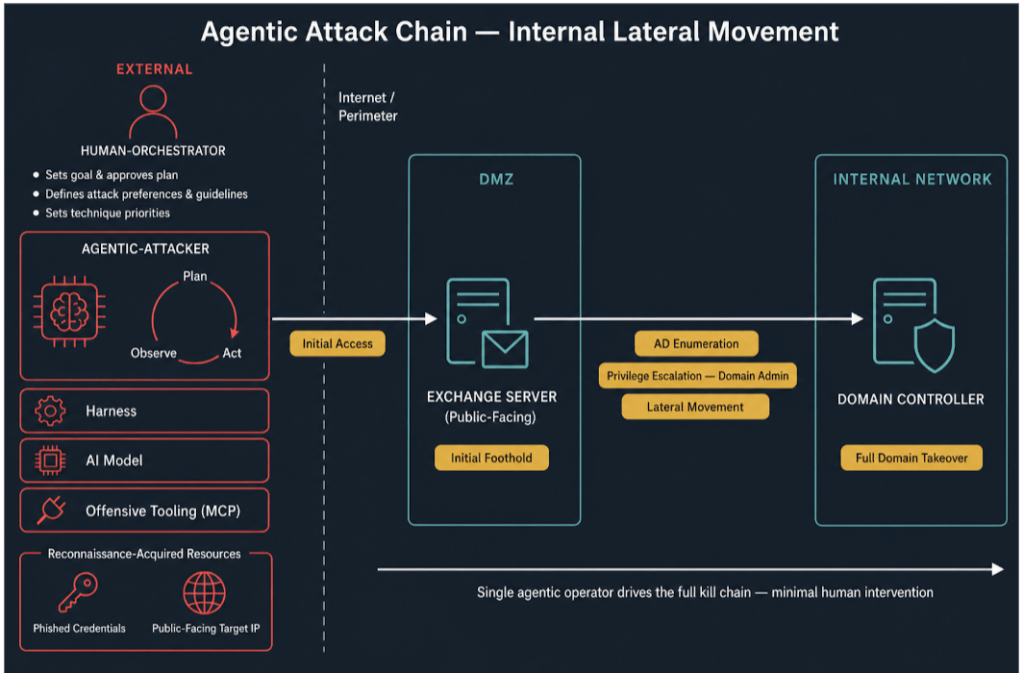
An illustration of an agentic AI attack chain and lateral movement within victim networks. (Source: Cato Networks)

The agent was given some – but not abundant – resources to complete its tasks, including an external Kali Linux attack host, the simulated target’s public IP address and a set of low-level domain credentials acquired through phishing.

It was not provided with any other details, and had to probe further for key information, such as further knowledge of the server type (Microsoft Exchange), the target’s operating system, version, build number, internal network topology, access to higher privilege accounts and other critical assets, nor was agent given any predetermined attack paths.

The Cato Networks research uses OpenAI models, but only as an example. Weisel said he believes other models would likely achieve similar results. In any event, if current trends hold, the kind of capabilities provided by LLMs like GPT 5.5 are likely to be open-source within a year.

Cato Networks is far from alone. Most enterprises have their own AI harnesses, and  executives tell CyberScoop they are playing an increasing role in more effectively steering the frontier model workflows.

While AI tools can struggle to duplicate human workflows in other areas, LLMs have long shown potential in cybersecurity and coding, improving greatly over the past few years. The Trump administration has set up a new federal clearinghouse for exchanging information between the public and private sectors on AI-discovered vulnerabilities, while European groups are setting up their own organizations to coordinate globally on AI cyber threats.

Eric Doerr, chief product officer at Tenable, told CyberScoop a harness used in the company called “Hexa”  offers a defensive advantage:  it can work with different commercial LLMs while delivering consistent  results.

“One of the first things we do when we get a [new] model is say ‘Well, let’s run it through Hexa and see what we learn,’” said Doerr. “We have a whole bunch of benchmarks. Is it the same, is it better? Where is it better? Where is it worse?”

Hexa is meant to ensure that whichever model or models become dominant, Tenable will be able to integrate it into their tech stack and protect their most sensitive assets from unintended behaviors. That frees up the LLM to do what it does best: find vulnerable code and establish attacker pathways for exploiting them.

“For years, it has been true that there are way more potential issues that a company has to deal with: code vulnerabilities, things that are unpatched, misconfigurations,” said Doerr. “There’s way more than you can actually remediate, and you really need to understand the difference between what’s a theoretical problem and a real problem.”

Dan Rapp, chief AI and data officer at Proofpoint, said their harness, “Satori,” has become a critical tool for keeping their agentic AI on track while giving humans the ability to step in when things go awry.

“I think what you’re seeing in the foundation of frontier models is you have raw intelligence, raw reasoning power, but to get these systems to perform the way you want to, both context engineering – the content provided ensuring that its accurate and relevant – and the harness engineering are essential to actually get the systems to perform well,” Rapp told CyberScoop.

That was a common theme in interviews with companies. While frontier models come and go, or are overtaken by international competitors, there will always be the need for the model to operate with data and context that often only the organization can provide.  

It suggests that while policymakers and cybersecurity experts have focused on the spread of newer and more powerful frontier models, industry – and likely soon the cybercriminal underground — has quickly developed the kind of technical infrastructure that is becoming far more important to AI cyber defensive and offensive tasks.

“We’ve had to bootstrap quite a few of these systems from first principles, and what it always boils down to is how effective you are with the tool calling… bringing in data, enriching the context,” said John Hopper, vice president of product engineering at SpecterOps.