







Discover how Octonous helps our team at Mozilla.ai cut through daily busywork, from automatically monitoring our libraries to staying on top of the latest developments in AI safety.

This is the second article in a series on how the Octonous team uses Octonous in their day-to-day work. Each post comes from someone on the team, writing about their own role.
The role of an AI Safety Engineer is multifaceted. Not only am I the core maintainer of any-guardrail, an open-source package that allows you to switch between guardrails seamlessly with an output standard that limits code edits, but I also conduct evaluations, security scans, and policy development. Such a broad role requires tools that make it easy to access many different integrations. Octonous is my go-to platform when I want my tools to talk to each other. In this blog post, we’ll go over three ways I use Octonous to help me do my work.
Creating Content Moderation Policies
cq is a centralized platform that we built that allows users to push knowledge units (KUs), resolution paths to errors their coding agents encounter. In the future, we plan to allow users to nominate their knowledge units to be used by other people’s coding agents. The risk surface of a platform like cq is vast, as we describe in our CAIS workshop paper, including, but not limited to, prompt injection attacks, DDoS attacks, and identity spoofing.
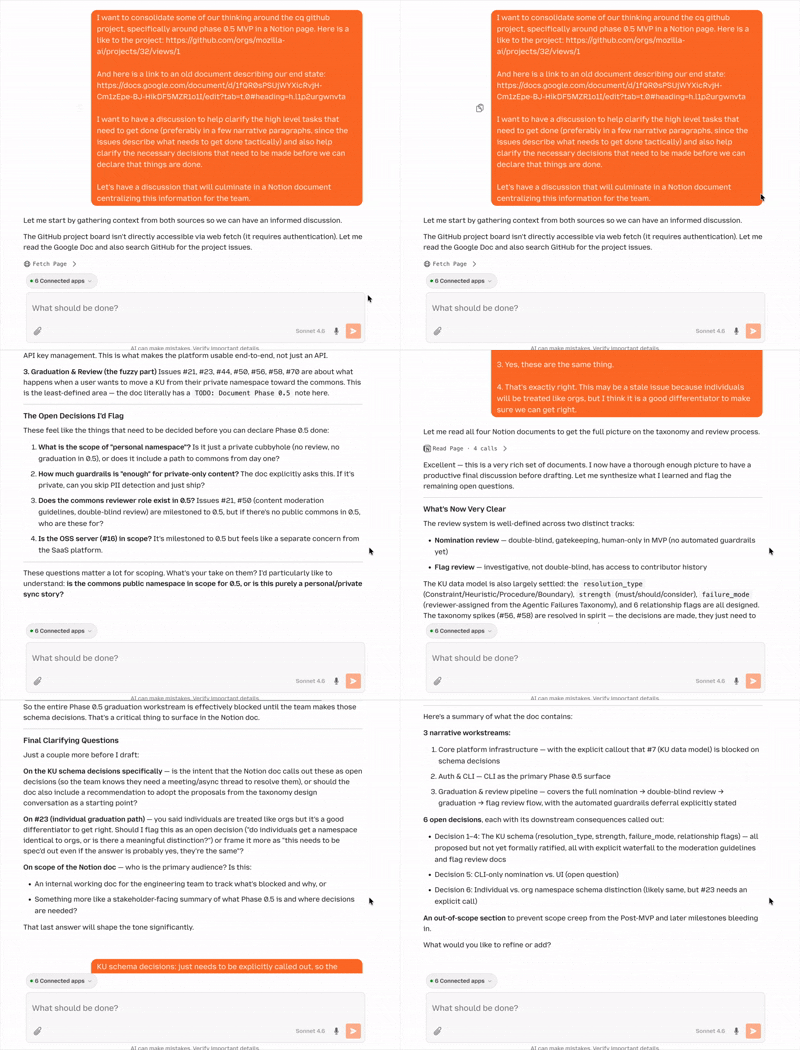
One way we plan to mitigate these risks is by having content moderation reviewers for nominated KUs. Octonous became an assistant for me, helping me aggregate and synthesize our documentation, allowing me to focus on refining my ideas for the types of content we want moderators to flag, as well as how to operationalize such content.
Getting Automated Updates on any-guardrail
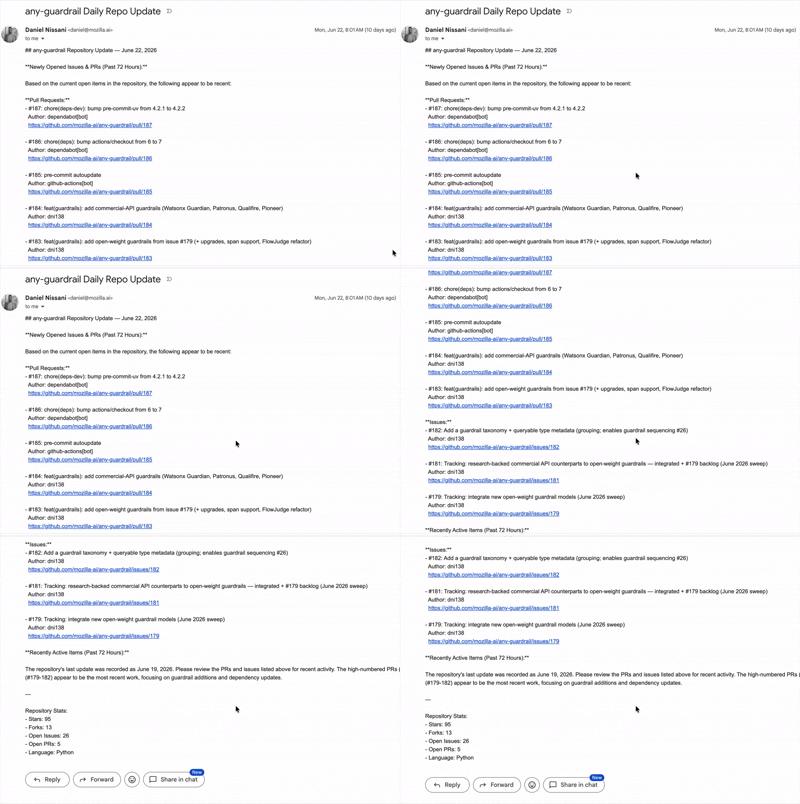
One of the most frustrating things I’ve experienced is having a new issue or PR put up on any-guardrail, and I forget to triage it in a timely manner. This has resulted in some clunky conversations that could have gone smoother if I had some kind of notification of new issues and PRs that are put on any-guardrail. Luckily, I was able to create a daily message with Octonous that sends me an email about any changes that have been made any-guardrail. Now, I have a daily roundup, making it near impossible for me to miss out on proposed changes to the package.
Weekly AI Safety Papers
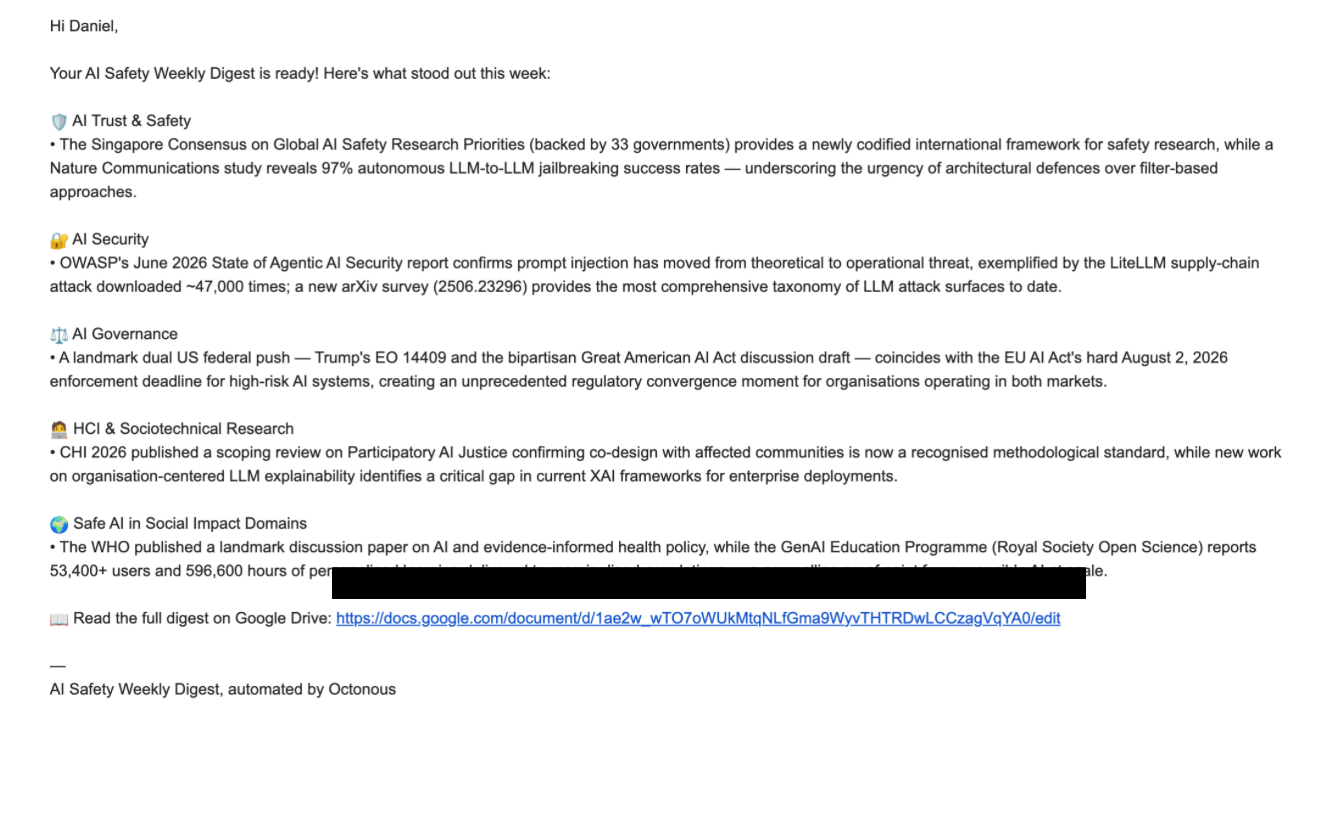
Part of my job is keeping up with the latest trends in AI safety. With such a broad role, it is hard to carve out time to find new papers, blog posts, etc., that will help spark new ideas and keep me up to speed. That’s why I used Octonous to create a weekly AI Safety round up. Every Friday morning, Octonous sends me a summary of the week in research with citations, so I can read the original source. This has saved me hours and lets me keep up with the field as I do the other components of my job.
Just Scratching the Surface
These are the components of my job that Octonous has impacted the most. But I believe I’m just scratching the surface. Octonous offers an easy user experience that allows you to link the applications you use most, unlocking workflows that weren’t possible before. I can’t wait to get more creative and figure out what else Octonous can help me do. Give it a try!
You can try Octonous at octonous.com. New users receive 1,000 free credits when they sign up, with more available through onboarding.