

惯性聚合 高效追踪和阅读你感兴趣的博客、新闻、科技资讯
阅读原文 在惯性聚合中打开

推荐订阅源

让小产品的独立变现更简单 - ezindie.com
U
Unit 42
Google DeepMind News
博客园 - 司徒正美
Y
Y Combinator Blog
F
Fortinet All Blogs
云风的 BLOG
云风的 BLOG
T
Tailwind CSS Blog
G
Google Developers Blog
酷 壳 – CoolShell
酷 壳 – CoolShell
罗磊的独立博客
D
DataBreaches.Net
T
The Blog of Author Tim Ferriss
Cyber Security Advisories - MS-ISAC
MyScale Blog
MyScale Blog
N
Netflix TechBlog - Medium
Microsoft Security Blog
GbyAI
GbyAI
P
Proofpoint News Feed
Jina AI
Jina AI
B
Blog RSS Feed
腾讯CDC
阮一峰的网络日志
阮一峰的网络日志
D
Docker

TheJournal.ie

Court told Eleanor Donaldson placed bugging device in her husband’s car over fears of affair TD says she's been left with 20cm scar after skin cancer diagnosis Homelessness: Record number in emergency accommodation, including new high for children Blue Origin rocket explodes during test launch John Gibbons: The planet is burning, but Ireland still isn't taking climate change seriously 'Truly devastating': Tributes paid to Masuma Sohrabi after stabbing in Clifden Mother and carer: You don't appreciate public services until your child needs them to survive Left or right? Sinn Féin's fence-sitting may be about playing the long game Gavan Reilly: Gerry Hutch and his 30% vote in Dublin Central's best-heeled area Gavan Reilly: The Gerry Hutch 37.1% share of the vote in the shadow of the IFSC Ebola on the rise: Why the latest outbreak should concern all of us Ireland's data centre energy drain: How Big Tech added €1.4bn to household electricity bills Living with myeloma: 'I chose not to fight this blood cancer, but to instead live alongside it' Alberta’s separation bid: How Canada’s next political crisis could come from within Kelly Earley: Militarism might be Ireland’s next economic disaster Raising them right: Ireland has a dog poo problem, and we parents are sick of stepping in it Money Diaries: A recently graduated digital journalist on €35K living in Dublin Global tech job losses: Is ‘AI-washing’ the new trend nobody wants to call out? Down on the farm with a difference: This is what happens when animals are allowed to feel safe Surrealing in the Years: Some shameful Irish attitudes take a leaf out of Israel's book Motoring: Should we trust self-driving cars? The physio is in: Ireland is growing older, but are we moving enough to age well? Tech dubbed 'creepy': AI smart glasses are here, but our privacy laws have not caught up Larry Donnelly: The polls point one way for Friday but byelections rarely follow the script The war on human thought: Educational institutions must take back control from AI The Bee Guy: World Bee Day won't save our little bee friends Kelly Earley: Could Mountjoy Square be Dublin’s most important park? Money Diaries: How is your spending and saving going? Would you like to keep a diary for us? Rearing them right: Should modern parents bring back ‘the man’? Ireland's energy future: What if the real failure here is that we stopped thinking bigger?
Eight dead after
https://www.thejournal.ie/author/afp/ · 2026-06-16 · via TheJournal.ie

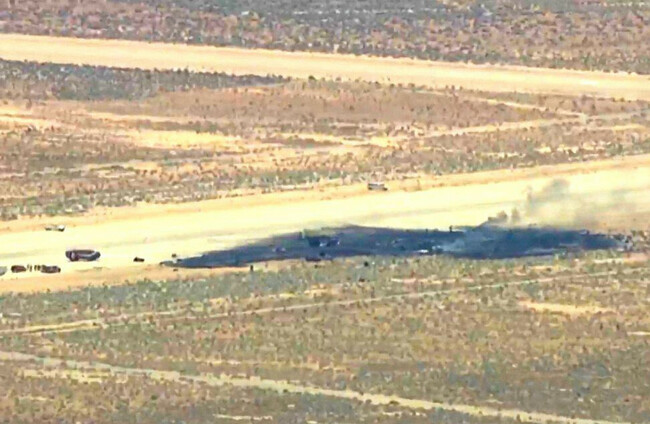
This image taken from video provided by KABC shows law enforcement responding to the scene of an aircraft crash, Monday, 15 June, near Edwards Air Force Base, Alamy Stock Photo

US Air Force

The heavy bomber was on a routine testing mission with a mixture of military, government and civilian contractors on board when it came down in a fireball.

EIGHT PEOPLE DIED when a US B-52 bomber crashed and erupted into a catastrophic fire shortly after takeoff at an air force base in California on Monday, officials said.

The heavy bomber was on a routine testing mission with a mixture of military, government and civilian contractors on board when it came down in a fireball at Edwards Air Force Base, 60 miles (95 kilometres) north of Los Angeles.

Footage of the aftermath of the crash, which officials said was “unsurvivable,” showed a large charred patch of ground on which almost nothing remained of the huge plane manufactured by Boeing.

“Edwards Air Force Base experienced a horrible tragedy, and we lost eight great Americans,” Colonel James Hayes told reporters at the base.

Hayes said the B-52 Stratofortress – a long-range bomber used by the US military since the 1950s – was on a test sortie as part of a radar modernization process.

“It took off, and immediately after takeoff, crashed and burst into flames,” he said, adding emergency services quickly swung into action, but soon determined that there would be no one to rescue.

“After reviewing the footage of the crash, it was deemed that this was an unrecoverable crash and unsurvivable.”

There was no immediate indication as to the cause of the tragedy, and a safety investigation probe was immediately begun.

The crash happened around lunchtime at the base, a major operations centre for the US military, and was contained within the perimeter, Hayes told reporters.

In the aftermath of the accident, the airfield was closed and all inbound aircraft were being diverted, the base said on social media.

Hayes said the identities of those who perished would not be released until all next of kin had been informed, a process he said was ongoing and could last for the rest of the day.

Boeing said two of those killed were employees of the company and it expressed its condolences to families of all the victims.

The B-52 is a heavy bomber that first flew in 1954 and was originally designed for war with the Soviet Union. It has received continual upgrades to keep it in service for decades since the Cold War’s end.

The massive bomber – which can carry a range of weapons, including bombs and cruise missiles – has a wingspan of 185ft (56 meters) and a length of 159ft (48 meters).

The plane is usually crewed by five people: an aircraft commander, a pilot, a radar navigator, a navigator and an electronic warfare officer, according to a US Air Force fact sheet on the plane.

With a combat range of up to 8,800 miles, the plane is capable of carrying a nuclear payload.

The United States has deployed the aircraft in conflicts in Vietnam, the Gulf, Iraq, Afghanistan, and most recently in Iran.