








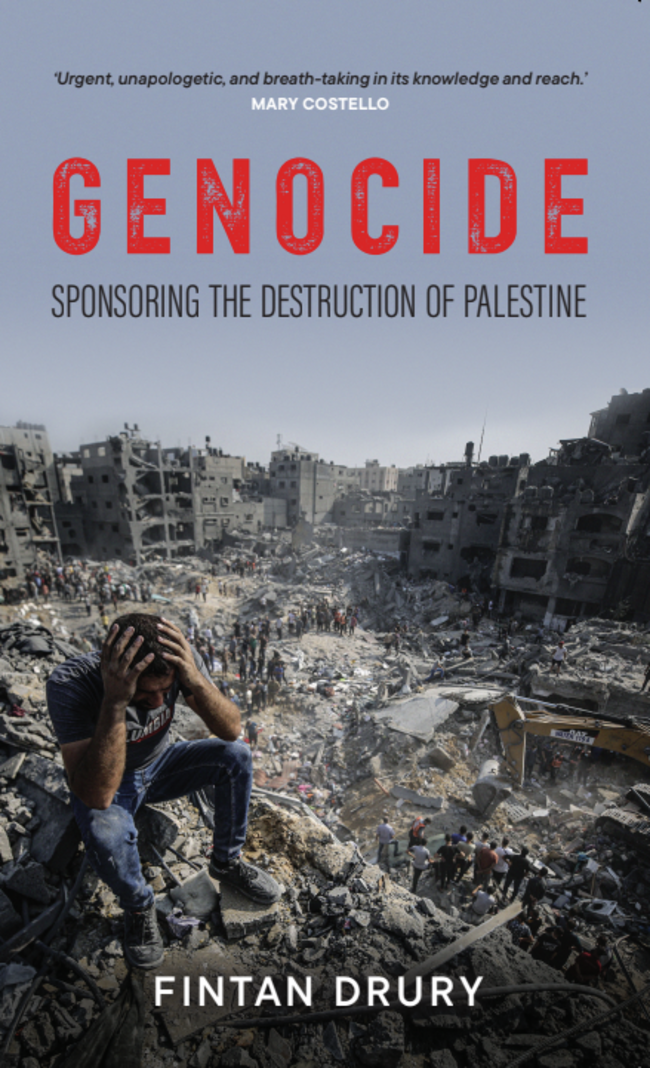
In a follow-up to his bestselling book, ‘Catastrophe Nakba II’, writer Fintan Drury has released ‘Genocide: the Destruction of Palestine’’.
In it, he focuses on how the United States and the UK stand accused of directly influencing the scale of the terror Israel has wreaked on Palestine and its people. Drury is unequivocal that it’s their direct sponsorship and that of some others which made Israel’s ongoing genocide possible…
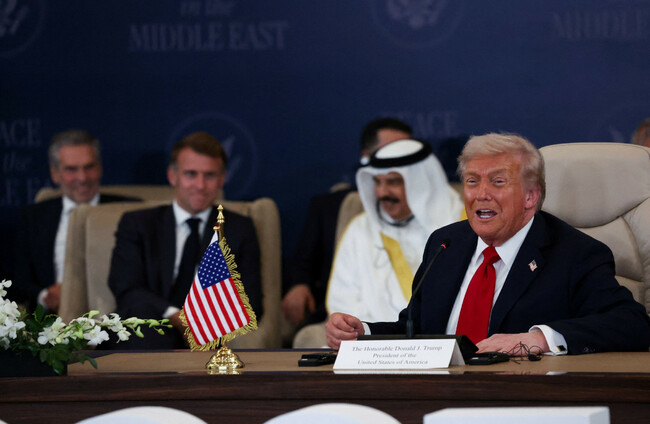
THE MOTIVATION WASN’T to ease or even erase past trauma. This concerned how those involved in brokering and supporting the process could help ensure its sustainability and benefit from their efforts. There was to be no hiding what this was about, no subtlety. ‘So I hope everybody’s now joining up. Now we have no excuses. We don’t have a Gaza, and we don’t have Iran as an excuse. That was a good excuse.’
It wasn’t a mistake, a clumsy off-script remark. This stunning comment was written down. ‘We don’t have a Gaza’ meant that this ravaged place, home to two million Palestinians, would no longer be an obstacle to whatever scheme Trump and his allies would decide upon.
His intentions were laid bare; the moment when any small hope that humanity was a fragment of his motivation evaporated. In history, there have been opaque peace agreements drafted to hide the real intentions. This one did not have that failing; there was no attempt to conceal that commerce was the plan’s primary driver.
President Trump wanted to assure the nations whose support he needed that, as the plan’s originator, he could guarantee it would yield them a meaningful return. He said the participation of the four signatories to the agreement was on that basis, and that others could become involved if they chose to do so. Unsaid, it was safe to assume Israel would be a big part of the plan.
Trump’s ignorance or indifference to facts has rarely been so manifest. That the land belonged to Palestine didn’t matter to him, so neither should it to all those others who were getting involved. When he did, for the one and only time, refer to the Palestinians, it was to reassure them that peace would bring them a return to some form of normality.
That did not mean the exploitation of their land would be for their direct benefit: ‘for the people of Gaza, the focus now must be on restoring the basics of a good life’. The idea of returning to how things were betrayed the US’s disinterest in the plight of Palestinians.
‘We don’t have a Gaza’ meant that the irritation it represented would no longer prevent real progress. The plan was to create a commercial bonanza for the US, its Gulf partners and, of course, Israel. The consolation for Gazans was a return to the basics of life.
October 2023, and beyond
In Catastrophe: Nakba II, I looked at what life was like for Palestinians on 6 October 2023, the day before the Hamas attack. Returning to life before the genocide would mean living in a place – your homeland – where the coloniser limited the supply of food and other critical supplies so that 80 per cent of you relied on humanitarian aid.
It meant living where only four per cent of the groundwater was fit for human consumption. It would mean living in what is often described as the world’s largest concentration camp, knowing that less than five per cent of you have permission to move in and out.
In the West Bank, Israel’s methods were more subtle, but, from 2022, increasing numbers were being killed, and land was being settled (stolen) at a markedly increased rate.
The Trump administration’s casualness about life for the Palestinians post any ‘peace’ should have registered alarm across the world. It did not. In July 2025, Israel’s minister of defence, Israel Katz, had spoken about the creation of a ‘humanitarian city’ in Rafah in southern Gaza.
Briefing Israeli reporters, he said the IDF would secure the area from a distance and that 600,000 Palestinians would be accommodated in the camp, with a plan to increase this to two million over time. Palestinians would be free to emigrate voluntarily, provided they accepted that they could not return.
That plan never evolved, but that it was spoken of publicly showed that Israel will do whatever is necessary to expand its territory. This expansion requires either continued attrition and annexation-creep characterised by the last 58 years or finding the means to force Palestinians to leave in great numbers. Israeli public opinion was no less committed to completing what had been started in Gaza.
Around the same time that Defence Minister Katz was briefing the media, the Israeli daily newspaper, Haaretz, published an opinion poll that showed 82 per cent of the Jewish population would support the expulsion of all Palestinians from Gaza.
This was the highest figure yet, although all opinion polls over the course of the genocide consistently showed that a majority of Israelis wanted a complete expulsion.
Big ideas, no diplomacy
Donald Trump’s words in Sharm el-Sheikh revealed everything about his ambition. ‘We’re gonna have a lot of money coming into Gaza and a lot of rebuilding and building. It’s not so much rebuilding. It’s really building, cleaning up and building. And I’m pleased to announce that numerous countries of great wealth and power and dignity have come forward to me just today and over the last week to say they want to help in the reconstruction of Gaza, putting up whatever money is necessary.
‘And the money is, of course, it’s a lot of money, but it’s not much compared to the value or the wealth of these tremendous countries.’
For the Gazans, it was about ‘the basics’; for America’s partners, it would be about much more. Trump believed the Palestinians should be grateful that, after two years of genocide, the US, other Western countries and some Arab states were committing to rebuilding Gaza. What was on offer to the inhabitants was a consolation prize of ‘the basics of a good life’, and the Palestinians knew Israel didn’t think them worthy even of that.
There was no mention of their colonised land being returned to them. There was no mention of self-determination. There was no mention of human rights or of the need for those who had slaughtered their family and friends to be held accountable. There was no reference to how Israel and its genocide-sponsors would undertake to make Gaza safe and commit the hundreds of billions of dollars necessary to rebuild an entire societal infrastructure that had been obliterated. There was no mention of how the tremendous economic value Trump talked of unlocking would be released for those whose land it was. The word ‘reparation’ appeared nowhere in Trump’s speech – but how could any of these imperatives have been referred to when they are not referenced anywhere in the ceasefire plan?
The Trump plan was Israel’s plan, the only one it would countenance. Israel did not want peace. Its government wanted to continue its genocide. Indeed, the hard-right-wing elements in the coalition government wanted to accelerate the killing of Palestinians in the West Bank as well as Gaza; as Ministers Ben Gvir and Smotrich said, the job must be finished.
Ben Gvir said, ‘I call on the Prime Minister, it is time to come to sense [sic], to return to intense fighting, to conquer, to crush, to win.’ Despite threatened resignations by these hardline ministers, the Trump plan had progressed at pace in response to activities involving France and Saudi Arabia at the UN.
Fintan Drury is a former RTÉ journalist, broadcaster and businessman. His new book, ‘Genocide: Sponsoring the Destruction of Gaza’ (Merrion Press) is published today, 18 June and is available from all bookshops.